• Following Us

  • Categories

  • Check out the Archives


  • Awards & Nominations

My 12 for ’18: The (Black) Power of Stories in “BlacKkKlansman”

It’s that time of year. I’ll counting down my top twelve films of the year daily on the blog between now and New Year. I’ll also be discussing my top ten on the Scannain podcast. This is number nine.

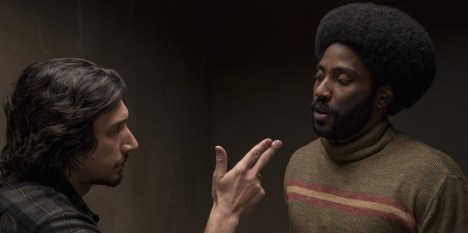
At its core, BlacKkKlansman is a story about the power of stories. In particular, the power of cinema.

This is no real surprise. Spike Lee is an avowed cinephile with an incredible hunger and passion for the medium. Lee knows the history of cinema, and understands the historical context of cinema. BlacKkKlansman is alternately a loving homage to blaxploitation and a discussion of blaxploitation. It is a film that is fundamentally about the way in which the stories that people tell influence and shape the world in which they live.
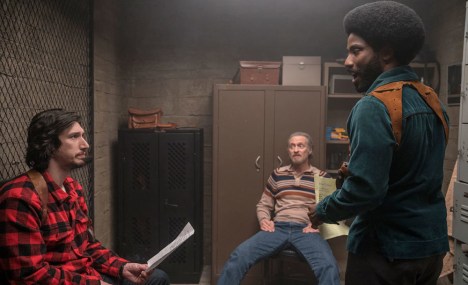
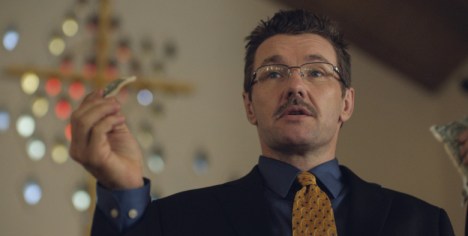
At the heart of BlacKkKlansman is a sequence in which real-life Civil Rights icon Harry Belafonte plays a fictionalised activist. He recounts, in gory detail, the story of a horrific lynching that he witnessed as a child. He contextualises this attack by reference to the success of Birth of a Nation, which he describes using the (anachronistic) term “blockbuster.” This sequence is intercut with the induction of new members into the local branch of the Ku Klux Klan, while gleefully rewatching (and cheering) Birth of a Nation.

The most interesting idea within BlacKkKlansman is the implication that it might be possible to counter-programme this. If narratives of hatred and violence can be perpetuated through cinema, then perhaps stories about collaboration and empathy can also be spread in that manner. Clever and self-aware, BlacKkKlansman feels like an attempt to construct one such narrative.
Continue reading

My 12 for ’18: Holding Out for a Hero in “Mission: Impossible – Fallout”

It’s that time of year. I’ll counting down my top twelve films of the year daily on the blog between now and New Year. I’ll also be discussing my top ten on the Scannain podcast. This is number ten.

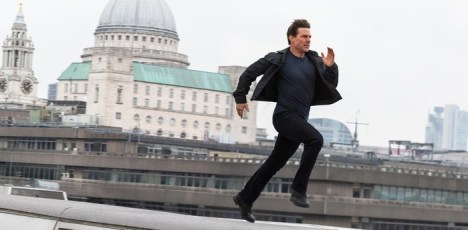
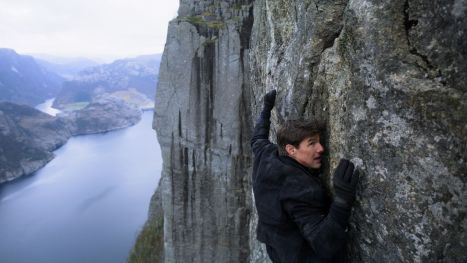
Mission: Impossible – Fallout was released around the tenth anniversary of The Dark Knight.

In fact, the week after I caught the preview of Fallout, I attended a tenth anniversary screening of The Dark Knight. This is important, because Christopher McQuarrie’s second Mission: Impossible film undeniably exists in conversation with Christopher Nolan’s epoch-defining blockbuster. It is impossible to watch Fallout without thinking of The Dark Knight, from Lorne Balfe’s propulsive score to the sight of an armoured truck sinking slowly into a river.

However, McQuarrie does something interesting with Fallout, in relation to The Dark Knight. Too many of the films influenced by that iconic piece of cinema opted for shallow and superficial homage. Thor: The Dark World and Teenage Mutant Ninja Turtles: Out of the Shadows and Transformers: Dark of the Moon and Transformers: The Last Knight settled for borrowing influence from the title. Law Abiding Citizen tried to embrace moral ambiguity. Man of Steel attempted to emulate that serious grounded approach to other properties.

In contrast, Fallout understands that the best thing that most films could learn from The Dark Knight is simple craft and professionalism. Fallout understands that top-notch production, an emphasis on in-camera effects and a propulsive sense of momentum are the most applicable lessons that most films could take from The Dark Knight. As such, Fallout takes those lessons and applies to them to Mission: Impossible, leading to the year’s most impressive embrace of the concept of heroism.

Continue reading

New Podcast! Scannain Podcast (2018) End of Year Edition!

It’s time for the latest Scannain podcast!

It’s the end of the year, which means that this is an episode all about celebrating the year that has been. I join Luke Dunne from Film in Dublin, Grace Duffy, Jay Coyle and Ronan Doyle to discuss 2018 in terms of films. That means a general natter about the year as a whole, an exploration of the top ten films at the Irish box office, a run down through our individual top tens, and the formation of a consensus Scannain top ten films of the year.

The end of year box office top ten is…

  1. The Greatest Showman
  2. The Grinch
  3. Black Panther
  4. Bohemian Rhapsody
  5. Peter Rabbit
  6. Jurassic World: Fallen Kingdom
  7. Incredibles 2
  8. Avenger: Infinity War
  9. A Star is Born
  10. Mamma Mia: Here We Go Again

And the consensus Scannain top ten films of the year are…

To get the individual top tens, which cover thirty-eight films in total, you’ll just have to listen to the podcast.

A special thank you to everybody who has contributed to the podcast over the year. This has been a great project, and would not be possible without a fantastic pool of contributors: Daniel Anderson, Philip Bagnall, Donnacha Coffey, Jason Coyle, Graham Day, Ronan Doyle, Grace Duffy, Luke Dunne, Emma Fagan, Stacy Grouden, Niall Murphy, Doctor Jennifer O’Meara, Andrew Quinn, Nicola Timmins, Alex Towers.

You can listen to the episode here, or click the link below.

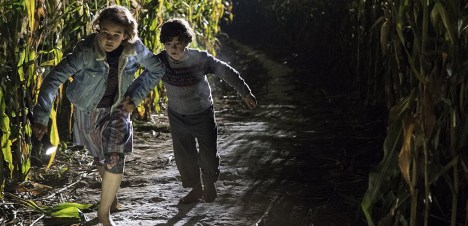
My 12 for ’18: Quiet Please in “A Quiet Place”

It’s that time of year. I’ll counting down my top twelve films of the year daily on the blog between now and New Year. I’ll also be discussing my top ten on the Scannain podcast. This is number eleven.

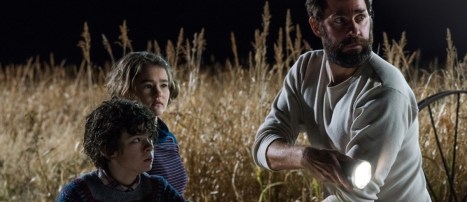
Much has been made of A Quiet Place as an old-fashioned horror throwback, and justifiably so.

There is a lot to like about A Quiet Place, especially for audiences who are maybe a little cynical about the modern cinematic landscape. It is an original property. It is not a sequel, reboot, prequel or remake. It is not even based on a book or a comic. It does not exist as part of a shared universe. It is not a story drowned out by the cacophony of end-of-the-world stakes. It is not a story that struggles under the weight on unnecessary exposition. It is a solid, mid-tier, old-fashioned horror film. It is the kind of respectable mainstream genre film that doesn’t really exist anymore.

However, there is something that separates A Quiet Place from the year’s other nostalgic prestige horror offerings like Hereditary. Hereditary was a film that largely succeeded as a nostalgic throwback to the classic horror films of the seventies, tapping into the same fears of familial dissolution as Don’t Look Now or The Exorcist. In contrast, A Quiet Place is a thoroughly modern film. It is a movie that very much reflects the modern world, although not necessarily in terms of theme or story. Indeed, trying to work out the politics of A Quiet Place is bound to be an exercise in frustration.

Instead, A Quiet Place is a modern film in the way that it engages overtly with and makes the characters complicit in the act of watching a horror movie. It is a horror film that is consciously designed in order to heighten and emphasise the manner in which people watch films.

Continue reading

Non-Review Review: Vice

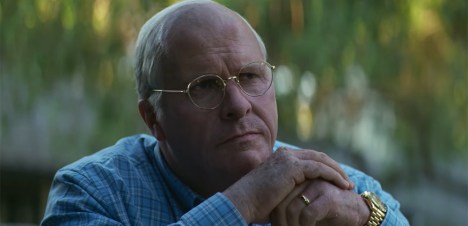
Vice feels at once like an extension of both Adam McKay’s work on The Big Short and recent innovations on the biographic picture format codified by I, Tonya.

At its core, Vice is the biography of a man whose defining attribute is how unassuming he appears. The opening text lays out the challenges facing the production team in trying to structure a biographical film around a man who has spent his life lurking at the edge of the frame, how hard it can be to extrapolate his inner workings from the outline of his journey through the world. Dick Cheney worked very hard to erase his own footprint; it is with no small irony that the film notes how thoroughly Cheney cleared his own email servers.

No need to be a Dick about it.

The film’s anonymous narrator, himself framed as perfectly average individual, repeatedly stresses how “ordinary” the central character presents himself. At one point, he advises a former colleague that the new standard operating procedure is “softly, softly.” Similarly, the documentary acknowledges the lacunas in the narrative that is constructing, how difficult it is – to evoke a different Shakespearean play than he chooses to quote – “to see the mind’s construction in the face.”

The result is fascinating, a character study that becomes an exploration of systemic flaws and inequities. Vice is a story about a man who appears to have no fixed political beliefs, no strong political identity, no clear political voice. Instead, Vice is a study of the politics of power as politics of itself, a tale about a man whose central political motivation is not ideological or existential, but purely practical. Vice is the tale of the will to power of a perfectly mundane and average individual, and the carnage wrought on his journey towards that power.

Vice City.

Continue reading

Dublin Film Critics Circle Awards, 2018

It’s the most wonderful time of the year!

Snow! Christmas! Terrible but enjoyable (and apparently, this year, controversial!) music! End of year “best of” lists!

I’m a member of a couple of critics’ organisations, so we’ll be releasing a couple of these lists upon which I voted. I’ll also hopefully be releasing my own top ten as part of a Scannain end-of-year podcast some time this week.

In the meantime, the Dublin Film Critics Circle have released their end of year awards. Thrilled to be a part of the group, who are voting on films released in Ireland during the calendar year of 2018. As such, it will be a different pool of films than the Online Film Critics Society awards.

A massive thanks to the wonderful Tara Brady for organising the awards this year, balloting members and collating results.

Anyway, without further ado…

Continue reading

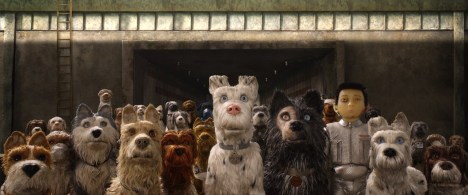
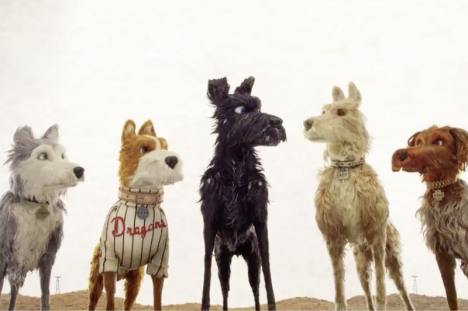
My 12 for ’18: Empathy in Any Language & “Isle of Dogs”

It’s that time of year. I’ll counting down my top twelve films of the year daily on the blog between now and New Year. I’ll also be discussing my top ten on the Scannain podcast. This is number twelve.

2018 has been a long year, but one that moves at a whirlwind pace.

It’s a bit of a paradox. Time moves so quickly that it seems impossible to keep up with everything that is unfolding. Stories that would have dominated the news cycle for months are now played out in the space of an afternoon, buried beneath the next big story and the next shocking revelation. However, despite how fast everything is moving, this has a numbing effect. The constant barrage of news and information makes things feel so much slower and longer than they would otherwise. 2018 moved so fast that it was impossible to keep up, but it also seemed to last an eternity.

As a result, seemingly ordinary periods of time can be stretched and distorted. The window between theatrical release and home media roll out has been getting shorter and shorter for most films, occasionally to the consternation of cinema chains. There are only a few scant months between the premiere of a film and its release as digital download or hard copy. Normally, that is not a long or extended period of time. In 2018 terms, it is an eternity. So much can change in that window.

I first saw Isle of Dogs in a crowded cinema during the Audi Dublin International Film Festival. The snow was falling outside. Although I did not realise it from the safety of the cinema, buses were being cancelled. Getting home afterwards would be an oddity, and I would spend the next four days locked in my house, staring at idyllic and unspoiled white snow. At the time, I really loved Isle of Dogs. It stayed with me, haunting and beautiful. The imagery was arresting, the compositions impressive, the simple story at the heart of the film an engaging appeal to empathy in a world increasingly bereft of it.

Continue reading

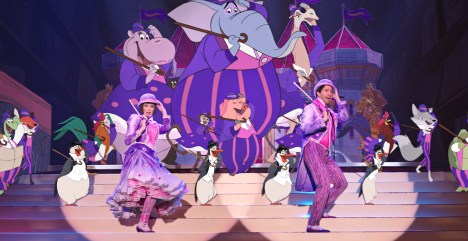
Non-Review Review: Mary Poppins Returns

Mary Poppins Returns largely accomplishes what it sets out to do.

Mary Poppins Returns is a belated sequel to the original film, and very clearly – and very strongly – takes that original film as its major influence. Indeed, many of the relative strengths and weaknesses of Mary Poppins Returns are carried over directly from the previous film. Mary Poppins Returns is visually inventive, narratively accessible, highly unfocused, and episodic in structure. These are all aspects that it shares with the beloved family classic that spawned it, for better and for worse.

The nanny’s state.

There is an endearing energy in Mary Poppins Returns, and a comforting nostalgia. Indeed, Mary Poppins Returns to the sort of film that was already endangered when Mary Poppins was released, the cinematic equivalent of vaudeville entertainment; a collection of largely isolated sketches tied together by the thinnest of string, serving as a showcase for the creative talents of everybody involved from the performers to the animators to the set designers. Mary Poppins Returns comes remarkably close to capturing the spirit and the appeal of the original.

However, Mary Poppins Returns struggles slightly to balance its fidelity for (and veneration of) the original with the demands of a modern family blockbuster, the film occasionally caught in the push-and-pull of familiarity and modernity. It doesn’t quite work, but it gets close enough for those craving an old-fashioned feel-good family film.

No need to make a song and dance about it.

Continue reading

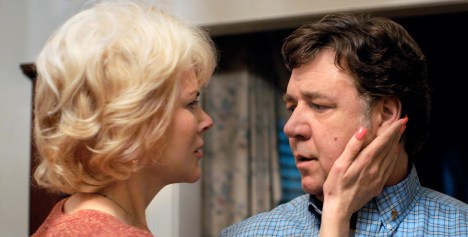
Non-Review Review: Boy Erased

Perhaps the most remarkable thing about Boy Erased is the amount of faith that writer and director (and supporting actor) Joel Edgerton puts in the material at hand.

Boy Erased is based on a memoir written by Garrard Conley, offering a fictionalised account of the writer’s time in gay conversion therapy in rural conservative America. The film is fiction to the extent that the names have been changed; Garrard Conley becomes Jared Eamons. However, Boy Erased never tries to disguise its influences or to assert ownership of the story. The end of the film includes pictures of the real-life inspirations for various characters, often illustrating how uncanny the film’s casting had been.

Bedfellows.

More than that, perhaps as a nod to the increased self-awareness within these sorts of stories, the film hints at its own fictionalisation. The article and book that Jared decides to write towards the end of Boy Erased is very plainly the basis of the film that audience is watching. There is something intriguing in that, in the way that Boy Erased folds itself into its own narrative. The ending of Boy Erased is rooted in the characters responding to the story that Jared has written of his experiences, a clever and reflexive narrative choice that is consciously (and shrewdly) underplayed.

However, the fact that this is the closest that Boy Erased comes to a subversive or deconstructive moment only underscores the matter-of-factness with which Edgerton’s handled the material. Outside of using the origins of the film to provide the basis for a third-act catharsis within the film, Edgerton takes a very straightforward approach to this story. He never seems particularly interested in bending the narrative out of shape or of heightening particular elements for dramatic tension.

Syke out.

In its own weird way, Boy Erased feels decidedly conservative for a contemporary awards film. It is much less energised or dynamic than other similar works, such as the addiction drama Beautiful Boy starring Lucas Hedges’ Lady Bird co-star Timothée Chalamet. This creative restraint is not a criticism in any way; quite the opposite. Edgerton trusts the story that he has been given, and trusts his cast to deliver. Boy Erased is not a showy or ostentatious piece of work, instead a film constructed to specification with care and craft.

Boy Erased is a film that exists primarily as a vehicle for its subject and for its cast, and that is a credit to Edgerton’s approach to the material.

They said that he needed this, but it couldn’t be father from the truth.

Continue reading

New Podcast! On “Filibuster #147” Talking “Christopher Nolan: A Critical Study of the Films” with Lee Hutchinson and Dallas King

I had the good fortune to stop by the latest Filibuster to chat about my latest book with Lee Hutchinson and Dallas King. Lee and Dallas were, as ever, gracious hosts and t was a joy to discuss Nolan for an hour with two fans of contemporary cinema on their last podcast of the year. I hope you’ll give it a listen.

You can listen to the podcast directly at the Filibuster website, but you can also listen to it directly below. You can also buy Christopher Nolan: A Critical Study of the Film as a print or ebook from a variety of online (and bricks and mortar) stores now.