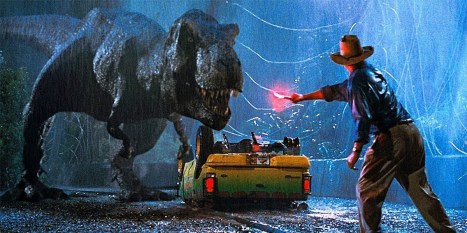
I published a new In the Frame piece at The Escapist this evening. For no reason other than because I watched it this week, I took a look at Jurassic Park and how it feels strangely prophetic.
Jurassic Park is many things: a cautionary tale about science run amok, about mankind’s hubris, about dads. However, watched decades later, it stands out as a cautionary tale about the kind of movie that it is. Jurassic Park is one of the best blockbusters ever made, but it was also a game-changer. It seemed to herald a revolution in computer-generated imagery that fundamentally altered the blockbuster landscape. In that sense, the film’s anxiety about the unforeseen consequences of these sorts of innovations, and of bringing the past to life again, have aged very well.
You can read the piece here, or click the picture below.
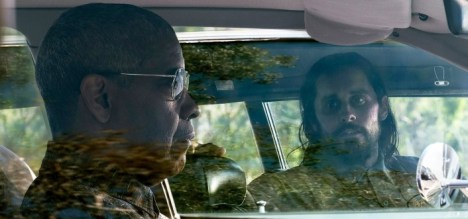
The Little Things was reportedly written by John Lee Hancock in the mid-nineties, and it shows.
The film is largely set against the backdrop of October 1990. There frequent reminders that this is effectively a period piece. During the opening sequence, one potential serial killer victim sings along with Roam from the B-52s on her car stereo. Another victim has a pink flyer for No Doubt pinned up on her fridge and a poster for The Lost Boys hanging in her living area. There are repeated references to how Richard Ramirez, “the Night Stalker”, still lingers in the living memory of the Los Angeles Police Department.
A new release window.
However, The Little Things feels like a period piece in some more fundamental ways. Most obviously, there’s the fact that The Little Things exists as a star vehicle, its cast including Oscar winners Denzel Washington and Jared Leto, along with Oscar nominee Rami Malek. The film is not based on any existing intellectual property, even if it is highly derivative in other ways. More than that, it harks back to the serial killer boom of mid-nineties cinema, when big studio films were dominated by procedural thrillers and forensic meditation.
The Little Things is neither an exemplar nor a deconstruction of the genre, but instead a straightforward reminder of its tropes and conventions seemingly cobbled together to construct something close to the statistical mean. The common refrain with a film like The Little Things is to suggest that this is the kind of film that they don’t make any more. The more worrying thought is that The Little Things seems to illustrate why.
The reactions to Malcolm and Marie have been divided, to the say the least.
On one extreme, some critics have been quick to laud Sam Levinson’s black-and-white character study as a surprise late addition to the awards race, a bracing old-fashioned character drama anchored in two compelling performances that interrogates a relationship that never seems certain whether it will implode or explode. It is the kind of film that invites comparisons to works like Who’s Afraid of Virginia Woolf?, The Boys in the Band or even something like Autumn Sonata: characters trapped in a confined space, with the drama ready to boil over.
On the other extreme, critics have been quick to argue that Malcolm and Marie is an indulgent mess anchored in a grossly unlikeable and shallow protagonist that never digs beneath the skin of its central characters. More than that, Levinson seems to use the film as an opportunity to work through his own issues as a promising (and privileged) young filmmaker who feels like he has not necessarily been given the critical respect that he deserves. Malcolm and Marie is a series of self-serious monologues delivered in the aesthetic of a (very pretty) Calvin Klein commercial.
As ever, the truth lies somewhere between these two extremes.
So, as I have mentioned before, I am launching a new video series as a companion piece to In the Frame at The Escapist. The video will typically launch with the Monday article, and be released on the magazine’s YouTube channel the following week. This is kinda cool, because we’re helping relaunch the magazine’s film channel – so if you can throw a subscription our way, it would mean a lot.
This week, I take a look at the power fantasy of the Marvel Cinematic Universe. With Captain America: Civil War, the MCU becomes a study in power without any responsibility.
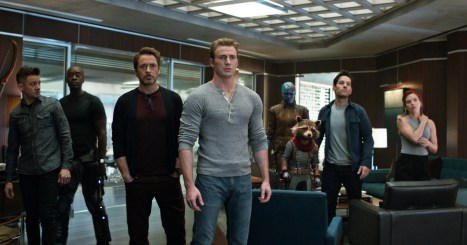
I published a new In the Frame piece at The Escapist this evening. Last week, there were rumours that Chris Evans might be returning to the Marvel Cinematic Universe, following his departure in Avengers: Endgame.
This is interesting, because it potentially undermines one of the more interesting facets of the Marvel Cinematic Universe going forward. Comic books are largely shaped and defined by nostalgia, with beloved characters filling familiar roles in perpetuity, with any major change to the status quo eventually rolling back to the default. In contrast, a cinematic universe operates by different constraints: actors move on, age out and even die. This would force a long-form shared universe to evolve in a way that comics haven’t had to. This is a good thing, as evolution is necessary.
You can read the piece here, or click the picture below.
So, as I have mentioned before, I am launching a new video series as a companion piece to In the Frame at The Escapist. The video will typically launch with the Monday article, and be released on the magazine’s YouTube channel the following week. This is kinda cool, because we’re helping relaunch the magazine’s film channel – so if you can throw a subscription our way, it would mean a lot.
This is a slightly older one, one that was prepared for both Christmas and for the fifth anniversary of Star Wars: Episode VII – The Force Awakens. I looked at one of the film’s most understated and under-explored legacies: the way in which the arrival of The Force Awakens killed one of the few spaces in the calendar where the adult-skewing blockbuster could thrive and prosper.
I published a new In the Frame piece at The Escapist this evening. With WandaVision launching this weekend and with reports that Chris Evans would be returning to the role of Steve Rogers, it seemed like a good time to take a look back at Captain America: Civil War as the point at which the MCU embraced the idea of power without responsibility.
Superhero stories are often about power and responsibility. However, one of the most striking aspects of the MCU has been its recurring embrace of the idea that power should come without any responsibility. Civil War is supposed to be a story about consequences, but instead becomes a story about characters desperately evading consequences, and asking the audience to cheer for them as they do. There’s something hollow and empty in that, and it’s arguably a rot at the root of the MCU.
You can read the piece here, or click the picture below.
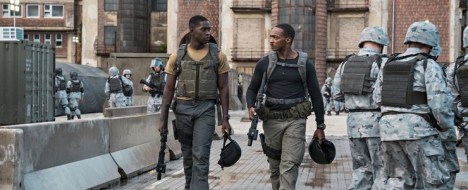
Outside the Wire often feels like Netflix resurrected Cannon Films, and tasked them with remaking Terminator 2: Judgment Day and Training Day, without any constraints in terms of logic or internal consistency.
Outside the Wire is a bad film, but it is a bad film in somewhat interesting ways. This is not the dull lifeless quality of Wild Mountain Thyme. It is instead the gonzo “throw everything at the wall, regardless of how it fits together” energy of a film like Serenity or Book of Henry. It is a film that makes a number of bizarre choices that often seem to confusingly double back on one another, to the point that any review of the film inevitably comes across as a deranged play-by-play rather than coherent criticism.
“You’re a droid, and I’m a ‘noid.”
Outside the Wire is set in Eastern Europe in the distant future of 2037, as a new Cold War brews between Russia and the United States, raging as a proxy war in the Ukraine. (It perhaps says something about the state of current politics that this reference feels very dated.) Lieutenant Thomas Harp is a drone pilot. During a routine assignment, he breaks the chain of command and fires a missile that kills two servicemen. As a penalty, Harp is assigned to active duty on the frontier.
This is a fairly standard set-up. It recalls movies that meditate on the morality of drone warfare, like Good Kill or Eye in the Sky. Indeed, as Harp arrives on site, the commanding officer outlines the brutal cynicism of this punishment. “You’re here because somebody deemed the dollar value of your training to be higher than the lives of those two men. If you survive, air force keeps a pilot. If you die, you’re a cautionary tale to all the other fly-by-wire assholes.” The stakes are grounded, logical. The moral at play is clear. Harp is going to learn what war is really like.
Robot Wars.
Then, in the space of three minutes, Harp is assigned to work with an officer named “Leo.” Leo is an oddity. “He’s not like us,” the commanding officer warns. Leo works alone in a large office, filled with records. He listens to vinyl music. He types on an analogue keyboard. Within minutes of arriving, Leo has already conscripted Harp on a covert mission behind enemy lines. It initially seems like Leo is planning to deliver a set of vaccines to a local children’s hospital. “So you’re hearts and minds, sir?” Harp asks. Leo replies, “Yes, I’m hearts and minds. Ostensibly.”
It turns out that the vaccine run that Harp has been assigned moments after arriving to his first active deployment is actually a clandestine strike mission to take out local war lord Victor Koval. Koval is plotting to take control of the Ukrainian nuclear arsenal, and Leo is committed to stopping that from happening. Leo walks Harp through an elaborate exposition machine, involving photo plays and interactive maps. There’s a lot of elaborate detail, but the mission is clear. This is a “save the world” buddy movie.
And then Leo takes off his shirt, and reveals that he is android. All of this is twenty minutes into the film.
I’m thrilled to be launching 3-Minute Reviews on Escapist Movies. Over the coming weeks and months, I will be joining a set of contributors in adding these reviews to the channel. For the moment, I’m honoured to contribute a three-minute feature film review to the channel, discussing Outside the Wire.
I published a new piece at The Escapist this evening. Because The Girl With the Dragon Tattoo is now on American Netflix, it seemed like a good time to take a look back at David Fincher’s underrated adaptation.
Daniel Craig has always had a challenging relationship with his most iconic role, that of super-suave super-spy James Bond. Many of his roles play off that tension, juxtaposing Craig with the audience’s expectations of him. The Girl With the Dragon Tattoo is no exception, essentially casting Craig in the role of the Bond Girl to Lisbeth Salander. Craig is repeatedly presented as vulnerable and distressed, often requiring rescuing and often existing as an extension of the women around him. It’s a clever, self-aware piece of casting.
You can read the piece here, or click the picture below.





















 the m0vie blog