• Following Us

  • Categories

  • Check out the Archives


  • Awards & Nominations

Non-Review Review: Into the Storm

Into the Storm is at least up front about its intentions.

It is a surprisingly pragmatic natural disaster film, one that moves with almost ruthless efficiency. Quite like the eponymous storm front, it goes where it wants to go, with little consideration for minor details like character development or intricate plotting. Into the Storm is a movie that knows what it wants to be and what it wants to be. There’s a strange utility to the world of Into the Storm.

Gimme shelter...

Gimme shelter…

In this world, used car lots exist purely to provide material for hurricanes to toss through the air; abandoned mills with all sorts of dangerous chemicals exist purely to put young members of the cast in peril; youtube-obsessed hicks exist solely as comic relief to be be shuffled out of the film before the stakes get well and truly raised. It’s a film that believes that twisters are fine on their own, but things can always be enhanced by the addition of a fire twister or by combining multiple twisters into a giant twister.

Into the Storm is a film so ruthlessly up front that it puts the Sci Fi (or SyFy) Channel to shame. There’s something almost endearing about that, even the result is far from satisfying.

Who films the filmmakers?

Who films the filmmakers?

Continue reading

Robin Williams

Robin Williams passed away.

It took a moment to let that sink in, to accept that we would be talking about Robin Williams in the past tense. Although the news broke in the evening time in the United States, it was announced in the middle of the night in Irish and European time. Over here, most of us fell asleep in a world where Robin Williams was a perpetual and much-loved screen presence, only to wake up in a world where Robin Williams was gone. It is very strange and very difficult piece of information to process, and something very hard to wake up to.

insomnia2

Continue reading

Non-Review Review: The Expendables 3

There is something almost laudable about The Expendables as a movie franchise. Like science-fiction conventions do for other genre performers, The Expendables provides retirement planning and income for a bunch of performers who might otherwise have passed their sell-by date. It’s vaguely reassuring to know that sometimes life (and ass-kicking) begins at fifty, and The Expendables is endearingly sincere and upfront about this function – giving action stars who might seem over the hill one last go around.

That goodwill is stretched to breaking point with The Expendables 3. Nobody expects a particularly insightful or well-constructed script for a film like this, but the screenplay is a mess. Structurally speaking, The Expendables 3 feels like it is being held together by rubber bands – rubber bands that are being stretched to breaking point with the film’s two-hour runtime. There is a tighter and exciting movie to be found in The Expendables 3, but the movie awkwardly lumbers past earnest and into indulgent.

Going to town on this one..

Going to town on this one..

Continue reading

Non-Review Review: Spider’s Trap

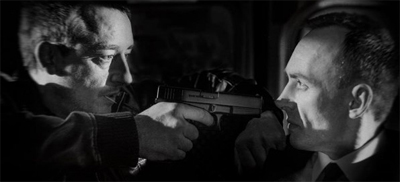
Spider’s Trap is a rather heavy-handed film. There are points where this works to the movie’s advantage – the stark black-and-white cinematography lends itself to exaggeration and effect. There are also points where the movie feels a little overly-earnest and awkward as it fashions its own noir tale about second chances and long-planned revenge. Beautifully shot by director Alan Walsh, Spider’s Trap is often endearing and charming, if not quite consistently brilliant. There are a few notable missteps, but there is also a lot to like.

Things aren't so black-and-white...

Things aren’t so black-and-white…

Continue reading

Non-Review Review: The Rover

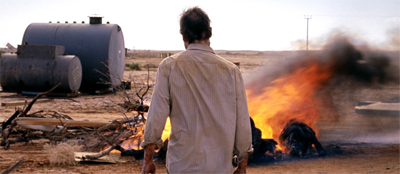
The Rover isn’t quite a post-apocalyptic road movie. A title card places the story “ten years after the collapse”, but it’s never clear what exactly “the collapse” is. Buildings still stand. Trains still run. Telegraph polls are still connected. Cars still drive. Military units still offer some small semblance of law and order. This isn’t a world that has collapsed, it is the decaying structure of a world still struggling to stand.

The Rover is a starkly beautiful and haunting film, one that says a lot with only a few scattered words. It’s unsettling not in its portrayal of a world that is dead, but instead in its attempt to capture a world struggling to keep breathing.

As the world burns...

As the world burns…

Continue reading

The X-Files – Sleepless (Review)

This August (and a little of September), we’re taking a trip back in time to review the second season of The X-Files. In November, we’ll be looking at the third season. And maybe more.

Vietnam casts a long shadow over The X-Files, just as it casts a long shadow over the rest of American popular culture. It was a conflict that left a scar on the American psyche, prompted no small amount of soul-searching and naval-gazing, forcing the country to contemplate its role on the global stage. The issues of war guilt and veterans rights haunted America well into the nineties, with films like Forrest Gump and Heaven and Earth still trying to make sense of it all.

Along with Watergate, Vietnam came to embody the disillusionment and disengagement of the seventies. While public discomfort with American involvement the Korean War never climbed above 50%, public disapproval of American involvement in Vietnam would reach almost 75% in March 1990. Vietnam remains a boogeyman, with memories of Vietnam arguably informing Clinton’s reluctance to commit American ground troops to foreign theatres during the nineties and serving as a frequent point of comparison to twenty-first century entanglements in Afghanistan or Iraq.

Howard Gordon’s first solo teleplay for The X-Files, Sleepless is an episode that explores Vietnam as a perpetual waking nightmare.

Preaching to the choir...

Preaching to the choir…

Continue reading

David V. Reed’s Run on Batman – Where Were You On The Night Batman Was Killed? (Review/Retrospective)

23rd July is Batman Day, celebrating the character’s 75th anniversary. To celebrate, this July we’re taking a look at some new and classic Batman (and Batman related) stories. Check back daily for the latest review.

David V. Reed enjoyed a long run on Batman. While he’s probably more infamous for his rather mean-spirited attack on Batman artist and co-creator Bill Finger in the pages of The Amazing World of DC Comics only a year after Finger passed away, Reed did some interesting things with the character and world of Batman. Perhaps the most notable of these stories is the four-part Where Were You on the Night Batman Was Killed?, an ambitious four-part story offering multiple-choice takes on the death of Batman.

It could be argued that Where Were You on the Night Batman Was Killed? has been a very influential Batman story. David V. Reed’s four-part saga sets up a structure that has been emulated quite a bit over the history of the Caped Crusader. For example, Almost Got ‘Im from Batman: The Animated Series follows a similar structure, with four Batman villains boasting about almost killing Batman. And Neil Gaiman and Adam Kubert’s Whatever Happened to the Caped Crusader? features many different deaths for Batman.

Long live the Batman!

Long live the Batman!

There are even faint echoes of Where Were You on the Night Batman Was Killed? to be found in the pages of Grant Morrison’s extended Batman run – populated as it is with replacement Batmen, cabals of evil villains boasting about their crimes, and the almost-but-not-quite death of the Dark Knight. Published in 1977, Where Were You on the Night Batman Was Killed? is a four-parter that seems quite a bit ahead of its time, if a little clumsy in execution.

It’s a decidedly goofy concept, executed in a decidedly goofy manner, but it is also quite wry and astute and perhaps even a little prescient.

Batman drops in...

Batman drops in…

Continue reading

Non-Review Review: Guardians of the Galaxy

Guardians of the Galaxy hits a few bumps along the way, but it works very well.

The key to this would seem to be James Gunn. Like the best of the Marvel comic adaptations, Guardians of the Galaxy is a film that manages to find its own unique authorial voice amid the cross-pollination of Marvel’s vast cinematic universe. Like Shane Black on Iron Man 3, Kenneth Branagh on Thor or Jon Favreau on Iron Man, James Gunn manages to put his own unique stamp on Guardians of the Galaxy – a film that remains compellingly personal amid the apocalyptic 9/11 imagery.

Lighting the way...

Lighting the way…

While the film suffers from some of the structural weaknesses that are typical of Marvel’s blockbusters, its strengths come from the director and co-writer. Although set in a vast universe with epic stakes and impossible odds, Guardians of the Galaxy works best when it focuses on its characters, whether the human Peter Quill (with his “outlaw name” Star Lord), the killing machine Drax, the sentient and sensitive tree Groot, the racoon named Rocket or the prodigal daughter named Gamora.

Guardians of the Galaxy is a film that introduces itself to the image of Peter Quill dancing beneath the logo, to the tune of Fooled Around and Fell In Love by Elvin Bishop, playing from a cassette labelled “Awesome Mix, Vol. 1.” That is all you need to know.

Gotta dance...

Gotta dance…

Continue reading

Grant Morrison and Chris Burnham’s Run on Batman Incorporated – Demon Star & Gotham’s Most Wanted (Review/Retrospective)

23rd July is Batman Day, celebrating the character’s 75th anniversary. To celebrate, this July we’re taking a look at some new and classic Batman (and Batman related) stories. Check back daily for the latest review.

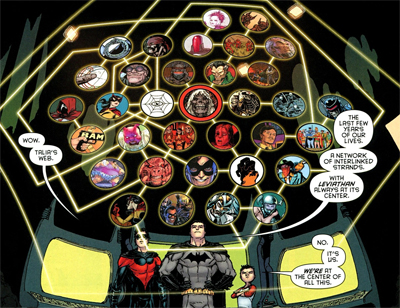
Between September 2006 and July 2013, Grant Morrison crafted his epic Batman saga from the ashes of Infinite Crisis. Over the course of seven years, the Scottish author re-worked and re-imagined the Caped Crusader, boldly trying to condense the character’s convoluted and sprawling history into a single narrative. Morrison pulled elements from across the character’s continuity – including stories believed wiped out by continuity reboots and existing as alternatives or “what-ifs.”

To describe Grant Morrison’s Batman epic as ambitious doesn’t begin to do it justice. It is a story that pushed the character out of what had been his comfort zone since the eighties and nineties. He made Bruce Wayne a father; he killed Bruce Wayne off; he banished Batman to the dawn of time and forced him to fight his way back to the present; he made Dick Grayson into Batman; he turned Batman into a franchise so that it might fight twenty-first century crime.
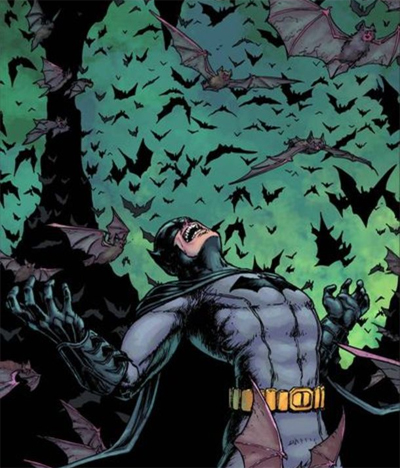
Beware the Batman...

Beware the Batman…

These are all seismic shifts to the status quo, and don’t necessarily conform to what people think about when they imagine a typical Batman story. The character of Bruce Wayne and his world changed dramatically. The very first issue of Morrison’s Batman run featured Batman capturing the last of his classic villains, allowing the Caped Crusader a change to face larger and more existential threats.

It is quite telling that Morrison’s storytelling became the driving force of Batman continuity, with DC spinning books and stories off from his central premise. Scott Snyder’s first Batman epic was The Black Mirror, a story featuring Dick Grayson as Batman, as part of Morrison’s status quo. When the company relaunched Batman & Robin as part of the “new 52”, it featured Damian Wayne as Robin, another innovation introduced by Morrison.

It's all connected...

It’s all connected…

Despite this sense that everything was changing, it seemed inevitable that everything would inevitably be reset. You can only change an iconic character like Batman so much, after all. If you bend Batman too far out of shape, he must inevitably snap back into his classic mould. It’s not inherently a bad thing – “Batman and Robin will never die!” to quote Batman R.I.P., and the characters endure because they revert to archetypes – but it does lend a sense of tragedy to everything.

Coming in the wake of the “new 52” reboot that represented an attempt to reset DC continuity back to its most archetypal configuration, it makes sense that Grant Morrison and Chris Burnham would write the second volume of Batman Incorporated as a tragedy. Morrison would announce his intention to step away from mainstream brand-name superhero stories in the wake of Batman Incorporated, and you can sense some of that fatigue in this story about how everything eventually gets set back to zero.
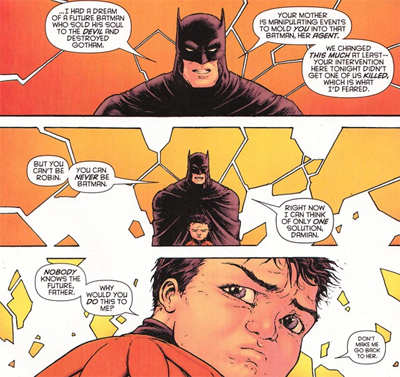
Everything falls apart...

Everything falls apart…

Continue reading

Non-Review Review: What If?

“Can men and women ever really be friends?” is so familiar that it’s practically a cliché. The line that exists between platonic male-female friendship and romantic entanglement was the engine that drove When Harry Met Sally, one of the best-loved romantic comedies ever produced. What If? covers familiar ground, charting the awkward friendship that develops between a young animator in a long-term relationship and a medical school drop-out working through his own issues.

To be fair, the tension between “romantic entanglement” and “platonic friendship” is somewhat undercut by the fact that What If? positions itself as a romantic comedy. The movie plots a familiar arc, hitting the expected plot points along the way. The structure is very clearly that of a romantic comedy, right down to the somewhat contrived (and inevitable) third act obstacles. Imposing the genre constraints of the “romantic comedy” upon a film like this cannot help but suggest an obvious answer to the  driving question.

What If? works despite the familiarity. That is largely down to the charm of its two lead performers. Daniel Radcliffe and Zoe Kazan play well off one another, creating a wonderfully intimate dynamic that suggests genuine affection rather than simply superficial attraction. What If? is a light comedy, but one that is executed with sufficient charm and wit.

Why can't we be friends?

Why can’t we be friends?

Continue reading