• Following Us

  • Categories

  • Check out the Archives


  • Awards & Nominations

Non-Review: Don’t Breathe

Don’t Breathe works reasonably well for about two thirds of its runtime.

The premise of Fede Alvarez’s Detroit-based horror is quite clever, a stew of familiar ideas thrown into a blender and delivered in a very stylish manner. Don’t Breathe is a film that begs to be summarised in pithy one-liners that bridge movie titles using the dreaded “… with …” In those terms, Don’t Breathe is Home Alone meets Halloween, Wait Until Dark meets The Bling Ring, Panic Room meets Saw. The combinations are infinite, as are the influences. And there is a charm to that.

Firing blind.

Firing blind.

Horror is a visceral genre; doing something new is great, but so is doing something familiar in a novel way. For its first two thirds, Don’t Breathe is an exciting and tense horror movie with an ingenious high concept and with a number of reliable jump scares. Fede Alvarez does not necessarily innovate, but he understands how to pace a sequence for maximum tension and he has a great eye for cinematic influences. Contemporary culture can often feel like “remix” culture, mashing old ideas together to create something interesting. Don’t Breathe fits with that.

The problem comes during the movie’s third act, when the thrills and horror slow down just long enough to flesh out the “monster” at the centre of the film. As it pushes into its climax, Don’t Breathe becomes a lot less intriguing and effective. In those final twenty minutes, Don’t Breathe indulges the baser impulses of the horror genre in a manner that is crass and cheap. Don’t Breathe begins as a series of inventive homages to the best that horror genre has to offer. Unfortunately, it ends as a demonstration of the genre’s worst attributes.

Setting his (gun) sight on them.

Setting his (gun) sight on them.

Continue reading

Non-Review Review: The Young Offenders

The Young Offenders is mighty Cork, boi.

Perhaps the most enjoyable aspect of Peter Foott’s coming of age adventure comedy is its sense of place. There are any number of Irish films that depict modern rural life, most obviously the films of John McDonagh (Calvary or The Guard) or Garage or even Smalltown. However, for all that those stories deal with big themes and bold ideas, it is rare to get a perfect sense of place. As with just about any country, Ireland offers a rich and diverse cultural landscape, and The Young Offenders is interested in exploring that landscape even before the first use of a map insert.

theyoungoffenders1

Continue reading

Non-Review Review: Anthropoid

“Concentrate on the details.”

The phrase is repeated in Anthropoid, and it speaks to the aesthetic of Sean Ellis’ tense Second World War assassination thriller. Ellis is very much fascinated with the details. This is reflected in the standard clandestine war movie fare; the reliance on maps and the maintaining of schedules, the decoding of messages and the construction of weapons. However, it is also reflected in Ellis’ directorial choices, with an emphasis on tight claustrophobic shots and meticulous care to ensure what the audience can or cannot see at any given moment.

Wet work.

Wet work.

The result is an engaging entry in the subgenre, a familiar story elevated by the craft on display. Ellis very skilfully and successfully ramps up the tension over the film’s two-hour runtime, mainly by keeping in complete control of the frame. Anthropoid is distinguished from other undercover war movies through the sheer scale of paranoia and dread that Ellis manages to generate, leading to a spectacular (and sustained) pay-off in the film’s third act. As its protagonists argue, the details are key.

There a few minor problems. Ellis is over-reliant on shaky camera work to keep the audience off-balance, a technique that is occasionally disorienting in a literal rather than a figurative sense. There are also moments when Anthropoid drifts away from its gritty grounding into easy visual metaphors and stock war movie tropes; crushed symbols of innocence trampled underfoot and a soaring triumphant score over silent scenes of carnage. However, these are the exception rather than the rule. As long as Anthropoid focuses on the details, it never loses track of itself.

Driving ambition.

Driving ambition.

Continue reading

Non-Review Review: Sausage Party

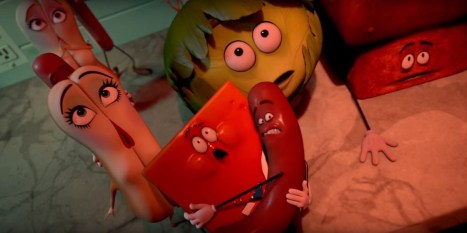
Perhaps the most charming thing about Sausage Party is that it exists in the first place.

After all, a computer-generated animated movie about foul-mouthed hyper-violent and aggressively sexual anthropomorphised food products was always going to be something of a tough sell. More than that, there was always a risk that the film’s best joke could not sustain the necessary ninety-minute runtime. “Let’s do an R-rated comedy animated in the style of a Dreamworks or Pixar film!” is very wry, but it seems like the kind of idea that brews in the early hours of the morning at a wild party and is promptly forgotten.

Food for thought...

Food for thought…

At one point in Sausage Party, the heroic hotdog Frank encounters a group of ancient foodstuffs hiding out in the liquor aisle of the shopping market that he calls home. These old and experience foodstuffs recall how they carefully cultivated and curated the mythology of the supermarket, building a religion that treated consumers as “gods” and which encouraged the store’s food and drink to dream of being “chosen.” There is even a hymn that the food sings every morning. A wisened old liquor bottle explains that this whole plan was the result of a massive stoner session.

In some ways, Sausage Party feels like it had a similar genesis, beginning with a goofy joke among friends that escalated and evolved into a surprisingly fleshed-out and developed world. Sausage Party works remarkably well given that it is essentially one very clever joke spread across ninety minutes, padded out with healthy doses of absurdity and puns. While the movie can occasionally feel a little indulgent and meandering, that charm carries it a long way. Sausage Party is one extended gag, but it is just about funny enough to pull it off.

Sweet mother of mercy...

Sweet mother of mercy…

Continue reading

Seventies Heaven – The Shifting Gaze of Cultural Nostalgia

Nostalgia is a funny thing.

It is infinitely more complex than most people will allow. By its very nature, it is highly fungible, intertwined with concepts like memory and politics in a way that does not always make it easy to parse. Nostalgia hits in waves, but those waves do not always hit at the same time with the same intensity. Nostalgia is not a single monolithic concept, it pulls and pushes from moment to moment. What is the nostalgia of the moment? The eighties nostalgia of Stranger Things? The nineties nostalgia of Independence Day: Resurgence?

theniceguys2

Trying to define a pattern in pop culture’s nostalgia is like trying to read the tea leaves, falling somewhere between a conversational art and outright hucksterism.  Still, one of the more interesting – and least discussed – aspects of the grand nostalgia industrial complex is the state of transition. Big waves become little waves, emphasis shifts, focus goes elsewhere. One of the more interesting shifts in nostalgia over the past couple of years has been a transition from a strong sixties nostalgia into something altogether more seventies.

It is a rather weird sight to behold, as if watching the popular image of one decade fade into the popular image of the other.

elvisandnixon8

Continue reading

Non-Review Review: War Dogs

At one point in the movie War Dogs, manipulative sociopath Efraim Diveroli presents his naive business partner David Packouz with a gift.

It is a sequence that is as illustrative of War Dogs as it is key for Efraim. The gift in question is a golden hand grenade, a gesture of tremendous subtlety on the part of the film and its secondary lead. See, Efraim and David are self-described gun runners. More than that, they are ostentatious over-the-top gun runners with no sense of tact and the bare minimum of business sense. What better way for Efraim to convey this to David (and for the film to convey it to the audience) than through the gift of a gold-plated hand grenade.

"Quick question: do we HAVE to be framed with these picture of Bush and Cheney? I mean, I think people get it."

“Quick question: do we HAVE to be framed with these picture of Bush and Cheney? I mean, I think people get it.”

However, the kicker comes in the inscription that Efraim has engraved on the bottom of the ridiculous gift. “The world is yours,” the grenade seems to promise its owner. It is, of course, a line from Scarface. It is, in fact, a line from both versions of Scarface. It is the bitterly ironic sentiment that closes out the film, an encapsulation of the greed and hubris that led the two gangster protagonists their downfall. Conveyed through advertising, it was also a stinging commentary on the American Dream. It was the height of irony, a cynical sting at the end of a moral fable.

There is a sense that Efraim does not necessarily understand irony. Having watched War Dogs, it is not entirely clear that the film does either.

Cool gun runnings.

Cool gun runnings.

Continue reading

It Follows the Rules – Horror Movies and “the Rules”

As with all cinema, horror movies tend to reflect the era in which they were created.

There are any number of obvious examples. The b-movie horrors of the fifties fixated on atomic horrors as an expression of anxiety of the development of the nuclear bomb and fears about science gone mad. The haunted house became a fixture of horror in the seventies owing to economic uncertainty, while the zombie became a reflection of unchecked mindless consumerism. The late eighties gave way to body horror as the AIDS virus became an international crisis. In the nineties, knowing irony seemed to take over.

itfollows3

Even in the first couple of years of the twenty-first century, the genre came to be dominated by supernatural monsters and found footage. Found footage offered a more grounded and realistic depiction of terror, reflecting the footage of real-life horrors captured on camcorders and mobile telephones for broadcast on the evening news. This dependence on found footage seemed to represent a logical extension of the ironic postmodernism of the nineties, a fear that the real world and the world of the horror were overlapping.

Indeed, it is quite easy to draw parallels between the War on Terror and the horror movies of the early twenty-first century. The found footage style recalls the images of 9/11 captured by citizen journalists and imprinted upon the public consciousness. The emphasis on torture in franchises like Saw and Hostel reflects contemporary political debates about how best to face the future. The renewed emphasis on foreign countries as inherently hostile in horrors like Hostel, The Ruins and Touristas.

Still waters...

Recent horror movies have seen a bit of a shift away from those kinds of themes and stories, although there are still traces to be found; The Shallows is very much an “American tourist in hostile territory” film while The Girl With All the Gifts looks to be a clever twist on the zombie genre that is still going strong following a millennial resurgence. Still, recent years have seen modern horror become increasingly nostalgic and old-fashioned, a trend best demonstrated by the horrors produced by James Wan like The Conjuring.

However, there is something else interesting happening in the background. Perhaps an extension of the same postmodern irony thread threaded through late nineties films like Scream and then evolving into the blurred fiction of found footage, modern horror films seem increasingly fixated on the idea of the “rules.” more and more, it seems like horror films insist upon their monsters conforming to an internal logic that the protagonists and audience can deduce (and exploit) through observation and experimentation.
lightsout

Note: This post includes spoilers for It Follows and Lights Out. If you haven’t seen them yet, consider yourself warned.

Continue reading

Non-Review Review: Lights Out

For the bulk of its runtime, Lights Out is a very old-fashioned and very clever horror movie.

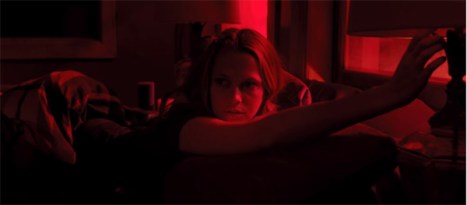
The basic premise of Lights Out is quite clever, even on its own terms. The central antagonist of the film is a demonic entity that seems to move through darkness. Characters are safe from its influence so long as they remain in the light. It is a very smart riff on a primal fear. The fear of darkness is the most primal of fears, the anxiety about the unknown and what might lurk in the shadows. Lights Out takes that universal fear and mines it for scares, in a fashion that is very classic while also quite clever.

A bit of the old ultraviolet...

A bit of the old ultraviolet…

The premise alone is enough to drive Lights Out, to power an eighty-one-minute horror film. However, director David Sandberg and writer Eric Heisserer go a great deal further. In the style of many classic horror stories, Lights Out positions its demon as an allegorical device. This demon that stalks its prey through darkness is treated as an apt metaphor for depression, a creature that has latched on to a small suburban family and tormented them quietly for years. It is a premise that The Babadook used to great effect, and it adds a little extra heft to Lights Out.

However, there is a sense that Lights Out is just a little bit too clever for its own good. The film follows its basic premise to a very clever and innovative conclusion within the world that it has created. The problem is that the movie’s final big plot development rather brutally undercuts the central allegory in such a way that the film trips over its own wit. Still, discounting those final few minutes, Lights Out is a visceral thrill-ride and a joy from start to almost-finish.

Red sky at night...

Red sky at night…

Continue reading

The Death of the Auteur Blockbuster, 2000-2016

Suicide Squad premiered last week, to incredibly negative reviews and an incredibly impressive box office.

There are a lot of discussions to be had about that, but the most interesting narrative is the story that has developed behind the scenes. If rumours are to be believed, it seems that there is a very intriguing book to be written about the production of Suicide Squad, although the less said about Jared Leto’s bodily fluids the better. Writer and director David Ayer was reportedly given six weeks to write a script featuring almost a dozen major characters, only for the final cut to be given to a company that had cut the film’s viral trailers.

suicidesquad

It is not particularly proud moment for film-making, particularly given the emphasis that Warner Brothers had put on their blockbuster slate as “film-maker driven.” Indeed, the laundry list of rumoured deleted scenes has become a convenient stick with which the movie might be beaten. How in the name of goodness could Suicide Squad be so messed up as to portray the fundamentally abusive relationship between the Joker and Harley Quinn as loving and affectionate? The answer is that the original cut of the movie was candid about the abuse, but it was cut out.

Although Warner Brothers’ DC movie slate has become an easy target for pundits looking to score cheap shots and drive page-views, the problem is more fundamental than that. In hindsight, with the summer of 2016 coming to the close, it feels like the end of the era. The curtain is drawing down on the short-lived “blockbuster auteur” era of big budget franchise film-making.

captainamerica-civilwar8

Continue reading

Non-Review Review: David Brent – Life on the Road

Perhaps David Brent: Life on the Road represents the edge case for the current wave of nineties nostalgia.

The Office premiered in July 2001. It was the first year of the twenty-first century, but spiritually near the end of what might be termed “the long nineties.” The mockumentary sit-com was something of a novelty at the time, building upon the rich history and legacy of British comedy personalities like Alan Partridge, with Ricky Gervais introducing the character of David Brent. Gervais did not invent cringe-comedy, but he certainly pushed it forward. Gervais’ work in The Office and Extras would inspire a whole generation of awkward social comedy.

He's got a t-shirt gun and he's not afraid to use it.

He’s got a t-shirt gun and he’s not afraid to use it.

David Brent is an interesting beast. On the one hand, it seems like a nostalgic return to familiar ground for a comedian who has long evolved past this persona. Barring a brief reprisal of the role for Red Nose Day in March 2013, Gervais retired the role of David Brent more than a decade ago. In some respects, David Brent finds the comedian retreading old ground that had been ceded to a generation of imitators and innovators years earlier. Gervais slips effortless back into the role, but there is a sense that the world has changed around him.

Despite Gervais’ best efforts, there is an awkwardness to David Brent. It is hard to tell whether Gervais has soften in the intervening years or whether the world has gotten harder, but David Brent feels trapped between two extremes. The feature film adaptation feels at once too mean-spirited and too kind-hearted towards its protagonist, offering a version of the character who is as awkward and offensive as he has even been while constructing a film that coddles the obnoxious former manager. The result is a film that feels off-balance, an old standard played out of tune.

Get Brent.

Get Brent.

Continue reading