• Following Us

  • Categories

  • Check out the Archives


  • Awards & Nominations

Non-Review Review: Revenge

This film was seen as part of the Audi Dublin International Film Festival 2018.

What if Nicolas Winding Refn directed a Blumhouse film?

Revenge is a neon-drenched and synth-saturated exploitation flick that takes some of the most familiar conventions of the survival horror genre and executes them with incredible style. Revenge puts a beautiful sheen on a very ugly film, constructing an effective revenge narrative full of striking imagery. As realised by director Coralie Fargeat, Revenge is a visceral experience. The film’s violence is almost tangible, the audience feeling every act of brutality inflicted upon the bodies of its cast.
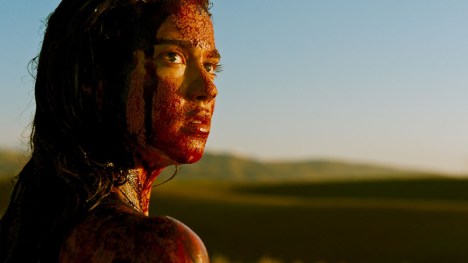
A lot of this is down to the craft of those involved, working under Fargeat’s direction. Jérôme Faurel’s sound design ensures that the audience hears every drip of blood, every splash on every surface. Cinematographer Robrecht Heyvaert and colourist Frédéric Savoir play up the contrast in the compositions, so the blood seems to burst off the screen against the bright yellows and the deep blues. Make-up effects artists Laetitia Quillery ensures that the cast carry every scar with them as the movie puts them through an endurance nightmare.

This attention to pure craft elevates Revenge above so many of its genre contemporaries. Revenge is undoubtedly trashy piece of cinema, but is never ashamed of what it is or apologetic for what it does. Instead, the film commits itself with an engaging and exhilarating enthusiasm. Revenge never views its genre as a limitation to transcend, but instead as a field in which to excel. And it certainly does.

Continue reading

Non-Review Review: Sweet Country

This film was seen as part of the Audi Dublin International Film Festival 2018.

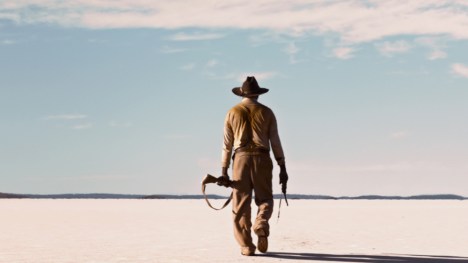
“What chance does this country have?” asks Sam Neill towards the climax of Sweet Country.

In the context of the scene, it isn’t entirely clear to whom the character is speaking. There is one other individual in the scene, but they are preoccupied at that moment and it’s not clear they are even within earshot when Neill’s character makes his grave assessment about the future of this young nation. However, outside the context of the scene, it is very apparent to whom Neill’s character is addressing his concerns. He is speaking directly to the audience through the medium of film.

Sweet Country is not a film that does subtlety or nuance. As Neill’s character offers this pointed question, he stumbles through the Australian wilderness, as if to suggest that he is lost. He stops just short of bluntly stating that he is lost, just like this country, the film demonstrating uncharacteristic faith in the audience’s narrative and thematic comprehension. Nevertheless, just in case the audience still doesn’t get it, Neill’s character asks this very profound question while wandering in the direction of the tail end of a rainbow set against a stormy sky.

“What chance does this country have?” the character wonders. The audience doesn’t feel the need to articulate the obvious response, “Not much, if it produces films like this.”

Continue reading

Non-Review Review: First Reformed

This film was seen as part of the Audi Dublin International Film Festival 2018.

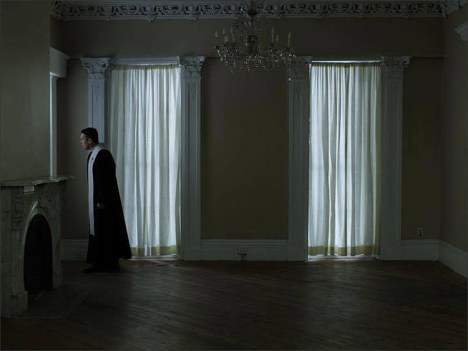
First Reformed is an unholy mess.

On paper, First Reformed has some very interesting ideas. It is a film grappling very consciously with weighty themes and heavy subject matter. It is about the challenge of finding faith in a modern and cynical world, and about reconciling the mundane maintenance of spiritual belief with the euphorically elevation of pure devotion. This is a broad theme that resonates in a world that feels increasingly disconnected and diffused, in a time when people feel increasingly distant from purpose or meaning.

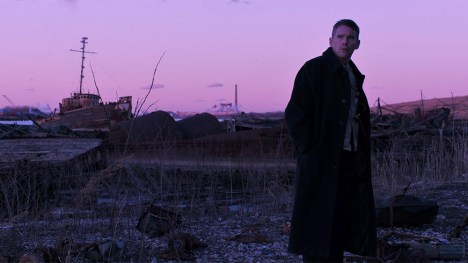
Indeed, the core premise invites comparisons to Taxi Driver, which remains the defining work in Schrader’s filmography. Schrader has been working as a writer for almost forty-five years, and as a director for forty years, but his body of work is still discussed in terms of the second script that he wrote. Although most audiences associate Taxi Driver with the creative partnership of Scorsese and DeNiro, it was a work that was very important to Schrader, articulating themes and ideas to which he would return time and time again.

First Reformed brings Schrader back to that, with Reverend Ernst Toller feeling very much like a spiritual sibling to Travis Bickle, a man who struggles to make sense and to find meaning in a chaotic world and who decides to impose his own order upon the universe. Schrader is very much playing with his own history and iconography here, playing out a familiar story in a new setting with a slightly different emphasis. As with a lot of artists revisiting their earlier and defining, the results are frustrating. First Reformed bends and contorts in the shadow of its predecessor, never coming into its own.

Continue reading

Non-Review Review: The Breadwinner

This film was seen as part of the Audi Dublin International Film Festival 2018.

Stories enrich us, stories empower us, stories sustain us.

The Breadwinner is many things. It is a beautifully animated film from Irish studio Cartoon Saloon, a worthy successor to The Secret of Kells and Song of the Sea, and also the first time that the company have looked beyond Irish shores for one of their feature-length releases. It is a stunning adaptation of Deborah Ellis’ novel, offering a compelling glimpse into Afghanistan as controlled by the Taliban at the turn of the millennium. It is a genuinely affecting tale of a young girl surviving in a climate that seems actively hostile to her very existence.

However, The Breadwinner is also a meditation upon the power of stories. This is not a surprise, it is very much in keeping with the aesthetics and interests of Cartoon Saloon. It is a recurring theme in their work. (As a point of comparison, Pixar Studios are invested in parental anxieties, down to the inclusion of the “Pixar Babies” in the credits of every major release.) Indeed, The Breadwinner might be seen as a spiritual successor to (or the third part of a thematic trilogy with) The Secret of Kells and Song of the Sea, stories about children reconnecting with the mythic history of their countries.

Indeed, this is one of the most striking and appealing aspects of The Breadwinner is the way in which it finds something universal in its very specific setting. The Breadwinner is a story very firmly anchored in one time and place, but one that should resonate with everyone.

Continue reading

Non-Review Review: Mute

Mute is a bold and ambitious mess.

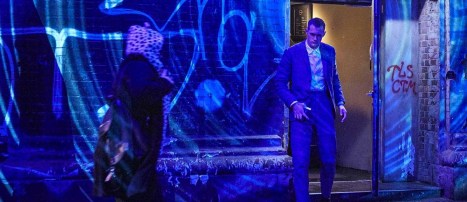
Mute is perhaps most interesting for what it is, and most frustrating in what it is about. In its own way, Mute stands as a triumph of the Netflix model. As it streams, Mute is undoubtedly the film that director Duncan Jones wanted to make. Indeed, it is next to impossible to imagine Mute making its way through the conventional studio system, and certainly not in the form that appeared on Netflix. Even watching the film play out, those never-materialised studio notes suggest themselves. (Most notably, “What is this film saying?”) There is nothing that feels like compromise about the film, and there is something very appealing in that.

However, there is also something deeply frustrating in Mute. The film is undoubtedly the unfiltered creative vision of its director, but there is something overwhelming in that. Mute is beautiful to look at, but almost too much to take in. Its world is vivid and fully formed, its atmosphere rich and evocative. However, there is something awkward in the story that unfolds within this dystopian landscape, the narrative never quite cohering in the same way as its grimy futuristic Cold War Berlin.

Mute is a film that is fascinating and impressive, if far from satisfying.

Continue reading

Non-Review Review: Black ’47

This film was seen as part of the Audi Dublin International Film Festival 2018.

Black ’47 is a powerful piece of pulp storytelling, a bold and daring window into an under-served chapter of Irish history.

Directed by Lance Daly, working from a story derived by a variety of writers, Black ’47 is essentially a western set against the background of the Irish Famine. Of course, the reality is much more nuanced than that simple description would suggest, but it provides a suitable starting point for discussion. Indeed, all the genre elements are in place; a soldier returns home from war to discover the horrors that have befallen his family, and decides that there shall be no justice on earth save for that which he might exact by his own hand.

Black ’47 is a very sparse and rugged film. It would be a surprise if the nominal lead character, Feeney, speaks more than one hundred words. Indeed, at one point he explicitly rejects the English language as a tool of communication. The landscape of the film is rough and cold, the audience feeling the chill that runs through the film and almost smelling the decay in the air. Black ’47 reflects its rough and wild settings, and the characters who have been shaped and moulded by those surroundings.

Black ’47 is an effective piece of storytelling.

Continue reading

Non-Review Review: The Lodgers

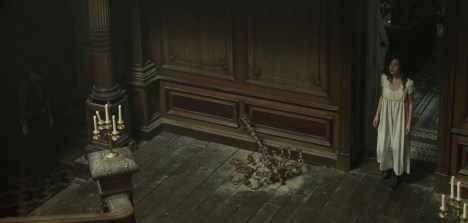
The Lodgers is a beautifully-directed and somewhat muddled gothic horror film.

The Lodgers literally drips with atmosphere, as one might imagine given the combination of writer David Turpin and director Brian O’Malley. Turpin has studied and lectured in English, writing his doctoral thesis on therianthropy. O’Malley directed Let Us Prey, one of the most visually striking and memorable Anglo-Irish horror films of the past couple of years. As such, a gothic horror set against the backdrop of Irish Independence seems very much in keeping with their aesthetics, and it does not disappoint.

The fall of the house of Lodgers.

The Lodgers is a rich piece of work, both in terms of visuals and themes. Like any good horror story, the subtext simmers through the work, O’Malley and Turpin tapping into rich veins of social and political anxiety, often weaving those threads together in a compelling and exciting manner. The Lodgers might be best described as the work of Edgar Allan Poe channeled through a seance with William Butler Yeats. It feels undeniably Irish, rooted in the land and its people.

At the same time, The Lodgers suffers slightly in its own internal mechanics. Like the big house at the centre of the story, the construction is largely sound. However, there is a sense that some upkeep and maintenance might be required. The Lodgers is undercut by a number of key defects including its casting and its dialogue. The Lodgers is visually striking and rich, but it stumbles in some of its more basic elements.

Stairway to heaven.

Continue reading

CinÉireann – Issue 4 (February 2018)

The latest issue of CinÉireann has just been released.

I’m delighted to have contributed several pieces to the magazine, talking about the Oscars, about Netflix and about Black Panther and the IMDb. There is some fantastic talent involved, and it is an honour to be involved.

As ever, thanks to the fantastic Niall Murphy over at Scannain for letting me be a part of it.

You can read CinÉireann as a digital magazine directly. You can even subscribe and get future issues delivered to you directly. Or click the picture below.

Non-Review Review: Finding Your Feet

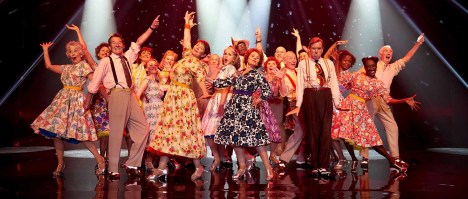
Finding Your Feet is a fairly placid and mostly unobjectionable film that adheres to an increasingly familiar formula, a gentle reminder that life can often begin at sixty.

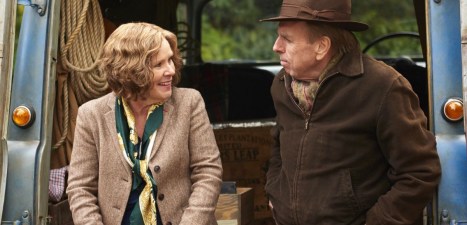
Finding Your Feet largely coasts off the charm of its cast, who seem to be having an enjoyable time with one another and appreciating the opportunity to find themselves cast as romantic leads in a globe-trotting adventure. In particular, there is something disarming in seeing Timothy Spall cast as a charming romantic lead, a disarmingly sincere lovable rogue who inevitably scrubs up quite nicely. Finding Your Feet offers very few surprises, but that is part of the attraction, perhaps worried that too many surprises might throw off the presumed viewer.

Spall good, baby.

However, Finding Your Feet is too awkward and clumsy to allow the audience to get entirely caught up in the familiar beats and rhythms of the tale. The familiar plotting of Finding Your Feet helps compensate for some strange storytelling decisions, with major character arcs unfolding off-screen and the film trying to fill its run time with things happening rather than focusing on the people to whom these things are happening.

Finding Your Feet is bland and inoffensive, its central cast providing a disarming charm that the movie never quite earns.

The sequel will feature a new addition to the cast and will be titled, ‘So You Think You Can Charles Dance?’

Continue reading

Black Panther Movement: IMDb Vote Rigging and the Politicisation of Everything…

Everything is political.

And not just in abstract sense any longer. Over the past two years, it has become clear that popular culture is not insulated from politics, and cannot be insulated from politics. There are any number of markers along this road; the rise of socially-conscious film criticism, the election of a reality television star as President of the United States, debates about diversity and representation on screen and in organisations. It is fair to debate all this, to wonder whether it is a necessary step on the road to maturity or another way in which it has become harder to escape into pop culture.

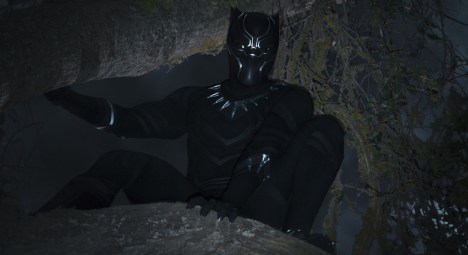
Over the past few weeks, Black Panther has become another front in the perpetual and never-ending culture wars, a battleground much like Gamergate in which views that would have been socially unacceptable even half a decade earlier are spilling out into the mainstream. Weeks before the film was released it found itself subjected to organised vote brigading and troll campaigns, racist fear-mongering and dogwhistling, panic and chaos. This was before the public had been given the opportunity to actually watch the film. Black Panther became a pop culture totem.

Much has been made of Black Panther as a progressive milestone. It is not the first black superhero movie, but it is the first Marvel Studios film with a primarily black cast and focusing exclusively on a black hero. It is perhaps the first true black superhero film of the superhero boom that the Blade trilogy helped to kickstart, but subsequently stood apart from. Black Panther is undeniably compelling from that perspective, a bold and necessary step forward. However, one look at social media demonstrates that there is still a long way left to go.

Continue reading