• Following Us

  • Categories

  • Check out the Archives


  • Awards & Nominations

Non-Review Review: 2 Fast 2 Furious

I’m rewatching The Fast and the Furious for a separate project, as solidarity with fellow film critic Jay Coyle for his “Cinema of Experience” project to look at the changing face of cinema in the twenty-first century. He’ll be writing up his account of how the experience of watching movies has changed in the past twenty-or-so years, but I found my rewatch of The Fast and the Furious interesting enough to write a longer-form review of it.

The Fast and Furious franchise exists somewhere in the space between The Fast and the Furious and 2 Fast 2 Furious, but is never quite caught on camera.

The Fast and the Furious is a late nineties undercover urban western about lawlessness in turn-of-the-millennium Los Angeles, of the dead end of the American Dream where young men (and occasional women) drive fast cars in circles to nowhere in particular, living their lives “one quarter mile at a time” without any purpose or any escape. It is a moral quagmire, a tribal wasteland in which law and order mean nothing. The film centres on a police officer sent to infiltrate this world of fast cars, who ultimately cannot bring his target to justice – because there is no justice in this empty and nihilistic world.

2 Fast 2 Furious is effectively a soft Miami Vice reboot. It is a bright and colourful thriller which follows former undercover police officer Brian O’Conner and his old friend Ramone Pierce as they are tasked to infiltrate a drug kingpin’s organisation in Miami. It is a much more conventional and delineated film, and also a much less existential. There are clearly defined good guys and bad guys, and O’Conner has absolutely no ethical objection to bringing in this particular criminal. The film is also appreciably brighter, both be virtue of its heavily saturated surroundings and by an increased emphasis on neon.

Watching 2 Fast 2 Furious, there’s a real sense that the production team had no idea what a hypothetical sequel to The Fast and the Furious would look like, only that it should exist… and maybe it should have some cars in it. Indeed, 2 Fast 2 Furious is pointedly at its most ridiculous when the script is forced to shoe-horn the “obligatory racing bits” into a conventional “undercover Miami drug bust movie.” There’s a weird disconnect between the two films, that goes beyond the absence of Vin Diesel.
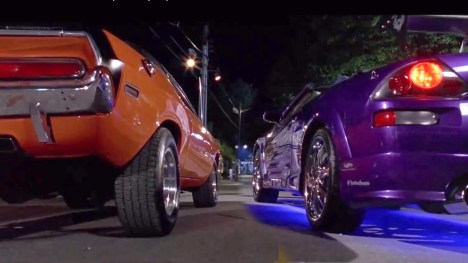
Even with Paul Walker present and few small continuity references, there’s little to tether 2 Fast 2 Furious to The Fast and the Furious. It recalls the sort of old-fashioned Hollywood cynicism that produced sequels like Die Hard with a Vengeance, when familiar characters would be clumsily bolted on to a completely unrelated script to create a new franchise installment. Of course, with Dom Toretto in the wind, 2 Fast 2 Furious doesn’t even really have that many familiar characters to anchor it. Brian O’Conner was never going to be the franchise’s breakout character, after all. 2 Fast 2 Furious only has the name.

In some ways, the spark that would drive the Fast and Furious franchise is found in neither The Fast and the Furious nor 2 Fast 2 Furious. After all, the later blockbuster installments of the franchise feel like a completely different breed than either film; espionage-style superhero films involving the fate of the world. That spark is found in the gap between The Fast and the Furious nor 2 Fast 2 Furious, in the cynical idea that just about any kind of movie can be a Fast and Furious movie if you stick enough cars in it.

Continue reading

Non-Review Review: Mission – Impossible: Fallout

Mission: Impossible – Fallout has the best third act of any blockbuster in years.

To be fair, the first two acts are highly enjoyable on their own terms, with writer and director Christopher McQuarrie building and maintaining momentum across the film’s near-two-and-a-half hour runtime. As expected of the franchise, Fallout is peppered with memorable set pieces that push the plot along with an endearing commitment to in-camera action set-ups, impressive stunt choreography and ambitious imagination; skydiving through a thunderstorm, a brutal bathroom brawl, a daring mid-movie motorcade abduction, a three-dimensional topographical pursuit.

Snow escape.

While all of these elements work well, with the bathroom brawl in particular serving as a worth addition to the franchise’s set piece canon, the final act of Fallout is a masterclass in blockbuster film-making. It is a genuinely dizzying piece of spectacle, a soaring accomplishment that manages to ratchet up the suspense for the better part of forty minutes, making excellent use of an ensemble in close geographic proximity but in very different situations. McQuarrie skilfully understands the rhythm and the tempo of the scene, crosscutting beautifully between the various strands to sustain the tension.

Fallout is not the best film in the Mission: Impossible franchise; it isn’t quite the all-rounder that Mission: Impossible III was, and it lacks the gleefully demented sustained adrenaline rush of Mission: Impossible – Ghost Protocol. However, it is a testament to the remarkable and sustained quality of the franchise, and the best movie of the summer to this point.

Just dive right in…

Continue reading

Non-Review Review: The Fast and the Furious

I’m rewatching The Fast and the Furious for a separate project, as solidarity with fellow film critic Jay Coyle for his “Cinema of Experience” project to look at the changing face of cinema in the twenty-first century. He’ll be writing up his account of how the experience of watching movies has changed in the past twenty-or-so years, but I found my rewatch of The Fast and the Furious interesting enough to write a longer-form review of it.

The Fast and the Furious is a curious piece of work, especially in the light of everything that followed.

From the opening scene through to the climactic setpiece, The Fast and the Furious is very much framed as an urban western, a tale of conflicted masculinity within an urban wasteland that might as well be lawless. Street racers serve as traffic cops at one point, blocking civilian cars from the predetermined race track without any interference from actual law enforcement. Towards the end, Dom Torreto seeks to evade the law by outrunning a train to a train crossing, one of the classic high-stakes western set pieces.

More than that, the introduction of Dom Torreto in The Fast and the Furious is very much meant to evoke the introduction of a western protagonist. He is first seen from obscured angles, glimpsed from behind and through a wire mesh. His presence is felt at a distance, an island of calm in a chaotic world. Torreto is introduced as an outlaw who seeks peace in a world that is constantly at war. This is perhaps a canny approach from a scripting and directorial perspective, acknowledging Vin Deisel’s strengths as a screen presence. Torreto’s first act is to break up a street fight outside the little restaurant stall operated by his sister.

Released in June 2001, The Fast and the Furious is one of the last action films of the nineties. It is a snapshot of a nation still paranoid about street gangs and boy racers, of urban decay and social collapse, of the apocalyptic notion that Los Angeles is the final frontier of the nation’s westward expansion. Explored in hindsight, these were perhaps more innocent times.

Continue reading

Non-Review Review: Searching…

Searching… is an interesting fusion. It blends the innovative narrative style of Unfriended with the more convention cinematic language of thrillers like Kiss the Girls.

This cocktail is at once welcome and overdue. Unfriended was one of those rare genuinely innovative pieces of mainstream cinema; in form, if not necessarily in function. Unfriended built from a premise that was both incredibly simple and also formally daring, telling a fairly standard supernatural teenage revenge story entirely through a computer desktop. As with Searching…, all of Unfriended unfolded within a computer screen.

Windows ’95 into the soul…

In hindsight, it is surprising that it has taken other genres so long to embrace that formal experiment. Cinema has a long history of eagerly coopting the language and experiments of horror for more prestigious and high-brow fare. Consider, for example, how quickly other genres coopted the “found footage” revolution of the early twenty-first century for action movies, thrillers, comedies, and even monster movies and superhero films. (Then again, that embrace of the “found footage” aesthetic may have caught on for reasons beyond the success of The Blair Witch Project.)

Searching… takes the basic formal conceit of Unfriended and applies it to a more conventional genre film. The result is an abduction thriller told exclusively through screens, through video streams, search histories, web cameras and screenshots. It’s a provocative premise, effectively turning the bigger screen into a smaller one and changing the rules of how the audience processes the imagery in front of them. However, Searching… clearly aspires to bridge the gap between screens big and small.

She needs to screen her fans better.

Continue reading

Non-Review Review: Skyscraper

Hollywood never really gives up on a genre that it loves, even when it might appear that the audience has moved on.

The perpetual reinvention of the western is one example, a genre that is constantly updated in terms of style and substance to reflect the times. The western has been reinvented and reimagined countless times over the past few decades, whether by combining it with other genres or by examining its underlying assumptions. The western survives in movies like The Hateful EightThe RevenantBone Tomahawk; films that are very clearly westerns even if audiences from the genre’s peak would struggle to recognise them.

Hanging on in there.

Disaster films are another example of Hollywood’s perpetual reinvention of a genre that has fallen out of style. While by no means as ubiquitous as they once were, disaster films still pop up from time to time. The attempts to update the disaster film often take the form of hybridisation, of tying the trappings of the genre into a more marketable template. In the nineties, Independence Day cleverly wed the disaster movie to an alien invasion narrative. More recently, Patriots’ Day tied the structure and rhythms of the disaster movie into a counter-terrorism epic.

Skyscraper hits upon what might be the ultimate genre fusion for the disaster movie template. At the very least, it feels like an inevitable hybrid in the modern cinematic climate. At its core, Skyscraper essentially asks… “what if a disaster movie, but also a superhero film?

The bed Rock of a stable marriage.

Continue reading

Non-Review Review: The Secret of Marrowbone

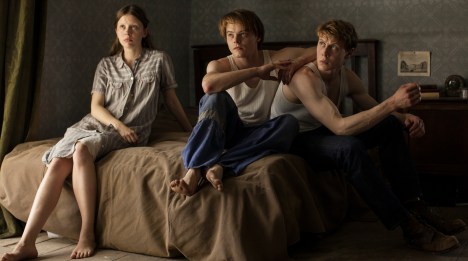
The Secret of Marrowbone is an interesting premise, albeit one told in the clumsiest manner possible.

The basic story is sound. The film has all the trappings of a gothic eastern seaboard horror, even borrowing several of its cues from the work of Edgar Allan Poe. There is a secretive family living in a rundown house, with a dark secret involving betrayal and violence. The central family, with the delightfully gothic name of “Marrowbone” have journeyed from England to the United States in the hope of a clean break, a fresh start. “No more memories,” the characters repeatedly assure one another. However, this is a ghost story. What are ghost stories but stories about memory?

Putting their secrets to bed.

However, the execution is severely underwhelming. The Secret of Marrowbone is a film with an incredibly tonal dissonance. Writer and director Sergio G. Sánchez veers wildly from gothic Jungian horror to exaggerated fifties melodrama and back again, the whiplash heightened by Fernando Velázquez’s heavy-handed score and Xavi Giménez’s inconsitantly saturated cinematography. The Secret of Marrowbone is half a semi-competent horror movie and half an overwrought trashy soap opera, neither element meshing cleanly with the other.

The result is dizzying and disorienting, but probably not in the way that Sánchez intended.

All Jacked up with nowhere to go.

Continue reading

Non-Review Review: Whitney

Celebrity documentaries can be tricky.

There are so many forces that pull narratives in so many directions; the attempts by those in the celebrity’s orbit to shift the story in order to favour their account of events, the yearning for a tabloid sensationalism to feed the impulses of the public, the difficulty separating personality from persona, and the fact that deceased celebrities cannot speak for themselves. Whitney has to contend with all of these challenges in its attempts to construct a portrait of one of the most vocal artists of the twentieth century.

Director Kevin MacDonald does a remarkably job in structuring his account of the troubled singer’s life and times, of capturing what it was that made Whitney Houston such a compelling figure for so long in the public consciousness, and the forces that contributed to her rise and her eventual implosion. Working with interviews of friends and family, and drawing from a variety of interviews both public and candid, MacDonald manages to sketch an outline of an intriguing figure and to explore a deeply harrowing story of fame and self-destruction.

Whitney is a deeply moving, sincerely soulful and truly heartbreaking piece of documentary cinema.

Continue reading

Non-Review Review: Tag

Tag is a charming comedy that largely coasts off star charisma and a surprisingly heartwarming premise.

The plot is a compelling hook of itself. Inspired by a true story, Tag is the tale of a bunch of male friends who take one month out of every year in order to participate in a game of tag. This game has been going, on and off, for the better part of three decades. As the players get older, the pranks get more elaborate – the ruses, the feints, the misdirections, the ambushes. However, throughout the movie, the characters repeatedly stress that the game has also kept them together and in one another’s lives.

Touching.

This is a familiar set-up. It is the stuff of “overgrown manchildren” comedy, the tale of adult (and often even middle-aged) men who have the emotional maturity of children. Stepbrothers is perhaps the gold standard of the increasingly common comedy subgenre, which arguably includes films as diverse as Old School, Bad Neighbours and Knocked Up. Even indie comedies have gotten in on the act with movies like The Skeleton Twins, Cyrus or Adult Beginners.

While not strong enough or smart enough to rank with the best examples of the genre, Tag flirts with something resembling self-awareness. The movie is just cognisant enough of its underlying immaturity to keep the audience onside. Tag also benefits from a strange bittersweet quality, its joyous celebration of hypermasculine friendship gently flavoured with something resembling melancholy. It’s never entirely clear how much of that melancholy is intentional, but it permeates and enriches the film.

Renner, Renner.

Continue reading

Non-Review Review: Escape Plan 2

Escape Plan was a rather disappointing exercise.

The first Escape Plan had a hell of a hook entirely separate to its central plot. Escape Plan brought together eighties action movie icons Sylvester Stallone and Arnold Schwarzenegger for the first time as equals; not one cameoing in the other’s movie, not a sly wink or a nod, but as leads in an action movie together. This was the b-movie equivalent to Heat, an opportunity to watch two titans square off against one another inside the framework of a vaguely defined science-fiction b-movie. The results were underwhelming, the film feeling too late and self-indulgent.

Escapes and scowls.

Escape Plan 2 is just a bad movie.

Escape Plan 2 seems to assume that the appeal of the original Escape Plan was not in its combination of two iconic action stars collaborating as equals, instead suggesting that the audience for the original Escape Plan was really there for the reheated prison movie clichés that had been handled much better in other movies. And so Escape Plan 2 drops Schwarzenegger for an even more complicated escape from an even more complicated prison. This feels like a fundamental misunderstanding of what the audience wanted. An unsatisfying prison movie without the Stallone/Schwarzenegger team is just an unsatisfying prison movie.

It’s all going according to plan.

Continue reading

Non-Review Review: Dublin Oldschool

Dublin Oldschool is a pillpopping, soulsearching, trainspotting Ulysses.

Following its central character on what effectively amounts to a bank-holiday-weekend-long bender, Dublin Oldschool is an ode to the idea of Dublin as a village. It is a celebration of the nation’s capital as a place where you are always where you needs to be, even if you don’t know exactly where you’re going. It’s a moving meditation on that intangible spirit of the city, on the metaphorical rivers that move through it, guiding its residents along journeys that they don’t always comprehend.

To beach’s own.

Befitting its protagonist, who spends most of the movie lost in a hazy of exotic substances and bouncing from one crisis to another, Dublin Oldschool is loose, rambling, a little indulgent. The movie isn’t afraid to wander, to take its time getting to where it’s going, to soak in the characters and the dynamics. However, that’s kinda the point. There is an endearing mellowness to Dublin Oldschool, even in its most sombre and serious moments, a sense of a film that is drifting to where it is supposed to be.

There’s something endearing in that idea.

Urban wild life.

Continue reading