• Following Us

  • Categories

  • Check out the Archives


  • Awards & Nominations

Non-Review Review: The Irishman

“Time goes by so fast,” Frank Sheeran reflects to a young nurse late in the movie. He adds, “You’ll understand when you get there.”

Of course, the nurse doesn’t quite understand the passage of time in the way that Frank does. “You’re young,” he explains. “You’ve got your whole life ahead of you.” In contrast, Frank Sheeran’s entire life seems to be left behind him. When The Irishman introduces the audience to its central character, he is already well past his prime. He is resting in a retirement community. He begins to narrate his story through internal monologue, but then decides to directly address the camera. After all, there is nobody left who might be exposed or shamed by his reminiscences. They are all long gone.
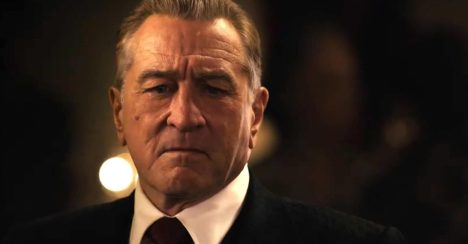
The end is DeNiro.

The audience really feels the passage of time in The Irishman. It is revealing that Frank’s most prized possession appears to be his watch. The watch itself changes as Frank’s situation does, becoming more ostentatious has his stock rises, but there is always a watch on the bedside table and it is always fixed first thing every morning. Even more than the ring that signifies his acceptance into the underground criminal fraternity, Frank holds tight to that watch. It measures the seconds that make up the minutes, the minutes that make up the hours, the hours that make up a life.

It is a critical cliché to praise a long film by saying that it doesn’t feel long, that the time spent watching a story unfold “flies by.” In some cases, that is true. Of this year’s hyper-extended offerings, both Avengers: Endgame and Once Upon a Time… In Hollywood move breezily enough that they never feel their length. In contrast, The Irishman does feel every minute of its three-and-a-half hour runtime. That’s part of the movie’s power. By the time that the audience has reached that conversation between Frank and his nurse, they have some small understanding of what he is saying. They have lived that life with him.
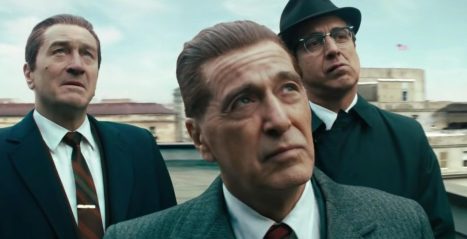
Get Hoffa his case.

Continue reading

Non-Review Review: Official Secrets

Official Secrets is an interesting story with some solid performances, but it’s also an unstructured mess.

Official Secrets unfolds against the backdrop of the lead up to (and immediate aftermath of) the invasion of Iraq. It follows GCHQ employee Katharine Gun’s decision to leak a classified internal memo in an effort to prevent the nation’s march to war. Along the way, Katherine’s story intersects with the press who bungled their efforts to hold the government to account, before evolving into something that vaguely resembles a Kafka-esque legal thriller about a woman charged with treason who cannot defend herself because to share any information with her legal team would be treason of itself.

Bringing a mic to the gun fight.

All of this should provide the solid basis for a character-driven drama. The film’s structure and content are typical of second-shelf-from-the-top awards fare; it is dealing with weighty subject matter in such a way that it also plays as a commentary on contemporary society, it is structured in such a way as to serve as a showcase for its lead performer who has a track record as an awards winner, and it treats its narrative and its characters with the solemnity that they deserve. This is quite close to something like Denial, to pick an obvious example.

Unfortunately, Official Secrets lacks to the sort of tight focus and easy self-confidence that elevates the best of these films. Official Secrets is constantly pushing itself and trying to ensure that it is holding the audience’s attention. It never feels entirely sure where the drama lies within the story, and so spreads its attention too wide and too thin. The result is a disjointed and uneven exploration of a story (and character) that deserve better.

“It’s all memo, memo, memo…”

Continue reading

Non-Review Review: Gemini Man

Gemini Man is a weird and unashamed nineties action movie throwback, for both better and worse.

This is baked into the film. The poster capitalises on the star power that drives the film. Alluding to the clone drama that drives so much of the plot, the poster to Gemini Man credits lead actor Will Smith twice above the line. In an era where the very concept of the movie star is trapped in a seemingly terminal decline, Gemini Man literally doubles down on its star branding. More than that, there is something surreal in the choice of Will Smith as that leading man, an actor whose career is largely defined by nineties hits like Enemy of the State, Men in Black or Bad Boys and whose career has floundered in recent years.

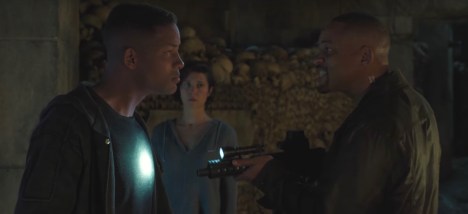
Face to Face/Off.

Gemini Man leans into this nostalgia. The film’s central hook lies in confronting Will Smith with a younger version of himself. Will Smith plays retiring assassin Henry Brogen, who finds himself hunted by a much younger version of himself. De-aged into the uncanny valley, the younger version of Will Smith consciously evokes the actor’s golden age. The film is set in 2019, but the computer-augmented action star feels lost in time; even his hairstyle and facial hair recall the actor’s appearance in The Fresh Prince of Bel Air rather than anything that might suggest a young man growing up in the twenty-first century.

While there’s a lot to unpack in the film, there’s also something disappointingly lifeless about Gemini Man. One of the film’s big action beats take place in a creepy catacomb, in what feels like an encapsulation of the film. Gemini Man never seems truly alive, instead feeling like a facsimile of another, older style of blockbuster.

Out of scope.

Continue reading

Non-Review Review: The Day Shall Come

The Day Shall Come is an ambitious piece of work that suffers from some very fundamental flaws.

Chris Morris’ long-awaited follow-up to Four Lions treads on relatively familiar ground. The narrative unfolds along two threads in parallel. The first of these focuses on Moses Al Shabazz and the Church of the Star of Six, a vaguely radical (but completely non-violent) religious organisation built around addressing historical injustice and using psychic powers to bring down construction cranes over Miami. The other narrative thread is build around the bureaucratic machinations of local law enforcement, desperate to justify the bulking up of their budget after the attacks on the World Trade Centre.

My ami.

Separately, these elements feel like they should work well enough for Morris. The opening credits promise that the film is “inspired by one hundred true stories” and the set-up is absurdist enough that it feels entirely believable. Morris’ knack has always been in articulating the heightened and surreal aspects of the modern world while grounding them in mundanity, so that even the most outlandish of concepts feels anchored in a world that is recognisable and convincing. Like all great satirists, Morris holds a mirror up to the world that he sees and produces a caricature that feels as true as an naturalist portrayal.

However, The Day Shall Come just doesn’t work. A lot of this is tonal, with one of the film’s two central story lines occasionally veering into trite sentimentality that feels completely at odds with the rest of the film and which plays as an attempt to soften Morris’ more conventional and abrasive style. The result is a film that has a few compelling elements and solid (if bleak) gags, but which often feels unjustly worried about how its audience will respond and so sands down its rough edges to make something more palatable. The problem is that the rough edges are by far the most interesting parts.

He can preach until he’s horse.

Continue reading

Non-Review Review: Joker

The most interesting parts of Joker are inevitably going to be drowned out in shout matches about the least interesting parts of Joker.

Before the film was released, it seemed to have a totemic power. Critics (especially American critics) seemed tied up in how “dangerous” this cinematic origin story of a killer clown could be. Entertainment Weekly refused to assign the film a simple letter grade. Vulture ruminated on whether mainstream audiences were ready for a film that combined the moral ambiguity and grit of seventies cinema with the trappings of superhero blockbusters. The film won the Golden Lion at the Venice Film Festival, and director Todd Phillips did his bit to stir the pot by complaining about the “far left” or “woke” culture.

All of which seems to combine to suggest that Joker is a film of the moment, to imbue the live action R-rated autumnal release about Batman’s arch enemy with a powerful cultural resonance. Joker seemed to exist as a Rorschach test, even before anybody arguing about it had actually watched a full scene of footage from it. Listening to the chatter, reading the churn of the internet, it seemed like Joker had to mean something. Even if the film refused to provide a simple meaning, that meaning would be imposed on it. Joker was to be the best and worst of the current moment. It was to be a film that spoke to the “now.”

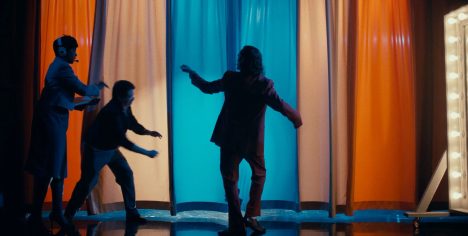
As such, it is almost a relief how stridently Joker refuses to actually say anything particularly insightful, and to trollishly chide the conversation around it for trying to force meaning upon it. In one of the film’s most absurdly on-the-nose moments, the camera passes over a demonstration outside a city opera house as protestors wave signs in the air. “We’re all clowns,” the sign proclaims. Amid the cacophony around it, how right Joker is.

Continue reading

Non-Review Review: Judy

Judy is set primarily against the backdrop of Judy Garland’s time performing in London in the late sixties within the six months leading to her death.

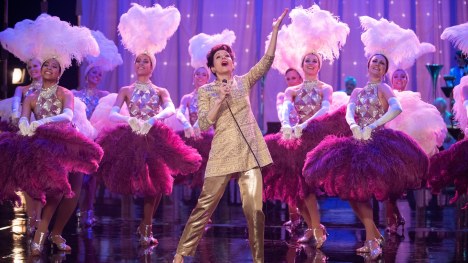
As such, it’s no surprise that the film features more than a few sequences of the protagonist taking to the stage and performing to the sold out crowds. In fact, there are very few surprises in Judy at all. The film hits most of its marks and delivers pretty much everything that is expected of it. After all, what would be the point of a Judy Garland biography that didn’t include renditions of old favourites like Somewhere Over the Rainbow or even The Trolley Song? The film’s framing device allows director Rupert Goold to fold these classics in without having to embrace the musical sensibilities of something like Rocketman.

Let’s Judge Judy.

The most revealing and indicative of the performances peppered through the film is not the one where Garland falls to pieces, nor the one where she makes a triumphant return and pours her heart out to the audience. (Naturally, the film hits both of those marks.) The most compelling of these sing-on-stage sequences is the first. Having arrived in London, Garland has refused to rehearse. As opening night approaches, she sits in her bathroom drinking. She is micromanaged and guided to the stage, thrown out in front of the first crowd. She is palpably nervous. The audience is anxious. It could all fall apart.

And it… goes okay. It isn’t the best night ever, nor the worst. Garland’s voice cracks a little even when she finds the right tempo, her movements are slightly robotic rather than spontaneous or energised. However, despite these complaints, everything holds together long enough for Judy to finish the set. The crowd gets what they paid for, and Garland delivers what she promised. It plays almost as a microcosm of Judy as a whole.

A familiar song.

Continue reading

Non-Review Review: The Laundromat

The Laundromat is as messy and awkward as it is ambitious and creative.

At the very least, The Laundromat demonstrates that director Steven Soderbergh is as playful as he has ever been. Soderbergh is fifty-six years old. He is supposedly retired. However, Soderbergh remains vital and energised. Soderbergh’s filmography is ecclectic, with projects varying wildly in terms of tone and quality. However, a willingness to experiment and to try new things remains one of the most unifying threads within his expansive filmography. While some older directors get stuck in familiar patterns and routines, Soderbergh seems pathologically anxious about the possibility of stasis.

A wealth of revelations.

This is most obvious in terms of craft, with Soderbergh often tweaking how he produces and distributes his output. Soderbergh directed the entirety of The Knick, embracing the potential of television as a storytelling medium beyond the familiarity of cinema. He has spent his retirement re-editing classic films, reflecting the ascent of “remix” culture. He shot all of Unsane on an iPhone, seizing on the potential of new technology to alter the film-making paradigm. He partnered with Netflix for the release of High Flying Bird, taking advantage of the streaming service’s deep pockets and esoteric sensibilities.

The Laundromat is not a huge leap for Soderbergh in terms of craft. Instead, it’s an ambitious film in terms of narrative. The Laundromat represents an effort on the part of the director to map the complicated and corrosive mechanisms of global capitalism through a series of sprawling and open-ended vignettes intended to sketch the outline of something far larger than any single story. It’s a familiar Soderbergh premise; the director has long been fascinated by the way in which systems and structures work – especially those built around capitalism or globalisation. It doesn’t always work, but is never less than fascinating.

Boxed in.

Continue reading

Non-Review Review: The Goldfinch

The Goldfinch is bizarre misfire, lurking somewhere within the uncanny valley of prestige awards fare.

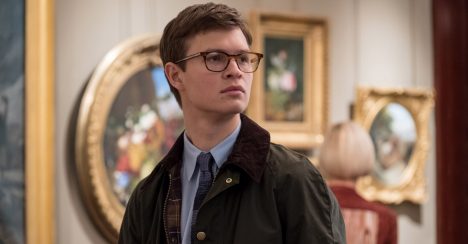
The film looks just enough like a standard end-of-year prestige piece to convince at a distance. John Crowley knows how to frame a shot and how to edit a sequence, particularly when setting it to music. The production values are impressive. The presence of actors like Jeffrey Wright or Nicole Kidman help to sell the illusion. The film itself is built around a variety of familiar awards-friendly tropes, charting the struggles of an orphan who drifts through the social strata twenty-first century American while struggling with his emotions and his drug addiction.

The Goldfinch is decidedly artless.

However, there’s also just enough wrong with The Goldfinch to push it into some weird liminal space. No three members of the cast seem to believe that they are in the same movie. The film decides to spend two hours as a reflective mood piece, before cramming a fairly generic thriller into the next twenty minutes, and wraps up by having a secondary character explain an ending that happened entirely off-screen. Large passages of the movie consist of time-lapse montages of characters staring into middle distance as overwrought monologues discuss concepts of grief and guilt.

Most of The Goldfinch is dull and lifeless, but there are moments when the film swerves wildly into surreality. Those moments aren’t necessarily good, but they are at least more interesting than the hollow prestige trappings that surround them.

I sense a laboured metaphor.

Continue reading

Non-Review Review: Rambo – Last Blood

There’s something almost disappointingly pedestrian about Rambo: Last Blood.

The sequels to Rambo: First Blood have often struggled to live up to the original film, to capture the aspects of that early eighties action drama that elevated above so many of its contemporaries. Watched today, First Blood is a surprisingly sensitive piece that exists worlds apart from the gleeful revenge fantasies of Rambo: First Blood, Part II or Rambo III. It exists a world apart from superficially similar action movies like Missing in Action or P.O.W.: The Escape, a surprisingly meditative and reflective piece of work.

Parting shots.

It isn’t really a surprise that Last Blood strips out a lot of that meditation and reflection. Even the best of the sequels – the no-nonsense Rambo, from 2008 – was relatively straightforward in its ambitions and its methods. What is disappointing about Last Blood is how mundane its own ambitions and methods really are. The bulk of Last Blood is given over to a story that feels lifted from the most crass of the spiritual descendants of the original Rambo, with the eponymous Vietnam veteran embarking on a mission into the Mexico underworld to recover his surrogate daughter.

That said, Last Blood roars to life in its final act, recapturing some of the thrills that distinguish the series from so many of its imitators and successors. There’s a pulpy absurdist thrill to the film’s final act, which tries awkwardly to combine the wry commentary of the original film with the hyper-violence of the sequels. The result is a film that averages out to somewhere around “just about fine.”

Take a bow.

Continue reading

Non-Review Review: Between Two Ferns – The Movie

Between Two Ferns: The Movie offers an abstract take on cringe comedy.

The film is an adaptation of the cult web series, which finds Zach Galifianakis planning a fictionalised version of himself. The basic set-up involves Galifianakis inviting on a particularly famous guest, and the interview coming very quickly off the rails. It often descends into awkward silence, although occasionally exchanges get a little punchier. The whole premise is a riff on the absurdity and tedium of celebrity interviews, which very rarely result in something so skin-crawlingly embarrassing, but can still feel deeply uncomfortable for both audience and participants.

At a crossroads.

The Movie wraps a framing device around that set-up, expanding the world of its fictionalised Galifianakis by offering a broader context for the viral web interviews. In the world of the film, Galifianakis is a small-town public access television host whose work has been distributed online by a cocaine-addled Will Ferrell. Ferrell has exploited this “grotesque” as a twenty-first century freak show, which has become a runaway success according to the click counters that Ferrell keeps on his office wall or even carries around in his pocket at all times.

The Movie adopts a familiar enough plot structure for this kind of adventure. It escalates the stakes while providing a framework for episodic encounters. After one particularly disastrous interview, Ferrell sets Galifianakis a challenge. If Galifianakis can land ten celebrity interviews on a road trip, Ferrell will secure his top seller a Lifetime (not life-time) chat show slot. So Galifianakis sets off on a road trip in the style of David Brent: Life on the Road, with a band of misfits sidekicks for a collection of broad comedic set pieces that run the gamut from genuinely hilarious to disappointingly repetitive.

That sinking feeling.

Continue reading