• Following Us

  • Categories

  • Check out the Archives


  • Awards & Nominations

Non-Review Review: Pressure

This film was seen as part of the Jameson Dublin International Film Festival 2015.

Trapping a bunch of people in a claustrophobic location under time pressure is really the key to instant drama.

It is a well-proven strategy that has been used so often because it works. It is a great vehicle for high-stakes tension, but also for tough interpersonal drama. If you pack people close enough together under just the right amount of strain, it is a great way to reveal and inform character. It leads to conflict, which is generally quite entertaining to watch. If you can harness that tension and that conflict, it is fairly easy to get the audience to go along with the rest of the film.

pressure1

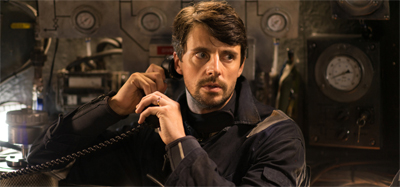
Pressure is a quintessential “bunch of people trapped in a tight space waiting to die” film. Four divers venture down to repair an oil pipeline, only for disaster to strike. The four characters find themselves trapped alone at the bottom of the ocean, with no real chance of survival. Tough decisions have to be made, and characters are thrown into conflict with one another as the air runs low and the power runs out. There are moments when Pressure really works as a claustrophobic thriller.

Unfortunately, there are just as many moments when Pressure doesn’t work. The film seems intent on pulling the audience out of the harrowing situation – whether through quick flashbacks or nightmare sequences that undercut the claustrophobic tension of the rest of the film. Despite the best efforts of the cast, the characters feel stilted and stock – spouting cliché dialogue and coming in the form of broad archetypes. The scripting is similarly haphazard, particularly in the somewhat contrived third act.
pressure

Continue reading

Non-Review Review: Shoulder the Lion

This film was seen as part of the Jameson Dublin International Film Festival 2015.

Shoulder the Lion is a visual sumptuous documentary from the creative team of Erinnisse and Patryk Rebisz.

The duo have a long history behind the scenes. Patryk is an accomplished cinematographer and Erinnisse is a veteran editor. However, barring a short film written and produced by Patryk a decade ago, Shoulder the Lion is the first time that the duo have taken complete charge of a film. The result is visually stunning. Shoulder the Lion is a documentary that divides its focus among three subjects – each dealing with a debilitating condition. However, the key is in how Shoulder the Lion attempts to relate to its subjects.

shoulderthelion2

Shoulder the Lion attempts to convey to the audience – visually and aurally – what it must be like to see the world through the perspective of its three subjects. There are any number of striking compositions and sequences in the film, as the Rebiszes invite the audience to experience even some small segment of what day-to-day life must be like for its three central individuals. As Alice Wingwall describes her deteriorating vision, the camera filters out the colours. As Fergal Sharpe describes the agony of tinnitus, a painful electronic buzz builds.

There are structural problems with Shoulder the Lion. Most obviously, the fact that it divides its attention between three subjects while devoting so much energy towards its visuals means that not all of the three central figures emerge fully-formed. Indeed, it could be argued that the film expends more time trying to replicate their disabilities than exploring their experiences beyond that. However, the result is a thought-provoking and well-constructed piece of film. It is a beautiful piece of work, if not quite as deep as it might have been.

shoulderthelion

Continue reading

Non-Review Review: Force Majeure

This film was seen as part of the Jameson Dublin International Film Festival 2015.

A blackly comic interrogation of modern masculinity, written and directed by Ruben Östlund, Force Majeure documents a family holiday that goes horribly and spectacularly wrong.

Following a nuclear family on their five-day ski holiday, Force Majeure examines the consequences of a fateful decision by the family patriarch. Dining on a restaurant on the upper levels of the resort, the family witness a controlled avalanche that quickly seems more and more uncontrolled. As a sea of white washes over the restaurant, Ebba tries to shield her children – while Tomas grabs his phone and his gloves and runs for cover, abandoning his wife and children to the elements.

forcemajeure

This sounds pretty bleak. However, Östlund shrewdly decides to play it as black comedy. He uses Tomas’ pretty spectacular failing as a jumping-off point into a number of delightfully uncomfortable sequences that manage to be both squirm-inducingly awkward and laugh-out-loud funny. For all the epic scale suggested by the movie’s one-line synopsis, Force Majeure is a rather more intimate piece of work. Two separate meltdowns over dinners with two different couples are arguably more catastrophic than any force of nature unleashed over the course of the narrative.

Force Majeure is a triumph, a stunning examination of a marriage under pressure.

forcemajeure4

Continue reading

The X-Files (Topps) #27-29 – Remote Control (Review)

This February and March, we’re taking a trip back in time to review the fourth season of The X-Files and the first season of Millennium.

In many respects, Remote Control is a very “big” story.

It is the biggest story that writer John Rozum has told to date on the comic book, one that spans three issues and seems to brush against the edge of the mythology most associated with The X-Files. Not only does Remote Control feature secret CIA experiments into psychic phenomenon, it also involves a UFO that is being transported through the United States and is hijacked by a foreign power. To top it all off, there is a super-soldier who can render himself invisible and make himself immune to bullets.

Everything is under control...

Everything is under control…

There is a very clear sense of scale to Remote Control, one that suggests this is a blockbuster adventure. This is the comic book equivalent of those mythology episodes that air during sweeps. At the same time, however, Remote Control brushes up against the limitations imposed upon the comic book by Topps and Ten Thirteen. While Remote Control offers the highest stakes that the comic book has seen since Feelings of Unreality, the script is quite clear that this is a story separate and divorced from anything happening in the show.

There are points where it feels like Remote Control goes out of its way to remind readers that this is just a tie-in comic book, and is thus secondary to the television show.

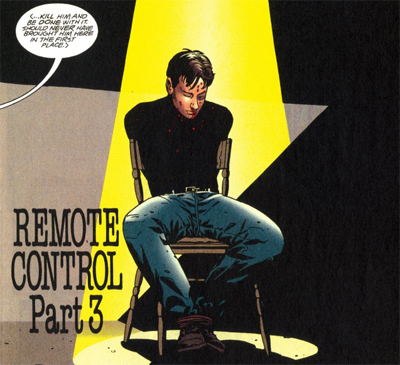
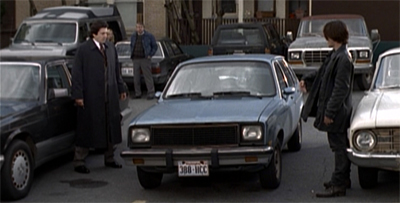
Mulder is a little tied up right now...

Mulder is a little tied up right now…

Continue reading

The X-Files – Zero Sum (Review)

This February and March, we’re taking a trip back in time to review the fourth season of The X-Files and the first season of Millennium.

For all that The X-Files exists in a murky shadow world populated by ambiguous figures and a government conspiracy dating back generations, the show has a pretty straightforward sense of morality. No good can stem from evil, the show seems to suggest; the show’s central mythology repeatedly has Mulder and Scully confront the legacy of sins committed by their forefathers. Even the title of Zero Sum alludes to the hollowness of Walter Skinner’s deal with the devil, his moral compromise that has no demonstrable benefit and severe demonstrable harm.

In Memento Mori, Walter Skinner compromised himself. He made a deal with the Cigarette-Smoking Man, in return for Agent Scully’s continued well-being. “What’ll it take?” Skinner asked, desperate for a chance to save Dana Scully. Ever ambiguous, the Cigarette-Smoking Man offered, “Well, I’ll have to get back to you on that.” Unfolding a few months later, Zero Sum is essentially about paying the piper. It is Walter Skinner settling up with the Cigarette-Smoking Man. He rolls up his sleeves and jumps into the dirty work.

Fire and brimstone...

Fire and brimstone…

Zero Sum is a story that you could not tell with Mulder. Although Mulder never faces the same choice as Skinner, the show has been quite consistent in its portrayal of Mulder’s morality. Mulder does not compromise; Mulder does not subscribe to the theory that a deal with the devil could ever pay dividends. In contrast, Skinner is a more ambiguous and pragmatic figure. Skinner spent significant sections of the second season caught between Mulder and the Cigarette-Smoking Man. The show only firmly committed him to Mulder and Scully in Paper Clip.

Zero Sum is a fantastic example of how the world of The X-Files has really grown and expanded around the lead characters. While the show will never quite develop into an ensemble, it is a series with a broad cast. It makes sense that it should begin to use them in a productive manner.

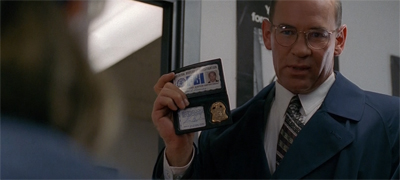
"Walter Skinner, F.B.I."

“Walter Skinner, F.B.I.”

Continue reading

Jameson Cult Film Club: Lock, Stock and Two Smoking Barrels & A Talk With Nick Moran (JDIFF 2015)

This film was seen as part of the Jameson Dublin International Film Festival 2015.

One of the biggest losses of the dissolution of the long-standing relationship between Jameson and the Dublin International Film Festival this year (aside from the fact that “J-diff” is a pretty catchy acronym) is the fact that the Jameson Cult Film Club seems unlikely to be held as part of future festivals. The Jameson Cult Film Club is a wonderfully fun and casual celebration of cult classic cinema in a rich and atmospheric environment, often accompanied with very clever theatrical flourishes.

There are quite a few events hosted each year, but it always felt appropriate that perhaps the highest profile event was staged during the eleven-day film festival, as just one example of how film seemed to take over the capitol for that week-and-a-bit of cinematic fun. Nevertheless, what might just be the final Jameson Cult Film Festival companion piece went down spectacularly well; with a screening of Guy Ritchie’s low-budget debut caper film, Lock, Stock and Two Smoking Barrels.

Jameson Cult Film Club 1

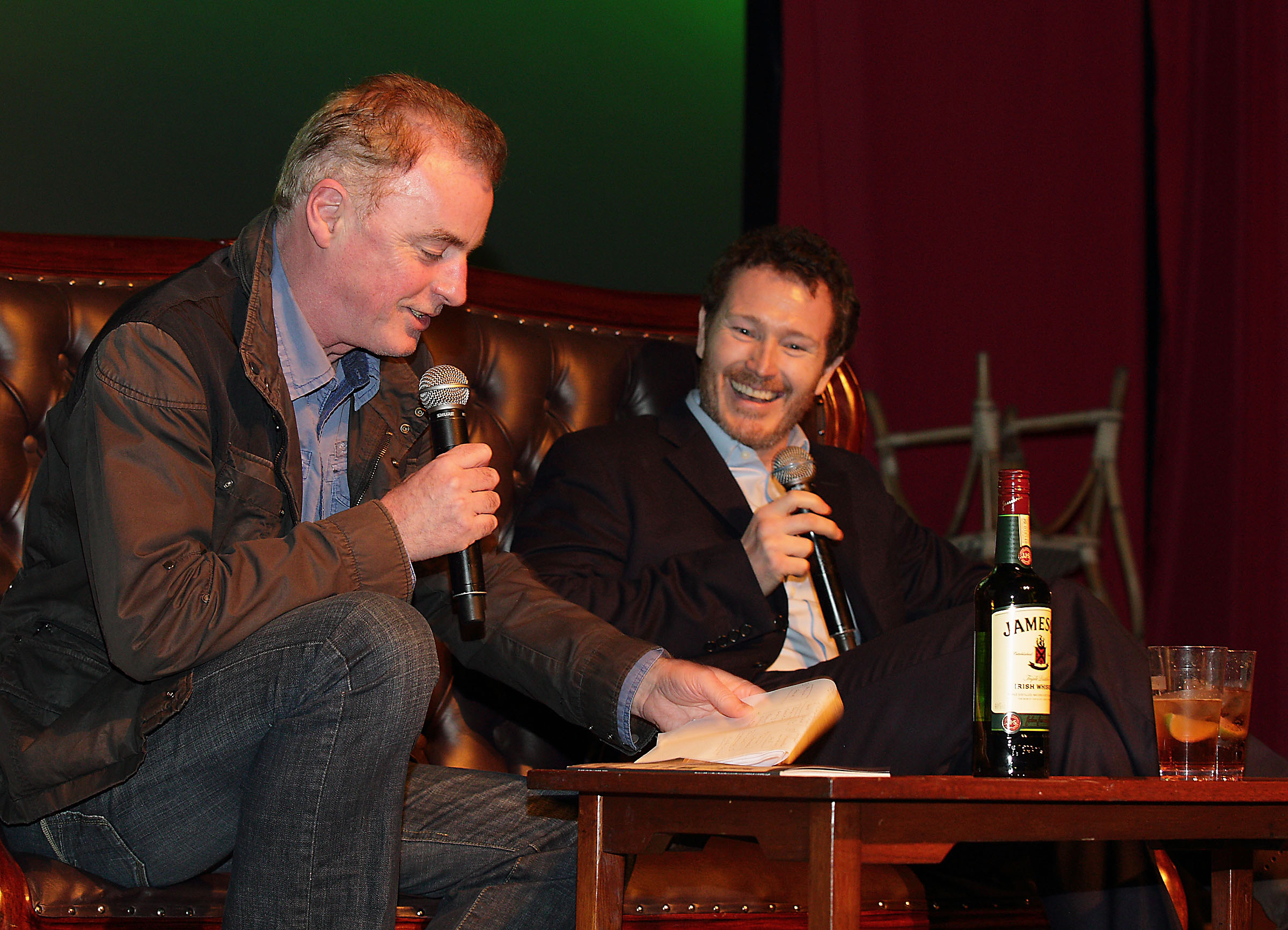
A delight for the audience – those who had seen it and those who hadn’t – the screening was accompanied by an engaging (and occasionally quite candid) interview between veteran journalist Dave Fanning and star Nick Moran. Moran – a writer and director in his own right – was on fine form, regaling the audience with stories from the production of the film, along with his own anecdotes about fame and fortune. Eager to field questions from the audience, and impressed by the thoroughness of Fanning’s research, Moran proved a natural storyteller.

Witty and self-effacing, Moran was a perfect (and sporting guest) for what turned out to be a fascinating interview.

X

Continue reading

Non-Review Review: All About Eva

This film was seen as part of the Jameson Dublin International Film Festival 2015.

All About Eva has ambition to burn.

It is a modern film noir set against the backdrop of the Irish racing scene, filmed mostly on a single stately country home and with a functional budget that seems minuscule even by the standards of independent Irish film. The fact that it exists is a testament to everybody involved. The fact that it comes very close to working is icing on the cake. All About Eva is a very stylish piece of work that very clearly has a lot of ambition behind it. It is a trashy revenge saga that is produced with a very high level of competence. In particular, director Ferdia MacAnna does great work.

However, ambition is only so much. As good as the film looks relative to its budget, there are a number of key structural flaws that cannot support the weight heaped upon them. Most obviously, All About Eva is an attempt to hark back to the classic femme fatale movies, with a seductive and manipulative young woman infiltrating a racing dynasty so as to dismantle it from the inside. All About Eva lives or dies based on that central performance. Newcomer Susan Walsh simply does not have the ability to carry the movie around her.

To be fair, Walsh is let down by an uneven and scattered script, which revels in cliché. All About Eva is a film that seems wryly aware of its own trite plot beats and dialogue, but that self-awareness can only carry a film so far. There is a point where homage is not enough to sustain a genre pastiche. All About Eva comes surprising close to working, and has an energy that is almost infectious. Unfortunately, it cannot make it over the line.

allabouteva

Continue reading

Non-Review Review: Dennis Rodman’s Big Bang in Pyongyang

This film was seen as part of the Jameson Dublin International Film Festival 2015.

Dennis Rodman’s Big Bang in Pyongyang tells a story that would seem almost too absurd or too far-fetched if it were a scripted drama. The documentary charts the former NBA star as he attempts to organise a friendly basketball game between North Korea and the United States. The idea came from Kim Jong-Un, who had struck up an unlikely friendship with Rodman during an earlier trip to the isolated dictatorship. Over December 2013 and January 2014, Rodman helped to organise the most unlikely basketball friendly in history.

dennisrodmansbigbanginpyongyang2

Continue reading

Millennium – Powers, Principalities, Thrones and Dominions (Review)

This February and March, we’re taking a trip back in time to review the fourth season of The X-Files and the first season of Millennium.

High matter thou injoinst me, O prime of men,

Sad task and hard, for how shall I relate

To human sense th’ invisible exploits

Of warring Spirits; how without remorse

The ruin of so many glorious once

And perfet while they stood; how last unfould

The secrets of another World, perhaps

Not lawful to reveal? yet for thy good

This is dispenc’t, and what surmounts the reach

Of human sense, I shall delineate so,

By lik’ning spiritual to corporal forms,

As may express them best, though what if Earth

Be but the shaddow of Heav’n, and things therein

Each to other like, more then on earth is thought?

– Raphael, Paradise Lost, Book V

This is about to get biblical...

This is about to get biblical…

Continue reading

The X-Files – Small Potatoes (Review)

This February and March, we’re taking a trip back in time to review the fourth season of The X-Files and the first season of Millennium.

Darin Morgan’s absence haunts the fourth season of The X-Files.

According to Frank Spotnitz, Darin Morgan had originally hoped to contribute a script in the middle of the season. Unfortunately, that idea fell through. The scramble to fill that gap in the schedule led to Memento Mori, which ultimately became the centre of the fourth season’s mythology arc, for better or worse. Scully’s cancer arc was just one result of the Darin-Morgan-shaped hole in the fourth season. Small Potatoes is another, the show’s first real “comedy” episode since Morgan departed the staff at the end of the third season.

A sting in the tale...

A sting in the tail…

Darin Morgan often gets credit for introducing the concept of comedy to The X-Files. That is not entirely fair; Glen Morgan and James Wong wrote Die Hand Die Verletzt shortly before Darin Morgan wrote Humbug. However, Morgan did refine the idea of comedy on The X-Files. Darin Morgan won an Emmy for writing Clyde Bruckman’s Final Repose, and he still considers Jose Chung’s “From Outer Space” to be among the best things that he has ever written.

Despite Morgan’s departure, it was clear that The X-Files could not completely avoid comedy. Once a show has demonstrated that it can do something particularly well, it becomes very difficult to stop doing that thing. Comedy episodes became something of a staple on The X-Files, with the show regularly churning out light-hearted and funny episodes (with varying degrees of success) until the show was finally cancelled after its ninth season. However, there was a long stretch after Morgan departed where the series seemed quite grim. Somebody would have to go first.

The inside, looking out...

The inside, looking out…

So Vince Gilligan stepped up to bat. Gilligan had been on staff for a bout a year at this point. He had quickly established himself as one of the most promising young writers in the room. While his first script for the show – Soft Light – was arguably more interesting than successful, Gilligan enjoyed an incredible hot streak when he joined the staff. Pusher, Unruhe and Paper Hearts are among the best scripts of the third and fourth seasons. With Small Potatoes, he seemed to position himself as the logical successor to Darin Morgan.

Darin Morgan even appears in Small Potatoes to pass the metaphorical baton.

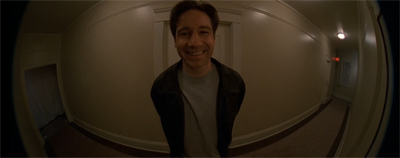
"Here's Mulder!"

“Here’s Mulder!”

Continue reading