• Following Us

  • Categories

  • Check out the Archives


  • Awards & Nominations

The X-Files (Topps) #30-31 – Surrounded (Review)

This February and March, we’re taking a trip back in time to review the fourth season of The X-Files and the first season of Millennium.

Surrounded marks the beginning of the end for Topps’ licensed X-Files tie-in comic book. There are only twelve issues remaining before Ten Thirteen would decided not to renew the contact, making this the last year for the comic. Of course, Topps would rather relentlessly milk the comic for whatever it was worth over the next year, publishing both a range of Season One adaptations and an adaptation of Kevin J. Anderson’s Ground Zero novel. They would also finally get around to releasing Stefan Petrucha and Jill Thompson’s AfterFlight graphic novel.

So there is a lot of content coming in the final year of Topps’ hold on that license. The X-Files was clearly a massive success for the newly-minted comic book wing of the company. Indeed, The X-Files was the last comic standing for Topps, and there is ample evidence that Topps was hoping to continue the line beyond The X-Files: Fight the Future, with several Season One adaptations solicited, but never published. Much like for the show itself, this was a boom time for Topps.
What's eating you?

What’s eating you?

However, the final year of the comic ultimately feels rather safe and generic. John Rozum is a competent comic writer; he understands the medium, and he knows how to play with other peoples’ toys. However, there is a sense that the comic book is really just marking time. There is very little that stands out about this last stretch of the comic; nothing which really demands to be read or to be added to the great X-Files canon. It is not bad, by any measure; it is just there.

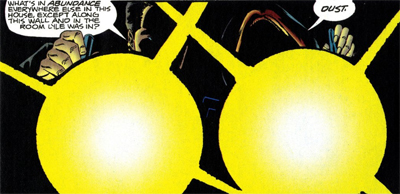
Surrounded is a prime example of the comic book marking time. It feels like a retread of familiar ground – both for the comic book and for the parent show. When Stefan Petrucha and Charles Adlard set stories like Silent Cities of the Mind or Home of the Brave in militia compounds, they were very much ahead of the television. By the time that Surrounded was published at the end of the fourth season, the show itself had already told stories about this world in episodes like The Field Where I Died, Tunguska, Terma and Unrequited.
Shining some light on the matter...

Shining some light on the matter…

Continue reading

The X-Files – Demons (Review)

This February and March, we’re taking a trip back in time to review the fourth season of The X-Files and the first season of Millennium.

The fourth season of The X-Files is an oddity.

That is particularly true when it comes to the show’s mythology. Not only has any sense of narrative progression stalled after the “to be continued…” hook of Talitha Cumi, the fourth season seems to branch the mythology out in multiple directions that never really get anywhere. Tunguska and Terma introduce a Russian conspiracy that quickly becomes a footnote. Tempus Fugit and Max focuses on private military contractors who are never mentioned again. Memento Mori gives Scully cancer halfway through the season, and the rest of the year tries to catch up.

A cigarette-smoking spectre...

A cigarette-smoking spectre…

Demons is an episode that sits rather awkwardly as the penultimate episode of the season. An episode about Mulder undergoing aggressive therapy to recover lost memories seems a little out of place with everything else going on around him. After Memento Mori, you would imagine he would be worried about Scully. After Zero Sum, you imagine he would be wary about putting himself in a vulnerable position. Demons feels very much like it would make a good first season episode, a product of the time when Samantha Mulder was our lead’s primary driving motivation.

Instead, Demons sits awkwardly before the big season finalé with its own clear agenda. Scully’s closing monologue is clearly designed to lead into Gethsemane as almost a four-part season-bridging epic. However, the execution feels a little too haphazard, a little too casual, a little too disorganised. Demons feels less like the lead-in to an earth-shattering story and more like a script designed to plug a gap late in the season.

"Hey, look on the bright side, this time next year, you'll be in a psychiatric institution."

“Hey, look on the bright side, this time next year, you’ll be in a psychiatric institution.”

Continue reading

Star Trek: Enterprise – Shockwave, Part II (Review)

Next year, Star Trek is fifty years old. We have some special stuff planned for that, but – in the meantime – we’re reviewing all of Star Trek: Enterprise this year as something of a prequel to that anniversary. This April, we’re doing the second season. Check back daily for the latest review.

Shockwave, Part I was one of the stronger episodes of the first season of Star Trek: Enterprise.

Shockwave, Part II is not one of the stronger episodes of the second season of Star Trek: Enterprise.

"Tell me how many seasons we get!"

“Tell me how many seasons we get!”

Continue reading

Millennium – Maranatha (Review)

This February and March, we’re taking a trip back in time to review the fourth season of The X-Files and the first season of Millennium.

Maranatha provides a nice close to Chip Johannessen’s four scripts for the first season of Millennium.

At its core, Maranatha is a story about stories. It is a tale about mythmaking and storytelling. It is about a monstrous man who seeks to transform himself into a creature of legend, brutally slaughtering innocent people in order to feed the idea that he is something much more than a corrupt political official. As such, the story sits quite comfortably alongside Johannessen’s other three scripts for the season, each of which is about storytelling or mythmaking in some form or another.

The power of Antichrist compels you...

The power of Antichrist compels you…

In Blood Relatives, James Dickerson attends the funerals of people he never knew, pretending to have been a part of the lives of the recently deceased; he tells stories and memories that never happened. In Force Majeure, Frank Black encounters a radical group of people who believe in the story of the end times; whether true or false, this story provides meaning to the life of the otherwise lost Dennis Hoffman. In Walkabout, Frank Black tries to piece together his recent history, constructing a narrative to account for out-of-character behaviour.

Maranatha serves as something of a culmination of this approach to Millennium. It the story of a sadist who seeks to elevate himself to the status of legend, dictating and shaping his own narrative through fear and manipulation.

"I wanna take his face... off!"

“I wanna take his face… off!”

Continue reading

The X-Files – Elegy (Review)

This February and March, we’re taking a trip back in time to review the fourth season of The X-Files and the first season of Millennium.

The first two-thirds of Elegy count as the best episode of The X-Files that John Shiban has written at this point of his tenure on the writing staff. Elegy starts out as an episode that leans into Shiban’s strengths. It is a very traditional and old-fashioned horror story, the first tried-and-tested ghost story that The X-Files has told in a while. The idea of a haunted bowling alley is so wonderfully weird and so quintessentially American that it fits The X-Files perfectly. For its first thirty minutes, Elegy is funereal and sombre, haunting and enchanting.

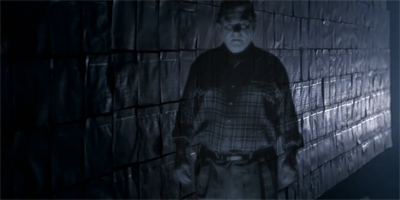
Elegy is a story packed with potentially interesting concepts. It is overflowing with clever ideas and memorable images. Shiban is a writer who has a great deal of affection for classic horror, and that affection shines through into Elegy. There is a slow and sorrowful atmosphere to the early stretches of the episode. Transparent grey spectres are a staple of the horror genre, but they work very well in this context. The X-Files has been quite reluctant to handle traditional monsters, so there is something rather strange and affecting about seeing such a classic depiction here.

Here there be ghosts...

Here there be ghosts…

Then things go to hell. To be fair, the problems with the last fifteen of Elegy are very much suggested from the start; they are just pushed to the fore. It becomes quite clear that Elegy has no idea how to resolve a “haunted bowling alley” story, so the script hastily and clumsily transitions to an “abusive care home” plot. The first two thirds of Elegy are not that interested in the character of Harold Spuller beyond his use as a plot device; a fact that becomes quite apparent in how the final third callously disposes of him.

Elegy is an episode that brushes against greatness. Its best ideas rank with the highlights of the fourth season. Unfortunately, all of that is undercut by a truly terrible final act.

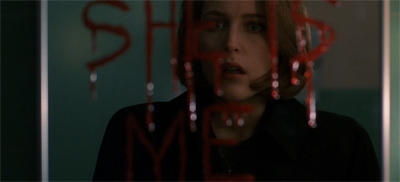
Blood on the mirror...

Blood on the mirror…

Continue reading

Millennium – Broken World (Review)

This February and March, we’re taking a trip back in time to review the fourth season of The X-Files and the first season of Millennium.

On paper, there is a lot to like about Broken World.

In theory, it is Robert Moresco building off the success of Covenant, developing another story that works within the framework of Millennium without adhering to the formulaic “serial-killer-of-the-week” approach. As in Covenant, Frank Black is wandering the country to do good, a stranger who comes to town to fight evil. In this case, the evil takes the form of a budding young serial killer – a fiend who has not yet claimed a human life, but seems to be building towards it.

"I think he's trying to tell us something..."

“I think he’s trying to tell us something…”

In reality, Broken World is a number of great ideas suffering from terrible execution. While the story is technically quite distinct from the stock “serial-killer-of-the-week” stories that haunted the series in the middle of the series, the practical difference is minimal. Broken World is another story of sadism and brutality that inevitably feels sleazy and exploitative. While the episode could be an interesting twist on a tired structure, Willi Borgsen is just another generic psychopath like Edward Petey or Art Nesbitt.

Still, the title feels somewhat appropriate. Broken World does a lot to demonstrate how far Millennium has come in this stretch of episodes. Broken World would have felt quite comfortable sandwiched between Weeds and Loin Like a Hunting Flame. Sitting between Powers, Principalities, Thrones and Dominions and Maranatha, it feels almost like a relic.

Who's gonna ride your wild horses?

Who’s gonna ride your wild horses?

Continue reading

Non-Review Review: Boychoir

This film was seen as part of the Jameson Dublin International Film Festival 2015.

Boychoir hits just about every emotional note that you would expect it to.

Of course, it hits those notes in ways that feel incredibly contrived and emotionally manipulative. Director François Girard and writer Ben Ripley are incredibly cynical in how they choose to resonate with the audience. The script and the direction for Boychoir is advanced with an almost ruthless pragmatism, a pragmatism that is not afraid to kill of relatives to generate tragedy and which is willing to gloss over any real or tangible emotional reactions to get the film to the point that is most coldly calculated to affect the viewer.

boychoir

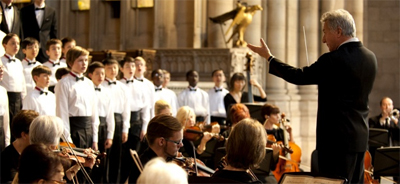
Boychoir very much goes through the motions for a film like this. It is a coming of age story set inside a highly competitive environment, juxtaposing a rather working class protagonist with those who have enjoyed privilege from a very young age. It is the story Stet Tate, a young boy who finds himself joining the National Boychoir; who quickly and inevitably discovers that his voice is a rare gift, and discovering exactly where that gift can take him and what it will teach him along the way.

Boychoir is a competent execution of a bunch of familiar tropes, albeit one that never strives for loftier goals. It is sappy and manipulative, but – given it aims to be sappy and manipulative – it is hard to treat that as a scathing criticism.

boychoir3

Continue reading

Non-Review Review: Lost River

This film was seen as part of the Jameson Dublin International Film Festival 2015.

There is a good film buried somewhere in Lost River.

Unfortunately, it is probably buried as deep as the community that give the movie its name.

lostriver5

Continue reading

Non-Review Review: The Canal

This film was seen as part of the Jameson Dublin International Film Festival 2015.

Ghosts are all around us.

As the opening scene of The Canal quite clearly states, the deceased endure long after their passing. Whether as images captured on camera or stories repeated in hushed tones, the dead haunt us. What are ghosts but the voices of history reaching out to the individual like some nightmare lodged deep in the collective unconscious? The “stone tape” theory of paranormal activity suggests that horrific events leave their mark, a blood stain that won’t wash out. What if that stain is psychological? What if ghosts are nothing but tales that echo in the darkness?

thecanal

It is not an entirely original concept, to be fair. The idea of ghosts that exist as stories (or as media) is quite an old idea. In fact, one particular jump scare in The Canal owes quite a specific debt to Ringu, the iconic Japanese horror story about a ghost trapped inside a haunted video cassette. That scene is not the only parallel; The Canal centres itself upon a man working at the National Archives who finds himself processing old footage. No sooner has he discovered the gory details of a brutal murder in his home than it seems that those same ghosts come to life.

The Canal hits a few speed bumps in its final act, but – for most of its runtime – the film is a thoroughly compelling modern day ghost story. Writer and director Ivan Kavanagh wears his cinematic homages on his sleeve, drawing quite openly from directors like Roeg or Kubrick. The Canal is an unsettling and fascinating Irish horror film.

thecanal5

Continue reading

Non-Review Review: Let Us Prey

This film was seen as part of the Jameson Dublin International Film Festival 2015.

Let Us Prey marks the feature film debut of director Brian O’Malley.

O’Malley certainly knows his stuff. Let Us Prey is visually striking and very well-directed. It is rich and memorable, perfectly capturing the eighties exploitation vibe that O’Malley is striving for. It isn’t too difficult to imagine Let Us Prey as a lost horror film from the eighties, with its synth-heavy soundtrack and vague paranormal underpinnings. O’Malley draws from a wealth of sources, but Let Us Prey feels most obviously indebted to the work of John Carpenter, feeling like a curious blend between Prince of Darkness and Assault on Precinct 13.

letusprey1

Unfortunately, O’Malley confident direction can do little to conceal the obvious flaws in a clumsy script. While Let Us Prey has an obvious affection for classic schlock-fest horror films, the script feels more than a little lazy and generic. Horror films generally trade in tastelessness or tackiness – that’s a huge part of the fun – but there is no sense of technique in how Let Us Prey parades its own depravity. The “shock” elements feel cheap and half-hearted.

O’Malley is very much a director to watch, but Let Us Prey is saddled with a script that is far more horrifying than anything O’Malley can actually put on screen.

letusprey

Continue reading