• Following Us

  • Categories

  • Check out the Archives


  • Awards & Nominations

Star Trek: Enterprise – Awakening (Review)

This May, we’re taking a look at the fourth (and final) season of Star Trek: Enterprise. Check back daily for the latest review.

9/11 forever changed the world.

In doing so, it also changed popular culture. As part of that, it also changed Star Trek. When it comes to discussing the way that the franchise was shaped and moulded by 9/11, there are a number of easy points upon which to focus. The third season of Star Trek: Enterprise quite blatantly positions itself as an allegory for those terrorist attacks, with Archer directly responding to a terror attack upon Earth and seeking to hold those responsible to account. Star Trek Into Darkness evokes those attacks both in its imagery and its conspiracy theory subtext.
Fallout warning.

Fallout warning.

However, the influence is much stronger than any of that. JJ Abrams’ Star Trek touched on the themes of trauma and loss that inform a lot of post-9/11 culture by making both Kirk and Spock survivors of horrific and unprovoked destruction. Similarly, the cosmology of Enterprise had been shaped and defined by those attacks since at least Shadows of P’Jem, reflected in the hostile and paranoid universe suggested in episodes like The SeventhCease Fire and The Crossing or the destruction of the timeline in Shockwave, Part I and Shockwave, Part II.

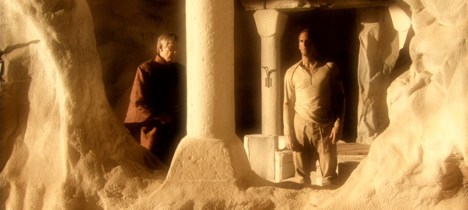
The fourth season is no less shaped by the War on Terror than the third season had been, even if that influence is less overt. The chaotic asymmetrical warfare of Storm Front, Part I and Storm Front, Part II evoke the political quagmire of foreign intervention in the twenty-first century. Home explores responses to traumas both personal and cultural. However the Kir’Shara trilogy is most overt in its War on Terror imagery, paralleling Archer’s journey into the desert following a terror attack with the looming spectre of war.
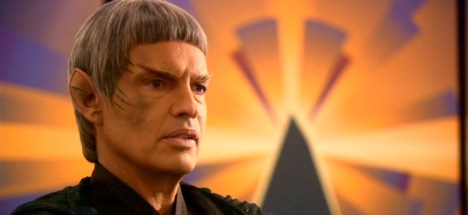
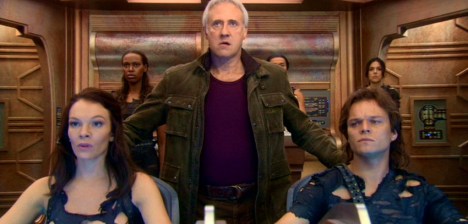
Have we reached peak Vulcan?

Have we reached peak Vulcan?

Continue reading

Star Trek: Enterprise – The Forge (Review)

This May, we’re taking a look at the fourth (and final) season of Star Trek: Enterprise. Check back daily for the latest review.

The Kir’Shara trilogy is the strongest three-parter of Star Trek: Enterprise‘s fourth season. It could legitimately be argued that the Kir’Shara trilogy is the strongest story of the entire season and one of the strongest stories of the show’s four-season run.

There are a lot of reasons why this is the case. The Kir’Shara trilogy makes great use of the franchise’s continuity and history, without getting too tied down into references for the sake of references. Indeed, there is a valid argument to be made that the trilogy represents the most overt rewriting of continuity across the fourth season, an ironic touch for a season so committed to continuity. The story does excellent work the show’s under-utilised supporting cast. The adventure actually merits three episodes, the story never dragging or wandering off on tangents.

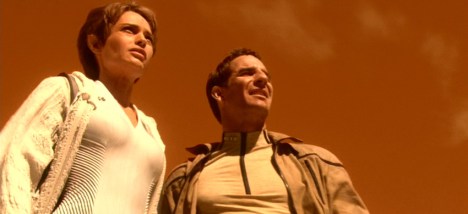
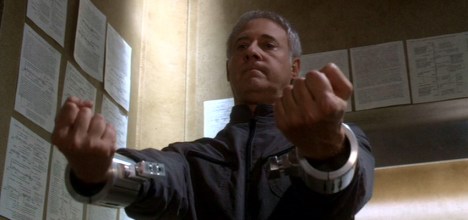
Under a not quite blood red sky...

Under a not quite blood red sky…

However, a large part of why this trilogy of episodes works better than the Borderland trilogy or the United trilogy is a simple piece of structuring. The Kir’Shara trilogy has a very clear and linear three-act structure, with each of the three episodes fitting comfortably together while doing their bit to advance and escalate the plot. There are no strange structural detours like the siege in Cold Station 12 or the visit to Andoria in The Aenar. Each of these three episodes is recognisable part of a singular larger story that builds to a crescendo.

The Forge does an excellent job setting up the arc, Awakening does an excellent job raising the stakes, and Kir’Shara does an excellent job tying it all together. The result is a satisfying two-hour television movie broadcast in three forty-minute chunks.

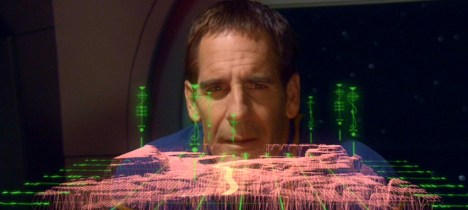
Mapping out an adventure...

Mapping out an adventure…

Continue reading

Star Trek: Enterprise – The Augments (Review)

This May, we’re taking a look at the fourth (and final) season of Star Trek: Enterprise. Check back daily for the latest review.

The fourth season of Star Trek: Enterprise is obsessed with continuity.

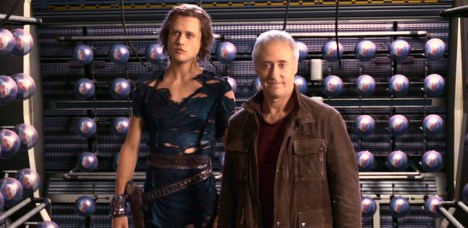
More than any other season of Star Trek, the fourth season drips with references and nods towards the franchise’s rich history. Nothing is off limits. The fourth season explains how the Klingons lost their ridges, what happened to the Defiant, how the Federation came to be, the origins of the Earth-Romulan War. It features prominent guest appearances from Brent Spiner, Jonathan Frakes and Marina Sirtis in roles explicitly tied to their part in the franchise. There are trips to Vulcan and the mirror universe, Romulus and Andoria.

Hitting rewind...

Hitting rewind…

This obsession with continuity is part of a double-edged sword. On the one hand, it arguably serves to make the show more insular and introspective at a point when the franchise was on the cusp of collapse. These references could distract from storytelling and feel like indulgence for the sake of indulgence. On the other hand, it is not as if a broader audience was watching Enterprise at this point. Pandering to the fanbase makes sense when the fans are the only ones left. More than that, if the franchise is dying, it makes sense to have its life flash before its eyes.

However, what is most striking about the nostalgia running through the final season of Enterprise is the way that it feels almost ahead of its time. In the way that fourth season looks backwards, it seems to almost be looking forwards.

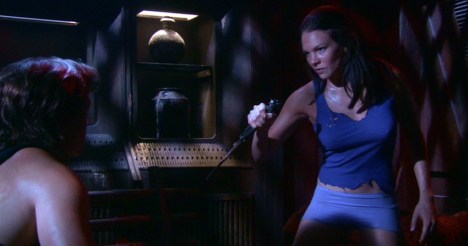
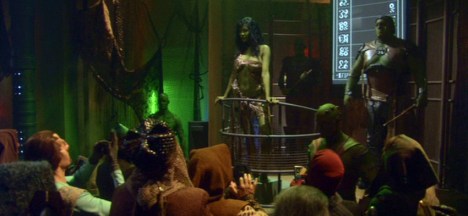
Obligatory sexy underwear fight, in case you forgot this is till airing on UPN.

Obligatory sexy underwear fight, in case you forgot this is till airing on UPN.

Continue reading

Star Trek: Enterprise – Cold Station 12 (Review)

This May, we’re taking a look at the fourth (and final) season of Star Trek: Enterprise. Check back daily for the latest review.

It seems like everybody loves Star Trek II: The Wrath of Khan. At the very least, Star Trek fans love the movie. Dearly.

The film has featured on several AFI ballots, even if it rarely placed. The film was included in The Guardian‘s 2011 “my favourite film” cycle. It placed second in a Rolling Stone readers’ poll of the best movies adapted from television series. A 2013 fan poll placed it as the best loved of all the Star Trek movies, the same poll that (ridiculously) ranked Into Darkness as the worst film in the franchise. In 2016, the film’s final conversation between Kirk and Spock topped a fandom poll of the duo’s best moments.

"The Wrath of Khan had a LOT of influence."

The Wrath of Khan had a LOT of influence.”

As such, The Wrath of Khan casts a long shadow. Four of the ten Star Trek films that followed borrow its structure and tone. Star Trek: First Contact swaps Khan for the Borg as the returning television antagonist. Star Trek: Nemesis casts Tom Hardy in the villainous role, complete with super weapon and nebula battle. Star Trek finds Eric Bana doing his best Ricardo Montalban impression. It is practically a relief (and a surprise to absolutely no one) when Benedict Cumberbatch finally announces, “My name is Khan.” At least he’s being candid.

Star Trek: Enterprise paved the way for all of this with its Borderland trilogy, which amounts to one gigantic nostalgic tribute to that second Star Trek film. Although the episodes bookending the trilogy are hardly subtle, the middle instalment of that trilogy is perhaps the most egregious example. There are points at which Cold Station 12 plays like a forty-minute deleted scene from The Wrath of Khan.

"I'm in command! And there's no Timothy Carhart to stop me now!"

“I’m in command! And there’s no Timothy Carhart to stop me now!”

Continue reading

Star Trek: Enterprise – Borderland (Review)

This May, we’re taking a look at the fourth (and final) season of Star Trek: Enterprise. Check back daily for the latest review.

Borderland establishes the format that will come to define the fourth season of Star Trek: Enterprise; the mini-arc, a single story told over two or three episodes before moving along to the next adventure.

Technically speaking, Storm Front, Part I and Storm Front, Part II established the format for the season. However, the franchise had done multi-part season premieres before. Star Trek: Deep Space Nine was particularly fond of the format, seguing from a status quo altering season finale into a multi-part season opener; The Homecoming, The Circle, The Siege, The Search, Part I, The Search, Part II, The Way of the Warrior, Image in the Sand, Shadows and Symbols. This is to say nothing of the massive six episode arc that opened the sixth season.

Put your hands together for Mister Brent Spiner.

Put your hands together for Mister Brent Spiner.

Borderland represents a departure because it signals that the fourth season of Enterprise will be comprised entirely of multi-episode stories. Historically, Star Trek shows had typically done one or two multi-part stories in a season, give or take a cliffhanger to bridge two years of the show. The fourth season of Enterprise would tell seven multi-part stories eating up seventeen episodes of the twenty-two episode season order. It was certainly a bold departure for the series and the franchise.

In fact, Borderland begins the franchise’s first three-part episode since the second season of Deep Space Nine. (Although determined fans could likely stretch logic a little to suggest that Tears of the Prophets or Zero Hour were season finales that formed a three-parter when tied into the two-part premieres that followed.) It is a curious departure, and one that immediately helps to establish the fourth season of Enterprise as something quite distinct.

A slave to continuity...

A slave to continuity…

Continue reading

Non-Review Review: Angry Birds

The Angry Birds Movie is an enjoyable animation experience.

Adapted from the famous touch-screen game, a favourite of phone users everywhere, The Angry Birds Movie has a fairly thin premise that can successfully distilled into its two-word title. Set on an island populated by flightless birds, the film follows the adventures of the series’ distinctive red character as he struggles to contain his rage and anger in a culture built around peace and harmony. The plot, such as it is, is driven by first contact between the feathered inhabitants and the mysterious green-skinned visitors from “the world of the pigs.”

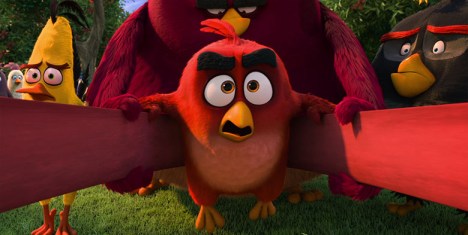
All fired up.

All fired up.

Video game adaptations can be tricky, particularly when it comes to adapting a video game that lacks a strong internal narrative. After all, very few players could claim to be emotionally invested in the skilful (and joyful) application of physics that made the original game so popular. Trying to construct a world around the stylistic affectations of a plotless video game can lead to all manner of convoluted nonsense; one need only look at Street Fighter or Super Mario Brothers to see the dangers of adapting a plotless video game.

The strength of The Angry Birds Movie is in how the films luxuriates in its plotlessness, embracing the arbitrary nature of its internal logic. The Angry Birds Movie is more concerned with being witty and energetic than in being cohesive or making sense. Given that it is a movie about cartoon birds propelling themselves like missiles towards a group of egg-snatching pigs that manages be both charming and funny, it seems like the prudent choice.

Bite-sized fun.

Bite-sized fun.

Continue reading

Scannain Podcast #72

Casino’s place in the great Scorsese pantheon – the love of (Oliver Stone’s) Nixon – pending American remakes of Irish films – the top ten – new releases, inc. Bad Neighbours 2, Evolution, Robinson Crusoe, Knight of Cups – other witty banter

Check out the podcast or click the link below!

podcast72

Podcast hosted by Scannain. Podcasting via Podbean. Archives available here. Podcast features: Niall Murphy, Philip Bagnell and Darren Mooney.

Star Trek: Enterprise – Home (Review)

This May, we’re taking a look at the fourth (and final) season of Star Trek: Enterprise. Check back daily for the latest review.

If Storm Front, Part I and Storm Front, Part II represented a transition between Brannon Braga and Manny Coto, then Home marks the point at which Manny Coto assumes full control of Star Trek: Enterprise.

As befits a season so steeped in Star Trek nostalgia, Home fits a familiar template. Each of three live action spin-offs took a brief timeout after an epic fourth season opener to tell a smaller character-driven story about the response to life-altering trauma. Jean-Luc Picard processed the trauma of The Best of Both Worlds, Part I and The Best of Both Worlds, Part II through the quieter moments of Family. Jake Sisko confronted the loss of his father in The Visitor. Even Seven of Nine faced her disconnection from the Borg Collective in The Gift.

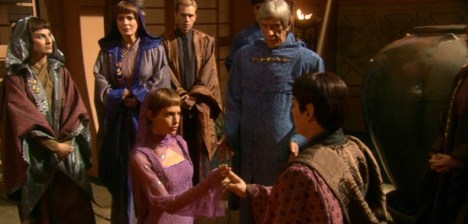
Marriage of inconvenience.

Marriage of inconvenience.

Home is clearly intended to allow the characters (and the show) to work through the issues generated by the epic third season arc, while also dutifully setting up plot threads that will play out across the rest of the season. Home might be a stand-alone episode in many ways, but it does serve to dovetail the third and fourth seasons of the show, working through character points that are hanging over from the show’s third year while also helping to establish elements that will become more important in the season ahead.

Home works rather well as a connecting structure, even if it lacks the raw emotional power of something like Family or The Visitor. It is well worth taking the time to focus upon (and flesh out) this cast. The biggest problem with Home is that so many of these characters feel underdeveloped, particularly compared to the casts of Star Trek: The Next Generation or Star Trek: Deep Space Nine. It is hard for those characters to carry an entire episode when they haven’t been properly developed.

"Go climb a rock!"

“Go climb a rock!”

Continue reading

Star Trek: Enterprise – Storm Front, Part II (Review)

This May, we’re taking a look at the fourth (and final) season of Star Trek: Enterprise. Check back daily for the latest review.

Storm Front, Part I and Storm Front, Part II arrive at a transitory time for Star Trek: Enterprise.

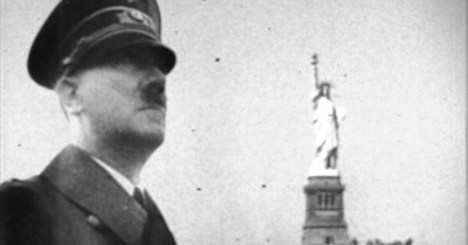
The fourth season was almost certain to be the end of the show, with Brannon Braga stepping back from the writers’ room to allow Manny Coto the chance to the take the reins. Coto would use the opportunity to more firmly connect the show to its franchise roots, constructing a final season that would serve as something of a bridge between this prequel series and the rest of the canon. However, there was just one problem. Coto inherited a cliffhanger from Zero Hour, the third season finale that stranded Archer in the past with some evil!alien!space!Nazis.

Into the sunset...

Into the sunset…

Although the fourth season of Enterprise is widely praised by the few fans who remained watching until the bitter end, Storm Front, Part I and Storm Front, Part II are often overlooked in discussions of the season. Much like These Are the Voyages… at the very end of the season, the opening two-parter is largely treated as a story foisted upon an incoming executive producer that does not reflect his own plans or desires for the season ahead. There is typically a sense of obligation to discussions of the two-parter as little more than a speed bump into the season.

This is a shame. Storm Front, Part I and Storm Front, Part II were both written by Manny Coto. Although the producer inherited the basic premise and the brief from his direct predecessors, how Coto chose to approach the material is quite insightful and informative. In that respect, Storm Front, Part I and Storm Front, Part II might be seen as an introduction to the Manny Coto era before it properly begins in Home.

"It's been a long road, gettin' from there to here... It's been a long time, but my time is finally near..."

“It’s been a long road, gettin’ from there to here…
It’s been a long time, but my time is finally near…”

Continue reading

Scannain Podcast #71

The unlikeliness of Jay being the biggest Marvel fan in the podcast – Danny Boyle as a director – new Irish Film Board funding – latest Irish release date calendar – Irish film at international film festivals – the top ten – new releases, inc. Civil War, Son of Saul, Atlantic, Demolition – other witty banter

Check out the podcast or click the link below!

podcast71

Podcast hosted by Scannain. Podcasting via Podbean. Archives available here. Podcast features: Niall Murphy, Philip Bagnell, Jason Coyle and Darren Mooney.