• Following Us

  • Categories

  • Check out the Archives


  • Awards & Nominations

Star Trek: Enterprise – Storm Front, Part I (Review)

This May, we’re taking a look at the fourth (and final) season of Star Trek: Enterprise. Check back daily for the latest review.

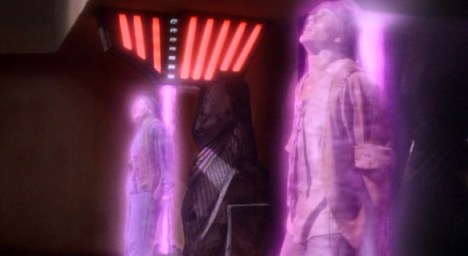
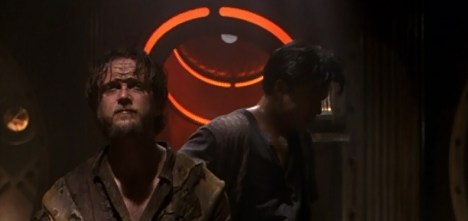
Storm Front, Part I and Storm Front, Part II arrive at a transitory time for Star Trek: Enterprise.

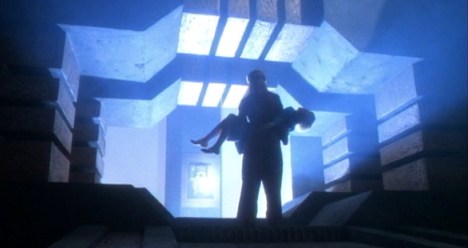
The third season of the show had wrapped on a somewhat unexpected cliffhanger, finding Archer confronted by an evil!alien!space!Nazi in the midst of what looked to be the Second World War. Given that the third season had been written as a single extended dramatic arc about Archer and his crew saving Earth from an alien threat, the twist seemed to come out of nowhere. Instead of allowing Archer and his crew to return home, Zero Hour threw out one final hurdle for the characters; a bump in the road home.

Ship shape.

Ship shape.

However, the episodes also marked a transition behind the scenes. This particular iteration of the Star Trek franchise was on borrowed time. There had been warning signs as early as the first season, but the massive reworking of the show in The Expanse suggested that the network had adopted a “do or die” approach to the future of this lucrative science-fiction franchise. The fact that the third season had its episode order cut and there were suggestions that a fourth season was unlikely suggested that the show had not “done.”

Even aside from all that, the start of the fourth season saw Rick Berman and Brannon Braga taking a step back from the franchise and handing the reins to executive producer Manny Coto. In that respect, Storm Front, Part I and Storm Front, Part II might be seen as the collective last gasp of the Berman and Braga era. Give or take These Are The Voyages…

Back to the future.

Back to the future.

Continue reading

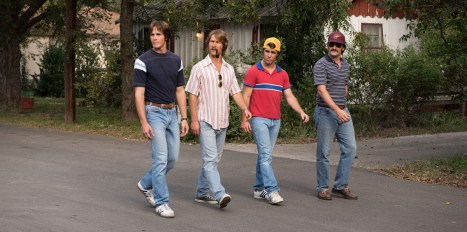
Non-Review Review: Everybody Wants Some!!

Richard Linklater is a director fascinated by the time in between.

This seems like a very obvious statement. After all, Linklater is still (relatively) fresh from a slew of nominations for Boyhood, a film that was famous for being shot with the same cast over the course of years and allowing the audience to literally watch its central character grow and develop. Many critics argued that the film was nothing more than a gimmick, a piece of performance art more than a narrative. Of course, the gimmick was largely the point of the film. Linklater is a director fascinated with the passage of time; Boyhood pushes that to the limit.

everybodywantssome

Of course, it is also interesting what Linklater does with his sense of time. Many of Linklater’s films unfold against the backdrop of a deadline. Before Sunrise, Before Sunset and Before Midnight build their deadlines into the title. Dazed and Confused follows a bunch of students on the last day of school. Everybody Wants Some!! operates with a literal countdown the ticks from the moment that Jake arrives at his college dorm to the start of his college classes. In theory, the film runs up against the clock.

However, Linklater’s deadlines tend to be arbitrary. His films are never race-to-the-finish thrillers as one might expect. Rarely are those precious few hours and minutes filled with important life-changing decisions and profound conversations. Instead, they are filled with a celebratory glimpse of the mundane, more extraordinary for their ordinariness. If anything, they feel like collective pauses; they are a deep breath before jumping back into life, a moment taken out of time, the last few hours before the clock really starts ticking.

everybodywantssome3

Continue reading

Star Trek: Voyager – Season 2 (Review)

This February and March (and a little bit of April), we’re taking a look at the 1995 to 1996 season of Star Trek, including Star Trek: Deep Space Nine and Star Trek: Voyager. Check back daily for the latest review.

The second season of Star Trek: Voyager was a disaster.

There is no other way to describe it. The second season of Voyager is a messy run populated with malformed episodes and terrible creative decisions, compounded by the sense that the production team has turned upon itself and the network is feeling more and more uncomfortable with its flagship show. The first season of Voyager had debuted at the franchise’s cultural zenith, as the cast of Star Trek: The Next Generation transitioned to the big screen with Star Trek: Generations and as Paramount chose the franchise to be the cornerstone of its new network.

voy-basicspart1w

However, there was very clearly trouble in paradise. It could be argued that Voyager was in a large part the victim of the franchise’s success. Frustration over how Paramount chose to assign the writing duties for Generations led Michael Piller to divorce himself from the franchise to develop other ideas.While UPN was very lucky to have a show like Voyager, the network consciously pushed the production team away from narrative experimentation in favour of cookie-cutter plotting.

The basic premise of “Starfleet and Maquis find themselves roughing it in the Delta Quadrant” was eroded surprisingly quickly over the course of that first year. All the Maquis crew members were in Starfleet uniforms by the start of Parallax. Any hint of conflict between the two was downplayed with a joint Starfleet and Maquis mutiny in Prime Factors. Luxury items like the holodeck were able to run in episodes like Heroes and Demons and Cathexis. A Romulan guest starred in Eye of the Needle. So the first season betrayed a lot of what made the initial idea interesting.

voy-resolutions26a

Continue reading

Star Trek: Voyager – Sacred Ground (Review)

This February and March (and a little bit of April), we’re taking a look at the 1995 to 1996 season of Star Trek, including Star Trek: Deep Space Nine and Star Trek: Voyager. Check back daily for the latest review.

Sacred Ground is a rather strange episode.

In a way, this is where the second season of Star Trek: Voyager dies. This is certainly true in a literal sense; it is the last of the four episodes held over from the end of the second season, buried between a quarter and a third of the way into the show’s third year. However, the episode also closes out some of themes that were bubbling through the first two years of the show. Michael Piller had imbued the first two seasons of the show with a new age spirituality, mostly through the character of Chakotay. Sacred Ground closes that out.

Holy plot.

Holy plot.

There is a sense that the show is uncomfortable with Sacred Ground. Although it was the first of those four carryover episodes to be produced, Sacred Ground was the last of the four to be broadcast. While the decision to air Basics, Part II at the start of the season makes logical sense, it is strange that the production team would choose to bury the episode as far into the season as possible. Of those four episodes, the production team were ready to air False Profits before Sacred Ground. That is a frightening thought.

It is understandable. Voyager‘s previous attempts at new age mysticism had not gone well, reducing Chakotay to a Native American cliché in episodes like The Cloud and Tattoo. However, it is also quite frustrating, as Sacred Ground comes closer to working than any of Piller’s earlier attempts.

Burying the consequences.

Burying the consequences.

Continue reading

Star Trek: Voyager – Remember (Review)

This February and March (and a little bit of April), we’re taking a look at the 1995 to 1996 season of Star Trek, including Star Trek: Deep Space Nine and Star Trek: Voyager. Check back daily for the latest review.

Much like The Chute before it, Remember is very much an attempt to do classic archetypal Star Trek.

Remember is an allegorical piece of social commentary that is as firmly rooted in the nineties as the prison politics that underpinned The Chute. As the name implies, Remember is a story fascinated with the idea of memory and legacy. In particular, it reflects the idea of cultural memory as construct that is shared from person to person and passed down from generation to generation. Touching on themes of Holocaust denial, Remember is a very potent piece of science-fiction allegory, one that treats cultural memory as something to be cultivated and maintained.

Whose (geno)cide are you on?

Whose (geno)cide are you on?

Remember is a good illustration of what the production team is trying to do as Star Trek: Voyager enters its third season. After a disastrous (and exhausting) sophomore year, it seems like the writing staff have opted against trying to give the show its own unique voice. Instead, the plan seems to be to craft the most archetypal approach to the franchise imaginable. From this point onwards, it becomes increasingly rare for the show to do episodes unique to its setting and premise, instead telling stories that would work with most iterations of the franchise.

This approach has its limitations, of course. By the time that the second season of Star Trek: Enterprise rolls around, even the most die-hard fans have had their fill of broadly-drawn mass-produced factory-setting Star Trek. While this approach could be argued to be a waste of an interesting premise and the betrayal of the show’s original promise, Remember makes a convincing argument that an archetypal Star Trek allegory can still work on its own terms. Remember is a powerful and effective piece of commentary in the classic Star Trek tradition.

Burning guilt...

Burning guilt…

Continue reading

Star Trek: Voyager – False Profits (Review)

This February and March (and a little bit of April), we’re taking a look at the 1995 to 1996 season of Star Trek, including Star Trek: Deep Space Nine and Star Trek: Voyager. Check back daily for the latest review.

If ever there was an argument against the importance of continuity, False Profits would appear to be it.

The Price was not a good episode of Star Trek: The Next Generation. In fact, it was quite a bad episode of television. There is a credible argument to be made that The Price was the worst episode of the third season of The Next Generation. Another contender is Ménage à Troi, another third season episode of The Next Generation that coincidentally (or not) happens to feature the Ferengi. By all accounts, The Price is an episode of television that should be forgotten about, consigned to reference books and ill-considered classic television marathons.

"Now, I know fans don't like the Ferengi episodes, but this is too much!"

“Now, I know fans don’t like the Ferengi episodes, but this is too much!”

Unfortunately, continuity intervenes. The climax of The Price ends with two Ferengi stranded in the Delta Quadrant after the Barzan wormhole collapses. In most stories, that would be the last time that those two characters appeared; they had served their dramatic purpose, demonstrating that the Barzan wormhole was effectively useless. However, once it became clear that Star Trek: Voyager was heading to the Delta Quadrant, that ending became a plot thread. It became a piece of continuity that could be employed by the production team, a storytelling opportunity.

That explains how False Profits came to be, a terrible sequel to a terrible episode that seems to exist purely to satisfy some dangling continuity.

Proxy war...

Proxy war…

Continue reading

Non-Review Review: The Silent Storm

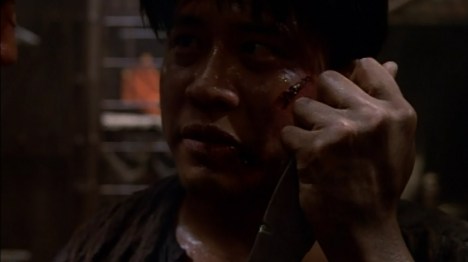
The Silent Storm is an ironic title for this over-produced melodrama.

The Silent Storm is a story about an abusive marriage and an unlikely affair that blossoms on an abandoned Scottish island when a trouble young man is assigned to the care of a fire-and-brimstone minister and the minister’s housekeeper-slash-wife. Inevitably tension mount and passions flair as the three characters dance around each other, with nothing but the craggy cliffs and choral soundtrack to keep them company. For an empty island abandoned to the forces of modernity, there’s a pretty loud choir to keep our three primary characters company.

Let us prey...

Let us prey…

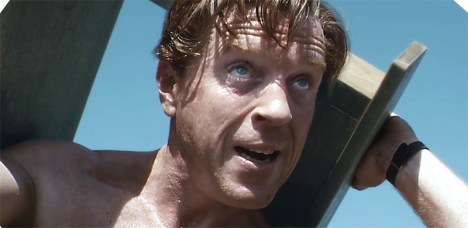
There is an appeal to this sort of dour character study. Writer and director Corinna McFarlane has cast two great actors in the lead roles of her first narrative feature; Damien Lewis and Andrea Riseborough are perfectly suited to this depressive melodrama, as a couple trapped in a repressive and abusive marriage with simmering tensions. The problem is the McFarlane never pitches the film at the right level. For a harrowing story of abuse and violence, the film frequently trips into self-parody.

Part of the fault rests with Lewis and Riseborough, who turn their performances up to eleven to match the production around them. However, a lot of the blame falls to McFarlane, who is utterly unwilling to let any moment stand on its own without pushing the theme or the mood to breaking point. The result is a film that struggles to find the right tone and so occasionally feels like a postmodern ironic deconstruction of the genre into which it is trying to fit.

Passion project...

Passion project…

Continue reading

Star Trek: Voyager – The Swarm (Review)

This February and March (and a little bit of April), we’re taking a look at the 1995 to 1996 season of Star Trek, including Star Trek: Deep Space Nine and Star Trek: Voyager. Check back daily for the latest review.

The Swarm helps to solidify the Jeri Taylor era, even as it is shuffled in among relics of Michael Piller’s tenure.

Much like The Chute before it, The Swarm has a great central premise built around the classic model of using the franchise to tell allegorical stories. The episode has a great hook and a great central performance, along with a strong sense of theme that makes it easier to relate to the whole thing. In The Chute, Kenneth Biller touched on issues of punishment and incarceration. In The Swarm, Mike Sussman tells a sweet story about caring for a loved one whose mental faculties are degrading. (This was a theme to which Sussman would return tangentially with Twilight.)

Talking to himself...

Talking to himself…

However, that strong central premise is also betrayed by several severe structural problems that hold the episode back from greatness. The Chute was a few rewrites away from greatness, its final act existing primarily to close out an hour of broadcasting rather than to tie together the preceding forty minutes of television. The Swarm grafts its emotionally compelling story of mental collapse onto a fairly generic “evil alien” narrative that somehow challenges to become the episode’s primary plot thread.

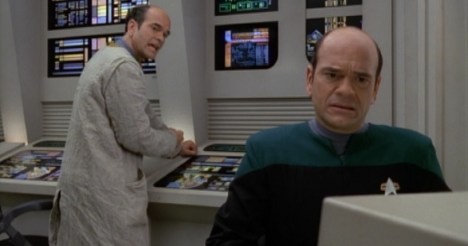
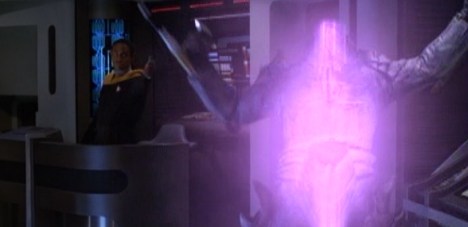
As with The Chute, there is a sense that The Swarm is codifying what will become standard practice for the series from this point forward. The biggest issue with The Swarm is the decision to undercut the episode’s emotional arc by having the series reset the EMH’s reset. In what arguably makes it the perfect example of the issues that will plague Star Trek: Voyager from here until Endgame, the show literally presses a reset button on a reset button. The Swarm is a meta-reset, if you will.

Purple haze...

Purple haze…

Continue reading

Star Trek: Voyager – The Chute (Review)

This February and March (and a little bit of April), we’re taking a look at the 1995 to 1996 season of Star Trek, including Star Trek: Deep Space Nine and Star Trek: Voyager. Check back daily for the latest review.

Season three begins. Kind of.

The Chute was the first episode produced for the third season. Basics, Part II and Flashback aired as the first two episodes of the season, but they had been produced towards the tail end of the second season and held back so that Star Trek: Voyager could launch its third season in early September. It was a smart strategy for the production team and UPN, but it did mean that there was a lot of holdover from the second season. Although the production team had wanted Basics, Part II to be the end of the Piller era, his ghost lingered on.

A breakout hit.

A breakout hit.

In some ways, the ghost of Michael Piller still haunts The Chute. The episode was produced after Piller’s departure, but writer Kenneth Biller credits the idea to the former executive producer and it feels very much in keeping with some of Piller’s pet fascinations and ideas. At the same time, The Chute does signal the beginning of the third season. It marks a point at which Voyager feels a lot more comfortable in its own skin, and where it feels like the writers have a clear grasp of what they want the show to be.

If the second season was a collection of misfiring experimental concepts and bold new directions, the third is markedly more conservative in its style and tone. The Chute is an episode of Voyager that is aiming squarely for an archetypal science-fiction allegory, and which manages to deliver on those terms. It is not necessarily ambitious or exceptional, but it manages to accomplish what it wants to do. What it wants to do is to be a very broadly-drawn (but recognisable) piece of Star Trek.

Dagger of the not-quite mind...

Dagger of the not-quite mind…

Continue reading

Scannain Podcast #70

Stanley Kubrick’s influence and outlook – the best of Richard Linklater – remakes of foreign language films – the success of Irish films in the United States – Director’s Fortnight at Cannes – a unique Irish top ten – new releases, inc. Louder than Bombs, Friend Request, Miles Ahead – other witty banter

Check out the podcast or click the link below!

podcast70

Podcast hosted by Scannain. Podcasting via Podbean. Archives available here. Podcast features: Niall Murphy, Philip Bagnell, Jason Coyle and Darren Mooney.