• Following Us

  • Categories

  • Check out the Archives


  • Awards & Nominations

Non-Review Review: The Old Man and the Gun

There’s a charming gentleness to The Old Man and the Gun, an old-fashioned charisma that reflects its octogenarian leading man.

The Old Man and the Gun has been largely branded as the last feature film to star Robert Redford. Of course, show business retirements are notoriously fickle, as Clint Eastwood has repeatedly demonstrated and will likely continue to demonstrate with The Mule. It isn’t too hard to imagine Robert Redford returning to the screen (or behind the camera) in a couple of years, his roguish grin enough to forgive the broken promise that audiences probably never wanted him to keep anyway. However, it is still impossible to escape the sense of The Old Man and the Gun as a farewell piece, a tribute sculpted in the image of its lead.
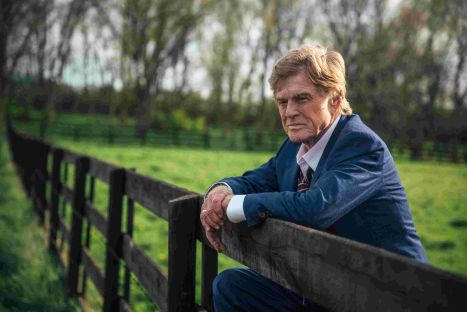
Every good thief should know a solid fence.

The Old Man and the Gun is gentle, sweet and has charm to spare. As a performer, Redford is defined by a star quality that feels increasingly old-fashioned in an era where blockbuster cinema is driven by established intellectual property and awards-season fare seems to be shaped by recognisable directors. Redford was always an actors whose central appeal lay in how hard it was to dislike him. Redford had a roguish charm that offset a more fundamental decency, a movie star who seemed like he’d have stories to tell over a nice drink, but never at anybody else’s expense.

If The Old Man and the Gun is to be Redford’s cinematic swansong, there are certainly worse ways to go.
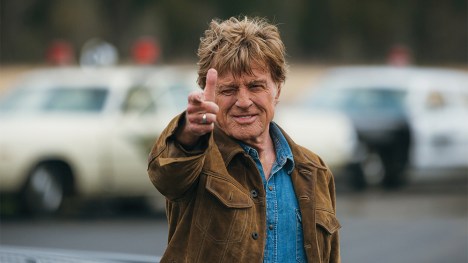
The Old Man and the Gun infamously blew its casting budget on Robert Redford, who insisted that he could play both title characters.

Continue reading

New Podcast! The X-Cast – Season 3, Episode 23 (“Wetwired”)

I’m back on The X-Cast this week, covering Wetwired with the one and only Tony Black. We took you into this season, and we can take you out of it too.

Wetwired is a curious beast. It’s an episode that a lot of people compare to Blood, but I’ve always seen it as being a lot closer to the first half of Anasazi. Which perhaps makes sense, if you consider it part of the third season finale in spirit. Wetwired is also an episode about which my opinion has shifted a great deal in recent years. I thought it was pretty fine when I reviewed it a few years ago, but – like a lot of The X-Files – it seems increasingly prescient in the modern context.

The truth is in here. You can listen to the episode here, or click the link below.

Continue reading

Non-Review Review: The Ballad of Buster Scruggs

The Ballad of Buster Scruggs is not so much a set of stories about the Old West, more a set of stories about the stories that are told about the Old West.

To be fair, the anthology film wears this premise on its sleeve. The Ballad of Buster Scruggs is by its nature an omnibus of short stories, drawing its audience’s attention to the format through the framing device of an anonymous hand leafing gently through an old hardcover book of short stories. Even within the individual stories, the Coen Brothers frequently nest smaller and more intricate narratives; whether stories shared at dinner, great works recited for an enchanted audience, or even just strangers in a stage coach making awkward conversation with one another.

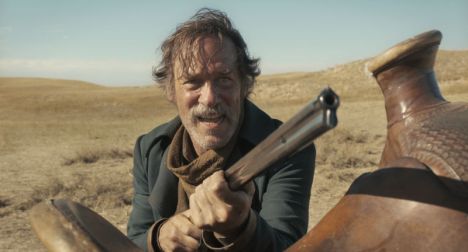
The rifle man.

In the film’s final segment, The Mortal Remains, the self-described “distractor” Thigpen explains that he distracts his quarry through stories. “People can’t get enough of them,” he assures his audience. “Because people connect the stories to themselves, I suppose. And we all love hearing about ourselves. So long as the people in the stories are us… but not us.” In its own weird way, positioned at the tail end of the narrative, Thigpen seems to offer something of a thesis statement for The Ballad of Buster Scruggs, a story about stories. In particular, a story about certain types of stories.

The Ballad of Buster Scruggs is decidedly uneven, as anthology films tend to be. That said, the quality is high enough (and the stories disparate enough) that it’s easy to imagine that each story of the six might be someone‘s favourite. The Coen Brothers very cannily and very astutely ensure a great variety in tone across the six installments, which range from gleefully nihilistic, to sombre and withdrawn, to eerie and uncanny. However, they are connected by a series of recurring preoccupations about life of the frontier and man’s awkward relationship to both that wilderness and his fellow man.

No need to make a song and dance about it.

The Ballad of Buster Scruggs is not consistent enough to rank among the Coens’ best work. While the movie maintains a consistent perspective and philosophical vantage point across its two-hour-and-ten-minute runtime, the individual stories vary so wildly in terms of aesthetic and rhythm that the film never quite coheres as well as it might. At the same time, The Ballad of Buster Scruggs contains enough delightful details in its smaller moments that linger, suggesting that the film might best be remembered as a collection of inspired moments rather than as a satisfying whole.

The Ballad of Buster Scruggs is not so much a ballad as a concept album.

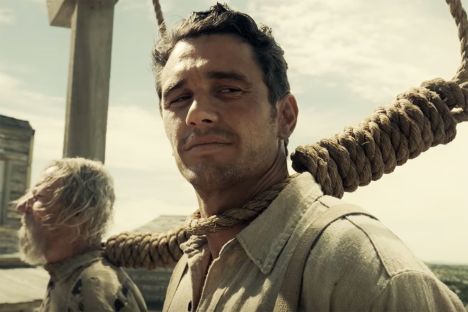
Don’t leave him hanging.

Continue reading

New Podcast! The X-Cast – Todd VanDerWerff and Zack Handlen on “Monsters of the Week”

This was fun.

I occasionally guest on The X-Cast with Tony Black, discussing The X-Files. I’ve been very proud to be part of the show’s discussion of individual episodes and also to participate in its ambitious beginning-to-end podwatch. However, this episode is particularly exciting for me, because it’s an interview that I managed to organise with critics Todd VanDerWerff and Zack Handlen on their new book Monsters of the Week.

Todd and Zack wrote about The X-Files at The A.V. Club over the past decade, and their reviews are some of the most engaging and insightful examinations of the series ever written. They were hugely influential on my own work, and are still a joy to read. Indeed, I had access to an early review copy of Monsters of the Week for the interview, and it is a joy to read.

The interview itself is broad. We cover everything from Todd and Zack’s early history with the show, through to debating its place in the television canon and even discussing a little bit about the current state of television criticism as a whole. Along the way, we discuss the show’s legacy, the challenges in approaching it in the current era, and how the Trump administration as made a surprisingly convincing case for the show’s status as an enduring television classic.

I’m very happy with the interview, and very thankful for Todd and Zack’s generosity with their time. You can check it out here, click the link below, or just play it from this post.

Doctor Who: The Tsuranga Conundrum (Review)

The Tsuranga Conundrum is a very strange episode, in large part because it is perhaps the first episode of the revived Doctor Who that feels like the product of a writers’ room.

In that, The Tsuranga Conundrum feels very much like an episode assembled to fulfill a checklist of requirements that were due before the end of the season. The primary plot is a stylish futuristic science-fiction adventure with a monster that serves as a solid mid-level threat for the primary cast. At the same time, the secondary plot exists to further the arc of one (arguably two) of the show’s credited leads in a way that is clearly positioning the character for a satisfactory resolution at the end of the year.

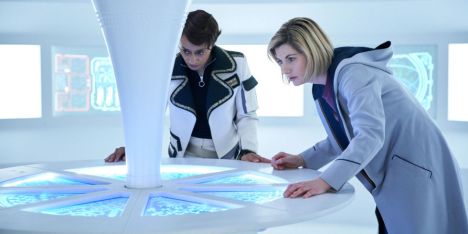
Pilot error.

The two threads in The Tsuranga Conundrum don’t necessarily gel with one another in the way that the plots of best episodes do, where several story threads all develop from the same unified idea and move in parallel, as would be more likely if a single writer had pitched and developed the episode from scratch. Instead, the various elements of The Tsuranga Conundrum seem to exist because there has to be a story like this among the ten episodes in the season order, and there wasn’t room to split the two elements into separate stories or there weren’t any other stories in which these elements might be integrated.

The Tsuranga Conundrum feels like a script that went through several passes inside a writers’ room, with each writer working on each draft emphasising a different aspect of the story to the point that whatever had originally been the central focus of the episode has been lost in the process. This would be worrying enough of itself, but The Tsuranga Conundrum is very pointedly not the product of a writers’ room. It is a script credited to a single writer, the head writer on the series. The Tsuranga Conundrum is a Chris Chibnall script that feels like it has passed through several different hands before hitting the screen.

Seeing red.

Continue reading

103. The 250 Anniversary Special 2018

Hosted by Andrew Quinn and Darren Mooney, The 250 is a (mostly) weekly trip through some of the best (and worst) movies ever made, as voted for by Internet Movie Database Users.

This week, to mark the podcast’s two-year anniversary and passing the one-hundred-episode threshold, we decided to bring back as many of the guests from the second year as possible. So, joining Andrew and Darren on this podcast are:

We thought we’d take the opportunity to have a talk about the best and worst of this list, both in general and over the past year, with particular emphasis on the changes that the IMDb made to their rankings of the worst films ever made back in July.

Continue reading

Non-Review Review: Outlaw King

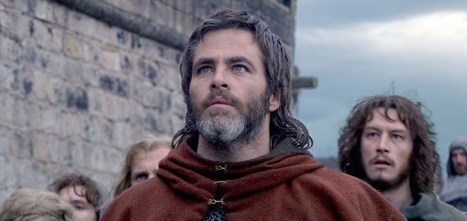
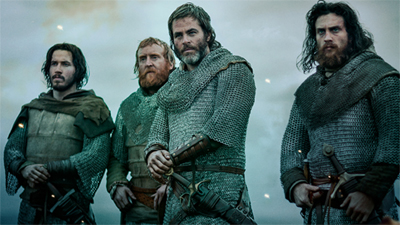
Outlaw King opens with a very impressive tracking shot, or what at least appears to be a very impressive tracking shot. The sequence lasts more than eight minutes, wherein the audience follows the action at the Scottish surrender to King Edward I. The camera follows various actors at they move through the scene, from inside the tent with King Edward I to the congress outside in the mud. The scene features an impressive sword fight, before heading back into the tent and out the other side, to the point where Kind Edward I has a massive trebuchet waiting.

The Scottish have surrendered. The revolution has failed. The lords of the region have bowed before the British Crown and sworn fealty to the throne. This gigantic instrument of war seems redundant, pointless. It has no purpose in this particular situation. Nevertheless, King Edward insists that the trebuchet be loaded, and discharged towards a prominent Scottish castle on the nearby hill. Edward explains that this is a gesture of authority, making it clear that the surrender is “final.” He adds, “Also, it took three months to build. So I don’t want to waste it.”

Great Scot!

It is an interesting introductory scene for a number of reasons. Most obviously, it is incredibly technically impressive. Director David Mackenzie is really just showing off here, demonstrating how much control he has over the film, how carefully managed the choreography is, how perfectly he can time the rhythms of the action to the movement of his camera. The introductory scene very skillfully introduces most of the major players and key dynamics that will inform the action that follows, in manner that is graceful and never overwhelming. It’s technically impressive.

At the same time, the entire sequence feels just a little bit like Edward’s gigantic trebuchet and perhaps even a little bit like the film as a whole. It is a wonderfully constructed piece of work that feels over-elaborate and over-complicated for what it is doing. Outlaw is a beautiful film underpinned by some intriguing ideas about power and violence, much like Mackenzie’s work on Hell or High Water. Unfortunately, Outlaw King lacks the warmth and humanity of Hell or High Water. Like that absurd trebuchet, it feels a little overly ornate and never entirely sure of its purpose.

A Brucie Bonus.

Continue reading

Non-Review Review: Bohemian Rhapsody

Bohemian Rhapsody is more invested in being a fairly standard music biopic than with being a slightly more specific Queen biopic.

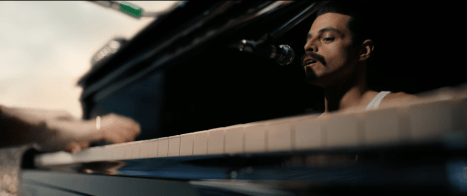
There’s a weird sense of familiarity that runs through Bohemian Rhapsody, which has nothing at all to do with its central characters and everything to do with the kind of story that it is telling. If anything, Bohemian Rhapsody will appear completely foreign and alien to dedicated fans of Queen, or anybody with even a passing knowledge of the bad’s history and discography. Instead, it will feel most comforting and familiar to the aficionados of the old tried-and-true biographical feature film formula memorably lampooned by Walk Hard.

Spotlighting its subject.

Bohemian Rhapsody repeatedly brushes up against conflicts between history as it occurred and the rhythms of that standard narrative template. In every single case, Bohemian Rhapsody chooses to side with the narrative template rather than the historical record. It is debatable whether there is anything inherently wrong with this, to be fair. This sort of film-making is an act of adaptation. It is often necessary to conflate, distort of fabricate events in order to convey an essential truth about some real-life person or character, because real life is not a narrative, despite best efforts to impose one upon it.

However, it is one thing to manipulate or distort the finer details of a narrative to hint at a deeper truth. It is another thing entirely to warp reality to fit an assembly blueprint that reveals next to nothing about any of its subjects.

A pale reflection of the man himself.

Continue reading

New Podcast! Scannain Podcast (2018) #41!

It’s time for the latest Scannain podcast!

This week, I join Jay Coyle and Ronan Doyle to discuss the week in film. As usual, we talk about the top ten and the new releases, as well as what we’ve watched this week. In this episode, Jay finally has his say on Mandy and ruminates upon disaster films old and new, while Ronan raves about Dogman and The Unbreakable Kimmy Schmidt.

The week in film news covers a bumper year for Irish nominees at the British Independent Film Awards, gives a quick shout to the Dublin Feminist Film Festival and discusses the shuttering of Filmstruck and the future of film archiving.

The top ten:

  1. La Fanciulla Del West – Met Opera 2018 (Opera)
  2. The Hate You Give
  3. Venom
  4. First Man
  5. Johnny English Strikes Again
  6. Goosebumps II: Haunted Halloween
  7. Smallfoot
  8. Halloween
  9. A Star is Born
  10. Bohemian Rhapsody

New releases:

You can download the episode here, or listen to it below.

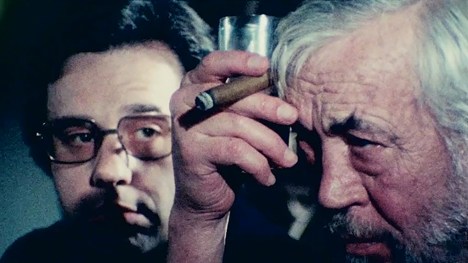
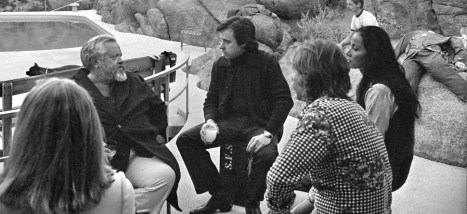
All’s Welles That Ends Welles: “The Other Side of the Wind” and a Sense of Seventies Timelessness…

There is a tendency to think of the current moment as the most important moment; call it “modernity bias.”

There is a certain egocentricism inherent in this premise, in the idea that this moment when we exist will always be the most important moment. On a purely philosophical level, there may some truth in the idea. After all, this is the one moment when we actually get to make a decision and exercise agency, this is the one moment where a course of action can be changed. Of course, people have made decisions in the past and can plan for the future, but this is the moment that exists right now. It’s understandable to think of the current moment in such terms.

Sometimes this can make it hard to engage with popular culture outside of those terms. Of course, a lot of popular culture is defined by the moment in which it was released. It would be hard to separate All the President’s Men (or even conspiracy thrillers like The Conversation or The Parallax View) from the cultural paranoia of the seventies, just as it would be hard to divorce films like Fight Club (or The Matrix) from the pre-millennial anxieties that informed them. This is not to suggest that these movies lack relevance outside their moments, but instead to acknowledge they are rooted in their times.

In most cases, works are released relatively close to the time at which they were produced, meaning that audiences and critics respond to these films in the context in which they were made. Audiences reacting to films like All The President’s Men or Fight Club were very much in step with the culture that informed it, and so there was a strong communion between what the film was saying and what the audience was hearing. Indeed, any critical reevaluation of these works exists in conversation with the original evaluation, and so the cultural conversation about these works of art tends to move forward from a fixed point.

However, this creates a challenge in assessing works that exist outside of that template. “Lost” works that have been recovered. “Incomplete” works that have been finished. Even older works that have been revisited. It is, for example very hard to separate Doug Liman’s reworked 2018 director’s cut of his 2010 film Fair Game from the context of its later release, specifically President Donald Trump’s pardoning of a key official involved in the events depicted in the film. It becomes an even bigger challenge when dealing with a work that is seeing the light of day for the first time years removed from its original context.

Is The Other Side of the Wind a lost seventies film, or is it a film for the closing of the second decade of the twenty-first century? Is it both? Is it neither? Is it something else entirely?

Continue reading