• Following Us

  • Categories

  • Check out the Archives


  • Awards & Nominations

Non-Review Review: Life Itself

Life Itself is a spectacular disaster.

There’s an incredible amount of ego on display in Life Itself, which makes a certain amount of sense. It is an auteur project from Dan Fogelman, written and directed by the guy responsible for This is Us. It is the kind of adult-centric drama that people don’t really make anymore, from the mind responsible for one of the biggest television hits of the decade. On paper, it is easy to see why there was a bidding war over Life Itself on the festival circuit, major studios tripping over one another to offer the largest cheque.

A pregnant pause.

Watching the film, of course, it is easy to see why Life Itself ended up as a cinematic footnote. It was dumped at the United States box office, dead on arrival. It limped into the United Kingdom with a simultaneous theatrical and television release on Sky One, a strategy usually reserved for enjoyable nonsense like Final Score. There is a reason for this. In Life Itself, ego gives way to indulgence. There is an incredibly and obnoxious smugness to Life Itself, the confidence of a truism scrawled clumsily on a beer mat, punctuated by several exclamation marks and underlined for emphasis.

Life Itself watches like the work of an over-eager film student motivated primarily by the profundity of their own insight, having assembled an impressive cast and offering a globetrotting story. Unfortunately, Life Itself is decidedly less fun than the best of those pseudo-profound philosophical treatises, delivered with a suffocating sense of its own self-importance.

Some significant (An)tonal issues.

Continue reading

112. Spice World (-#42)

Hosted by Andrew Quinn and Darren Mooney, and this week with Marianne Cassidy and Grace Duffy, The Bottom 100 is a subset of the weekly The 250 podcast, a trip through some of the worst movies ever made, as voted for by Internet Movie Database Users.

This time, Bob Spiers’ Spice World.

Continue reading

Non-Review Review: Welcome to Marwen

Welcome to Marwen is a deeply weird film, and not in a good way.

The basic structure of the film is a feel good narrative of a character coming to terms with his post-traumatic stress disorder. Mark Hogancamp was beaten almost to death by a group of Neo-Nazis outside a bar, for nothing more than mentioning that he liked to wear women’s clothes. Mark has retreated into himself, creating a model village called “Marwen”, an anachronistic Belgian village from the Second World War. The town is home to a toyetic doppelgänger for Mark, the heroic “Hoogie”, who finds the courage to fight Nazis despite his losses.

The toast of the town.

The arc of the film is very obvious from that premise, with a number of other details sprinkled into the script to provide stakes and momentum. Nicol, an attractive redhead dealing with the loss of her son and a stalker ex-boyfriend, moves in across the way and connects with Mark. At the same time, the sentencing of the criminals who attacked Mark is fast approaching, and Mark needs to read his “victim impact statement” in open court. There is also a suggestion that Mark is wrestling with addiction, having to careful ration his painkillers.

All of this is fairly standard prestige picture stuff, providing Mark and the audience with a very clear journey across the film and offering a potentially hopeful conclusion to Mark’s journey. This is all very hokey, but it could work. It is a very earnest narrative, but director Robert Zemeckis is the kind of storyteller who knows how to make those sorts of narratives work. Forrest Gump is a beloved classic for a reason, no matter how clumsy and hokey it might be.

Mark his words…

However, Welcome to Marwen chooses to elaborate upon its stock upbeat triumph-over-adversity template in a number of frankly bizarre ways. Welcome to Marwen flails wildly between genres, pivoting from earnest and overwrought melodrama to absurd fantasy to lazy comedy on a dime. The issue is not that Welcome to Marwen doesn’t cohere as a film, the issue is that many of the individual scenes within the film struggle to find a consistent tone from one minute to another.

Zemeckis is a skilled enough craftsman that the film impresses on a purely technical level; the dolls tilt into the uncanny valley on occasion, but there is every indication that this is intentional. However, on a purely narrative level, Welcome to Marwen feels like it was put together by a twelve-year-old who had only read about how movies work.

Hoogie’s heroes.

Continue reading

Star Trek: Voyager – Nightingale (Review)

During the production of the third season of Star Trek: The Next Generation, producer Michael Piller laid down a template for Star Trek storytelling that became a large (and underrated) part of the series’ successful. Following on from the unfocused and clumsy first two seasons, Piller advocated from a strong character-driven storytelling sensibility, advocating for a narrative structure whereby each episode would reveal or inform something interesting about a given character, quite apart from any phenomenon of the week or interesting alien species.

It was a template that was so sturdy that Piller himself could open the season by applying it to Wesley Crusher in Evolution. Ronald D. Moore was perhaps the first writer to really understand the appeal of the structure, applying it to Worf in The Bonding and Sins of the Father. Even when episodes weren’t about the main characters, they still offered some insight. Tin Man, Déjà Q and The Defector were both episodes focused on a guest star, but that guest star was largely seen through Data’s eyes.
Captain Kim.

There were stories that didn’t adhere to this template. Often, like in Hollow Pursuits and Yesterday’s Enterprise, they focused on a guest star rather than the leads. However, these episodes were the exception that proved the rule. Even the less successful episodes of the season, like A Matter of Perspective or Ménage à Troi were still elevated above the troubled first and second seasons by this attention to character-driven storytelling. Piller set a template that lasted for the next four seasons, and beyond.

In the middle seasons of Star Trek: Voyager, there was a tension between this template and the demands of contemporary television. The writing staff on Voyager understood the basic rhythms and structure of the template that Piller established, and kept applying it after his departure following Basics, Part I and Basics, Part II. Stories like Nemesis and Timeless found a way to apply that template to even neglected characters like Chakotay and Kim. The only issue was that the template felt increasingly outdated.
He’s (Nee)lixed.

Modern television was moving on. The X-Files and Babylon 5 were embracing sprawling epic television storytelling. Television series like The Sopranos and Oz were adopting a more novelistic approach to the medium. Even Star Trek: Deep Space Nine was consciously moving away from self-contained episodes in favour of longer-form storytelling, most notably the six-parter that ran from A Time to Stand through to Sacrifice of Angels. There was a sense that, even applied skillfully and correctly, the Piller template reflected an older mode of television storytelling.

One of the big issues with the seventh season of Voyager is a palpable feeling that even this foundational block of Star Trek storytelling dating back to The Next Generation has begun to erode. The seventh season of Voyager is packed with stories that look and feel loosely that familiar Piller template, broad narratives focusing on individual characters and big ideas wherein the characters develop or discover something about themselves. However, these episodes also tend to look like they were constructed from a faded photocopy of that classic blueprint.
In-tractor-able.

This is reflected in the broad “Star-Trek-iness” of stories like Drive or Critical Care, episodes that gesture toward social commentary while working hard to avoid actually saying anything potentially engaging. It is also reflected in character-driven episodes like Imperfection or Body and Soul, which superficially resemble the template that Piller laid out for telling a good self-contained Star Trek story, but failing to connect all of the pieces in a way that makes any real sense.

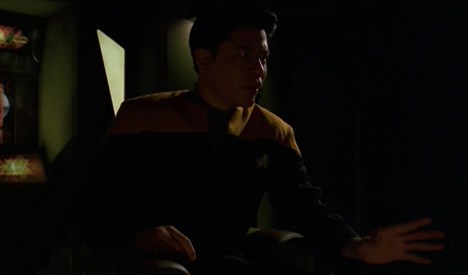
Nightingale is perhaps the season’s best example of this, for so many reasons. It is the last Voyager episode to focus on the character of Harry Kim, but returns to what has been his standard character arc since Demon. It has a strong central throughline about the importance of taking command, and the responsibilities of being in authority, but it also never allows these elements to cohere into a strong central thesis. It contains stock Star Trek elements like an alien war and the challenge of non-interference, but doesn’t do anything with them. It is simply a mess.

Continue reading

Online Film Critics’ Society Awards, 2018

Christmas is over, but awards season keep right on truckin’.

I’m a member of a couple of critics’ organisations, so we’ve been releasing a couple of these lists upon which I voted. I’ve also released my own top ten as part of a Scannain end-of-year podcast.

In the meantime, the Online Film Critics’ Society have released their end of year awards. Thrilled to be a part of the group, who are voting on films released internationally during the calendar year of 2018. As such, it will be a different pool of films than the Dublin Film Critics Circle awards.

Anyway, without further ado…

Continue reading

Doctor Who: Resolution (Review)

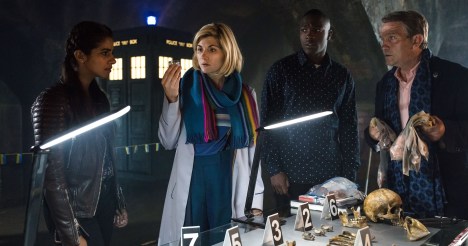
Despite being positioned as a New Year’s Special and being the only episode of Doctor Who broadcast in 2019, Resolution functions as a season finale to the eleventh season.

This is both a good thing and a bad thing. In terms of working relatively well, Resolution helps to compensate for the damp squib that was The Battle of Ranskoor Av Kolos. It provides a sense of spectacle and threat that was sorely lacking from the last episode of the broadcast season. It also wraps up a number of thematic threads from the season and even provides a much more effective bookend to The Woman Who Fell to Earth than simply bringing back an underwhelming antagonist.

Calling the Dalek out.

However, there are also problems. Most obviously, the fact that Resolution functions as a slightly-delayed series finale makes The Battle of Ranskoor Av Kolos seem even more pointless. There was no need for The Battle of Ranskoor Av Kolos to serve as such a half-assed bookend to The Woman Who Fell to Earth, given Resolution would do a much better job. The storytelling real estate in The Battle of Ranskoor Av Kolos could easily have been given over to literally anything but the episode that was broadcast. That’s deeply frustrating.

There is another issue as well. Writing a New Year’s Special that also serves as a season finale is a risky move. The End of Time, Part II attempted this, and struggled to find the right balance, mostly be eschewing the holiday elements in favour of providing closure with the larger Davies Era as a whole. Resolution tries to strike a more effective balance between being an epic season finale and an episode that can be watched by the whole family after gorging on a massive dinner. This creates an internal tension that Resolution never quite resolves.

Digging deep.

Continue reading