• Following Us

  • Categories

  • Check out the Archives


  • Awards & Nominations

Star Trek: Voyager – Bliss (Review)

Bliss is a textbook example of Star Trek: Voyager doing textbook Star Trek.

The episode feels like a stew composed primarily of leftovers, the residue of past meals thrown together to serve up something lukewarm and familiar. Bliss is not necessarily a bad episode of television, per se. It is rather lifeless and generic, but it is hardly the weakest episode of the season or the series. Instead, Bliss is the kind of episode that fades gently from memory, a hollow confection that doesn’t taste particularly nice, but which at least offers something to chew over.
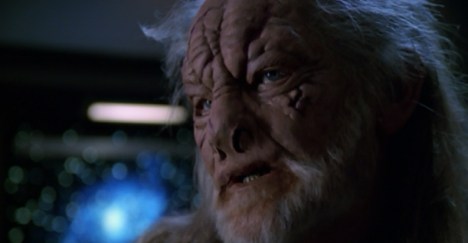
Good Sheppard.

Bliss is a cocktail of familiar Star Trek plot elements. At the centre of the story is the sort of gigantic monstrous space entity that haunted earlier tales like The Immunity Syndrome or Datalore, a reminder of how weird and dangerous space can be. The “pitcher plant” in Bliss recalls the parasites from Operation — Annihilate! or the space vampire from The Man Trap. It feels like something almost Lovecraftian, a “beast” with tendrils that reach into the minds anybody near enough so that it might lure them to their doom. It is unfathomable to those caught within its grasp.

Qatai exists in opposition to this malign entity, caught in an immortal struggle with a force more vicious and more powerful than he could ever be. The EMH compares Qatai to Ahab, acknowledging the debt that Bliss owes to Moby Dick. Of course, the Star Trek franchise is populated with stories built upon that classic template; Obsession, The Doomsday Machine, Star Trek II: The Wrath of Khan, Star Trek: First Contact, Star Trek: Nemesis, Star Trek. It is hard to think of a more generic source of inspiration for an episode of Star Trek.
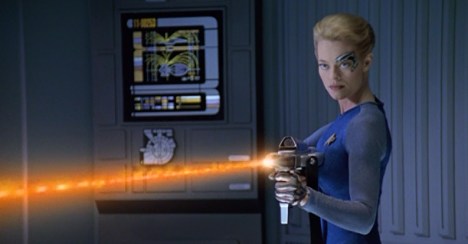
The show could use a shot in the arm.

Even beyond that, Bliss touches on plot ideas and elements that will be familiar to most Voyager viewers. As with episodes like Eye of the Needle or False Profits, the crew are tempted by a phenomenon that seems to promise the possibility of getting the crew home quickly. As in Hope and Fear and The Voyager Conspiracy, Seven of Nine becomes preoccupied with the notion that she is the only member of the crew with an objective perspective that allows her to see the truth. As with The Cloud or One, this might be deemed an “anomaly of the week” episode.

The result is something the feels very much like a representative distillation of Voyager, the statistical mean of the series derived to a decimal point. Bliss is perhaps the perfect encapsulation of Voyager as a television show. It is neither truly great or truly awful, it is merely there.
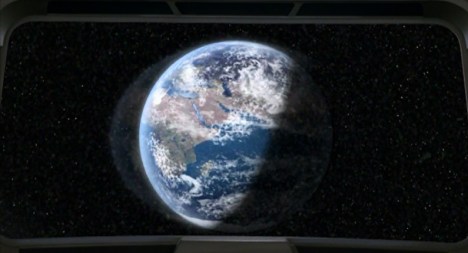
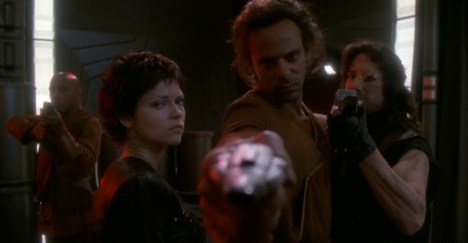
Coming down to Earth.

Continue reading

Non-Review Review: Annabelle – Creation

The issue with Annabelle: Creation is not one of skill or technique. Annabelle: Creation is a very well-crafted and well-constructed horror film. The issue is that Annabelle: Creation never quite figures out what kind of horror film it wants to be.

Annabelle: Creation struggles with tone. The movie bounces between extremes. At some points, it feels like it wants to be a genuinely dark and unsettling study of trauma and exploitation, a harrowing horror movie metaphor for some of the worst terrors that could be inflicted upon its young cast in their remote location. At other points, it is a much more conventional action horror movie, combining the blockbuster thrills approach of The Conjuring with the almost playful concept-driven self-aware scares of Lights Out.

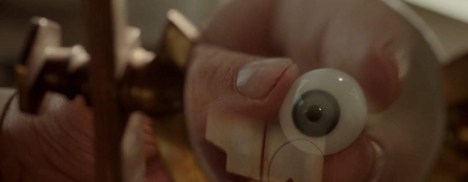
Eye, Creepy Demonic Doll.

The movie often feels caught between these two approaches, repeatedly suggesting something much darker nestled at the core of what is a fairly solid and fairly recognisable horror template. There are moments when Annabelle: Creation is skin-crawlingly effective, and there are moments when the film cleverly punctuates its scares with awkward-laugh-out-loud moments of stress relief. In isolation, David Sandberg balances both approaches quite well.

The problem comes in trying to blend them together.

“Give me a moment, I’ve got to put my face on.”

Continue reading

Star Trek: Deep Space Nine – Field of Fire (Review)

Field of Fire is an oddly nineties piece of television.

All television shows are inevitably a product of their time. This was particularly true of the twenty-odd-episode-a-season shows produced during the twentieth century, subject to the brutal churn of a weekly production schedule. The production team needed scripts, which meant that the writers needed ideas. Inevitably, those ideas were drawn from the wider culture around them. As a result, television is often an interesting lens through which culture might be examined, a projection of how a given society sees (or perhaps wishes to see) itself.

The noblest aim.

Star Trek: Enterprise was inescapably a product of the War on Terror, caught in the gravity of the attacks upon the World Trade Centre. Star Trek: Voyager was undeniably a child of the nineties, driven largely be a sense of listless anxiety in the shadow the millennium. While Star Trek: Deep Space Nine could never be entirely removed from its cultural context, it still stood apart. The writers tended to draw their themes from history, rather than from current affairs, creating a Star Trek show that seemed to exist beyond its cultural moment.

Of course, there are exceptions. Field of Fire is that most nineties of television episodes, the serial killer psychological thriller.

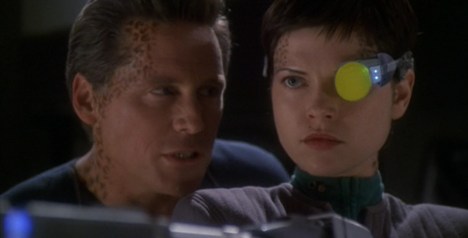
Highly illogical.

Continue reading

Non-Review Review: Atomic Blonde

Atomic Blonde is a very pretty mess.

Atomic Blonde is a stylistic showcase for director David Leitch and star Charlize Theron, a bruising and beautiful ballet of brutality with a killer soundtrack. Atomic Blonde is a film set in a funhouse mirror version of Berlin in November 1989, a movie that argues its location is more a state of mind than a physical place. The violence in Atomic Blonde is visceral, the mood tangible, the soundtrack delectable. Atomic Blonde is a feast for the senses.

Seeing red.

However, Atomic Blonde also makes next to no sense. The film is an action movie dressed in the attire of a nihilistic espionage thriller, and a little narrative confusion inevitably comes with the territory. These films are all but obligated to have twists and betrayals, macguffins and revelations, switches and levers. Atomic Blonde embraces that zany approach to plot and structure with relish. However, the problem with Atomic Blonde is more fundamental than all that. It often struggles to remain coherent from one scene to the next, from one set piece to another.

Atomic Blonde is beautiful chaos, an exploding collage that probably didn’t make any sense to begin with.

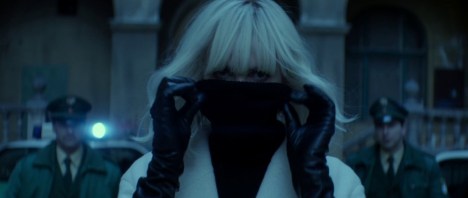
Putting her turtleneck on the line.

Continue reading

Star Trek: Deep Space Nine – The Emperor’s New Cloak (Review)

The Emperor’s New Cloak is a disaster.

To be fair, it is not a messy disaster. There is nothing particularly novel in how terrible The Emperor’s New Cloak actually is. Most of the awfulness is carried over from Through the Looking Glass and Shattered Mirror. The sharp decline in quality and merit of the mirror universe episodes since the concept’s reintroduction in Crossover has become a gentle slope. The Emperor’s New Cloak is unfunny and broadly homophobic nonsense, clumsily plotted and horribly paced. If it sets a lower bar for these mirror universe episodes, that bar is not appreciably lower.

Not quite having a blast…

The Emperor’s New Cloak is terrible in the same way that Prodigal Daughter and Field of Fire are terrible. It is as though Star Trek: Deep Space Nine has reached a point where its bad episodes are no longer surprising, simply uninspired. No audience member watching The Emperor’s New Cloak will wonder how any of these ideas made it to screen. There is none of the novelty that defined the horrors in episodes like Meridian, Let He Who Is Without Sin… or even Profit and Lace. There is just a creeping sense of fatigue.

In some ways, it makes sense that the most disappointing episodes of the seventh season should be affected by this feeling of exhaustion. The end is nigh, the production team have been working on the series for seven years. Even their bad jokes are no longer shocking, simply tired.

A dark moment for all involved.

Continue reading

39. Lagaan: Once Upon a Time in India (#249)

Hosted by Andrew Quinn and Darren Mooney, The 250 is a fortnightly trip through some of the best (and worst) movies ever made, as voted for by Internet Movie Database Users. New episodes are released every second Saturday at 6pm GMT, with the occasional bonus episode between them. This week, the pair are joined by Babu Patel and Giovanna Rampazzo, with thanks to Siraj Zaidi and The Indian Film Festival of Ireland.

This time, Ashutosh Gowariker’s Lagaan: Once Upon a Time in India.

During British rule, a small Indian village comes together to play a cricket match against the local British regiment. In a season without rain, the stakes are high. If the villagers win, they will be spared taxation for three years; if the villagers lose, they will have to pay triple tax. It is all to play for.

At time of recording, it was ranked the 249th best movie of all time on the Internet Movie Database.

Show Notes:

Star Trek: Voyager – Gravity (Review)

Gravity is a powerful story, all the more effective for its relative simplicity.

Tuvok has been one of the most overlooked and ignored regular cast members on Star Trek: Voyager. The later seasons tend to neglect Harry Kim and Chakotay, but they had been given considerable focus in the earlier years of the show. Chakotay had been a major focus in The Cloud, State of Flux, Cathexis, Initiations, Tattoo, Manoeuvres and Basics, Part I. Kim had taken centre stage in Emanations, Prime Factors, Non Sequitur and The Thaw. In contrast, Tuvok remained relatively anonymous, more of a supporting player than a narrative focal point.

Vulcan on a ledge.

In hindsight, this appears a rather strange choice. Tuvok is the first full-blooded Vulcan character to appear as a regular on a Star Trek show. Spock is easily the most iconic character in the franchise, to the point that he would be the torchbearer for the JJ Abrams reboot and his family still haunts Star Trek: Discovery. As such, having a fully Vulcan character should have led to all manner of interesting stories. After all, Tuvok was introduced in Caretaker as a spy working undercover in the Maquis. There should have been a lot of material to mine in the set-up.

However, for most of the run of Voyager, Tuvok seemed cast in a supporting role. He was the investigator in episodes where the crew were falsely accused, as Paris was in Ex Post Facto or Torres was in Random Thoughts. He was a reliable sounding board for other characters, as with Kes in Cold Fire or Neelix in Rise or Seven of Nine in The Raven. He was even effectively employed as a mind-controlled monster in episodes like Cathexis and Repression. Tellingly, most of the handful of episodes focusing on Tuvok focus on events where he is not himself; Tuvix, Riddles.

Vulcan love slave.

This is a shame, as there is a lot of fertile ground to explore within Vulcan psychology. Logic is never as clean or simple as Spock made it sound. Existence is full of logical contradictions and inconsistencies. The two best Tuvok-centric episodes of Voyager tend to focus on these inconsistencies. Meld is an episode in which Tuvok asks questions for which there can be no answer, and in which his insistence that the universe is an ordered and logical structure pushes him to some very dark places. Gravity explores the long-standing myth that Vulcans are emotionless.

Gravity is a surprisingly influential episode of Voyager, an episode that explores the implications of an idea which the larger Star Trek franchise had taken for granted for more than thirty years. It is an episode that feels unique in the larger context of Voyager, one build as much around character as action. It is story about love and repression, one rooted very much in who Tuvok is. It might just be one of the best Vulcan-centric stories in the franchise.

Tuvok lightens up.

Continue reading

Star Trek: Voyager – Bride of Chaotica! (Review)

Bride of Chaotica! is an enjoyable mess.

As its title implies, Bride of Chaotica! is a celebration of nostalgic futurism. It is a culmination of a number of themes running through the series. Most obviously, this particular brand of retrofuturism has been a recurring gag since Night at the start of the fifth season, but it fits within a broader context. From the outset, Star Trek: Voyager has been engaged with a more nostalgic sci-fi aesthetic than Star Trek: The Next Generation or Star Trek: Deep Space Nine.

Bride of evil.

Voyager‘s retrofuturism has taken various forms; the old school “space western” tone established by Caretaker, the retro sci-fi trappings of episodes like Innocence or Rise, the monster mayhem of episodes like Phage or Macrocosm, the Cold War paranoia of Cathexis or In the Flesh, Tom Paris’ nostalgic holoprograms in Lifesigns or Vis á Vis, the abductees from the early twentieth century in The 37’s. However, perhaps the most basic is baked into the concept of the show. Voyager is literally a series about the desire to return to a safer and more familiar time.

In some ways, Bride of Chaotica! cements this nostalgia in the context of the larger Star Trek canon, embracing the anxiety that has become increasingly apparent in the years since the thirtieth anniversary. After all, the surrounding feature films all literalise the pull of the past. Star Trek: First Contact has Jean-Luc Picard literally journey back to twenty-first century Earth while revisiting his most iconic moment. Star Trek: Insurrection has the crew discover the fountain of youth. Star Trek: Nemesis confronts Picard with a younger clone of himself.

Radio Chaotica!

It is perhaps telling that Voyager was the moment at which the Star Trek franchise stopped pushing forward. During and after Voyager, the franchise would become increasingly backwards-looking. Star Trek: Enterprise would invite the audience to meet James T. Kirk’s childhood era, trying to recapture that old magic. JJ Abrams’ Star Trek reboot would focus on a young version of Kirk and Spock. Star Trek: Discovery will feature a central character who is something close to Spock’s sister. There is a conscious pull of nostalgia.

Perhaps the future was better yesterday.

Never too far afield.

Continue reading

Non-Review Review: An Inconvenient Sequel – Truth to Power

An Inconvenient Sequel feels somewhat inconvenienced by factors outside of its control.

Much like An Inconvenient Truth, this documentary is very meticulously and carefully structured. It is built around the same core idea of a climate change lecture provided by Al Gore, but it also has a very linear and clear arc to it. There is a definite narrative running through An Inconvenient Sequel, which occasionally feels like a real-life thinking person’s political thriller, only with fewer shady businessmen and less immediately dramatic stakes. An Inconvenient Sequel has a story that it very clearly wants to tell, centring on Al Gore at the Paris Climate Change Conference.

However, that narrative is repeatedly interrupted. Forces beyond Gore’s reckoning creep in around the edges of the story that he wants to tell. Gore very clearly intended for this narrative to be triumphant in nature, to the point that he opens his big presentation in the middle of the film by promising the audience a happy ending. However, time and again, real life intervenes. Disruptions interrupt the flow of the story that Gore has constructed, to the point that the last ten minutes of the film feel like a bizarre postscript, as if real life were directed by M. Night Shyamalan.

It would be churlish to blame Gore for this. In fact, An Inconvenient Sequel is in many ways more interesting for these outside elements that creep into the story being told. Real life is full of complications that are unforeseen and yet inevitable. However, there is a sense that these sweeping dramatic reversals have caught Gore and the documentary off-balance, that they are struggling to properly respond, that they are not ready to veer “off script” to cope with what the world has thrown at them. The result is uncomfortable, chaotic, and surreal. And oddly compelling.

Continue reading