• Following Us

  • Categories

  • Check out the Archives


  • Awards & Nominations

Netflix and Marvel’s Luke Cage – Season 1 (Review)

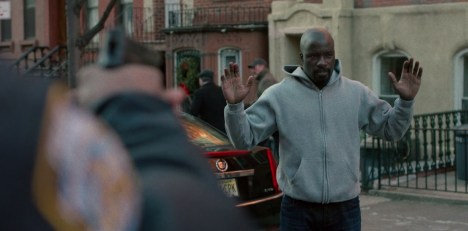
Luke Cage is an exceptional black superhero show.

Those twin concepts cannot be divorced from one another. The thrill of Luke Cage is how skilfully and how cleverly executive producer Cheo Hodari Coker interweaves those two strands. Luke Cage is not simply a story about Harlem that happens to feature superpowers, nor is just a superhero story that happens to feature African American characters. Coker carefully crafts the show that those two parts of itself become inseparable and indivisible. Luke Cage relishes its superhero storybeats, and bringing them together in service of a different kind of protagonist.
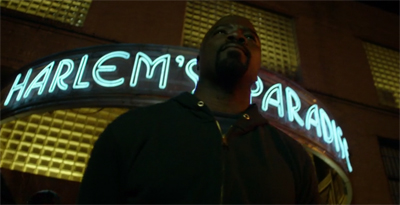
lukecage-nowyourmine29

It feels entirely appropriate that Luke Cage should be the focus of this series, the first superhero story of the franchise age to focus on a black protagonist. (There are a number of earlier examples from Blade to Catwoman to Steel, but those largely predate the current shared-universe-driven popular consciousness.) Luke Cage was the first black comic book hero to have his own on-going monthly title, and one of the earliest high-profile examples of a black superhero character not to incorporate “black” into his name, like the Black Panther or Black Lightning.

Of course, it feels shameful that it took this long. Hawkeye has somehow managed to appear in four blockbuster feature films before Marvel Studios produced a franchise film with a black lead actor. Spider-Man has been rebooted three separate times, but Black Panther will not open until 2018. Guardians of the Galaxy came out of nowhere long before Marvel Studios or Warner Brothers opened a summer tentpole superhero film with a minority or female lead. Meanwhile, Marvel has an influx of blonde white guys named Chris.
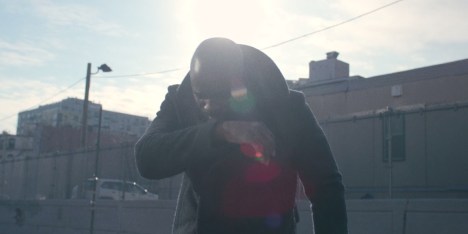
lukecage-dwyck2a

As such, Luke Cage is definitely overdue. And it keenly understands this. Every aspect of Luke Cage is filtered through an African American perspective that helps to give it a vibrance and energy that revitalises the format. In terms of plotting and structure, Luke Cage is perhaps the most traditional superhero story since Thor. However, the true beauty of the thirteen-episode miniseries lies in the improvisation around those beats and how the production team choose to hit the requisite notes. Luke Cage feels like an extended jazz album riffing on old standards.

However, as delayed as this appearance might be, it still feels perfectly attuned to the climate of late 2016. As Method Man reflects in and interview with the Sway Universe podcast in Soliloquy of Chaos, a great example of how keenly Luke Cage engages with black culture, “You know, here’s something powerful about seeing a black man that’s bulletproof, and not afraid.” That has never been more true.
lukecage-dwyck9a

Continue reading

New Podcast! The X-Cast – Season 2, Episode 1 (“Little Green Men”)

Just a quick link to a guest appearance over on The X-Cast, an X-Files podcast run by the wonderful Tony Black.

I had the privilege of guesting on the show to talk about the second season premiere, Little Green Men. Wherein we discuss the worst government surveillance agents ever, how parking charges are the real crime at the Watergate, and whether Mulder really is a “pig.” More seriously, it was an absolute pleasure to guest on the show, and Tony knows his stuff inside and out. Check it out the episode here, or click the link below.

podcast

Continue reading

Luke Cage – Moment of Truth (Review)

There is a lot to be said for how the Netflix television series choose to introduce their central characters.

The first season of Daredevil opens with the eponymous vigilante laying a brutal smackdown on Turk and breaking up a people-smuggling ring, clearly establishing the world of the show and the character’s rougher edges. The second season opened with a similar action set-piece in which the masked hero tracks a bunch of armed robbers to a downtown church leading to a suitably atmospheric image. Jessica Jones lifted its opening scene from Brian Bendis and Michael Gaydos’ Alias, with the hero smashing a deadbeat client through the glass pane on her door.

lukecage-momentoftruth

These are all sequences intended to set up the year ahead. The first season of Daredevil is preoccupied with the question of whether Matt is trying to do good or whether he is simple enabling his own baser impulses. The second season of Daredevil is much more of a traditional superhero tale with prophecies and ninja cults, along with super assassin ex-girlfriends. The broken glass in the door to Jessica’s office becomes a recurring motif across the first season of Jessica Jones, a reminder of how the character is constantly clearing up the shattered remains of her life.

In contrast, Luke Cage opts to introduce its character in a very different manner. Although Moment of Truth inevitably builds to an action set piece, that action set piece is tucked away neatly in the final minutes of the episode, feeling almost like an afterthought. Instead, Moment of Truth sets the tone for the season ahead. It opens with an extended conversation in a barbershop that covers topics from the merits of former Los Angeles Lakers (and Miami Heat) coach Pat Riley to whether Al Pacino has an “eternal ghetto pass.”

lukecage-momentoftruth1

It is a very relaxed conversation. And in many ways, Luke Cage is a very relaxed kind of show. That is in many ways the best thing that can be said about the series and the worst thing that can be said about it. Luke Cage unfolds at a pace that might be affectionately described as stately and cynically dismissed as glacial, taking its time hitting expected beats. However, the greatest strength of Luke Cage is the confidence and verve with which it hits those marks. Luke Cage is a pleasure to watch, a show charming enough that it earns enough goodwill to take its time.

Luke Cage starts as it means to go on. Charming and comfortable in itself, relaxed and confident. Despite the plotting a structural similarities that run through the season, this is a decision that immediately distinguishes itself from Daredevil and Jessica Jones. Like its lead character, Luke Cage walks tall and acts like it is bulletproof.

lukecage-momentoftruth2

Continue reading

Non-Review Review: Miss Peregrine’s Home for Peculiar Children

Miss Peregrine’s Home for Peculiar Children works best when it serves as a vehicle for Tim Burton’s imagination, exploring a world where tall tales seem to be real and monsters manifest themselves literally, where trauma and loss are explained through escape into fantasy, and where shadows distort and bend into uncanny shapes as if to suggest that there is so much more to this world than it might first appear. This is all stock Burton imagery, but the director approaches it with an endearing energy.

Unfortunately, there is more to Miss Peregrine’s Home for Peculiar Children. The film is not content to play as broad Burton fantasy of childhood mythmaking and coming of age. Despite an opening act that hints at something of a young adult follow-up to Big Fish, Miss Peregrine’s Home for Peculiar Children inevitably gets bogged down in the finer trappings of its young adult source material. Exposition is ladled on, rival orders are established, sequels are set up, familiar plot beats are not so much hit as hammered.

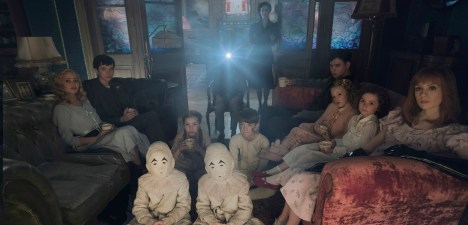
Movie night.

Movie night.

Continue reading

Star Trek: Voyager – Future’s End, Part I (Review)

In a very real way, the third season of Star Trek: Voyager begins with Future’s End, Part I and Future’s End, Part II.

After all, the episode airs directly after Sacred Ground. Although mixed into the broadcast order with a bunch of episodes that had been produced during the third season, Sacred Ground was the last episode of the second season production block to be broadcast. (Basics, Part II had been the last episode to be produced.) Sacred Ground was the last episode of Voyager to be tied to producer Michael Piller, who had been working on the franchise since the start of the third season of Star Trek: The Next Generation. There is some sense of symmetry there.

Tuvok and roll.

Tuvok and roll.

Sacred Ground feels like an appropriate place to draw a line under the first two seasons of Voyager, to suggest that the earlier incarnation of the show is finished and that a new era is beginning. After all, Sacred Ground was really the last gasp of the New Age mysticism that Michael Piller had tried to infuse into Voyager through episodes like The Cloud or Tattoo. (Piller would return to that New Age fascination with Star Trek: Insurrection.) Sacred Ground even featured something of a rebirth of Captain Kathryn Janeway.

However, if Sacred Ground represents the end of the second season, what about the start of the third season? What makes Future’s End, Part I and Future’s End, Part II such an effective new beginning?

Feels like going home.

Feels like going home.

Continue reading

Star Trek: Deep Space Nine – Trials and Tribble-ations (Review)

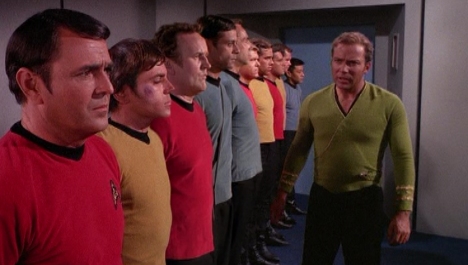
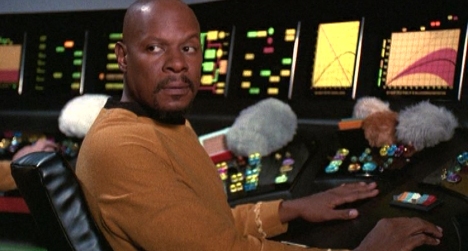
Trials and Tribble-ations is a love letter to the franchise.

The thirtieth anniversary of Star Trek was a big deal. In many ways, the thirtieth anniversary celebration marks the end of the franchise’s cultural peak. Star Trek: The Next Generation is still fresh enough in the cultural consciousness that the anniversary is a big deal, even if the ratings on Star Trek: Deep Space Nine and Star Trek: Voyager are not necessarily what everybody would want them to be. The decline that would last through to the end of Star Trek: Enterprise only really comes into play in the wake of the big anniversary.

You know when you've been Gumped.

You know when you’ve been Gumped.

The thirtieth anniversary of the franchise was an embarrassment of riches, particularly from the perspective of a rather limp fiftieth celebration. Even the disappointment of Flashback was dwarfed by the abundance of affectionate homages and triumphant celebrations of a television series that had gone from a cult failure repeating endlessly in syndication to a pop cultural juggernaut with two television series and a successful film franchise running simultaneously. Trials and Tribble-ations was very much the cornerstone of all this.

Sure, there were other celebrations to mark the franchise’s big three-oh. While Flashback might of been a bit of a disappointment as a big anniversary special, Future’s End, Part I and Future’s End, Part II were a loving ode to Star Trek IV: The Voyage Home. Indeed, Star Trek: First Contact went even further and threw Star Trek II: The Wrath of Khan into the mix, blending the franchise’s most acclaimed and most financially successful films together for the occasion. Captain Janeway even crossed paths with the cast of Frasier to mark the occasion.

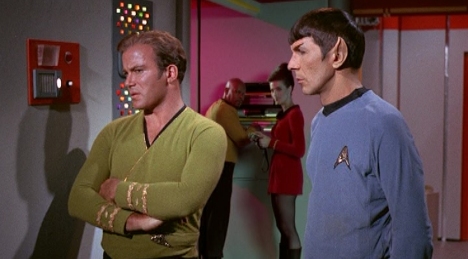
Quite the lineup.

Quite the lineup.

In spite of all of that, Trials and Tribble-ations stands quite apart from all the noise around it. There is a legitimate debate to be had about whether it is unequivocally the best of these productions, although it stands a very strong chance of winning that particular argument. However, there is no denying that it is the best celebration of the thirtieth anniversary. It is an adoring and affectionate love letter to the Star Trek franchise, one that seems to have been produced with giddy grin on its face and a skip in its step.

However, Trials and Tribble-ations works even beyond that. It is not simply a loving tribute to a monument of American popular culture, although that would be entirely justified. It is an acknowledgement to the decades of fandom that kept Star Trek alive during its occasional adventures in the wilderness.  Trials and Tribble-ations does not just praise Star Trek for surviving thirty years despite being cancelled after three seasons, but which captures the enthusiasm that sustained the series across those thirty years.

Doesn't scan.

Doesn’t scan.

It would be easy for a thirtieth anniversary special to treat the occasion as an act of cultural archeology, the careful and ritual unearthing of a popular artifact with all due reverence paid. Indeed, this was arguably the central problem with Flashback, an episode more interested in Star Trek as a memory and as a subject of nostalgia than a living breathing organism. Trials and Tribble-ations instead opts to treat Star Trek as a living and breathing organism, something tangible and material rather than abstract and ethereal.

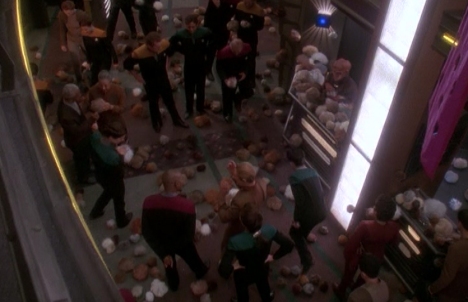
Indeed, the episode ends with the revelation that the past is not another country. Sometimes you can bring something back. Even if that thing is a tribble.

You can go home again...

You can go home again…

Continue reading

Non-Review Review: Free State of Jones

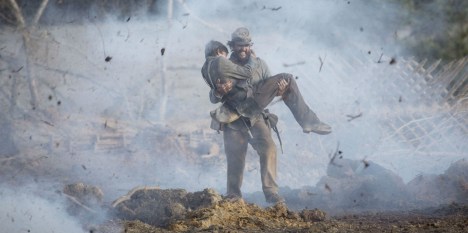
Free State of Jones does a decent job approximating the feel of a prestige picture.

Free State of Jones feels almost like writer and director Gary Ross is running through a checklist of all the elements expected from a successful prestige picture. It deals with heavy subject matter, unfolding primarily during the Civil War and touching upon Reconstruction. It is paced indulgently, never rising to more the a sitting trot. It is anchored in performance by a critically-acclaimed Oscar-winning actor who dominates the film. Its cinematography is uncomplicated and stately. It is laboured with a framing device that offers the illusion of depth.

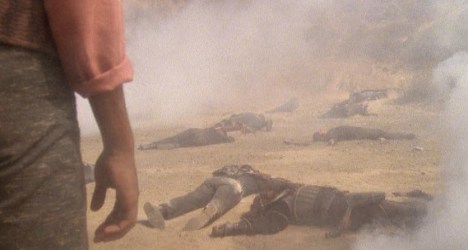
When the dust settles...

When the dust settles…

Free State of Jones plays as an imitation of a much bolder and provocative film. There are points at which the film brushes up against potentially brilliant ideas, only to back away. For a film about slavery, Free State of Jones finds itself unable to look beyond its white leading character. The framing and scene composition is clearly intended to seem dignified, but instead feels lifeless. The film’s perspective is limited, in both a literal and figurative sense. There are a lot of interesting ideas inside Free State of Jones, but none of them are allowed to grow.

There is a heavy earnestness to Free State of Jones, but it suffocates the story.

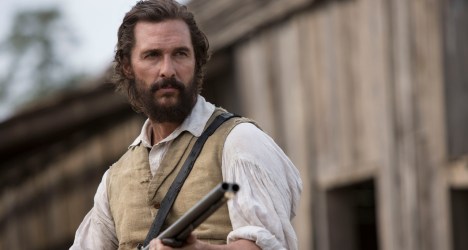
Riding shotgun on secession.

Riding shotgun on secession.

Continue reading

Star Trek: Deep Space Nine – The Assignment (Review)

The Assignment is perhaps the most conventional episode of the fifth season of Star Trek: Deep Space Nine. It is also one of the most disappointing.

The Star Trek franchise has long been fond of “possession” and “imitation” stories, dating back through Whom Gods Destroy and Turnabout Intruder to Lonely Among Us and Datalore and Power Play. It is easy to see the appeal of these stories from a production standpoint. An effective possession story can likely be filmed on standing sets and relies primarily upon an established member of the ensemble. For an actor, it provides an exciting opportunity to play against type, which is a great way to keep a weekly television series exciting.

O'Brien must suffer... through a terrible script.

O’Brien must suffer… through a terrible script.

However, it is very much a stock plot. There are only so many variations that a long-running franchise can put on the tried-and-tested formula before it begins to feel a little tired. Deep Space Nine has already had more than its fair share of “out of character” plots, from The Passenger to Dramatis Personae through to Crossover and all the other mirror universe episodes. It gets to the point where “there’s an evil alien inside Keiko O’Brien” feels like a fairly bland iteration of this particular type of Star Trek story.

In a season where Deep Space Nine spends so much time pushing the boundaries of Star Trek, it is frustrating to see the show offer up such a generic installment.

Rom is in a bit of a fix...

Rom is in a bit of a fix…

Continue reading

Sympathy for the Other: The Science-Fiction Horror Film in the Brexit/Trump Era

It’s not over. It’s just not yours any more.

– Melanie, The Girl With All the Gifts

exmachina

Note: This post contains minor spoilers for the reboot of Westworld and major spoilers for the endings of The Girl With All the Gifts and Ex Machina. Consider yourself warned. Continue reading

Star Trek: Deep Space Nine – … Nor the Battle to the Strong (Review)

“The world breaks everyone and afterward many are strong in the broken places.”

– Hemingway, A Farewell to Arms (1929)

Far a field.

Far afield.

Continue reading