• Following Us

  • Categories

  • Check out the Archives


  • Awards & Nominations

Netflix and Marvel’s Daredevil – Season 2 (Review)

This month, we’re doing daily reviews of the second season of Daredevil. Check back daily for the latest review.

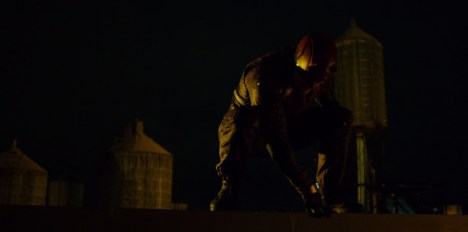
The second season of Daredevil is a dysfunctional mess.

Unfortunately, it is not a particularly interesting mess.

daredevil-380b1

Continue reading

Star Trek: Voyager – Lifesigns (Review)

This February and March, we’re taking a look at the 1995 to 1996 season of Star Trek, including Star Trek: Deep Space Nine and Star Trek: Voyager. Check back daily Tuesday through Friday for the latest review.

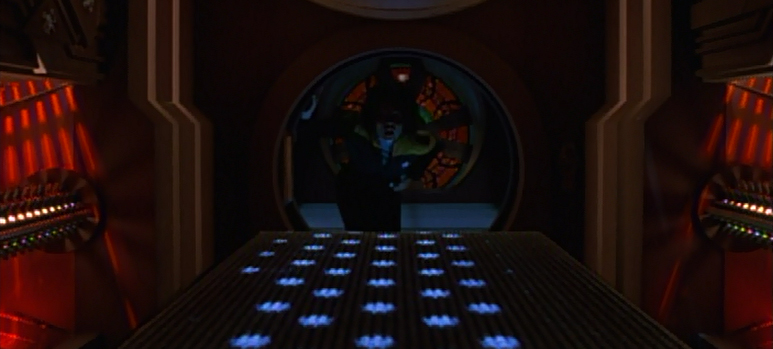
Lifesigns is a fascinating piece of television.

In hindsight, it seems a shame that the production team decided to focus on the Kazon during the first two seasons of Star Trek: Voyager. The Kazon are perhaps the most unfortunate and misguided recurring alien species to appear across the entire Star Trek franchise, never quite afforded the redemption that turned the Klingons and Ferengi from two-dimensional caricatures into fully-formed and well-realised species. The Kazon were a misguided creation in Caretaker; they remained so in Basics, Part II. Shattered offers no redemption.

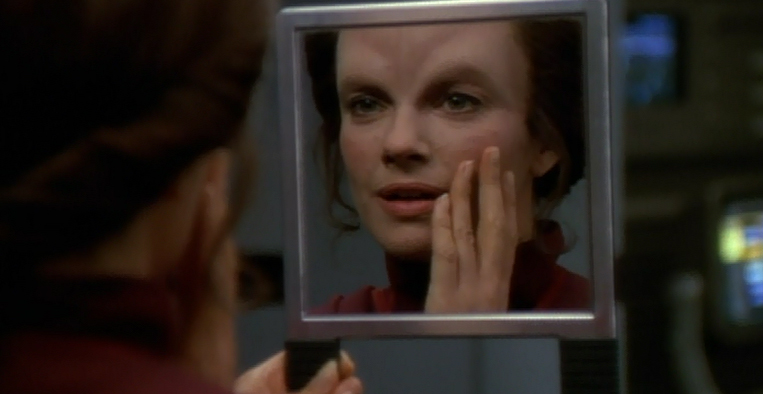
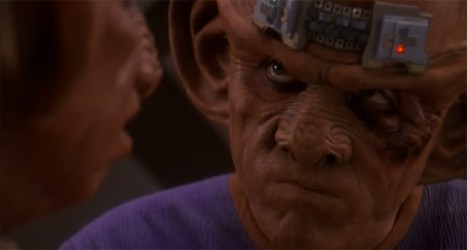
The face of the frenemy...

The face of the frenemy…

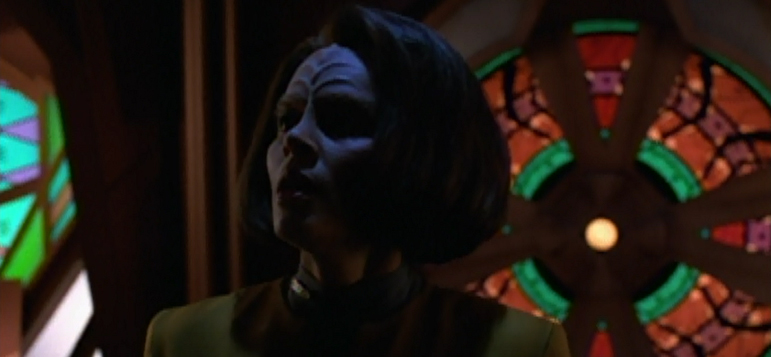
In contrast, the Vidiians are much more interesting. To be fair, it is possible that the Vidiians are so interesting precisely because they are underused; their appearances tend to be motivated by the demands of individual episodes rather than by some grand desire to create an iconic Star Trek species. At the same time, it is perhaps too much to suggest that the Vidiians are fully-formed or multi-faceted; the show never offers them the same opportunity for development afforded to species like the Kazon or the Borg or the Hirogen.

Despite all this, Lifesigns demonstrates the Vidiians can be used in an interesting and creative way. Even as the episode dedicates considerable space to demonstrating that Kazon are a much less interesting new species.

Starin' at the stars...

Starin’ at the stars…

Continue reading

Daredevil – Bang (Review)

This month, we’re doing daily reviews of the second season of Daredevil. Check back daily for the latest review.

The Marvel Universe has a strong attachment to New York City.

There are any number of examples that might be cited, from the lighting of the Empire State Building in blue and red to celebrate the release of The Amazing Spider-Man to J. Michael Straczynski’s cringe-inducing issue of The Amazing Spider-Man where megalomaniac (and occasionally mass murdering) supervillain Doctor Doom cries in the rubble of the World Trade Centre. The company and its characters have a long and rich history that is intertwined with the city itself.

Church Devil.

Church Devil.

At the same time, certain titles and characters have stronger attachments to particular areas and eras of the city. Spider-Man will always be rooted in Manhattan. The X-Men are symbolically tied to Westchester. Daredevil might be connected with Hell’s Kitchen, but he is anchored in a very particular version of Hell’s Kitchen; the gritty version of Daredevil pioneered by Frank Miller is tied to the dangerous neighbourhood as it existed against the backdrop of the seventies and eighties. (The Punisher is similarly rooted in seventies and eighties New York.)

Of course, Hell’s Kitchen has changed in the intervening years. It is no long as run down as it once was, subject to the forces of gentrification and modernisation. The first season of Daredevil touched on this idea, using the Chitauri attack from The Avengers to explain why the neighbourhood had been set back a few decades and turned into an urban hellhole. Wilson Fisk was suggested to be plotting a gentrification that had already taken place in the real world, casting out working-class inhabitants in order to remodel the area.

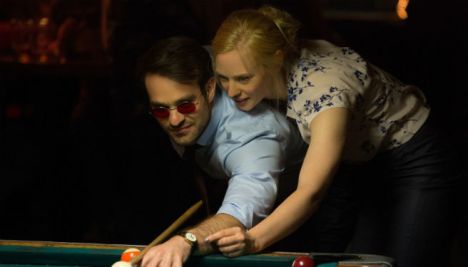
In with a shot...

In with a shot…

The second season of Daredevil adopts something of a different approach, which makes sense given the transition from producer Steven DeKnight to Doug Petrie and Marco Ramirez. Although there are fleeting references to “the Incident” later in the season, the invasion is no longer used to explain the urban nightmare of Hell’s Kitchen. Instead, the season adopts an approach akin to a stylistic period piece. Although Daredevil is still unfolding in the present day, the series is populated with markers that place it in an earlier context.

Bang seems to suggest that Daredevil is unfolding a version of New York anchored in the summer of 1977.

Don't leave us hanging...

Don’t leave us hanging…

Continue reading

Star Trek: Voyager – Death Wish (Review)

This February and March, we’re taking a look at the 1995 to 1996 season of Star Trek, including Star Trek: Deep Space Nine and Star Trek: Voyager. Check back daily Tuesday through Friday for the latest review.

Death Wish is an interesting beast.

On the one hand, it is a decidedly cynical cash-in. It is very much a crossover episode that exists to cement the ties between Star Trek: Voyager and Star Trek: The Next Generation, to the point where it not only features a beloved guest star who bookended the seven-year run of The Next Generation, but also a “special appearance” from the secondary lead of that show. It was also consciously moved around in the production order so it might air in February sweeps, and was heavily hyped as part of the network’s news cycle.

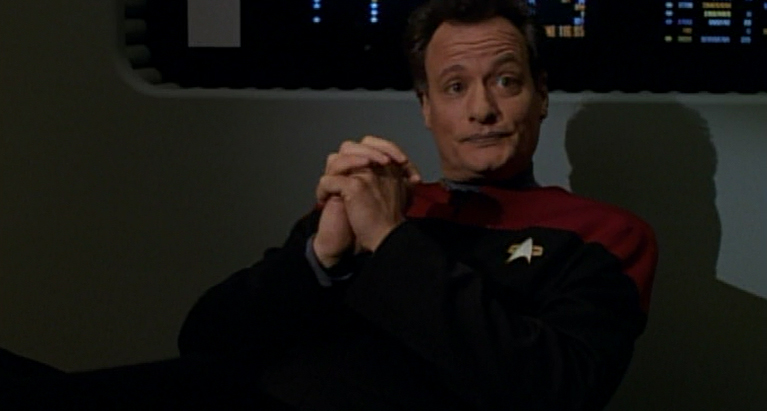
Qrossover!

Qrossover!

On the other hand, Death Wish is a fascinating episode on a number of levels. It is certainly the best of Q’s three appearances on Voyager, and certainly ranks among some of the character’s best work in general. Death Wish engages with a fairly hefty social issue of the nineties, as Janeway is embroiled in a debate about the morality of suicide. It also serves as a vehicle for writer Michael Piller to put his own version of Voyager on trial, with certain segments of the episode resonating quite clearly with the behind-the-scenes turmoil on the show.

Death Wish is a paradox of an episode. It is bold and daring on its own terms, but it is also cynical and coy. It is an example of Voyager actively steering into its reputation as “Next Generation Lite”, which will cause a lot of problems for the show down the line. This is a shame; Death Wish is actually quite interesting on its own merits.

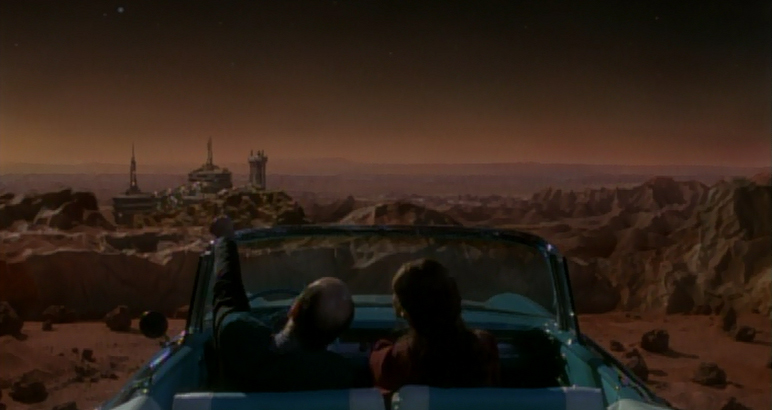
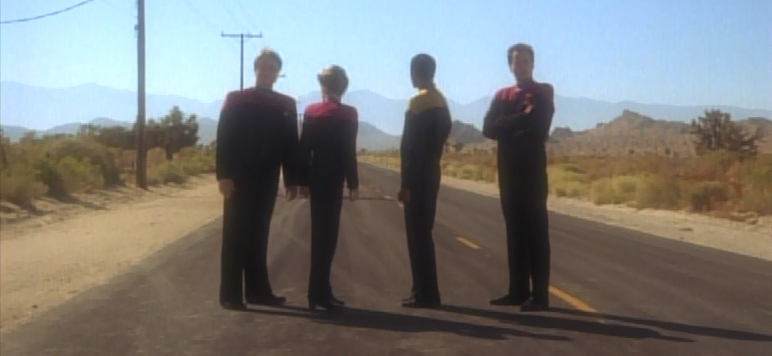
The road to nowhere...

The road to nowhere…

Continue reading

Star Trek: Deep Space Nine – Bar Association (Review)

This February and March, we’re taking a look at the 1995 to 1996 season of Star Trek, including Star Trek: Deep Space Nine and Star Trek: Voyager. Check back daily Tuesday through Friday for the latest review.

The politics of Star Trek can occasionally be difficult to pin down.

There are obvious reasons for this, of course. Television is a collaborative medium, the result of lots of different creative voices. It is hard to argue that Star Trek has an consistent set of politics, because those creative voices have very different politics. Even on the original show, episodes like Errand of Mercy and The Omega Glory suggested that Gene L. Coon and Gene Roddenberry had very different perspectives on the Vietnam War. Certainly, Star Trek: The Next Generation and Star Trek: Deep Space Nine have very different viewpoints.

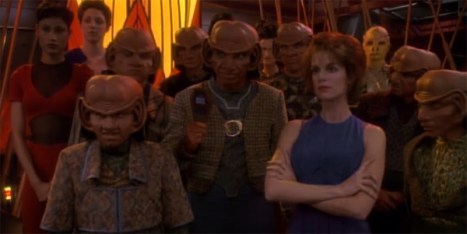
Don't beat yourself up, Quark...

Don’t beat yourself up, Quark. We have some Nausicaans to do it for you.

However, it is also the case that the franchise has always been quite careful when engaging with political discourse, particularly in the context of its nineties incarnation. The myth of Star Trek paints the show as progressive and liberal, but the truth is that the series rarely broke new ground in the nineties and into the new millennium. Episodes like Rejoined and Judgment were very much the exception rather than the rule, engaging with big political and social issues in a very clear manner. A lot of the time, the franchise played it fairly safe.

That is part of what makes Bar Association such an interesting episode of television. As with Rejoined, there is a sense that the Star Trek franchise should take the liberal politics of Bar Association for granted. After all, while there is some ambiguity as to exactly what form of economic theory is employed by the Federation, it certainly isn’t capitalism. However, it is interesting to hear the franchise (perhaps literally in this case) put its money where its mouth is, allowing a major character to quote Marx and Engels.

Strike while the bar is hot...

Strike while the bar is hot…

Continue reading

Scott Snyder & Greg Capullo’s Run on Batman – Endgame (Review)

This March sees the release of Batman vs. Superman. To celebrate, we’ll be looking at some iconic and modern Batman and Superman stories over the course of the month.

Scott Snyder and Greg Capullo’s Batman has been lodged in a constant state of apocalypse.

The duo have framed Batman as a blockbuster comic book, to the point that it seems like Batman stares down the end of all things more often than the rest of the superheroes in Geoff Johns’ Justice League. All of Snyder and Capullo major stories have placed Gotham City on the edge of the abyss, teetering (and even falling) into darkness. It is a sharp contrast to the lower key threats of Snyder’s work on The Black Mirror, very consciously a stylish affectation to reflect the fact that Batman is very much one of the comic book industry’s blockbuster title.

Bringing back the laughs...

Bringing back the laughs…

In The Court of Owls, Gotham finds itself subjected to a long night of terror by an army of undead assassins. In Death of the Family, the Joker carves his way across the city. In Zero Year, the origin of Batman is tied to a disaster on the scale of No Man’s Land. Even outside of his work on the main title, Snyder’s role as “executive producer” of Batman Eternal saw yet another apocalypse visited upon Gotham in a relatively short space of time. It becomes exhausting after a while.

To be fair, it is reasonable to ask whether this is just part of a larger cultural context. Pop culture has always been fascinated with the end of the world, but it seems increasingly fixated on the concept in recent years. The popularity of the zombie genre is just one example, but any list of critically and commercially successful art in the twenty-first century will confront the reader with multiple ends of all things. The Walking Dead, The Road, Mad Max: Fury Road, Jericho, Revolution, Book of Eli, and so on and so forth.

"Hm. Maybe we should consider counselling...?"

“Hm. Maybe we should consider counselling…?”

However, popular culture is not just fascinated with post-apocalyptic horror. Increasingly, media engages with the question of what the end of the world will look like, rather than the question of how we might survive it. Fear the Walking Dead depicts the end of the world that led to its sister series. Chris Carter revived The X-Files so that the final episode could depict the end of the world as foreshadowed across the original nine-season run. With advances in CGI, blockbusters like The Avengers and Man of Steel can render destruction on an impossible scale.

As such, Scott Snyder and Greg Capullo’s recurring fascination with the end of all things exists as part of a broader cultural context. Still, the writer and artist seem to position Endgame as the ultimate apocalypse for its two central characters.
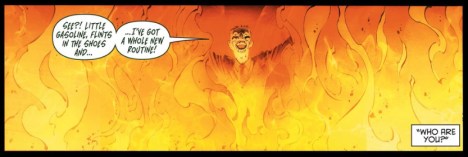
Burning down the house...

Burning down the house…

Continue reading

Star Trek: Voyager – Dreadnought (Review)

This February and March, we’re taking a look at the 1995 to 1996 season of Star Trek, including Star Trek: Deep Space Nine and Star Trek: Voyager. Check back daily Tuesday through Friday for the latest review.

Dreadnought is arguably a much better version of Prototype.

Both are essentially horror stories about B’Elanna Torres essentially creating a new mechanical life form, making a decision that has unforeseeable consequences. There is an element of reproductive horror to all this, reinforced by the clever decision to have B’Elanna literally give the eponymous warhead her own voice and watch it engage in a course that is quite literally self-destructive. It is perhaps the quintessential reproductive horror story, the fear that we might create something that will supplant us; that our children become the worst reflections of ourselves.

Engine of mass destruction...

Engine of mass destruction…

It is interesting that Dreadnought followed Meld so closely; both are essentially stories about how Star Trek: Voyager (and its characters) cannot cleanly escape their past, as much as the show might push it (and them) towards a generic Star Trek template. The middle of the second season sees an emphasis on the idea that Voyager is composed of two radically different crews – that Starfleet and the Maquis are not as integrated as shows like Parallax or Learning Curve might suggest.

Alliances, Meld and Dreadnought all build on the idea of underlying tensions that were mostly glossed over during the first season. Of course, this creates a weird dissonance, as Voyager seems to actually be moving backwards rather than forwards – attempting a half-hearted do-over of some of its earliest miscalculations.

Engineering a solution...

Engineering a solution…

Continue reading

Non-Review Review: 10 Cloverfield Lane

10 Cloverfield Lane is a beautiful piece of speculative paranoid horror.

The plot follows Michelle, a young woman who is involved in a car crash. She wakes up to find herself in a strange concrete bunker, under the care of the mysterious (and more-than-slightly sinister) Howard. As she comes to her senses, Howard advises her that something horrible has happened; the world has ended outside and they are sealed safely inside an air-tight self-sustaining bunker. However, Michelle has a healthy degree of skepticism about Howard’s claims, wondering what exactly is going on and just how trustworthy Howard actually is.

At home at the end of the world. Maybe.

At home at the end of the world.
Maybe.

To reveal any more would be to spoil the film. 10 Cloverfield Lane is very much a “mystery box” production, in keeping with various other JJ Abrams projects from Cloverfield to Super 8 to Star Trek Into Darkness. Although Abrams is not directing, 10 Cloverfield Lane retains a lot of the director’s aesthetic. It is a film that is designed to be seen with the bare minimum of information, to the point where the unveiling of the movie’s title came surprisingly late in the release process.

However, writers Drew Goddard and Daniel Casey (working from a story by Matthew Stuecken and Josh Campbell) and director Dan Trachtenberg use that mystery box structure in a manner distinct from Abrams’ blockbuster sensibilities. 10 Cloverfield Lane plays like a feature-length high-budget episode of The Twilight Zone, a story that looks and sounds great but would (mostly) lend itself to a stage play adaptation. 10 Cloverfield Lane feels very much like a classic high-concept science-fiction horror, in the best possible way.

Music to his ears...

Music to his ears…

Continue reading

Batman – Knightfall (Review/Retrospective)

This March sees the release of Batman vs. Superman. To celebrate, we’ll be looking at some iconic and modern Batman and Superman stories over the course of the month.

Knightfall is one of the definitive Batman stories.

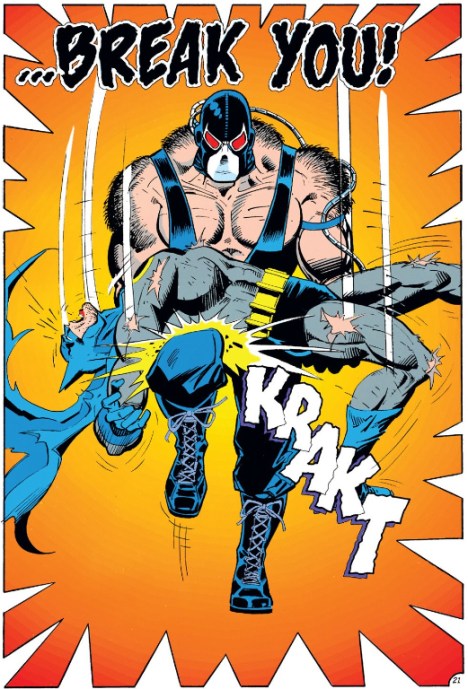
That is, to be clear, not the same as saying it is one of the best. Knightfall is far too chaotic and disorganised to rank among the best Batman stories ever told. This becomes particularly obvious when the story enters its second and third act, as everything falls to pieces and the saga sort of sputters out rather than coming to a clear end. Indeed, this problem can be seen even in the nineteen-issues-and-change introductory arc; the creative teams start with a strong focus and clear direction, but this quickly descends into anarchy as the story builds a forward momentum.

Batman just snapped...

Batman just snapped…

At the same time, there is something striking and ambitious about Knightfall. It is no surprise that Denny O’Neil considers it one of his crowning accomplishments as editor of the line. Asked to name his favourite Batman arc, O’Neil replies, “I guess it would be Knightfall because it involved me so deeply–I worked on it as a comic series, a novel, and a radio show. It was a very steep mountain to climb, but we climbed it and that was satisfying.” There is no denying the influence and success of the arc.

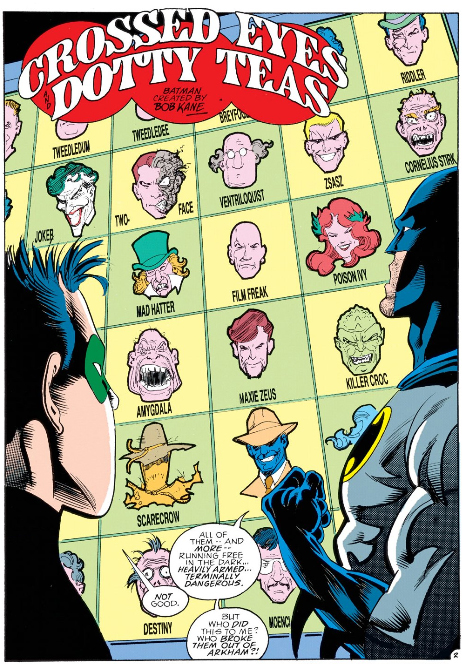
In some respects, Knightfall is an astonishingly cynical piece of work. It is quite blatantly designed as a crossover with a high-profile guest cast and killer high concept. Indeed, Knightfall could be seen as a headline-grabber in the style of The Death and Return of Superman, but with the added hook of Batman’s iconic rogues gallery. After all, it was the nineties, the era of sensationalist headline-grabbing sales stunts. It could be argued that comics (and mass culture) have always been stuck in this cycle, but it was particularly evident in nineties comic books.

All of Batman's greatest adversaries... ... and Maxie Zeus.

All of Batman’s greatest adversaries…
… and Moench.

However, Knightfall has two core virtues that go a long way towards excusing the confusion and excess at the heart of the story. The first is that there is a sense that the writers seemed to have a (very) rough idea where they would like to end up, even if the journey was not mapped in advance. While the plot resolves with a convenient and contrived twist, at least it does not hinge on Bruce magically waking up from a coma. More than that, though, there is a sense that Knightfall is actually trying to say something about its central character.

For all the noise and static along the way, Knightfall is essentially a story about Batman means in the context of the nineties.

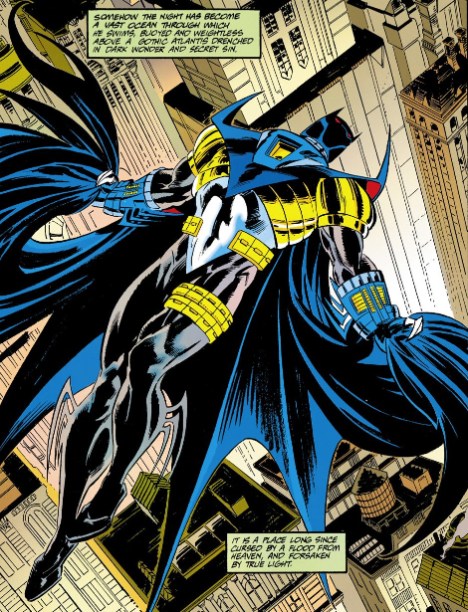
Armoured and dangerous...

Armoured and dangerous…

Continue reading

Star Trek: Deep Space Nine – Sons of Mogh (Review)

This February and March, we’re taking a look at the 1995 to 1996 season of Star Trek, including Star Trek: Deep Space Nine and Star Trek: Voyager. Check back daily Tuesday through Friday for the latest review.

Moving Worf over from Star Trek: The Next Generation to Star Trek: Deep Space Nine could be seen as a cynical move.

In fact, it was a bit of a cynical move, a rare example of executive meddling in the basic plot of Deep Space Nine. Although there is some disagreement as to precisely how much give and take was involved in the decision-making process by the production team and the studio, it was clear that the writing staff had not originally envisaged Worf joining the show and that the addition of Michael Dorn to the show’s cast was an attempt to shore up the show’s ratings and profile. These are the realities of network television production.

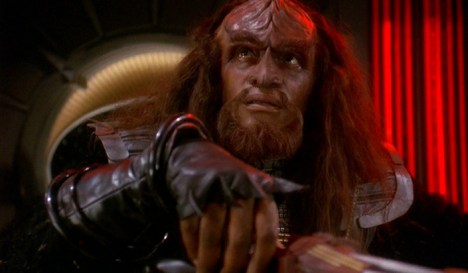
As the world Kurns...

As the world Kurns…

At the same time, moving Worf over to Deep Space Nine from The Next Generation afforded the production team unique opportunities and storytelling possibilities. With Star Trek: Voyager unfolding in the distant Delta Quadrant, Deep Space Nine had been largely free to reinvent and rework the franchise’s status quo for its own purpose. Deep Space Nine was allowed to play with toys that would have been off limits while The Next Generation was on the air; war with the Klingons, Federation civil war, Dominion invasion.

However, actually transitioning a character from The Next Generation to Deep Space Nine allowed the production team even more freedom and even greater contrast. Although very clearly the same character, Worf changes between The Next Generation and Deep Space Nine. There is a sense that Deep Space Nine is a lot more willing to carry certain aspects of the character to their logical conclusion, in a way that was simply not feasible on The Next Generation. This is clear in Sons of Mogh, when Worf attempts to murder his own brother.

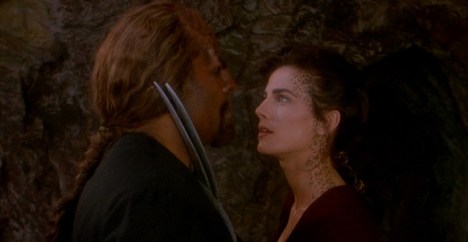
Flirty!

Flirty!

Continue reading