• Following Us

  • Categories

  • Check out the Archives


  • Awards & Nominations

Non-Review Review: Zoolander II (aka 2oolander)

Zoolander II arrives a decade and half after Ben Stiller’s original male model comedy, perhaps tapping into the same rich vein of nostalgia that led to the release of Jurassic World and the relaunched X-Files.

Zoolander is a fascinating (and beloved) film. It is (along with Anchorman) one of the defining comedies of the early twenty-first century, to the point that it (allegedly) counts among Terrence Malick’s favourite films. The film offers one of Ben Stiller’s most iconic performances and is filled with memetic lines and catchphrases. Tellingly, the teaser trailer to Zoolander II offered hints to its identity through visual shout-outs to some of the gags that had soaked into the popular imagination. It is a surprise that the sequel took this long to produce.

Model investigators...

Model investigators…

Zoolander sits awkwardly between the end of the twentieth century and the start of the twenty-first. It was among the more high-profile films to digitally erase the World Trade Centre following the 9/11 attacks. Roger Ebert famously argued that Zoolander was one reason “why the United States is so hated in some parts of the world.” Mirroring its protagonist, the disconnect between the world in which the film was produced and the world in which is was released suggested an engaging innocence.

It is perhaps too much to expect Zoolander II to measure up to the original film, to offer that same surprising (and perhaps unintentional) innocence. Zoolander II is reasonably diverting, if solidly unspectacular. The film lacks the same sparkle that made the original such a hit, falling back a little bit too far on in-jokes and familiar characters without offering much new or exciting of its own.

A familiar ring to it...

A familiar ring to it…

Continue reading

Star Trek: Deep Space Nine – Hippocratic Oath (Review)

This February and March, we’re taking a look at the 1995 to 1996 season of Star Trek, including Star Trek: Deep Space Nine and Star Trek: Voyager. Check back daily Tuesday through Friday for the latest review.

Hippocratic Oath represents a return to normality for Star Trek: Deep Space Nine. The Way of the Warrior was a feature-length war epic tasked with introducing a new regular character and a new status quo, while The Visitor was an intimate character study that stood quite apart from the show around it. With Hippocratic Oath, the show gets back to business as usual. It even has a classic a-story/b-story split with Bashir and O’Brien’s Gamma Quadrant hijinx juxtaposed with Worf learning his place on the station (and the show).

This is not to suggest that Hippocratic Oath is a bland hour of Star Trek. Indeed, it is a tightly-constructed story that hits on some of the show’s core themes and most interesting dynamics. One of the problems with the third season of Deep Space Nine was the fact that it had a strong start but no idea on how to build from that. Hippocratic Oath seems to serve very much as a “business as usual” episode of the fourth season, helping to set a baseline of quality of the show going forward.

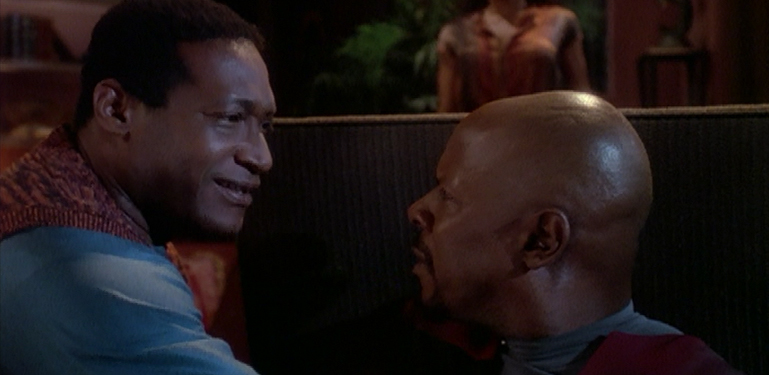
Awkward bromantic moment...

Awkward bromantic moment…

Continue reading

Star Trek: Deep Space Nine – The Visitor (Review)

This February and March, we’re taking a look at the 1995 to 1996 season of Star Trek, including Star Trek: Deep Space Nine and Star Trek: Voyager. Check back daily Tuesday through Friday for the latest review.

To my father, who is coming home.

Daddy's home...

Daddy’s home…

Continue reading

Star Trek: Voyager – Parturition (Review)

This February and March, we’re taking a look at the 1995 to 1996 season of Star Trek, including Star Trek: Deep Space Nine and Star Trek: Voyager. Check back daily Tuesday through Friday for the latest review.

One of the more interesting aspects of the second season of Star Trek: Voyager is its stubborn refusal to give up on elements that simply do not work.

Time and again, and often at the behest of producer Michael Piller, the second season returns to concepts that were problematic and troublesome in the first season. The obvious goal is to fix those problems so that those elements can be successfully reintegrated into the surrounding show. This is why the second season returns to concepts like the Kazon as a threat and Tom Paris as a rebel and Neelix as a character with a useful function on the ship. This is not a bad approach. If the first season of a show is about experimentation, then the second season is about calibration.

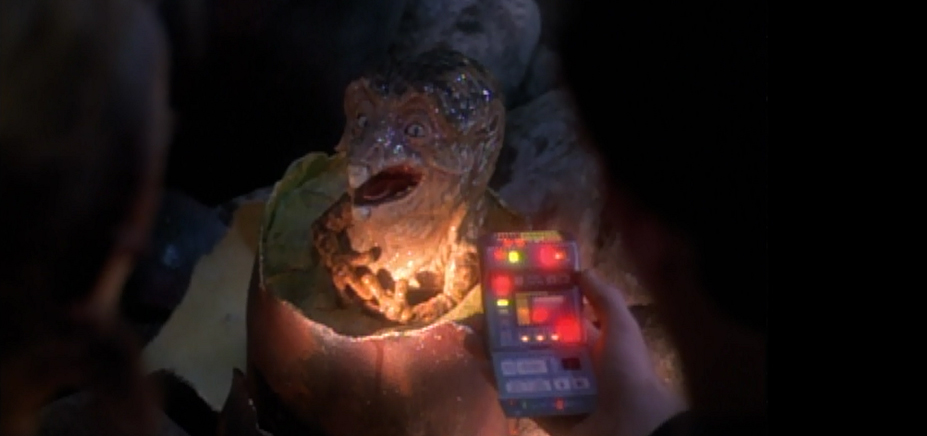
Two men and a lizard lady...

Two men and a lizard lady…

It is hard to begrudge Michael Piller this approach. After all, it had worked quite well on Star Trek: The Next Generation and Star Trek: Deep Space Nine. In particular, it took Deep Space Nine about three years before it figured out how to make characters like Bashir, Dax and Quark capable of carrying their own episodes without making the audience want to bash their heads against a large blunt surface. It is not unreasonable to take the same approach to dealing with the elements of Voyager that are not working.

There is a very significant difference, though. The problematic elements of Voyager have little to do with execution; they are fundamental problems with the concepts. The Kazon do not work as a threat because they are one of worst alien species that Star Trek ever produced, rooted in some rather unpleasant racial stereotypes tied to contemporary Los Angeles gang culture. Tom Paris does not work as a rebel and womaniser because Robert Duncan McNeill works better as a charming goof. Neelix’s romance with Kes is toxic because she is a child and he’s possessive.

Cooking up a storm...

Cooking up a storm…

As such, it feels like the second season of Voyager spends a lot of time fixing problems that are fundamentally unfixable. One of the great aspects of the premise of Voyager is the fact that the show is in a constant state of movement. Unlike the cast of Deep Space Nine who are fixed in a single place, the cast of Voyager are constantly moving forward. It is possible for Voyager to jettison the parts that are simply not working. (Cue lazy joke about the size of Kazon space.)

Parturition is an example of this phenomenon, as Voyager tries to “fix” the toxic relationship between Neelix and Kes, while offering Tom Paris some small semblance of character growth. Unfortunately, it seems very attached to the idea of Neelix and Kes as a romantic couple and Tom Paris as a playful romantic rogue, which means that the best that it can hope to do is to not make the underlying problems any more obvious. While Parturition is nowhere near as bad as Elogium or Twisted, it still feels like a series treading water.

It's time for the Delta Quadrant's favourite fifties sitcom, "Last Tango With Paris."

It’s time for the Delta Quadrant’s favourite fifties sitcom, “Last Tango With Paris.”

Continue reading

The X-Files/30 Days of Night (Review)

This January, to prepare for the release of the new six-part season of The X-Files, we’re wrapping up our coverage of the show, particularly handling the various odds and ends between the show’s last episode and the launch of the revival.

The X-Files/30 Days of Night is the most satisfying X-Files story of the interregnum between The Truth and My Struggle I.

The comic book miniseries is notable for a number of reasons. It is the simultaneously the last X-Files comic to be published by Wildstorm and the first X-Files comic to be published by IDW. It is the first comic book crossover between X-Files characters and another established comic book franchise, and it crosses over directly through Mulder and Scully rather than using the Lone Gunmen to insulate the franchise. It is also the first X-Files comic to be illustrated by Tom Mandrake, who would later work with Joe Harris.

Darkness falls...

Darkness falls…

There are other reasons that The X-Files/30 Days of Night stands out. The comic is the work of a creative team (much) more strongly associated with 30 Days of Night than The X-Files, and there is a sense the comic services that franchise more than The X-Files. Barring the first twelve-issues of Stefan Petrucha and Charles Adlard’s Topps run, which was really more of a series of shorter interlocking stories, The X-Files/30 Days of Night is also the longest single X-Files comic book story published to this point in the franchise’s history.

It is also just really good.

Due North...

Due North…

Continue reading

Star Trek: Deep Space Nine – The Way of the Warrior (Review)

This February and March, we’re taking a look at the 1995 to 1996 season of Star Trek, including Star Trek: Deep Space Nine and Star Trek: Voyager. Check back daily Tuesday through Friday for the latest review.

The third season of Star Trek: Deep Space Nine was really just a dress rehearsal for what lay ahead.

The third season had been a tumultuous time for the show, with Michael Piller departing the franchise to pursue opportunities outside Star Trek. It was the year directly after the end of Star Trek: The Next Generation, and all attention was focused on the pending release of Star Trek: Generations and the launch of Star Trek: Voyager. On top of that, the third season suffered from a great deal of confusion and disorganisation throughout the year, making it very hard for the production team to set an end goal for themselves.

"This could be the start of a beautiful friendship..."

“This could be the start of a beautiful friendship…”

In fact, the third season of Deep Space Nine was such a mess that the production team had not even managed to hit the end of season cliffhanger that they wanted. The Adversary had been drafted at the last possible minute when the studio vetoed the idea of ending the year with a Vulcan withdrawal from the Federation. This is not to discount the long list of impressive episodes produced during the season, but it does illustrate that the third season of Deep Space Nine had not progressed according to plan.

At the same time, it was a vital learning experience for the show. It provided a clear framework for what followed, providing producer Ira Steven Behr with a foundation from which he would build the rest of the run. The work put in during the third season would pay dividends in the fourth and fifth seasons, as the show began to play with and pay off ideas that had been carefully and meticulously established during that most chaotic of seasons. In fact, the show begins paying off those dividends with The Way of the Warrior, the first episode of the fourth season.

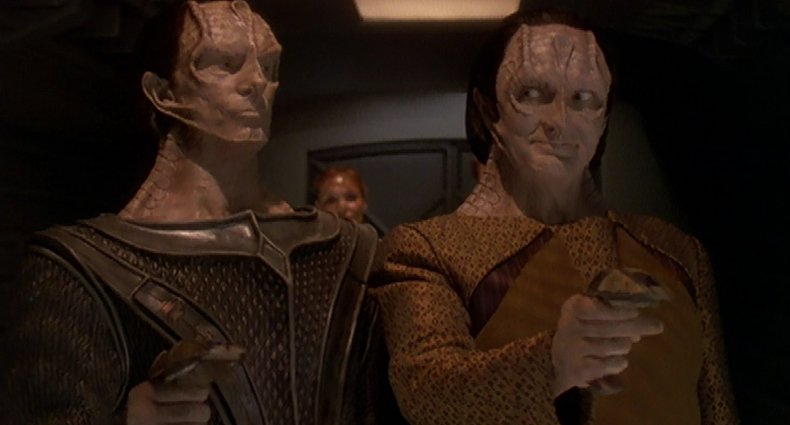
Klingons woz 'ere...

Klingons woz ‘ere…

Continue reading

The X-Files (Wildstorm) #5-6 – Dante’s Muse (Review)

This January, to prepare for the release of the new six-part season of The X-Files, we’re wrapping up our coverage of the show, particularly handling the various odds and ends between the show’s last episode and the launch of the revival.

And Wildstorm’s X-Files comic dies a quiet death.

The seven-issue (six monthly issues and a special “zero” comic) miniseries is an oddity. These seven comics tell four self-contained mysteries that stand quite separate from another, even as they echo the show’s creative peak. These four self-contained stories are credited to three different writers; the first two stories are written by producer and writer of the classic show, while each of the final two stories is credited to an established industry veteran with a long history working at DC comics.

THE TRUTH IS OUT THERE

THE TRUTH IS OUT THERE

Still, the miniseries feels like something of a damn squib. Barring that X-Files/30 Days of Night crossover, these seven issues represent everything that Wildstorm chose to do with the license. It certainly pales in comparison to the more comprehensive and thorough exploitation of the property by previous owner Topps and future owner IDW. While part of that is likely down to the simple fact that Wildstorm was in its extended death throes, perhaps it also speaks to where The X-Files was at that point in time.

Perhaps there simply was not that big a market for The X-Files in late 2008 and into 2009. Perhaps the memory of the show’s final season lingered too strongly in the cultural memory, or perhaps the cultural remembrance of show had faded entirely. The spark of nostalgia that would resurrect the show half a decade later had yet to be kindled. For whatever reason, it seemed like The X-Files was not quite ready to return to the popular consciousness.

EVERYTHING DIES

EVERYTHING DIES

Continue reading

The X-Files (Wildstorm) #3-4 (Review)

This January, to prepare for the release of the new six-part season of The X-Files, we’re wrapping up our coverage of the show, particularly handling the various odds and ends between the show’s last episode and the launch of the revival.

Frank Spotnitz could not stick around forever.

The veteran X-Files writer and producer could not stick around for even half a year. These days, it is customary for “big name” authors to commit to a very short run of comic book issues before jumping off; while comic book veterans like Marv Wolfman or Chuck Dixon or Chris Claremont would have committed to years on a particular title during the seventies and eighties, it became increasingly common for higher profile writers to enjoy shorter stints. While this is the case for high-profile industry veterans like Warren Ellis, it is particularly true of celebrity authors.

THE TRUTH IS OUT THERE

THE TRUTH IS OUT THERE

Brad Meltzer wrote thirteen issues of Justice League of America. Kevin Smith wrote eight (and a bit) issues of Daredevil and fifteen issues of Green Arrow. Richard Donner wrote seven issues of Action Comics, and contributed a short story to the anniversary special. Sam Hamm wrote three issues of Detective Comics. While these creators might have had great stories to tell with these characters, they were also not necessarily comfortable with committing to a month schedule indefinitely. (They also had careers outside the medium, to be fair.)

Still, there is something quite jarring about Frank Spotnitz’s departure from Wildstorm’s X-Files comic book after only three issues. Spotnitz barely had time to define what the comic was supposed to be, beyond a glimpse into a weird alternate universe where Mulder and Scully are trapped in a perpetual 1998. It is debatable whether a licensed tie-in really needs anything more than that, given the tendency to treat such tie-ins as little more than a supplement to a more mainstream iteration of the same basic product.

DECEIVE INVEIGLE OBFUSCATE

DECEIVE INVEIGLE OBFUSCATE

At the same time, it feels like Spotnitz’s departure leaves an already confused monthly series with no strong identity of its own. Quite pointedly, Spotnitz’s name still appears on the full cover to the first issue written by Marv Wolfman; whether this suggests that Spotnitz was intended to write the issue or simply the result of a rush to press is unclear. As a result, Wildstorm ended up passing its X-Files monthly series from one writer to another, with industry (and DC comics) veterans Marv Wolfman and Doug Moench each handling a two-part story.

The results are intriguing, if not particularly compelling. Wildstorm’s X-Files comics are most remarkable for its sense of detachment from anything and everything. It is “unstuck” in a way that none of the franchise’s other flirtations with comic book storytelling are not. In its own way, this feels entirely appropriate; this is The X-Files as published by one of the two most largest and most iconic comic book publishers. Continue reading