• Following Us

  • Categories

  • Check out the Archives


  • Awards & Nominations

Non-Review Review: Anaconda

Anaconda is a B-movie. It’s not a homage to a B-movie, or a love letter to that type of film. It’s not a nostalgic throwback, or an attempt to capture some of the elements of those old cheesy productions. It actually is a B-movie. There’s no real attempt to execute the film in a manner that rises above those, or even captures that type of filmmaking at its best, it’s just a solid example of what a B-movie might look like, were it produced today. It’s hard to argue that Anaconda is a good film – and I’ll readily concede that it’s actively a badone – but there is some charm to be found it, if only from the way that all the hyper-trashy elements seem to come together in what appears to be a perfect storm of creature feature cheese.

I always had a crush on Jennifer Lopez...

Continue reading

Mark Millar’s Run on Ultimate Fantastic Four – Vol. 3 (Hardcover) (Review/Retrospective)

Celebrating the 50th anniversary of the Fantastic Four, I’m taking a look at some of the stories featuring the characters over the past half-century.

Mark Millar isn’t quite the tough guy he makes himself out to be. Asked a few years ago about whether the birth of his child might tame some of his more sensationalist tendencies, Millar replied that – if anything – he would be even more motivated to push the envelope in order to demonstrate he hadn’t mellowed. And, in fairness, the years since have seen ideas like Kick-Ass or Wanted or Nemesis, all excessively and ridiculously cynical, graphic and violent. However, I maintain that Millar is a stronger writer when he channels his inner softer romantic – for example, demonstrating the respect he showed Superman in Red Son. Taking over Ultimate Fantastic Four for a year (perhaps on a trial run before writing for regular Fantastic Four), you get a sense that Millar has a genuine affection for these characters and their world – too much to try to make them “darker and edgier”, for example. While his run on Ultimate Fantastic Four isn’t the best thing he’s written, it is sharp and entertaining – and delivered with enough energy that it can’t help but warm the reader’s heart.

Never a drag...

Continue reading

Fresh Perspectives: Classic Directors and Not-so-Classic Films…

I caught Mel Brooks’ High Anxiety at the weekend, and I have to admit, I liked it. I’d only heard the movie mentioned in passing from time to time, never discussed with the same reverence as Space Balls or Blazing Saddles or Young Frankenstein, but never with the same bitterness as Dracula: Dead and Loving It. It never really made it on to any conscious “to see” list with any of the great works from iconic directors. However, I really enjoyed it. Don’t get me wrong – I don’t consider it a forgotten classic, or a misunderstood gem overlooked in Brooks’ impressive filmography. It has its flaws and problems, but I enjoyed it. In fact, while I wouldn’t consider on par with some of his stronger films, I dare say that I actually enjoyed it more than some of them, despite the fact I hadn’t heard that much about it. In fact, I can’t help but wonder if I enjoyed it more because I hadn’t heard that much about it.

High expectations can lead to monstrous results...

Continue reading

Non-Review Review: High Anxiety

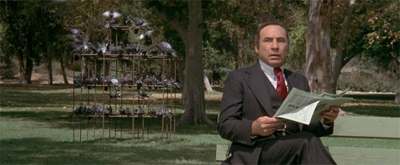
I quite enjoyed High Anxiety, even if it didn’t rank quite as high as some of Brooks’ other efforts. While it still possesses the same wonderful wry moments, High Anxiety is a Mel Brooks film that arguably works better as a farce than as a parody. I suspect that this has something to do with the director’s intended target. While Westerns were ripe for mockery in Blazing Saddles and old horror films were perfectly suited to the sense of humour in Young Frankenstein, it always seemed like Alfred Hitchcock was aware of his own filmmaking style, and seemed to occasionally be gently mocking it himself, rather than playing his heightened suspense with a po-faced sincerity. I think that parody and satire work best when they represent an attack on a target that suffers from a little bit too much self-importance, while Hitchcock’s films are generally a little more self-aware than that.

Gone to the birds?

Continue reading

Right In Time: Are Some Concepts Just Too Silly For Movies?

I think it’s happened to all of us at some point. We see a poster for a film, or the start of a trailer that looks fascinating – all the right talent is involved to grab our attention, the technical stuff looks well-executed, it’s stylish and smart… and then we catch the plot of the film. It’s a plot that kind of makes us pause, drawing an almost unconscious, “huh?” from our collective lips. Maybe we read it twice to try to make some sense out of it, but there’s no joy. It still sounds as absolutely and impossibly silly as it did when we first read of the plot. It has happened to me quite a few times over the years, as I’ve found myself wondering how the hell such a concept could work on the big screen. I’ll confess, it happened when I read the plot summary for In Time, directed by Andrew Niccol, which drew this appropriate response

More at The Shiznit...

Continue reading

Non-Review Review: Targets

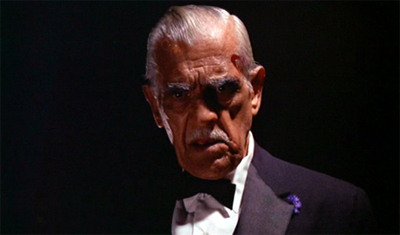
Targets still feels quite a bit ahead of its time, which is quite something for a film intended to transition between the classic horror monster movies and the more sinister and grounded modern horrors. Indeed, Boris Karloff’s last starring role seems to prefigure a shift in the type of horror movies flooding the cinemas, years ahead of the more iconic and mundane “slasher” icons who succeeded Dracula and Frankenstein as the monsters at the matinée. Targets is an intriguing and remarkable little film, charmingly understanded and perhaps appealing for the lack of pomp it attempts to generate.

The horror!

Continue reading

Critical Revisionism: Retrospective Re-Evaluation…

It’s funny. I always figured that long-term critical re-evaluation was sort of a one-way street. I guess it always seemed that people were talking about “classics” that got an unfair rap from critics and audiences on initial release, but have subsequently become amongst the most influential films within their genre. I’m talking about movies like Blade Runner or The Thing, movies that were attacked on initial release, but have undergone a massive transformation and vindication in popular consciousness. I generally figured that good films that got bad reviews would eventually be found and praised for the quality productions that they were, while over-praised mediocre (or worse) films would languish in purgatory, forgotten about, save the occasional television re-run. So I’m surprised at the way the tide seems to have turned against Juno in the five years since the film’s original release.

Well, that's one response...

Continue reading

You’d Be Muppets To Say No: Let the Muppets Host the Oscars…

UPDATE: Well, time marches on. Sometimes by the hour. It’s Billy Crystal. Not that I expected the gang to get a look-in. Still, I think the points stand.

There are days when it seems like the internet is about to explode. Somebody has a random thought, posts it or shares it, and it just catches on like wildfire. Before you know it, it seems like half the world is saying “that’s actually not a bad idea!” and the other half is saying “that’s a great idea!” The campaign to have the Muppets host the Oscars is one of those things that has just come to life, like a phoenix from the ashes of Brett Ratner’s resignation and Eddie Murphy’s departure. I generally don’t comment on these things, because they speak for themselves, and I don’t like to just run a post saying “everything these guys are saying is true!”, but this is the exception rather than the rule. I want to see the Muppets host the Oscars. I know it isn’t going to happen, but damn if it isn’t the most outrageous, ambitious and insane idea that has been suggested.

And that, my friends, is exactly why it should happen, even if it probably won’t.

Continue reading

Non-Review Review: Staten Island

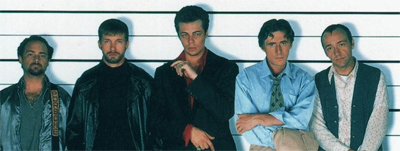
Staten Island is a convoluted little film that seems to shameless emulate several anthology films, with the most obvious influence being seen in Quentin Tarantino’s Pulp Fiction, borrowing the device of telling three interlocking but distinct stories set in different timeframes relating to the same bunch of characters. Still, that’s not necessarily a reason to dislike the film, which manages to offer an interesting, if not comparable, set of tales. James DeMonaco probably should have realised that borrowing so heavily from a classic film sets a ridiculously high standard, and one the movie falls far short of reaching. Still, there are moments where the film does work, even if they seem evenly-spaced with awkward and pointless sequences.

One psychotic mobster, sitting in a tree...

Continue reading

Who Spoils the Spoilers? On the Right Not to Be Spoiled…

Apparently, spoilers are good for you. Well, that’s what one survey from August suggests:

UC San Diego psychology researchers Nicholas Christenfeld and Jonathan Leavitt wanted to test if being spoiled hurt someone’s enjoyment of a story. So they took 30 test subjects and let them read 12 short stories by famous authors like John Updike, Roald Dahl, Anton Chekhov, Agatha Christie and Raymond Carver. Some they just read straight, others they read with a paragraph beforehand that ruined the ending or major twist in the piece. In almost all of those cases, the reader liked the story more when they were spoiled.

Published way back in August, this generated quite a bit of on-line discussion, and a lot of people were quick to suggest that the logic held true for movies as well, and modern blockbusters at that. It seems like a ready-made defense for those posting a constant stream of spoilers for The Dark Knight Rises, or leaking plot twists for various popular television shows. However, I’m not necessarily convinced by this logic.

This survey is suspect…

Continue reading