• Following Us

  • Categories

  • Check out the Archives


  • Awards & Nominations

X-Men: Messiah Complex (Review/Retrospective)

This is the seventh in a series of comic book reviews that will look at the direction of Marvel’s core continuity (and in particular their “Avengers” franchise) over the past five or so years, as they’ve been attempting to position the property at the heart of their fictional universe. With The Avengers planned for a cinematic release in 2012, I thought I’d bring myself up to speed by taking a look at Marvel’s tangled web of continuity.

It has been commonly accepted that the “golden days” of X-Men crossovers are behind us. Of course, “golden days” is a subjective term – for every Age of Apocalypse, there was an Onslaught Saga – but there’s no way to argue that the mutants didn’t dominate Marvel’s output in the nineties. One would have thought that with Bryan Singer’s X-Men helping give birth to the superhero genre, this past decade might have been an even better one for the franchise, but it was not to be. In fact, The Avengers seem to have replaced the X-Men as the engine driving Marvel’s storytelling universe. Some might suggest that it is so blatant that it looks intentional (prompting a movie-related “conspiracy theory”), although Marvel have casually denied it – with vice president Tom Brevoort stating “these things tend to go in waves”. However, Messiah Complex is the first of a series of crossovers with the X-Men titles following House of Mwhich would chart the franchise’s gradual return to the status quo.
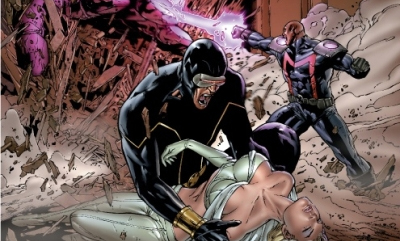
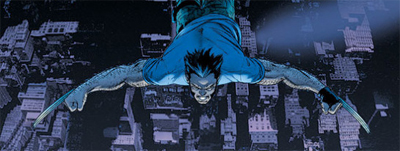
Cyclops has warmed to Ms. Frost…

Continue reading

House of M (Review/Retrospective)

This is the third in a series of comic book reviews that will look at the direction of Marvel’s “Avengers” franchise over the past five or so years, as they’ve been attempting to position the property at the heart of their fictional universe. With The Avengers planned for a cinematic release in 2012, I thought I’d bring myself up to speed by taking a look at Marvel’s tangled web of continuity. Get an overview of what I’m trying to take a look at here.

The X-Men represent the oddball of mainstream superhero comic books. In a genre and medium dedicated offering a static setup – things never really change or resolve – the X-Men are built upon the very idea of evolution. The whole basis of the franchise is the pursuit of equality by the genetically distinct mutant population, the idea that they and mankind can grow together. It has even been frequently suggested that these super-powered individuals represent out future or our replacements. However, the only way to actually tell a story like that is to follow it through to its logical conclusion – to let the ball roll and to let the world change. It feels a little counterproductive for Charles Xavier and his students to still be fighting for the same rights as everyone else nearly fifty years on – it might even seem a little stale. Grant Morrison’s superb New X-Men run offered a solution of sorts – it gave us a world where humanity would be extinct in a couple of generations and showed the growth and relationship between human and mutant subculture. Gone was the minority struggling against an oppressive majority – a more complex example of race relations had come into play with “mutant music” and “mutant slang” making their impression on the youth, amid a silent and almost invisible middle-class backlash. This was an ingenious approach which demonstrated the relevance of the franchise. Unfortunately, Marvel were not quite pleased with this – some people even, ridiculously, accused Morrison of telling all the remaining X-Men stories – and decided to set things right. They did that through House of M.

Dive in...

Continue reading

Wolverine: Enemy of the State (Review)

Wolverine is a bit of an odd character. He’s a bit of an odd character to have endured the sheer amount of publicity that he has and to remain a big gun at Marvel. He was introduced as an opponent in The Incredible Hulk, before ending up drafted on to Chris Claremont’s revised Uncanny X-Men roster. After that, he was lucky enough to earn his own miniseries (written by Claremont and drawn by Frank Miller), which became his on-going series which led to him featuring as a leading character in multiple team books and a title character in several solo series, all at the same time. Only Spider-Man can compete with that level of exposure, and Spider-Man arguable has a better claim to it as a richly layoured, complex and pseudo-realistic character (in the sense of being “Peter Parker: Schmuck”, rather than “Your Friendly Neighbourhood Spider-Man”… you get the idea). On the other hand, Wolverine’s defining trait is that he is very, very good at killing things.

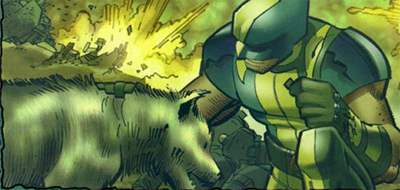
Even an unstoppable killing machine can stop to pet the dog...

Continue reading

Suspending Your Belief: Age Before Beauty…

It’s strange, isn’t it, what will break our suspension of disbelief? I mean, we’ll accept (while watching Superman) that a man can fly around in his underwear, but the fact he advertises his weakness to kryptonite in a public interview is distracting. Or we’ll somehow buy into an archeologist who searches for the holy grail and encounters all manner of occult phenomenon, but when it comes to aliens extra-dimensional beings… well, a lot of us call foul. Still, I’ve been thinking a bit of late about the really quite weird fascination that movies seem to have with age and recasting.

Grasping at straws to keep Patrick Stewart on board...

Continue reading

Wolverine: Old Man Logan (Review)

What is it about the X-Men and crapsack futures? Mark Millar has taken everybody’s favourite feral anti-hero and dropped him in his own particular horrible future. Old Man Logan takes a familiar Millar conceit – “what if the bad guys won?” – and applies it to the familiar Marvel Universe. Of course, this being Millar, he’s piled even more horror and crappiness on top of that, giving us an inbred Hulk family and wild dinosaurs, but it’s an idea that many will recognise from his own Wanted, among other works. Of course, this being a Wolverine book, we follow the familiar antihero as he attempts to navigate post-apocalyptic America (divided into four kingdoms) while delivering a mysterious package with former Avenger Hawkeye.

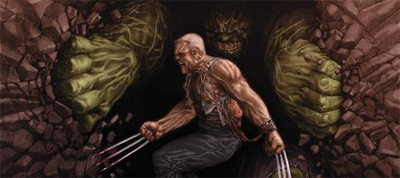
A hulkin' good time...

Continue reading

Astonishing X-Men Omnibus by Joss Whedon & John Cassaday

Why did I have to follow Grant Morrison?

– Joss Whedon’s email correspondence with Marvel

What with all that talk of Whedon directing The Avengers on the big screen, I decided it was worth checking out his run on one of the most enduring superhero teams of all time.

Is this a breakout hit?

Continue reading

Brian K. Vaughan’s Run on Ultimate X-Men – Vol. 5-6 (Hardcover)

Brian K. Vaughan is the accidental Ultimate X-Men author. Originally drafting a single arc to transition between Brian Michael Bendis and a potential arc by David Mack, his entire tenure was overshadowed by the near-constant suggestion that X-Men director Bryan Singer would be hijacking the title for a storyline or two. Neither of these two proposals came to pass, and Vaughan ended up working on the series for nearly two years. Perhaps because of the seemingly temporary nature of his stay – liable to end with any given arc – his run seems to lack overall consistency or direction. That isn’t to criticise his individual stories, which are arguably the best in the entire run of Ultimate X-Men, but an observation about the nature of Vaughan’s tenure.

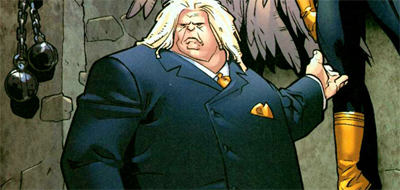
Mojo is big... in television...

Continue reading

New X-Men Omnibus by Grant Morrison (Review/Retrospective)

Every once in a while a creator lands a run on a mainstream comic which suits them to a ‘t’. There’s Alan Moore’s tenure on Swamp Thing and Frank Miller’s run on Daredevil, for example. Sure, both writers did great work with other characters on a stand-alone basis (notably Superman and Batman respectively), but these were generally individual arcs rather than directing three or four years of the characters’ stories. Having read New X-Men, I can confirm that Grant Morrison has found his own such series.

Is there beauty in the beast?

Continue reading

Robert Kirkman’s Run on Ultimate X-Men – Vol. 7-9 (Hardcover)

Ultimate X-Men is a tough title to get a read on. The fact that the run has been broken down into blocks by all manner of superstar writers means that there’s really no consistent underlying principle feeding through the eight-year life of the title. On the other hand, the fact that none of these big name writers like Mark Millar or Brian Michael Bendis could create a book living up to the series’ potential indicates that maybe there wasn’t a writer who could steward the book through its entire life cycle. Ultimate Spider-Man serves in many ways as a fulfillment of the promise of the Ultimate line, it’s almost a single, decade-long story of growth and development, the very evolution of a world of superheroes. Ultimate X-Men is very much the opposite, the constantly bending backwards over itself, jolting, starting and reversing as it seems unable to decide where exactly it’s going at any given moment. Robert Kirkman’s run is perhaps the best examples of the series’ strengths and ultimately (ha!) its weaknesses.

Somebody's been watching Terminator a bit too often...

Note: Some of Aron Coleitte’s work is covered in the Hardcover Volume 9 (with the rest of his short run spilling over into the Ultimatum Hardcover). If I can bring myself to pick up Ultimatum, I will run a review of his rather short tenure on the title. This review is only concerned with Kirkman’s run – up until the end of the Apocalypse arc.

Continue reading

Non-Review Review: X-Men Origins – Wolverine

Well, at least it’s an action movie that acknowledges its pointlessness. It isn’t a spoiler to point out that – since Wolverine doesn’t remember his origin in X-Men and has to reminded in X-Men II – none of the events here have any real importance to the character development of the Canadian superhero. The audience knows buying a ticket that anything he learns will be erased and lost and that the film itself is just an explosion-filled flashback which, even if had something worth saying, would be pointless anyway. That said, it does deliver somewhat convincing action sequences and two very good leading performances.

The other man of steel...

The other man of steel...

Continue reading