• Following Us

  • Categories

  • Check out the Archives


  • Awards & Nominations

Warren Ellis’ Run on Astonishing X-Men – Ghost Box, Exogenetic and Xenogenesis (Review/Retrospective)

This May, to celebrate the release of X-Men: Days of Future Past, we’re taking a look at some classic and modern X-Men (and X-Men-related) comics. Check back daily for the latest review.

Astonishing X-Men is an interesting book. It was originally launched to allow Joss Whedon and John Cassaday to work on an X-Men title that was (mostly) free from the confines of the wider Marvel Universe at their own pace. However, when – after considerable delays – it finally finished, it seemed quite tough to figure out what to do with the book. Astonishing X-Men was selling too well to cancel outright, and Marvel had the opportunity to capitalise on its popularity and acclaim.

Assigning writer Warren Ellis to the title was quite a clever decision. While Ellis might lack the broader pop culture cache of Joss Whedon, he is a known and respected comic book writer. Allowing Warren Ellis to cut loose on a title usually results in a delightfully chaotic and exciting comic book that manages to stand apart from just about any mess of continuity that might have spawned it.
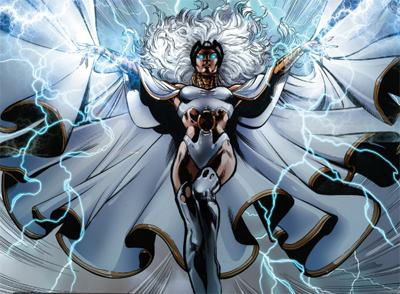
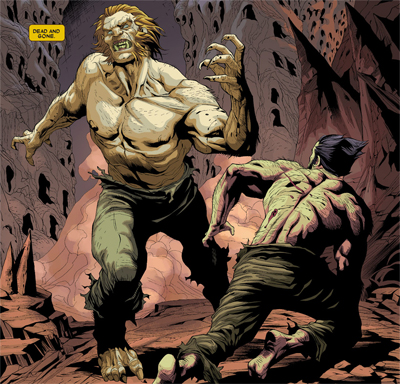
Storm warning...

Storm warning…

Ellis’ output on Astonishing X-Men is practically breathtaking. Ellis has a tendency to stay on mainstream superhero comics for relatively short runs. He worked on Secret Avengers for six months, and spent a year each on Ultimate Fantastic Four and Thunderbolts. Ellis tends to step into a superhero comic, shake things up rather brilliantly, and then walk away having made quite an impression. In many cases, Ellis’ short runs serve to define characters for years afterwards; look at Norman Osborn.

However, despite this reputation for short tenures on superhero comics, Ellis produced eighteen issues with the Astonishing X-Men brand; eleven issues of the main series, two issues of the Ghost Boxes miniseries and five issues of the Xenogenesis miniseries. That’s quite an impressive body of work. It is enough for a reasonably-sized omnibus collection. It allows Ellis a lot of room to play with his ideas, and also to make quite a mark on the central characters.
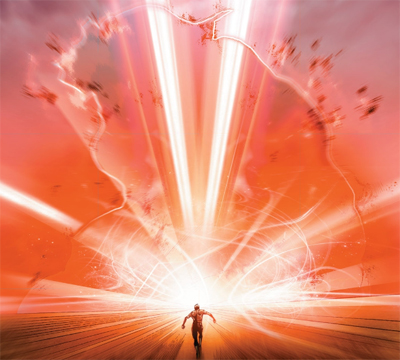
Having a blast...

Having a blast…

Continue reading

An Interview with Chris Claremont, Part V (of V)

All this week, to celebrate the release of X-Men: Days of Future Past, we’re publishing a serialised interview that we conducted with the wonderful Chris Claremont back in February for publication in a British comic book magazine. Many thanks to Mr. Claremont for taking the time to talk to us, and also to Adam Walsh for allowing us to publish this.

It’s hard to imagine Chris Claremont having too many regrets, something he readily concedes.

His work on the X-Men remains iconic and influential. His relationship with Marvel has provided an incredibly pay-off for the publisher.

“The benefits are still playing out in other media,” he explains. “The brutal fact of the matter is that there have been seven movies derived from the X-Men. My fingerprints in terms of characters, and circumstances and the approach to storytelling are all over them.”

xmenfirstclass8

Continue reading

X-Men: The End – Book Two: Heroes and Martyrs (Review/Retrospective)

This May, to celebrate the release of X-Men: Days of Future Past, we’re taking a look at some classic and modern X-Men (and X-Men-related) comics. Check back daily for the latest review.

To describe Chris Claremont’s three six-part miniseries that comprise X-Men: The End as “convoluted” is to miss the point. Of course they are convoluted. Claremont is essentially writing a gigantic epilogue to his work on Uncanny X-Men. He is tidying away decades of continuity and offering a sense of closure to his work on these characters and their world. Claremont is an exceptional storyteller when it comes to long-form serialised storytelling.

As a writer, Claremont tends to layer interesting twists on top of interesting twists, with every resolution opening up more avenues for future stories to explore. He has demonstrated an ability to string along plots for decades, revisiting characters and situations years after most readers had forgotten about them. These are the qualities that make his Uncanny X-Men run so deeply fascinating, but they are also the qualities that make him a bit of an awkward fit for a concept like The End, an epic miniseries built around the idea of wrapping up the entire X-Men mythos.

Some things never go into fashion...

Some things never go into fashion…

However, what is so fascinating about X-Men: The End is that all of the elements that Claremont uses are the same elements that he has been playing with since he took over Uncanny X-Men. The story beats have a familiar pattern to them, the themes are familiar, the characters speak as they did in the years that Claremont wrote them. What is fascinating about X-Men: The End is the way that it serves to really set Claremont’s take on the X-Men in stone, treating the elements associated with Claremont as a truly inexorable part of the comic’s mythology.

X-Men: The End is very much a Chris Claremont comic, through-and-through. That’s what makes it feel like such a perfect fit.

A wing and a prayer...

A wing and a prayer…

Continue reading

An Interview with Chris Claremont, Part IV (of V)

All this week, to celebrate the release of X-Men: Days of Future Past, we’re publishing a serialised interview that we conducted with the wonderful Chris Claremont back in February for publication in a British comic book magazine. Many thanks to Mr. Claremont for taking the time to talk to us, and also to Adam Walsh for allowing us to publish this.

Seventeen years is a long time in real life. It’s an eternity in comic book publishing.

Chris Claremont remained on Uncanny X-Men for seventeen years non-stop from 1975 through to 1991. Even Stan Lee only wrote The Amazing Spider-Man for a decade. It’s a phenomenal accomplishment, particularly in an industry where that sort of creative stability is uncommon.

Did Claremont have any idea at the time that he would be working on the title for that long? “I never thought I would stay on for seventeen years,” he freely admits. “I just never ran out of ideas. It was too much fun. They were my friends, I didn’t want to dump them and run away.

xmen-claremont2

Continue reading

An Interview with Chris Claremont, Part III (of V)

All this week, to celebrate the release of X-Men: Days of Future Past, we’re publishing a serialised interview that we conducted with the wonderful Chris Claremont back in February for publication in a British comic book magazine. Many thanks to Mr. Claremont for taking the time to talk to us, and also to Adam Walsh for allowing us to publish this.

The heart of Chris Claremont’s storytelling is character.

In talking about the iconic X-Men characters he helped to shape and define, he’ll often use their first names. Even minor characters like Thunderbird get referenced using their proper names.

“People are not picking up the book to see the action,” Claremont explains. “People are picking up the book to see the characters.” For Claremont, one of the keys to writing Uncanny X-Men for so long was remaining true to the characters.

wolverinesavethetiger7

Continue reading

Jason Aaron’s Wolverine – Wolverine, Vol. 4 (Review/Retrospective)

This May, to celebrate the release of X-Men: Days of Future Past, we’re taking a look at some classic and modern X-Men (and X-Men-related) comics. Check back daily for the latest review.

Jason Aaron’s work on the character of Wolverine is absolutely fascinating. The writer was written for Logan across a number of different books and in a number of different contexts. Indeed, his first professional comic book credit was on an eight-page story featuring the character. Since the publication of that first story, Aaron has enjoyed a long and productive relationship with Marvel’s most iconic mutant.

He has written Get Mystique for the third volume of Wolverine. He has written a number of miniseries featuring the character – including the tie-in Manifest Destiny miniseries and a six-part Astonishing Spider-Man and Wolverine miniseries. Along the way, he has provided a number of back-ups and short stories featuring the character. He also secured two different spin-offs for Wolverine –  the sixteen-issue Weapon X title and Wolverine and the X-Men.

Slice o' life...

Slice o’ life…

So Aaron and Wolverine work quite well together. It’s no surprise that Aaron was chosen as the writer to launch the fourth volume of Wolverine, shepherding the book to its three-hundredth issue. While his work on Wolverine might not be quite as brilliantly eccentric as Astonishing Spider-Man and Wolverine or as insanely fun as Wolverine and the X-Men, it does represent a rather thoughtful and insightful reflection on the popular comic book character.

After all, one of the recurring themes of Aaron’s work with Wolverine is the idea that a character who has lived to long – and one who has been published so frequently – must have seen and done almost everything by this point. The trick is to try and find something new and exciting for the character after all these years. In many respects, that is what is most interesting about Jason Aaron’s run on Wolverine: how much of the run exists to push the character into position for the next leg of his arc.

Villains of all Creeds down here...

Villains of all Creeds down here…

Continue reading

Non-Review Review: X-Men – Days of Future Past

X-Men: Days of Future Past works best as a paean for sixties optimism. A little bloated and messy, with not enough room for all its characters or side plots, X-Men: Days of Future Past could do with a trim or three. At the same time, it’s a very thoughtful and reflective blockbuster, pondering questions about innocence and idealism. There’s a sense that X-Men: Days of Future Past works better as a sequel to X-Men: First Class than it does an epilogue and critique of X-Men III.

Blue skies are gonna clear up...

Blue skies are gonna clear up…

Continue reading

Ed Brubaker’s Run on Uncanny X-Men – Divided We Stand (Review/Retrospective)

This May, to celebrate the release of X-Men: Days of Future Past, we’re taking a look at some classic and modern X-Men (and X-Men-related) comics. Check back daily for the latest review.

Divided We Stand actually feels like the start of something interesting for Ed Brubaker’s run on Uncanny X-Men. It’s a story arc that heralds a bold new direction for Marvel’s merry mutants in the wake of Messiah Complex, taking the team out of their comfort zone and suggesting that Uncanny X-Men will be moving a little outside its comfort zone and trying something different. It’s a story arc that sees the team reflecting on the past and considering the future.

So, naturally, it is Ed Brubaker’s last solo arc on Uncanny X-Men.

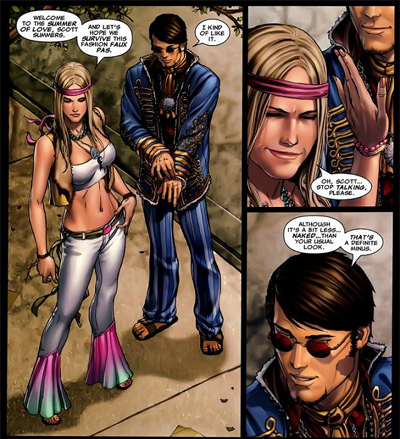
A bad trip?

A bad trip?

Continue reading

An Interview with Chris Claremont, Part I (of V)

All this week, to celebrate the release of X-Men: Days of Future Past, we’re publishing a serialised interview that we conducted with the wonderful Chris Claremont back in February for publication in a British comic book magazine. Many thanks to Mr. Claremont for taking the time to talk to us, and also to Adam Walsh for allowing us to publish this.

Chris Claremont’s studio looks a lot like you might expect.

Joining me online for a conversation about his work, the webcam allows me a glimpse of Claremont’s working area. As befits the man who wrote Uncanny X-Men (along with quite a few spin-offs and tie-ins) for seventeen years, the place is overflowing – with what look like notes and sketches, stories and ideas.

Some of these many papers are filed away neatly into boxes, some are sorted into giant stacks, some threaten to break free and consume their creator whole. Much like Claremont’s imagination and energy, these pieces of paper seem infinite – far too much to be contained in the space afforded.

It isn’t only Claremont’s study that evokes his creative process. He talks in a style familiar to anybody who has ever read any of his work. Answering the onslaught of questions, Claremont remains articulate and clever – often answering with wry wit and a knowing smile.

Subjects mentioned in passing become vitally important later on. Stories go in directions you don’t expect. What starts as a joke ends with an honest insight; what begins as profound statement ends with a clever punchline.

uncannyxmen-daysoffuturepast15

Continue reading

Nick Spencer’s Run on Ultimate Comics: X-Men (Review/Retrospective)

This May, to celebrate the release of X-Men: Days of Future Past, we’re taking a look at some classic and modern X-Men (and X-Men-related) comics. Check back daily for the latest review.

Strangely enough, it’s the second relaunch of the Ultimate comic book line that feels like it is finally dealing with Ultimatum. Jeph Loeb’s “kill ’em all and let editorial sort ’em out” event had served as the catalyst of a relaunch for the entire line, ending long-running books like Ultimate Spider-Man, Ultimate Fantastic Four and Ultimate X-Men. The line was re-tooled and re-focused and relaunched following that event.

However, that relaunch quickly fizzled out. Mark Millar’s run on Ultimate Comics: Avengers could not quite measure up to the dizzying heights of his original run on The Ultimates. Jeph Loeb’s Ultimate Comics: X shipped sporadically at best and his run on Ultimate Comics: New Ultimates was something of a mess. Meanwhile, Brian Michael Bendis continued his run on Ultimate Comics: Spider-Man as if nothing much had changed.

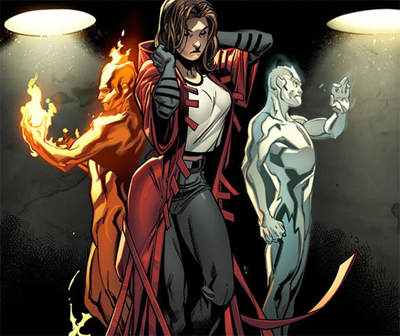
A song of ice and fire...

A song of ice and fire…

Oddly enough, it was the second relaunch that seemed to click. Coming out of The Death of Spider-Man, the slate was cleaned and the various books all got new beginnings. Jonathan Hickman took over Ultimate Comics: The Ultimates, Nick Spencer helmed Ultimate Comics: X-Men, while Brian Michael Bendis launched Miles Morales in a new volume of Ultimate Comics: Spider-Man. This was a very real shift in the status quo, and one that marked a clear departure from what came before, with bold new vision.

One of the more interesting attributes of the latest relaunch of the Ultimate line was the sense of heightened continuity between the various books. In particular, Jonathan Hickman’s run on The Ultimates overlapped quite heavily with Nick Spencer’s work on X-Men. As a result, the first year of each of the three titles seemed to be building towards Divided We Stand, a massive crossover between the various titles.

Sentinels-of-not-quite Liberty...

Sentinels-of-not-quite Liberty…

Spencer’s X-Men doesn’t work quite as well as Hickman’s Ultimates, suffering from the fact that nothing seems to get resolved. Dealing with a massive cast and an epic scope, Spencer’s Ultimate Comics: X-Men spends its first year establishing where all of its characters are and how their situations reflect on the larger story that is in motion. It’s an ambitious storytelling model, as Spencer crafts one big story from the ground (or the sewers) to the heights of the Oval Office, but it means that everything is barely set up before it is time to knock it down again.

Spencer’s Ultimate Comics: X-Men is a run with no shortage of great ideas and impressive scale, but one that suffers from the fact that the writer never gets to follow through on the world that he has built.

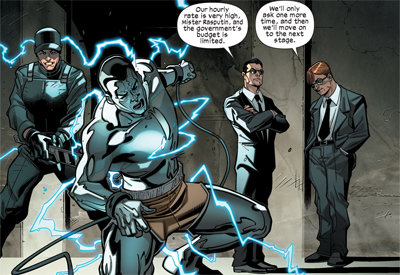
Shocking treatment...

Shocking treatment…

Continue reading