• Following Us

  • Categories

  • Check out the Archives


  • Awards & Nominations

The X-Files: Season One (Topps) #7 – Fire (Review)

We’ve recently finished our reviews of the nine seasons of The X-Files. Along the way, we tried to do tie-ins and crossovers and spin-offs. However, some of those materials weren’t available at the right time. So this week will be spent finishing Topps’ line of “Season One” comics, published during the fifth season in the lead up to The X-Files: Fight the Future.

Space was perhaps the best of Topps’ Season One line of comics, a version of the first season episode that came much closer to realising the potential of Chris Carter’s outer space mystery than anything that appeared on a television screen during the show’s first year. In a way, Space suggested a possible sustainable model for the Season One line of comics beyond a rather cynical attempt to have two separate X-Files comics running in parallel. What if the Season One line could be used to “fix” stories that had misfired the first time around?

This makes a certain amount of sense. After all, there is little point in just rehashing the show’s strongest moments. The comic adaptation of Beyond the Sea might entertain, but it will never be the definitive or stronger example of that story. The comic adaptations lack the chemistry of David Duchovny and Gillian Anderson, but they do have an unlimited visual effects budget and the ability to filter a story through a unique artistic sensibility. So perhaps Season One should not fixate on a “greatest hits” tour of the first season, but should instead focus on the misfires.

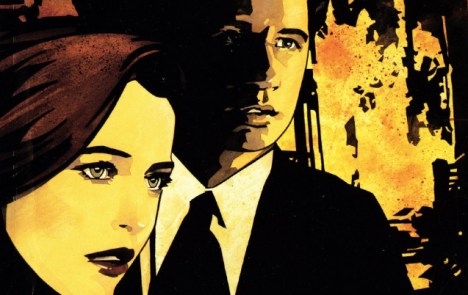
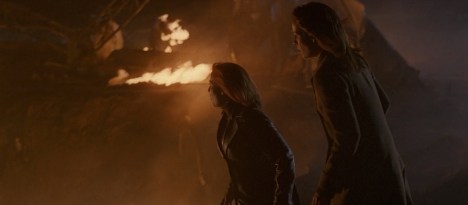
Burn with me...

Burn with me…

Continue reading

The X-Files – Season 9 (Review)

This December, we’re taking a trip back in time to review the ninth season of The X-Files.

Very few television shows end when they should.

As much as television might be an artistic medium, it has generally been governed by commercial realities. The length of a television episode is not determined by the volume of the story that needs to be told, but is dictated by the slot allocated it with room left over for advertising. The length of a season is typically negotiated between the demands of the creative team and the needs of the network. Popular shows are seldom allowed to retire at a natural end point, but are instead extended until they reach viable syndication figures or the audience loses interest.xfiles-improbable30a

Things are changing, to a certain extent. The emergence of cable television has allowed creators a greater degree of freedom in how they want to tell their stories. Television series are allowed to wrap up on their own terms, even when they are at the height of their popularity. There is even a bit more give-and-take when it comes to scheduling shows that do not fit comfortably within the standard hour-long block. This allows shows like Breaking Bad, The Sopranos and Mad Men the chance to conclude at a point where it is organic to do so.

However, this was not the television landscape in which The X-Files emerged. Although it helped shape and define television in the nineties, The X-Files was very much a product of the network television system. That meant extended season runs, but it also meant that the show was sustained as long as it remained popular. Due to the fact that television audiences tend to drain rather than spontaneously disappear, this meant that the show was arguably extended years past an organic end point. Indeed, The X-Files had several logical end points.

xfiles-johndoe7a

The plan was to wrap things up after five seasons, meaning that The End might have been the end, and that the show might never have moved from Vancouver to Los Angeles. However, the show was extended for two seasons as ratings declined from their peak. At the end of the seventh season, Requiem was written and filmed before anybody knew there would be an eighth season. A disastrous television season forced Fox to renew the show. The eighth season ended with Mulder and Scully in a happy place in Existence, but was such a success that Fox greenlit a ninth season.

It is interesting to wonder what might have become of The X-Files had the show ended at any of those three logical end points. Would the show be more fondly remembered? Would the general consensus be that the series had ended in a reasonable place? Would fans be relatively satisfied with what had been offered? Would recommendations of the show be a lot less guarded than they would become in the years ahead? There is no way to know the answers to any of these questions. However, there is no getting around the fact that the ninth season is a disaster.

xfiles-sunshinedays15a

Continue reading

The X-Files – The Truth (Review)

This December, we’re taking a trip back in time to review the ninth season of The X-Files.

It is interesting how the popular memory of a thing can differ from the actual thing itself.

Memory was always a key theme of The X-Files, particularly in the early years of the show. Although the aliens and the conspirators were plucked from the demented imaginations of the most paranoid tinfoil hat enthusiasts, a surprising amount of the show was rooted in real history that had been allowed to slip by under the radar: the genocide of the Native Americans; the resettlement of German and Japanese war criminals after the Second World War; radiation experiments upon prisoners; the Tuskegee syphilis experiment.

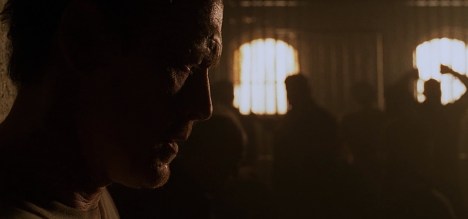
Daddy's home.

Daddy’s home.

The truth is contained in the gap between memory and history. In a way, then, it feels entirely appropriate that the popular memory of The X-Files should remain quite distinct from the show itself. The popular memory of The X-Files tends to suggest that the mythology makes no sense, that it does not fit together in any tangible form. This is an opinion repeated so often that it has become a critical shorthand when discussing the end of the show; much like the assertion “they were dead all along” tends to come when discussing Lost.

The truth is that the mythology of The X-Files largely made sense. Sure, there were lacunas and contradictions, inconsistencies and illogicalities, but the vast majority of the mythology was fairly linear and straightforward. It had been fairly straightforward for quite some time. The show had been decidedly ambiguous in its first few seasons, only confirming that colonisation was the conspiracy’s end game in Talitha Cumi at the end of the third season. Elements like the black oil and the bees tended to cloud matters, but the internal logic was clear.
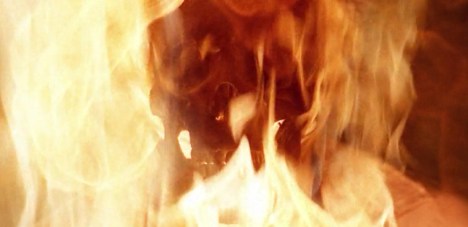
Everything burns...

Everything burns…

Significant portions of both The X-Files: Fight the Future and Two Fathers and One Son had been dedicated to spelling out the finer details of the mythology in great detail. Mankind were not the original inhabitants of Earth; the former occupants had returned and were making a rightful claim; the conspirators had agreed to help them, selling out mankind for a chance to extend their own lives. Everything else was window dressing. The production team had laid everything out during the fifth and sixth seasons.

Still, the general consensus of The X-Files was that it was a show driven by mysteries that was always more interested in questions than answers. This was certainly true, but it was somewhat exaggerated. When the cancellation was announced, the media immediately demanded answers. A month before The Truth was broadcast, Tim Goodman complained about how the show offered “precious few answers to Carter’s riddles.” Two days before the broadcast, Aaron Kinney wondered of the conspirators, “Who are these people and what is their agenda?”
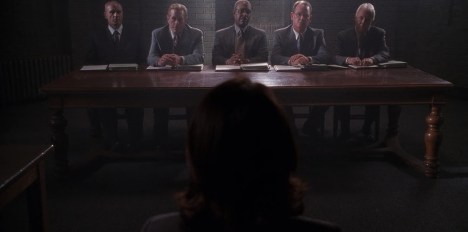
The Truth on trial...

The Truth on trial…

It does not matter that these answers have mostly been provided and that the truth is mostly know. This was the context of the conversation unfolding around The Truth, and it likely explains a number of the creative decisions taken during the production of the episode. The Truth plays as an extended video essay dedicated to providing answers that were offered three or four seasons earlier in relation to mysteries that are no longer part of the show. The Truth is a passionate and intense argument that the mythology of The X-Files does make sense.

For viewers tuning back into the show for the first time in years, this means long expository monologues and skilfully edited montages that do not tie into the plot of the episode in any significant way. For those who stuck with the show for these past few seasons, it means rehashing everything that the show has taken for granted since the fifth or sixth season. While it feels like The Truth is desperately longing for vindication, to the extent where the show puts itself on trial in the person of Fox Mulder, this does not make for compelling viewing.

Happy ending.

Happy ending.

Continue reading

The X-Files – Sunshine Days (Review)

This December, we’re taking a trip back in time to review the ninth season of The X-Files.

Well, here’s hopin’ the TV stays off and he learns how to love the real world.

– Doggett stops just short of adding “… and that goes for you as well.”

The X-Files was always a more romantic show than it would readily admit.

The popular image of the show might be Mulder and Scully walking through darkness searching for a truth that may never be revealed or a hideous monster preying upon innocent victims. Chris Carter’s most successful work might be rooted in the dual betrayals of Watergate and Vietnam. The characters might stalk car parks late at night or explore the darkest corners of the urban landscape. Mulder and Scully might be abducted by forces beyond their control, and subjected to the cruel whims of uncaring fate. The show’s motto might be “trust no one.”

"Let's call it a day..."

“Let’s call it a day…”

Nevertheless, that cynicism is offset with a deep-seated romance. “Trust no one” is one of the defining mantras of The X-Files, but there are other more optimistic catchphrases; “I want to believe” and “the truth is out there.” Optimism outvotes cynicism by a two-to-one majority. It is not quite a decisive victory, but it is something in this cynical and chaotic world. While Mulder and Scully might never actually find the truth which they so desperately seek, they did find one another. That is more than either could have hoped and than some people can claim.

Sunshine Days is a staggeringly romantic and optimistic piece of television. Indeed, it suggests that the cynicism of The X-Files was really just a practiced veneer. As the title suggests, Sunshine Days allows the central cast to smile more frequently over forty-five minutes than most have in the course of their entire run on the show. As with the rest of the show, Sunshine Days is rooted in the culture of the seventies. However, there is something quite heartwarming in how Vince Gilligan eschews All the President’s Men for The Brady Bunch.

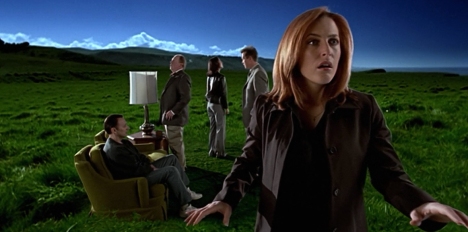
Out of this world...

Out of this world…

Continue reading

The X-Files – Release (Review)

This December, we’re taking a trip back in time to review the ninth season of The X-Files.

Release is a breath of fresh air.

There are problems with the episode, serious problems. The plotting is incredibly loose, with Release relying upon a series of incredible contrivances even once you get past the supernaturally-gifted crime-solver who only joined the FBI so he could solve a murder that happens to connect back to Luke Doggett. At best, Release is clumsy and inelegant. At worst, it makes absolutely no sense. More than that, there is the question of whether or not the episode is actually necessary. Does The X-Files actually need to resolve the murder of Luke Doggett?

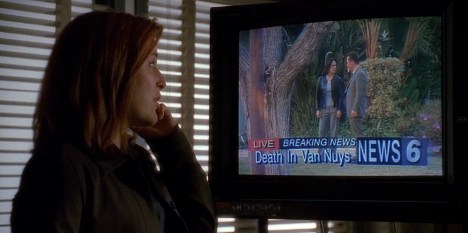
Picture perfect...

Picture perfect…

These are fairly sizable and fundamental problems. There is no getting around them. However, Release offsets those problems by being a spectacularly-produced piece of television. Everything works, from Robert Patrick’s performance to Mark Snow’s piano-heavy score to Kim Manner’s stylised direction. Release is a reminder of just how sleek and well-oiled The X-Files could be. That is quite a relief after the triple whammy of Scary Monsters, Jump the Shark and William. Release is a good episode on its own terms; in context, it is a masterpiece.

It also helps that Release feels like the first attempt to give the show actual material closure since Improbable. That closure is thematic rather than literal, with the mystery of Luke Doggett’s death serving as a vehicle through which the show might finally resolve some of its own lingering threads. In the case of Release, the show is tidying away the strands that have been woven into the fabric of The X-Files from the beginning; strands that paid homage to Silence of the Lambs and gave birth to Millennium. Release bids farewell to the forensic side of The X-Files.

The old man and the sea...

The old man and the sea…

Continue reading

The X-Files – Jump the Shark (Review)

This December, we’re taking a trip back in time to review the ninth season of The X-Files.

As The X-Files trundles towards its finalé, there is a sense that the production team do not understand “closure.”

There is, of course, a cheap gag to be made here. Long-time fans of the show might joke that the show never understood the concept of “closure”, as demonstrated by the fact that the show’s mythology frequently resembled a precariously-balanced tower of Jenga bricks gently swaying in a light breeze. This is perhaps a bit unfair; episodes like Requiem and Existence had done a good job of bringing the television show to a point where it might end, only for the show to be picked up for another season.

Shot down in their prime... time slot.

Shot down in their prime… time slot.

The end of the ninth season differs from the ends of the seventh or eighth because the production team know that the show is going to end. There will be no last-minute reprieve, no green-light give mere days before the last episode is actually broadcast. This is, in many ways, the end of The X-Files. With that in mind, the final episodes of the ninth season begin tidying away dangling plot threads and narrative loose ends in the hopes of satisfying the audience. The show seems to be running through a checklist. Lone Gunmen now. William next. Luke Doggett after that.

The problem, of course, is that none of these concepts are really calling for definitive “closure.” There is no reason for the show to draw a line under these supporting characters or plot arcs. It is possible for fans to imagine life beyond a television show for many characters without engaging in ruthless pruning. The Lone Gunmen do not need an epic send-off. In fact, the idea of an epic send-off seems to represent a misunderstanding of the characters themselves.

"Chris Carter said we're invited to the wrap party..."

“Chris Carter said we’re invited to the wrap party…”

Continue reading

The X-Files – Improbable (Review)

This December, we’re taking a trip back in time to review the ninth season of The X-Files.

So I am convinced, from many experiments, I could not study to any degree of perfection either mathematics, arithmetic or algebra without being a deist, if not an atheist.

– John Wesley, The Use of Money

Dio ti ama.”

God loves you. A nice though. An ordering principle.

Three simple words.

There are worse Gods to believe in.

There are worse Gods to believe in.

Continue reading

The X-Files – Underneath (Review)

This December, we’re taking a trip back in time to review the ninth season of The X-Files.

Nothing like cancellation to get the vultures circling.

It is the nature of television that not every episode ends up exactly the way that the production team would like. Working on a tight deadline with a limited budget, compromises have to be made. Sometimes, there is not enough time to properly polish a script so that it makes sense. Other times, the special effects have to be rushed. Churning out twenty-odd episodes in a season demands a lot of the production team, and it seems impossible to maintain a perfect record across a full season.

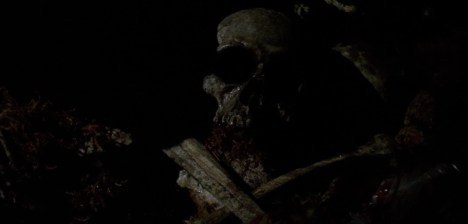
Skull and bones..

Skull and bones…

The X-Files might have held itself to the highest production standards, but there are inevitable missteps along the way. Fearful Symmetry is about invisible zoo animals because there is no way that the show could be about visible zoo animals. Teso dos Bichos had difficulty wrangling its cats. The special effects work on Tunguska came so close to the wire that people in different parts of the country actually saw different cuts of the episode. Parts of Christmas Carol had to be reshot when the child actor proved unreliable in Emily.

These are the realities of television production. It is not always pretty, and the result is not always fantastic, but it gets done. Fans and commentators have a tendency to overlook these problems when they occur at the height of the show. They are less forgiving when they occur past the show’s prime.

Crosses to bear...

Crosses to bare…

Continue reading

The X-Files – Audrey Pauley (Review)

This December, we’re taking a trip back in time to review the ninth season of The X-Files.

One of the surprising aspects of the ninth season is just how strong the episodes centring on Doggett and Reyes are.

True, there are not necessarily too many “all-time classic” episodes to be found across the length and breadth of the ninth season; that is arguably true of every season since the sixth. The strongest episodes of the ninth season tend to be those focusing on the two new lead characters actually doing their jobs and navigating the weird world around them. 4-D, John Doe, Hellbound and Audrey Pauley rank among the very best that the ninth season has to offer. The biggest problem with the ninth season is the difficulty that the show has maintaining that level of quality.

Into the void...

Into the void…

The ninth season never manages any real consistency. It never commits to one vision of the show or the other. While the stronger episodes suggest that The X-Files might be ready to move on past Mulder and Scully to embrace Doggett and Reyes, the show always returns to insisting that Mulder is still the most important character on the show despite David Duchnovny’s reluctance to return. Nothing Important Happened Today I featured David Duchovny’s stunt butt before Gillian Anderson, Robert Patrick or Annabeth Gish. That is the show’s priority.

This becomes particularly troublesome in the second half of the season. Steven Maeda seems to have a great deal of luck in his ninth season writing assignment, tackling episodes that wind up taking on a larger symbolic importance. 4-D was the first episode to be both produced and broadcast after the events of 9/11, due to scheduling choices that pushed Hellbound later into the season. Although Nothing Important Happened Today I was broadcast nearly two months after the attacks, the production team were actually working on Dæmonicus when news broke.

"Woops. Sorry. Wrong wall."

“Woops. Sorry. Wrong wall.”

Audrey Pauley winds up being the first episode to be produced and broadcast after the cancellation of The X-Files had been announced. The public had been informed of the cancellation between the broadcast of John Doe and Hellbound. The production team had found out while working on Scary Monsters. Due to scheduling choices, Scary Monsters had been pushed back later into the season and Audrey Pauley was aired first. Although it is quite likely Maeda was working on Audrey Pauley long before the cancellation, it still echoes through the work.

Audrey Pauley plays into some of Maeda’s core themes, suggesting alternate and pocket realities that navigate the void between life and death. As with 4-D, Audrey Pauley is very much a post-9/11 episode of The X-Files. However, it is also very much a post-cancellation episode of The X-Files.

Now, where have I seen this before?

Now, where have I seen this before?

Continue reading

The X-Files – Providence (Review)

This December, we’re taking a trip back in time to review the ninth season of The X-Files.

It is frequently argued that 9/11 killed The X-Files.

There are two sides to this argument. The most defensible side suggests that audiences simply lost all appetite for conspiracy and paranoia when confronted with an atrocity on that scale; that viewers wanted to be comforted and reassured about authority in the wake of the attacks. This argument is perhaps supported by the significant drop in viewers between Existence and Nothing Important Happened Today I, suggesting that the audience simply wasn’t interested in finding out what the ninth season had to offer – regardless of quality.

Oh your gods...

Oh your gods…

The other side of the argument suggests that the production team themselves were ill-equipped to deal with post-9/11 reality. The X-Files was a show rooted in the cultural context of the nineties, and had just been asked to adjust to a seismic shift. The world had changed dramatically over the course of a few hours on a morning in Autumn. The eighth season had seen the show drift away from government conspiracies and towards a more conventional alien invasion narrative, one that could play as a reactionary fantasy of the War on Terror.

The ninth season aired in the immediate aftermath of 9/11. The season was actually in production when the attacks took place, with the team halting work on Dæmonicus as the reports came in. While the ninth season does not necessarily have a coherent and rational response to those events, it is clear that the production team want to say something. Much of the ninth season mythology seems to struggle with what it wants to say and how best to say it.

Fire and brimstone...

Fire and brimstone…

Continue reading