• Following Us

  • Categories

  • Check out the Archives


  • Awards & Nominations

Millennium – Exegesis (Review)

This July, we’re taking a trip back in time to review the sixth season of The X-Files and the third (and final) season of Millennium.

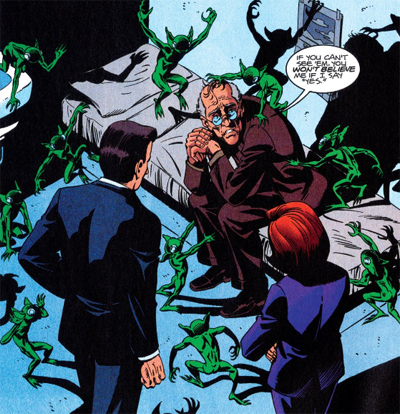
It is odd to think of The Innocents and Exegesis as a two parter, despite the explicit “to be continued” that bridges the two episodes.

The Innocents is very much a straightforward procedural episode, with Frank rejoining the FBI and investigating a string of mysterious occurrences that are all connected. As Frank tries to pull himself back together after the death of his wife, various parties insist that he is more lost than ever before. There is a sense that Frank needs to work though what happened to him, regardless of the doubts expressed by his embittered father-in-law or his friendly supervisor at the FBI. Of course others doubt him, and of course he works through those doubts.
"I can see it all clearly..."

“I can see it all clearly…”

It is very much a standard “lead character gets his life back together” story, complete with obligatory sequence where Frank demonstrates he has made his peace with the loss of Catherine by using his story as emotional leverage to ply a confession (or, at least, an explanation) from a person of interest in the on-going investigation. The Innocents is a very banal and paint-by-numbers episode of television. Underneath all those biohazard warnings and eerie blue-eyed siblings, there is a strong procedural element to The Innocents. It feels trite and coy.

At the very least, Exegesis is more unique. It feels like an episode of Millennium, rather than some generic dime-a-dozen procedural. This is likely down to the fact that The Innocents was written by Michael Duggan and Exegesis was written by Chip Johannessen. Michael Duggan was a writer who had a lot of experience on procedurals (Law & Order and C-16: FBI), but who had no prior experience writing Millennium. Hired to run the show in its third year, he would only write two scripts for the show before departing seven episodes into the season.

Go fly a kite...

Go fly a kite…

In contrast, Chip Johannessen had helped to define Millennium’s identity in its first year. In fact, with a group of nearly identical female sisters working towards a mysterious goal (based on vague prophecy), Exegesis owes a great deal to Johannessen’s earlier script Force Majeure. While it does illustrate how Exegesis feels like a more traditional Millennium episode than The Innocents, it is not a comparison that does Exegesis any favours. Force Majeure was one of the best episodes the show ever produced; Exegesis is… not.

As with The Innocents, Exegesis is handicapped by a lot of the clumsy production decisions made at the start of the third season. It feels curiously disconnected from what came before; it plays a little too much like a reheated leftover from The X-Files; a lot of the nuance and development given to Peter Watts and the Millennium Group over the second season is washed away. Nevertheless, it does have a clearer sense of purpose and energy than The Innocents. It feels like Johannessen knows what he wants to say, even if the show is still tripping over itself.

Welcome back, Frank.

Welcome back, Frank.

Continue reading

John Rozum and Alex Saviuk/Charles Adlard/Gordon Purcell’s Run on The X-Files (Topps) (Review)

This May and June, we’re taking a trip back in time to review the fifth season of The X-Files and the second season of Millennium.

It is amazing to think that Topps’ licensed comic book tie-in to The X-Files lasted three-and-a-half years, let alone that it was such a success that it spawned a second on-going series, a miniseries and a considerable volume of one-shots and digests and annuals. If anything, Topps enjoyed greater success exploiting the license than even IDW has – despite the fact that Topps was a relatively young company with minimal experience in comic book publishing while IDW has a reputation for (and a lot of experience at) skilfully leveraging these sorts of tie-in properties.

This success would be remarkable in any context, but the comic book succeeded at a time of turmoil for the entire comic book industry. The late nineties were not a good time for comics, with the speculation bubble imploding and Marvel filing for bankruptcy. The success of Topps’ X-Files comic book is in many way a triumph of the brand, yet another reminder of how the series was on top of the world. There were lots of others – the ratings, the film, the tie-in video game – but the success of the comic was part of the narrative of The X-Files at this stage of its life.

xfiles-remotecontrol10

The comics themselves are actually surprisingly good. There is a reason that one of the first things that IDW did upon receiving the license was to publish “classic” collections of these comics. One of the more interesting aspects of the monthly series was the way that it managed to feel like The X-Files while still seeming suited to the medium in question. Stefan Petrucha and Charles Adlard pitched their run as something akin to a Vertigo comic, feeling like a crossover between The X-Files and the work of Grant Morrison or Neil Gaiman.

The influences on John Rozum’s run are a lot less ambitious. Time and time again, Rozum seems to position his run on The X-Files as a rather strange hybrid between the first season of the television series and pulpy fifties horror comics. There are quite a few stories in Rozum’s run that might easily be read alongside Fantagraphics’ E.C. Comics archives, albeit guest starring Mulder and Scully. (And modern fashions. And phones. And so on.) It is a perfectly reasonable and legitimate way to approach the idea of “X-Files comic books.”

xfiles-beprepared3

Indeed, it seems especially reasonable given the existing tensions between Ten Thirteen and Topps over the comics. The relationship had been fraught since the early days of the comic, with Ten Thirteen objecting to both Petrucha’s dense and ambitious plotting and Adlard’s moody and atmospheric art. Petrucha was fired from the title after sixteen issues, while Adlard was phased out in favour of better likeness artists like Gordon Purcell or Alex Saviuk. Ten Thirteen wanted a safer and more conventional comic book under Rozum’s pen, and they got it.

While it is easy to understand why these creative decisions were made, it does not make them any more palatable. Rozum’s work on The X-Files is generally quite consistent and occasionally even impressive. But it seldom seems ambitious or exciting. Under Petrucha, the tie-in comic carved out its own space that intersected with the parent show. Under Rozum, the comic book seems to do nothing but skirt the margins.

xfiles-cropduster2

Continue reading

Non-Review Review: The X-Files – Fight the Future

The X-Files: Fight the Future is often described as the mythology episode that somehow got released into theatres. In her review, Joyce Millman teased that Fight the Future was little more than “a two-hour episode of the show, except with better production values and a nicer wardrobe for Scully.” It is a fair point. It is not too hard to imagine a slightly cheaper version of Fight the Future split into two parts and replacing The End and The Beginning as the two-parter bridging the fifth and sixth seasons of the show.

Certainly, Fight the Future retains the late-stage mythology’s reluctance to provide any real sense of closure to the long-running plot about alien invasion and colonisation. Writers Chris Carter and Frank Spotnitz increase the stakes by using some of that sweet blockbuster money to pay for a gestating alien fetus, but what do Mulder and Scully actually accomplish? What would a viewer jumping from The End to The Beginning miss, except for the fact that the Well-Manicured Man has left the mortal plane to visit that great Somerset estate in the sky?

What you've all been waiting for, admit it...

What you’ve all been waiting for, admit it…

The answer is nothing, but that is not the point. As much as Fight the Future enjoys playing with the trappings of the mythology (black oil! bees! tanker trucks! space ships! Oklahoma City!), the film is only interested in the idea of alien colonisation as a vehicle to explore the show’s central relationship. Carter and Spotnitz have shrewdly realised that Fight the Future will have the largest possible audience for the show, and has decided to give the general public what they want.

As a two-hour mythology episode, Fight the Future leaves a lot to be desired. As a two-hour Mulder and Scully ship tease, it is right on the money.

Buried secrets...

Buried secrets…

Continue reading

The X-Files – The End (Review)

This May and June, we’re taking a trip back in time to review the fifth season of The X-Files and the second season of Millennium.

The End is a watershed moment for the show.

There is a reasonable argument to be made that The End accomplishes very little in terms of narrative. It doesn’t really do a great job bridging to The X-Files: Fight the Future. It certainly doesn’t do a great job wrapping up any of the show’s long-running concerns. Indeed, it adds two characters who will go on to become major (if controversial) players in the show’s overarching mythology. Even the big dramatic twist at the end of the episode feels familiar, with The End closing on a more memorable visualisation of the cliffhanger to The Erlenmeyer Flask.

Burn, baby, burn...

Burn, baby, burn…

Nevertheless, The End does feel like an end of sorts. It closes out five seasons of The X-Files. Carter had suggested in interviews that he only wanted to do five seasons of the show before transitioning into feature films, and so The End marks the conclusion of the run that Carter had originally planned for the show. After all, The X-Files had crossed the hundred episode mark earlier in the year. It was ripe for syndication. It was at the stage where Fox and Ten Thirteen did not need to keep the show on the air to keep printing money.

At the same time, The End marks another more definitive sort of end. It would be the last piece of The X-Files to be filmed in Vancouver until The X-Files: I Want to Believe a decade later. Vancouver was a part of the show’s DNA. It had been the show’s production hub since The Pilot. More than two decades later, The X-Files would return to Vancouver for its six-episode wrap-up miniseries. Discussing the revival, Carter argued that Vancouver was “a natural place to make a show like The X-Files.” Certainly, the mood and atmosphere lent itself to the series.

"My video collection!"

“My video collection!”

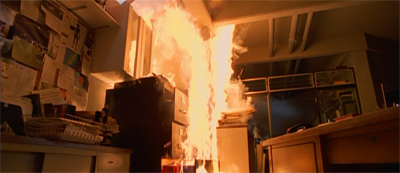
So The End marks a fond farewell from the production team to a city and region that had served them well.  In that respect, it feels like a more definitive sort of ending. The End opens with a scene that is confident enough to let Canada be Canada. As with the opening scene of Herrenvolk, it is almost comical how hard The End flags its “and starring Canada as Canada” cred, to the point where a mountie rushes to the aid of an assassination victim. The closing scene of The End burns down the show’s most iconic and memorable sets.

While The End is not necessarily a satisfying mythology episode or season finalé in its own right, it does feel like a suitably big moment in the evolution of the show.

Smoking gun...

Smoking gun…

Continue reading

The X-Files – Folie à Deux (Review)

This May and June, we’re taking a trip back in time to review the fifth season of The X-Files and the second season of Millennium.

Folie à Deux is the last stand-alone episode of the fifth season, and the last stand-alone episode to be produced in Vancouver. It is also a pretty essential episode before The X-Files: Fight the Future, reinforcing just how essential Mulder and Scully are to one another shortly before the movie threatens to break them up for good.

Folie à Deux is also one of Vince Gilligan’s most underrated scripts from the show’s entire run, a thoughtful examination of the relationship between Mulder and Scully that provides a clever counterpoint to his script of Bad Blood. If Bad Blood was essentially a story about how Mulder and Scully see the universe differently, then Folie à Deux represents an attempt to heal that rift, perhaps suggesting that Mulder and Scully have come to share their own unique form of madness.

Bugging Skinner...

Bugging Skinner…

Continue reading

The X-Files (Topps) #40 – Devil’s Advocate (Review)

This May and June, we’re taking a trip back in time to review the fifth season of The X-Files and the second season of Millennium.

Devil’s Advocate is a perfectly serviceable comic.

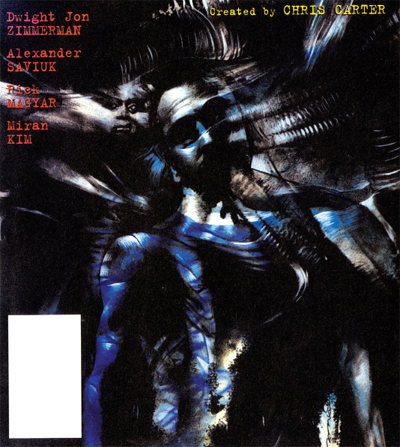
Its most distinguishing feature is the fact that it was not written by John Rozum, even though the art is provided by Alex Saviuk. This is not the first time that Rozum had taken a break from the monthly title. Writer Kevin J. Anderson had substituted in for Family Portrait, providing a quick two-issue fill-in rather early in the run. Here, executive editor Dwight Jon Zimmerman steps in to script the issue, possibly freeing up Rozum to finish work on the adaptation of The X-Files: Fight the Future that Topps planned to publish to mark the release of the film.

Ghosts in the machine...

Ghosts in the machine…

Dwight Jon Zimmerman was an industry veteran. He had worked at Marvel during the late eighties, writing for characters like Spider-Man and Wolverine. He joined Topps when they announced their plan to expand into the world of comic book publishing. Zimmerman worked as both an executive editor and as a writer. He worked on the company’s Mars Attacks! line. He also wrote Once Upon a Time…, the illustrated biography of Princess Diana that was published by the company in 1997.

Zimmerman’s interests tend towards the military. He has written articles on American military history for American Heritage, the Naval Institute Press, and Vietnam Magazine. He served as President of the Military Writers’ Society of America. As such, it is no surprise that Devil’s Advocate plays to those strengths. It is an old-fashioned “military cover-up” story, with little to distinguish or define it from dozens of similar stories told using these characters over years and years.

"This is why we should go rafting in the daytime, Scully."

“This is why we should go rafting in the daytime, Scully.”

Continue reading

The X-Files (Topps) #39 – Scum of the Earth (Review)

This May and June, we’re taking a trip back in time to review the fifth season of The X-Files and the second season of Millennium.

Scum of the Earth taps right into the sweet spot for John Rozum’s sensibilities.

Rozum’s work on Topps’ monthly X-Files comic book might not have been quite as ambitious as that of his predecessor, but he had his own areas of interest and recurring themes. Scum of the Earth provides the perfect intersection between the classic horror comic aesthetic of stories like The Kanashibari and Donor and the more environmentally-conscious storytelling of scripts like Skybuster or Cam Rahn Bay. It is essentially a retelling of The Blob starring Mulder and Scully, in which the blob is created by toxic waste and bio-terrorism.

The green death...

The green death…

Scum of the Earth is not particularly elegant in its storytelling. Rozum’s script covers a lot of ground in the space of a single issue, presenting Mulder and Scully with a crisis that could easily threaten the entirety of the United States. it genuinely feels like Mulder and Scully have wandered into some lost fifties b-movie, capturing a lot of the atmosphere to which Ivan Reitman seemed to aspire by casting David Duchovny in Evolution a few years later. Scum of the Earth is an exceedingly silly comic book, and unashamedly so.

It is also great fun, which is something that really can’t be undersold when you are talking about an X-Files tie-in comic book.

Swamp Thing!

Swamp Thing!

Continue reading

The X-Files – Mind’s Eye (Review)

This May and June, we’re taking a trip back in time to review the fifth season of The X-Files and the second season of Millennium.

Likely as a result of the peculiar factors around its production, the fifth season of The X-Files is a rather strange cocktail.

There are only twenty episodes in the season. Seven of those are mythology episodes – Redux I, Redux II, Christmas Carol, Emily, Patient X, The Red and the Black, The End. The rest of the season devotes considerable space to experimentation and adventurous storytelling. Episodes like Unusual Suspects and Travelers take the focus off Mulder and Scully. Shows like The Post-Modern Prometheus and Bad Blood are experimental in their storytelling. Episodes like Chinga and The Pine Bluff Variant focus almost exclusively on one or other of the leading duo.

Locked out...

Locked out…

Even the remainder are not what might be described as typical “monster of the week” stories. Both Detour and Folie a Deux focus on the relationship between Mulder and Scully as much as the monster at the heart of the story. Kill Switch is an episode written by a special guest writing team, one that defines itself by how odd it feels. All Souls is a meditation on Scully’s faith. The fifth season doesn’t really have a lot of room left for the classic episodic no-frills-attached “monster of the week” stories.

Which is part of what makes Mind’s Eye so fascinating. In any other season, Mind’s Eye would stand as a pretty solid example of the form – a pretty solid “this is what The X-Files does” episode of television like Pusher or Leonard Betts before it. However, the fifth season is so strange and weird in structure and form that Mind’s Eye stands out all the more. The best of the season’s straight-down-the-middle standalone stories, Mind’s Eye throws the rest of the season into contrast. It demonstrates just how odd the fifth season actually is.

A bloody disaster...

A bloody disaster…

Continue reading

The X-Files (Topps) #38 – Cam Rahn Bay (Review)

This May and June, we’re taking a trip back in time to review the fifth season of The X-Files and the second season of Millennium.

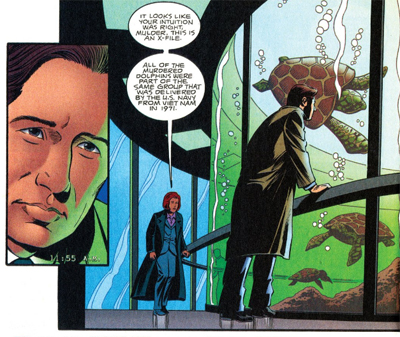
Cam Rahn Bay returns to one of the recurring themes of John Rozum’s run on Topps’ X-Files tie-in comic book.

It is essentially a cautionary tale amount mankind tampering with nature and the unforeseeable repercussions of such meddling. As such, it feels very much in keeping with scripts like Skybuster or Scum of the Earth. This idea of human hubris is a theme that is very much in keeping with The X-Files as a franchise, perhaps most keenly reflected in Chris Carter’s deep affection for Mary Shelley’s Frankenstein and for environmental causes. Cam Rahn Bay is very much in keeping with that aesthetic.

All at sea...

All at sea…

However, there are problems with the story. Most obviously, Rozum’s prose seems a little clunky and awkward. Cam Rahn Bay is a heavy-handed and clumsy meditation on mankind’s fixation with imposing its will over the natural world. However, there is also something slightly hypocritical about the story. As much as Cam Rahn Bay criticises the use of animals in a military capacity, it never seems to question the use of animals in captivity. While the training of dolphins to do military work is treated as deplorable, training them to do tricks for entertainment is lauded.

Cam Rahn Bay feels a little tonally ill-judged, with this fairly significant blindspot undermining a lot of Mulder’s impassioned rhetoric about how mankind treats the natural world.

"Sorry, I was just thinking abotu Deep Throat..."

“Sorry, I was just thinking abotu Deep Throat…”

Continue reading

The X-Files – Travelers (Review)

This May and June, we’re taking a trip back in time to review the fifth season of The X-Files and the second season of Millennium.

For all that the fifth season of The X-Files is building towards a major summer movie release, the production team seem surprisingly relaxed about it.

The fifth season is as experimental and as loose as the show ever got. Patient X and The Red and the Black suggested that Chris Carter didn’t even feel beholden to the continuity of The X-Files: Fight the Future, introducing new characters and concepts to the mythology that could not possibly be inserted into the film at this late stage. Similarly, the show was willing to play around with special guest writers like Stephen King and William Gibson, film an entire episode in black and white, focus on relatively minor characters, and reveal two separate secret histories of the X-files.

What do you call a baby Fox?

What do you call a baby Fox?

Of course, some of these innovations were driven by necessity or large goals. Patient X and The Red and the Black represent the beginning of the end for this stage of the mythology. Stories like Unusual Suspects and Travelers focus on characters other than Mulder or Scully because David Duchovny and Gillian Anderson were otherwise engaged. Nevertheless, there is a very relaxed vibe to the fifth season, as if the show is taking an extended moment to enjoy the peak of its popularity. As well it should.

Travelers is an episode that is far from essential in many respects. It is clunky in places, indulgent in others. It feels like the production teams are just happy to root through the old costuming wardrobe and prop departments, delighted to compose over-written monologues and stock characters. Travelers is light and fun, with its indulgence and its relative lack of substance making it more enjoyable than it would otherwise be.

He'll (Garret Dilla)hunt you down...

He’ll (Garret Dilla)hunt you down…

Continue reading