• Following Us

  • Categories

  • Check out the Archives


  • Awards & Nominations

Star Trek VI: The Undiscovered Country by J.M. Dillard (Review)

This June, we’re taking a look at some classic Star Trek movie tie-ins. Check back daily for the latest reviews and retrospectives.

Reading her novelisation of Star Trek VI: The Undiscovered Country, it’s hard to shake the feeling that author J.M. Dillard really does not like this film.

It’s a very peculiar sensation, to read an adaptation clearly written by somebody who could not care less for the source material. It is not unique, of course. Diane Carey’s adaptation of Broken Bow is downright scathing in its attitude towards Star Trek: Enterprise. It just seems rather strange that J.M. Dillard’s early adaptation of Star Trek V: The Final Frontier seems a lot fonder of its source material.

st-theundiscoveredcountry-dillard

Continue reading

Star Trek: The Next Generation – Sarek (Review)

This January and February, we’ll be finishing up our look at the second season of Star Trek: The Next Generation and moving on to the third year of the show, both recently and lovingly remastered for high definition. Check back daily for the latest review.

Sarek is a rather wonderful episode of Star Trek: The Next Generation. It’s a celebration of the franchise’s history, but without being overwhelmed by the weight of continuity. It’s also a heart-breaking story about an old man coming to terms with his mortality, assessing the legacy that he leaves behind and the future he had hoped to shape. The beauty of Sarek, then, is the way that the episode ties these two threads together – offering a rather touching metaphorical exploration of Gene Roddenberry’s own influence on the franchise and his own deteriorating health.

Back to the future...

Back to the future…

Continue reading

Star Trek – Sarek by A.C. Crispin (Review)

This January and February, we’ll be finishing up our look at the second season of Star Trek: The Next Generation and moving on to the third year of the show, both recently and lovingly remastered for high definition. Check back daily for the latest review.

We’ll be supplementing our coverage of the episodes with some additional materials – mainly novels and comics and films. This is one such entry.

One of the more interesting things about the expanded Star Trek universe is the diversity. It is possible for supporting characters and guest stars to carry their own narratives and stories within the grand sweeping tapestry of the Star Trek universe. Despite his importance to the mythos, Mark Lenard’s Sarek only made a handful of appearances across the history of the franchise. He only appeared once in the entire classic Star Trek television show, in Journey to Babel.

It is a testament to Mark Lenard’s dramatic abilities and D.C. Fontana’s writing that Sarek would recur across Star Trek: The Animated Series, Star Trek: The Next Generation and even the original Star Trek movies. The character – despite only appearing in a supporting role across four televised episodes and four feature films – remains one of the most intriguing supporting characters across the franchise.

A.C. Crispin’s Sarek offers a fascinating glimpse at one of the show’s most compelling guest stars, even if the novel does suffer a bit trying to “fix” some of the problems that the author seems to see in Star Trek VI: The Undiscovered Country.

tos-sarek

Continue reading

Star Trek: The Next Generation – Who Watches the Watchers? (Review)

This January and February, we’ll be finishing up our look at the second season of Star Trek: The Next Generation and moving on to the third year of the show, both recently and lovingly remastered for high definition. Check back daily for the latest review.

Who Watches the Watchers? continues a strong start to the third season of Star Trek: The Next Generation. It is the last episode of the third season produced by Michael Wagner. He would depart the show and leave Michael Piller in charge of the scripts for the rest of the season. It’s also the third-to-last credit for writers Hans Beimler and Richard Manning, who had both been around from the first season.

The writing duo would work on Yesterday’s Enterprise with Ira Steven Behr and Ronald D. Moore, but also finish Allegiance before departing the show at the end of the third season. (They were rather enraged by Piller’s tactless “writing 101” memo, sent later in the season.) Manning and Beimler would go on to write Paradise for Star Trek: Deep Space Nine, and Behr would convince Beimler to return to the franchise for the fourth season of Deep Space Nine. Beimler would be Behr’s most faithful writing partner on that spin-off, teaming with Behr throughout the sixth and seventh seasons in particular.

In many ways, Who Watches the Watchers? returns to some of the themes that the duo had touched upon in their strongest script of the first season, Symbiosis. It’s a complicated morality tale about the ethics of Starfleet and the burden of the Prime Directive.

The answer, apparently, is Liko.

The answer, apparently, is Liko.

Continue reading

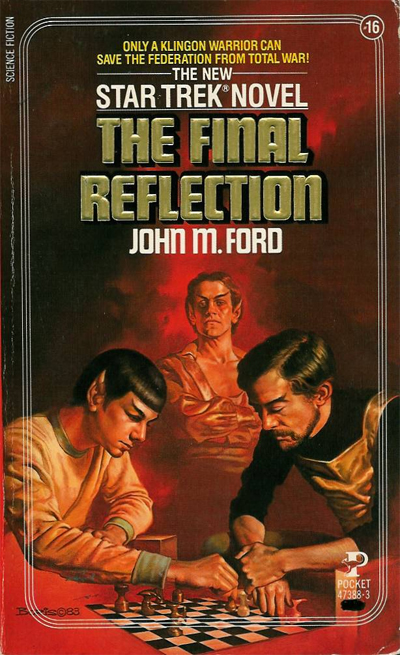
Star Trek – The Final Reflection by John M. Ford (Review)

To celebrate the release of Star Trek: Into Darkness this month, we’ll be running through the first season of the classic Star Trek all this month. Check back daily to get ready to boldly go. It’s only logical.

We’ll be supplementing our coverage of the episodes with some additional materials – mainly novels and comics and films. This is one such entry.

The Final Reflection was written in 1984. Development on Star Trek: The Next Generation would only be announced in 1986. Sure, there were a bunch of successful movies being produced, but these only amounted to a couple of hours of Star Trek once every few years. And, even then, the movies were aimed at a much broader audience, without the same development and continuity that a television show could offer. Not that Star Trek ever really had that tight a sense of continuity, of course, but it must have seemed unlikely that things could ever go back to the way they had been. Certainly, in 1984, nobody could have anticipated the eighteen-straight years of Star Trek running from Encounter at Farpoint to These Are the Voyages.

As a result, fans had to look to other avenues to expand and develop the rich Star Trek universe. The novels were one such avenue, although they developed slowly. Mission to Horatius had been published while the show was on the air, but it was very clearly aimed at a younger audience. Spock Must Die! would be published in 1970. However, the spin-off fiction developed relatively slowly. Star Trek had yet to become a massive franchise with tie-in multimedia commercial opportunities.

Perhaps because the Star Trek novels had not quite turned into a massive franchising opportunity, and they weren’t under the same level of publicity or scrutiny that they would be in the years to come, writer John M. Ford was able to do something quietly revolutionary with his first Star Trek novel, The Final Reflection. He was able to venture away from our core cast of iconic characters and instead develop the Klingon Empire.

More than that, though, he was able to paint the Klingons as the good guys.

tos-thefinalreflection5

Continue reading

Star Trek – Dagger of the Mind (Review)

To celebrate the release of Star Trek: Into Darkness this month, we’ll be running through the first season of the classic Star Trek all this month. Check back daily to get ready to boldly go. It’s only logical.

I knew we were due a nice Shakespearean title soon. And The Conscience of a King is just around the corner, to boot. Seriously though, I have to admit a massive fondness for these wonderfully lofty and high-minded episode titles. It’s something that links the original Star Trek and Star Trek: Deep Space Nine quite firmly, and was sadly never enthusiastically taken up by any of the other spin-offs. It’s a shame, because – regardless of the quality of the episodes in question – there’s something undeniably endearing about forty-five minutes of television given a pretentious name like For the World is Hollow and I Have Touched the Sky, The City on the Edge of Forever or Wrongs Darker Than Death or Night.

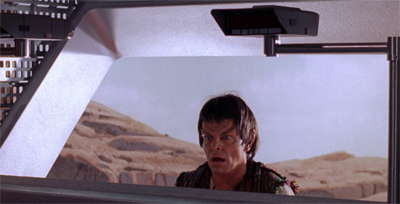
A scream...

A scream…

Continue reading

Star Trek: The Next Generation – The Child (Review)

To celebrate the twenty-fifth anniversary of Star Trek: The Next Generation, and also next year’s release of Star Trek: Into Darkness, I’m taking a look at the recent blu ray release of the first season (and a tiny bit of the second), episode-by-episode. Check back daily for the latest review.

Let’s play make believe for a second here. Let’s imagine you are producing a television show that had a very rocky first season, but seemed to be making steps in the right direction. This was a show already respected for its depiction of social issues like racism or drug use…

However, despite that, the first year of the show had some major gender issues. Your writers and actors had been pointing out that some of the episodes in that first year could be considered sexist. Of the three actresses in you regular cast, two left. One became the first regular on a Star Trek show to die in the middle of the season, and you had to write the first episode of the second season to write out the other actress who had been having some trouble with a male producer.

Now, keeping all that in mind, let’s carefully consider what to do with the remaining female lead character. If you are producing the second season of Star Trek: The Next Generation, you choose to have an alien impregnate that character without consent, use her body as incubation chamber, exploit her maternal instincts and then make her watch what she believes to be her own child die. More than that, you make sure that the female character is completely superfluous to the script itself, and that nobody seems to care particularly about her.

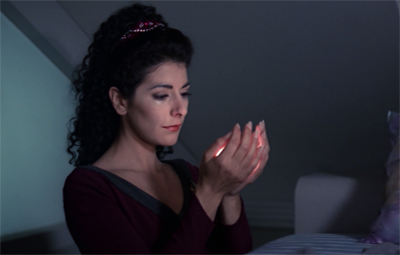
Don't worry, Troi. Face of the Enemy is less than half a decade away...

Don’t worry, Troi. Face of the Enemy is less than half a decade away…

Continue reading