• Following Us

  • Categories

  • Check out the Archives


  • Awards & Nominations

Star Trek: Voyager – Lifesigns (Review)

This February and March, we’re taking a look at the 1995 to 1996 season of Star Trek, including Star Trek: Deep Space Nine and Star Trek: Voyager. Check back daily Tuesday through Friday for the latest review.

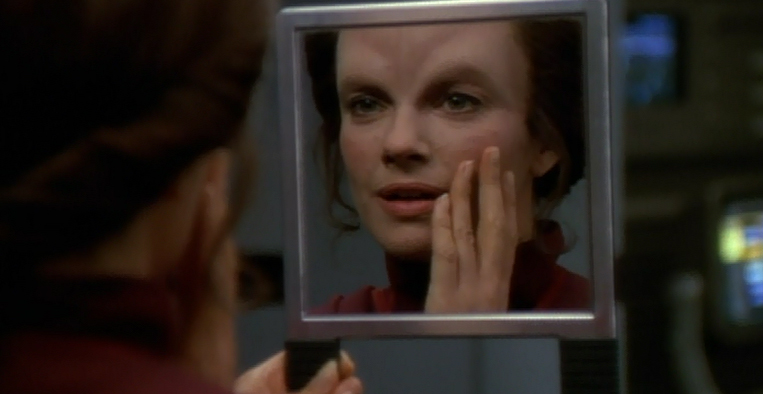
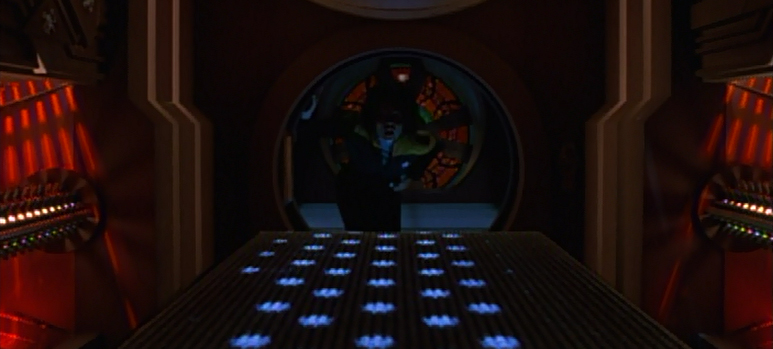
Lifesigns is a fascinating piece of television.

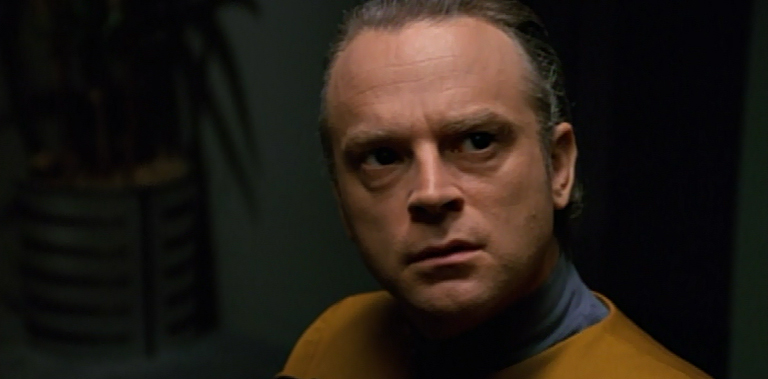
In hindsight, it seems a shame that the production team decided to focus on the Kazon during the first two seasons of Star Trek: Voyager. The Kazon are perhaps the most unfortunate and misguided recurring alien species to appear across the entire Star Trek franchise, never quite afforded the redemption that turned the Klingons and Ferengi from two-dimensional caricatures into fully-formed and well-realised species. The Kazon were a misguided creation in Caretaker; they remained so in Basics, Part II. Shattered offers no redemption.

The face of the frenemy...

The face of the frenemy…

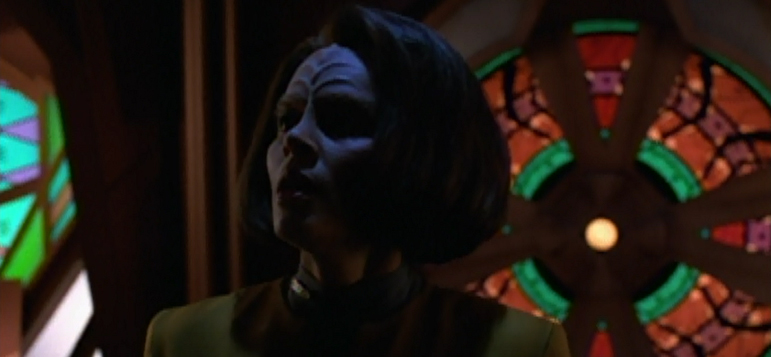
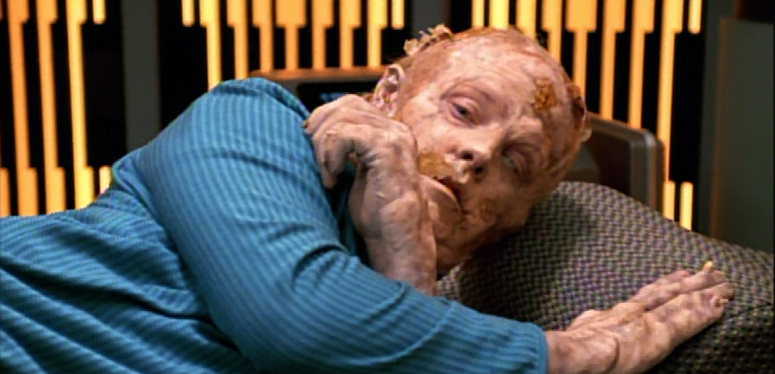
In contrast, the Vidiians are much more interesting. To be fair, it is possible that the Vidiians are so interesting precisely because they are underused; their appearances tend to be motivated by the demands of individual episodes rather than by some grand desire to create an iconic Star Trek species. At the same time, it is perhaps too much to suggest that the Vidiians are fully-formed or multi-faceted; the show never offers them the same opportunity for development afforded to species like the Kazon or the Borg or the Hirogen.

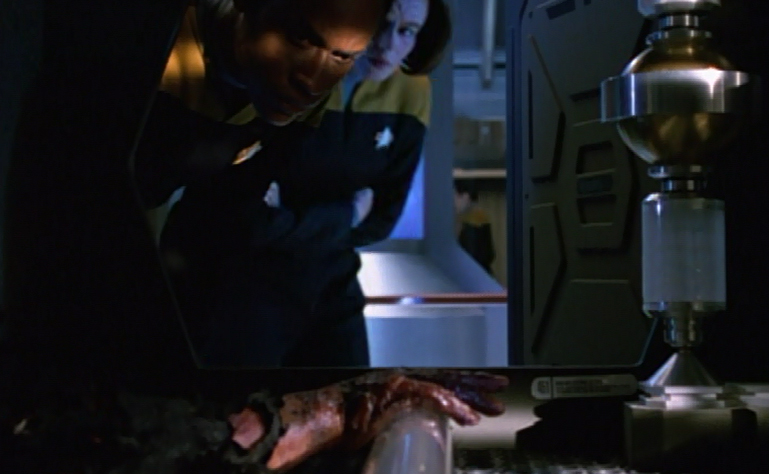
Despite all this, Lifesigns demonstrates the Vidiians can be used in an interesting and creative way. Even as the episode dedicates considerable space to demonstrating that Kazon are a much less interesting new species.

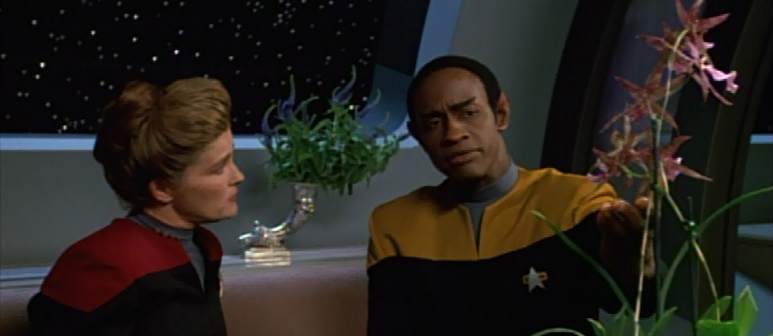
Starin' at the stars...

Starin’ at the stars…

Continue reading

Star Trek: Voyager – Death Wish (Review)

This February and March, we’re taking a look at the 1995 to 1996 season of Star Trek, including Star Trek: Deep Space Nine and Star Trek: Voyager. Check back daily Tuesday through Friday for the latest review.

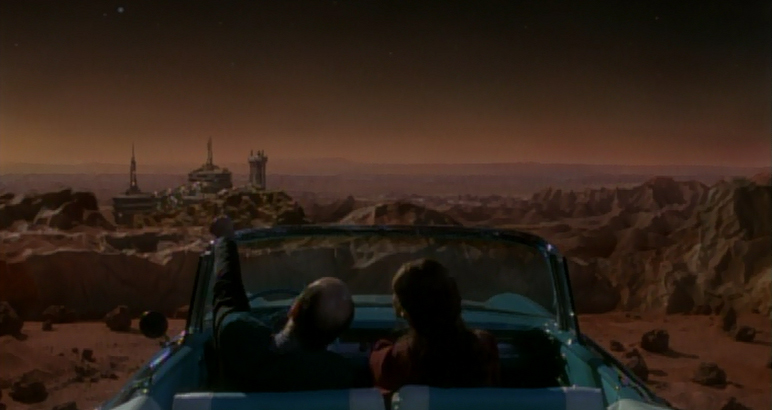
Death Wish is an interesting beast.

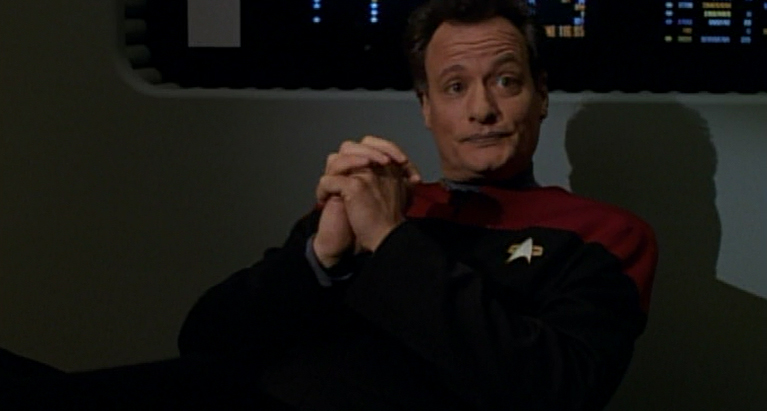
On the one hand, it is a decidedly cynical cash-in. It is very much a crossover episode that exists to cement the ties between Star Trek: Voyager and Star Trek: The Next Generation, to the point where it not only features a beloved guest star who bookended the seven-year run of The Next Generation, but also a “special appearance” from the secondary lead of that show. It was also consciously moved around in the production order so it might air in February sweeps, and was heavily hyped as part of the network’s news cycle.

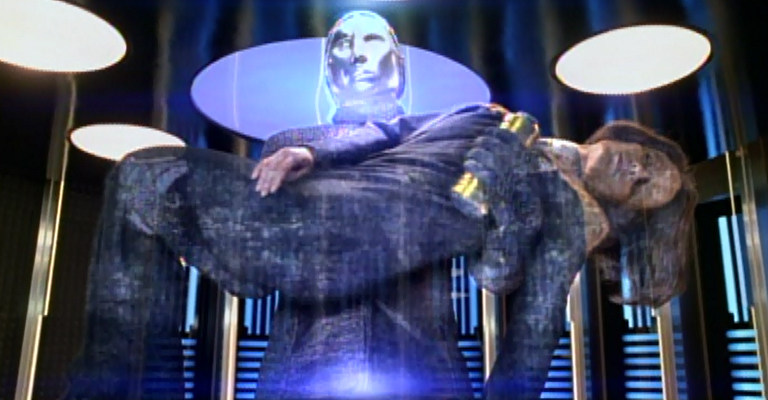
Qrossover!

Qrossover!

On the other hand, Death Wish is a fascinating episode on a number of levels. It is certainly the best of Q’s three appearances on Voyager, and certainly ranks among some of the character’s best work in general. Death Wish engages with a fairly hefty social issue of the nineties, as Janeway is embroiled in a debate about the morality of suicide. It also serves as a vehicle for writer Michael Piller to put his own version of Voyager on trial, with certain segments of the episode resonating quite clearly with the behind-the-scenes turmoil on the show.

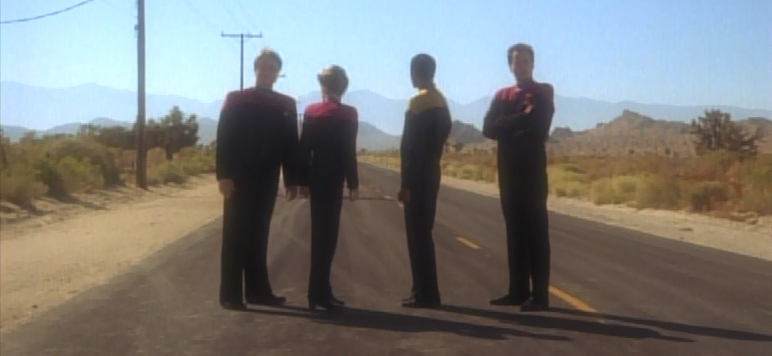
Death Wish is a paradox of an episode. It is bold and daring on its own terms, but it is also cynical and coy. It is an example of Voyager actively steering into its reputation as “Next Generation Lite”, which will cause a lot of problems for the show down the line. This is a shame; Death Wish is actually quite interesting on its own merits.

The road to nowhere...

The road to nowhere…

Continue reading

Star Trek: Voyager – Dreadnought (Review)

This February and March, we’re taking a look at the 1995 to 1996 season of Star Trek, including Star Trek: Deep Space Nine and Star Trek: Voyager. Check back daily Tuesday through Friday for the latest review.

Dreadnought is arguably a much better version of Prototype.

Both are essentially horror stories about B’Elanna Torres essentially creating a new mechanical life form, making a decision that has unforeseeable consequences. There is an element of reproductive horror to all this, reinforced by the clever decision to have B’Elanna literally give the eponymous warhead her own voice and watch it engage in a course that is quite literally self-destructive. It is perhaps the quintessential reproductive horror story, the fear that we might create something that will supplant us; that our children become the worst reflections of ourselves.

Engine of mass destruction...

Engine of mass destruction…

It is interesting that Dreadnought followed Meld so closely; both are essentially stories about how Star Trek: Voyager (and its characters) cannot cleanly escape their past, as much as the show might push it (and them) towards a generic Star Trek template. The middle of the second season sees an emphasis on the idea that Voyager is composed of two radically different crews – that Starfleet and the Maquis are not as integrated as shows like Parallax or Learning Curve might suggest.

Alliances, Meld and Dreadnought all build on the idea of underlying tensions that were mostly glossed over during the first season. Of course, this creates a weird dissonance, as Voyager seems to actually be moving backwards rather than forwards – attempting a half-hearted do-over of some of its earliest miscalculations.

Engineering a solution...

Engineering a solution…

Continue reading

Star Trek: Voyager – Meld (Review)

This September and October, we’re taking a look at the 1995 to 1996 season of Star Trek, including Star Trek: Deep Space Nine and Star Trek: Voyager. Check back daily for the latest review.

Meld is a masterpiece. It is the best episode of Star Trek: Voyager to date. There is perhaps a reasonable argument to be made that it is one of the best episodes that the series ever produced. It is, in many respects, one of the strongest and most compelling exploration of themes that have been bubbling around in the background since Caretaker, offering a more thoughtful and insightful exploration of the nineties culture of fear and anxiety than anything involving the Kazon. It is certainly the best use of Tuvok that the show managed in its seven year run.

Meld is an episode about violence, in its many forms. It is a story about the horrors and arbitrariness of unprovoked violence, but also about the cycles of violence that such actions can create. In many respects, Meld is a more scathing criticism of the death penalty than Repentance, the seventh season episode explicitly written as a death penalty allegory. Unlike many of the surrounding episodes, Meld actually manages to make good use of the show’s Delta Quadrant setting to heighten the dramatic stakes.
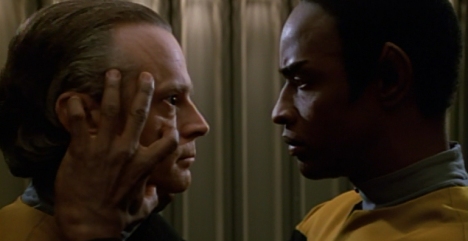
"Where's your head at?"

“Where’s your head at?”

In a way, Meld represents a collision of the franchise’s past and future. Meld may be the last truly great Star Trek script written by Michael Piller, the writer who helped to define the modern iteration of the franchise with his work on the third season of Star Trek: The Next Generation. At the same time, it is also Mike Sussman’s first story credit on the franchise; Sussman would go on to join the show’s writing staff in its final season and would be one of the few writers to serve a full four seasons on Star Trek: Enterprise.

While the script for Meld is exceptionally well-written, the episode is elevated by a combination of factors. Cliff Bole does great work in bringing a very unconventional Star Trek episode to life. Meld could be seen as a continuation of the second season’s b-movie charms. Following on from the robot wars of Prototype and the body horror of Threshold, Meld plays like a Star Trek serial killer thriller. Bole’s directorial choices are consciously stylised, with delightful little touches like the band of light across Tuvok’s eyes when the body is discovered.
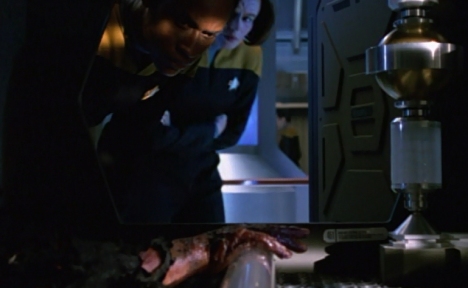
"Funny. I though Braga murdered Darwin last week."

“Funny. I thought Braga murdered Darwin last week.”

The episode also benefits from two mesmerising central performances from guest star Brad Dourif and Tim Russ. Russ was always one of the more under-utilised members of the Voyager ensemble, particularly when his “obligatory emotionally detached character” role was usurped by Seven of Nine in the fourth season. It is a shame, as Russ has a great deal of fun channeling Nimoy in his portrayal of the franchise’s first full-blooded Vulcan regular. Tuvok (and Russ) deserved more attention than the show afforded him.

That said, it is Brad Dourif who steals the show here. Lon Suder is one of the most fascinating guest characters in the history of the Star Trek franchise, and perhaps the only recurring character member of the Voyager crew who made any impression. A lot of that is down to the novelty of a fundamentally violent character in a Starfleet uniform, but Dourif is absolutely brilliant in the part. Dourif might just be the best guest star ever to appear in Voyager, and one of the franchise’s all-time greats.

Beta(zoid) male.

Beta(zoid) male.

However, perhaps the most striking aspect of Meld is the way that it feels very much of its time; it is an episode that firmly engages with a cultural context around Voyager. So much of Voyager seems lost in some sort of weird science-fiction neverland where the fifties and sixties never ended that a well-produced episode that feels of its time is a rarity. Meld is an episode that would feel strange ten years earlier or ten years later, but one which aligns perfectly with the wider context of 1996.

It is a overdue triumph from the Voyager team.

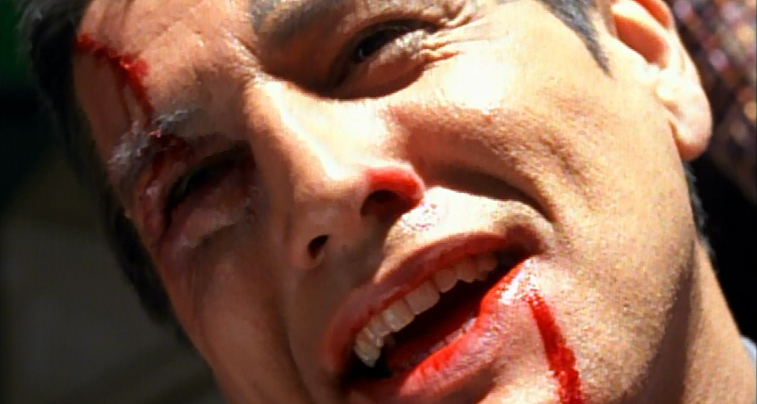
Smile!

Smile!

Continue reading

Star Trek: Voyager – Threshold (Review)

This February and March, we’re taking a look at the 1995 to 1996 season of Star Trek, including Star Trek: Deep Space Nine and Star Trek: Voyager. Check back daily Tuesday through Friday for the latest review.

Threshold is hated by fandom.

Veteran reviewer Jamahl Epsicokhan described it as “one of the all-time worst episodes of Star Trek ever filmed.” He is far from the only voice raised in protest. Winston O’Boogie remarked that, watching the episode, “you can’t help but think that something has gone terribly, terribly wrong with the world that allowed this to happen.” Assessing writer Brannon Braga’s contributions to the larger franchise, Jim Wright reflected, “Whatever else he may accomplish, he’s as forever shackled to Threshold as George Lucas to Jar-Jar.”

It's not even the worst episode of the season...

It’s not even the worst episode of the season…

Threshold is terrible. There is no way around that. It is a very stupid episode that is never entirely sure what it is trying to say from one moment to the next. More than that, positioning it as an important Tom Paris arc in the middle of the second season serves to sabotage the already confused character arc running between Alliances and Investigations. There is absolutely no context in which Threshold could be described as a “good” (or even “competent”) hour of television.

At the same time, it is not one of the worst episodes of the franchise ever produced; it is not even one of the worst episodes of the series. Surrounded by episodes like Tattoo or Alliances, the episode cannot even make a particularly confident claim to being the worst instalment of the season. None of this should be confused as an endorsement of Threshold. It is condemnation of everything that exists around Threshold.

The great mutato!

The great mutato!

Continue reading

Star Trek: Voyager – Alliances (Review)

This September and October, we’re taking a look at the 1995 to 1996 season of Star Trek, including Star Trek: Deep Space Nine and Star Trek: Voyager. Check back daily for the latest review.

One of the more persistent and convincing criticisms of Star Trek: Voyager is the idea that it was very narrative conservative; that the show got comfortable playing out the familiar formula that had been established by Star Trek: The Next Generation, and so never attempted to innovate or experiment in the way that Star Trek: Deep Space Nine (or eventually Star Trek: Enterprise) did. This is a perfectly valid criticism of the show as a whole, but it does ignore some of the weird tensions that played out across the first two seasons.

It is fair to say that Voyager never truly experimented. However, there are several moments in the first two seasons where it looks like the show was considering doing something unique or unprecedented. The show walked up to the edge, looking up and down; it never quite made the leap, but it seemed to weigh the possibility of jumping headlong into uncharted territory. However, it ultimately only dipped its toes in the water before getting cold feet and returning to the comfort of the familiar.

"Everyone liked Godfather III, right?"

“Everyone liked Godfather III, right?”

The sad truth about the second season of Voyager is that the show made a number of attempts to do something different or unique, only to botch each and every one of those attempts so completely that the production team learned not to even try. The second season’s more adventurous creative decisions all ended in humiliation and farce, explaining why the show desperately sought the warm blanket of a familiar format and an established template. After all, it was the more conventional episodes of the second season that had been (relatively) well received.

The second season of Voyager turned the process of trying something moderately ambitious and failing spectacularly into something of an artform. Of course, given the simmering tensions behind the scenes, it often seemed like the show wanted to fail. Michael Piller desperately wanted to do new things, only to meet resistance from his fellow producers and writing staff. Writers like Kenneth Biller would publicly criticise assignments they had been handed, offering a sense of just how much faith the staff had in these ideas.

"You wouldn't like me when I'm angry..."

“You wouldn’t like me when I’m angry…”

Alliances marks perhaps the most ambitious element (and most spectacular failure) of the second season of Voyager. It is the centrepiece of Michael Piller’s attempts to develop the Kazon into a credible (and convincing) alien threat, while also setting up a recurring arc that will allow Piller to push Tom Paris into the role of “lovable rogue” of which Piller was so fond. These were elements that excited Piller a great deal, but left most of the rest of the production team relatively cold.

So there is a great deal of irony in the fact that Alliances is ultimately written by Jeri Taylor, who was increasingly at loggerheads with Piller over the direction of Voyager. In light of that context, it makes sense that Alliances is an episode that aggressively critiques its own existence. Janeway spends most of the episode frustrated at the fact that the story is happening at all, and Alliances builds towards a climax that seems designed to convince the viewer that this whole idea is misconceived on just about every possible level.

Blooming disaster...

Blooming disaster…

Continue reading

Star Trek: Voyager – Prototype (Review)

This September and October, we’re taking a look at the 1995 to 1996 season of Star Trek, including Star Trek: Deep Space Nine and Star Trek: Voyager. Check back daily for the latest review.

In what is becoming a recurring theme for the second season of Star Trek: Voyager, Prototype is a mess.

As with a lot of the surrounding episodes, its production was fraught and tense; tensions seemed to be building among the production team as the season progressed. Prototype was an episode that was largely driven by Michael Piller, and one opposed by Jeri Taylor. Kenneth Biller was responsible for tweaking and rewriting Nicholas Corea’s script, but he does not seem particularly fond of the episode. These tensions and disagreements would build to a climax in the second half of the year.

Bride of 4739...

Bride of 3947…

Prototype is not a good episode, by any measure. There are a lot of elements that are interesting on their own terms, but there is also something quite nasty and uncomfortable sitting at the heart of the hour. It is a story about motherhood, but one which suggests that unconventional motherhood must be monstrous and grotesque. Even beyond the awkward subtext of the episode, there are problems. Despite Piller’s attempts to energise storytelling on Voyager, the pacing of Prototype is atrocious.

Prototype is not the biggest misfire of the season. Given the season around it, this should not be misconstrued as an endorsement.

(Warp) core values...

(Warp) core values…

Continue reading

Star Trek: Voyager – Resistance (Review)

This February and March, we’re taking a look at the 1995 to 1996 season of Star Trek, including Star Trek: Deep Space Nine and Star Trek: Voyager. Check back daily Tuesday through Friday for the latest review.

Resistance is a very episodic instalment of Star Trek: Voyager.

It begins with the ship facing a convenient plot-generating fuel-shortage, the type of problem that the ship had encountered near the start of Phage or The Cloud or Tattoo. It is the kind of problem that was not mentioned in previous episodes, and which will never be presented as a potentially recurring problem. In fact, Resistance is the only episode of Voyager (or Star Trek) where the word “Tellerium” is mentioned. Many of the stock criticisms of Voyager apply here.

Fifty shades of Joel Grey...

Fifty shades of Joel Grey…

At the same time, Resistance is proof that the episodic model is not entirely without merit. For all that modern television has tended towards serialisation and arcs and long-form storytelling, there is nothing inherently wrong with a good old-fashioned done-in-one adventure. On a purely cosmetic level, Resistance is the typical Voyager episode; it relies on contrivance, it features a host of guest characters who will never appear (or be mentioned) again, it has no lasting impact. And yet it works better than any episode to this point in the second season.

As easy as it is to get distracted by arguments about serialised and episodic storytelling, or about arcs and standalones, the truth is that Voyager‘s problems are at once more simple and more complex than that. The grand irony of the second season is that it is the only season of Voyager to attempt a storytelling arc, but that storytelling arc is pretty universally derided as one of the worst things that the show ever did. (It isn’t really, but it’s still pretty bad.) The truth is that it doesn’t matter how Voyager chose to tell its stories, as long as it told them well.

Mellon head...

Mellon head…

Resistance is a fairly standard episode of Voyager, but it is elevated in the telling. The story seems unlikely to rank among anybody’s favourite Voyager episodes, but it is an efficient and effective character study with a solid script and a great central performance. The production team were able to recruit Oscar-winning actor Joel Grey as the primary guest star, lending the story an incredible level of pathos. Lisa Klink also makes quite an impression with her debut teleplay, providing a story that is careful to give most of the cast something to do.

The result is proof that there’s nothing inherently wrong with a largely episodic approach to Star Trek storytelling, as long as the material is up to scratch.

"This is knife reunion, no?"

“This is knife reunion, no?”

Continue reading

Star Trek: Voyager – Manoeuvres (Review)

This February and March, we’re taking a look at the 1995 to 1996 season of Star Trek, including Star Trek: Deep Space Nine and Star Trek: Voyager. Check back daily Tuesday through Friday for the latest review.

It is weird to think that the much-maligned Kazon provided perhaps the closest thing that Star Trek: Voyager had to a long-form story arc.

That probably says more about Voyager than it does about the Kazon. In storytelling terms, Voyager was firmly episodic. There were some loose threads that would span and connect multiple episodes, but the bulk of the show was comprised of very traditional “done in one” adventures. It seems fair to observe that Voyager represented something of a backslide for the franchise. It was much more episodic than Star Trek: Deep Space Nine, but also less interested in long-form storytelling than the later years of Star Trek: The Next Generation.

"This is still more enjoyable than Tattoo!"

“This is still more enjoyable than Tattoo!”

One suspects that the Kazon arc running through the second season had something to do with this storytelling choice. Michael Piller pushed really hard to make the Kazon a recurring threat to Voyager and to place them at the centre of the second season. As a result, they become a loose thread that runs through several of the season’s “big” episodes. They place a traitor on board Voyager in Alliances. They provided Tom Paris with a character arc culminating in Investigations. They provided the season-ending cliffhanger in Basics, Part I.

The arc was not well-received, whether by the fans or by the staff. It is not too difficult to understand why. Even before considering the quality of the arc itself – or the storytelling involved – the Kazon are hardly the most compelling Star Trek villains. Allowing for that, it seemed like the writing staff had no real idea how to serialise a story arc across a season, making all manner of clumsy mistakes along the way. The arc never gathered momentum and it never paid off, which are very real problems when trying something that ambitious.

Either you Kazon... or you be gone...

Either you Kazon… or you be gone…

Manoeuvres effectively kicks off the arc. Although the Kazon had appeared in Initiations earlier in the second season, Manoeuvres features the first reappearance of Seska and Cullah since State of Flux midway through the first season. The episode is perhaps the strongest of the “Kazon” shows, with a sense of momentum driving the first half of the script. However, things rather quickly come off the rails in the second half of the story. Already, the production team’s inexperience with serialised storytelling is showing.

Manoeuvres is perhaps as good as the Kazon ever got. It is nowhere near good enough.

So that's why they call them raiders...

So that’s why they call them raiders…

Continue reading

Star Trek: Voyager – Cold Fire (Review)

This February and March, we’re taking a look at the 1995 to 1996 season of Star Trek, including Star Trek: Deep Space Nine and Star Trek: Voyager. Check back daily Tuesday through Friday for the latest review.

Cold Fire is an episode that exemplifies the feeling that second season’s treading water.

Cold Fire opens with a somewhat unconventional recap of Caretaker. Unlike most “previously on…” sections of Star Trek: Voyager (or the Star Trek franchise as a whole), this block is narrated by Majel Barrett in-character as the ship’s computer. It becomes clear that Cold Fire is interested in following up on the dangling threads left by Caretaker, with the crew of Voyager encountering the female mate alluded to in Janeway’s conversations with the eponymous Nacene character from Caretaker.

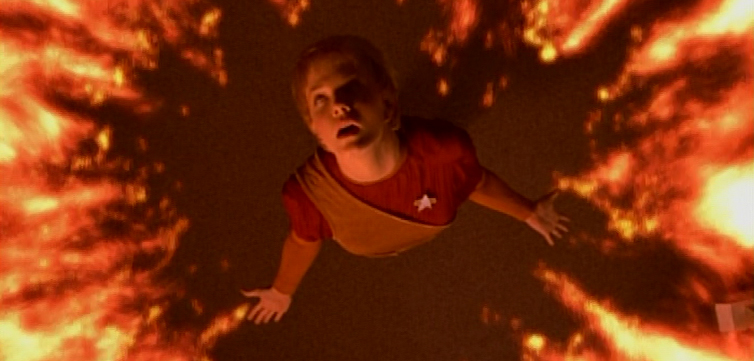
Everything burns...

Everything burns…

This should be a big deal. After all, the Caretaker is the character responsible for plucking Voyager and the Val Jean out of the Alpha Quadrant and depositing them on the other side of the galaxy. Finding another being with a similar amount of power presents a very real and tangible opportunity for Janeway to get her crew home. If the Caretaker could pull them all the way across the Milky Way, then it stands to reason that Suspiria could send them all the way back. Cold Fire presents a potential end to Voyager’s journey.

Unfortunately, Cold Fire never really does anything with that storytelling angle. Even when Janeway comes face-to-face with Suspiria at the climax of the episode, she never asks the powerful entity to send her crew home. So Cold Fire feels like an episode that spends forty-five minutes walking in circles, accomplishing little of note.

"It's probably just the inertial dampeners acting up..."

“It’s probably just the inertial dampeners acting up…”

Continue reading