• Following Us

  • Categories

  • Check out the Archives


  • Awards & Nominations

The Spirit Archives, Vol. 21 (Review/Retrospective)

The end is nigh. Even if I didn’t know that these wonderful hardcover collections from DC comics were finishing up soon (with the last of the weekly strips collected in The Spirit Archives, Vol. 24), I could probably get a sense that things were winding down from a quick read of The Spirit Archives, Vol. 21. Up until this point, The Spirit has had five years of quality following Will Eisner’s return from service in the Second World War. It’s very hard to think of any comic (then or now) that has enjoyed any four consecutive years of quality that measures up to the work by Eisner on The Spirit at the very height of its game.

And it is, I must confess, very easy to get caught off-guard by the slow (but steady) decline in quality in The Spirit. After all, off-peak Spirit by Will Eisner is still better than most of its contemporary comics. And, to be fair, the vast majority of modern comics. There is some great stuff here – some truly fantastic, great stuff. Unfortunately, there’s also a lot of evidence that Eisner’s creative energies were ebbing just a bit. The end was fast approaching, and this collection features the first truly noticeable stumbles.

Somebody's a fan of the Great Train Robbery...

Somebody’s a fan of the Great Train Robbery…

Continue reading

Non-Review Review: Red Riding – The Year of Our Lord 1974

This is the North. We do what we want.

– Craven explains how things work to Eddie

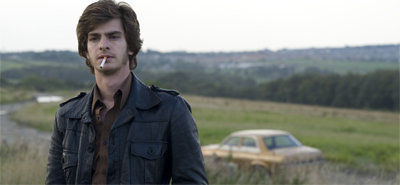
Red Riding is certainly an ambitious effort. David Peace wrote four books exploring violence and corruption in Yorkshire, centring around the morbid history of brutality in the North. Occupying a strange ethereal realm between fact and fiction, sometimes those crimes are fictionalised, but sometimes real murders and murderers intersect. The child murders of this first instalment, Red Riding: 1974, evoke the infamous Moors murders in Manchester during the sixties, while the arrest of an innocent party calls to mind the case of Stefan Kiszko. Adapting the series of four books into a trilogy of films, Red Ridingmakes for a fascinating – if gloomy – exploration of the darker pages in the region’s cultural history.

He’s gone far (Gar)field…

Continue reading

Non-Review Review: The Sapphires

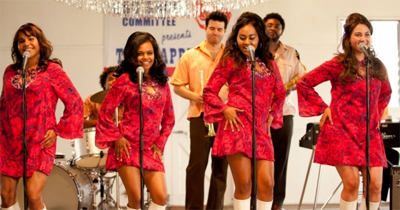
The Sapphires is the perfect feel-good movie to take us into Oscar season. The “goldilocks” of feel-good cinema, the movie balances its tone well. It’s never too heavy, but it’s never too light. Dealing with the eponymous Aboriginal girl band and their career in Vietnam during the conflict, it’s often both witty and touching at the same time. This quality is best encapsulated by Chris O’Dowd, playing the group’s slightly dodgy Irish manager, Dave Lovelace. A barely-functioning alcoholic tasked with keeping the tensions in the group under control, O’Dowd manages to make Lovelace simultaneously hilarious and somewhat tragic – a character we truly like, even if we also pity him. It’s a fantastic performance in a very solid film.

Good morning, Vietnam!

Continue reading

Fall of the Mutants: Uncanny X-Men (Review/Retrospective)

With our month looking at Avengers comics officially over, we thought it might be fun to dig into that other iconic Marvel property, the X-Men. Join us for a month of X-Men related reviews and discussion.

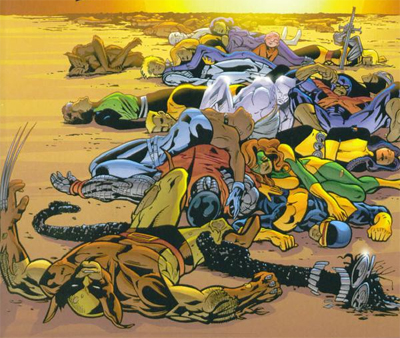
Part of me does feel a little bit sorry for Chris Claremont. After all, his Uncanny X-Men run was trapped in a perpetual second act. He hadn’t introduced the franchise, inheriting it from a bunch of other writers and artists, and he couldn’t resolve it either. So, as a writer, Claremont was charged with keeping readers interested in an on-going narrative that spanned well over a decade. Occasionally, the writer would try to keep things fresh, and Fall of the Mutants represents just such an attempt. Trying to transition his team from one status quo to another, you have to give the writer credit for pitting the team against an enemy who is (effectively) God, even if it does make this chapter in his on-going saga the equivalent of Star Trek V: The Final Frontier.

United we fall…

Continue reading

Garth Ennis’ Run on Punisher MAX – Hardcover, Vol. V (Review)

To celebrate St. Patrick’s Day, this month we’re going to take a look at Northern Irish writer Garth Ennis’ run on that iconic Marvel anti-hero, The Punisher. Check back every Friday and Wednesday for a review of a particular section.

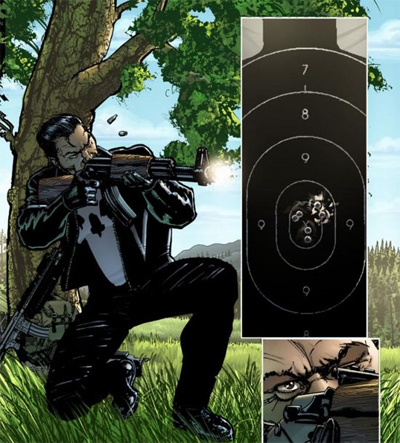
And so we’re here. We’ve reached the end of Garth Ennis’ Punisher MAX run, and one of the last things the author wrote for the character (he’d go on to write the Punisher: WarZone miniseries to tie into the film of the same name). It’s frequently regarded as perhaps the definitive run on the character, one held up as an example of what the Marvel MAX imprint is capable of. So, it’s been a long, sixty-issue journey to this point. And, I have to confess, I wasn’t entirely blown away by the run, or the conclusion to it.

Firing on all cylinders?

Continue reading

Non-Review Review: Platoon

I think now, looking back, we did not fight the enemy; we fought ourselves. The enemy was in us. The war is over for me now, but it will always be there, the rest of my days. As I’m sure Elias will be, fighting with Barnes for what Rhah called “possession of my soul.” There are times since, I’ve felt like a child, born of those two fathers.

Oliver Stone Charlie Taylor meditates on Vietnam

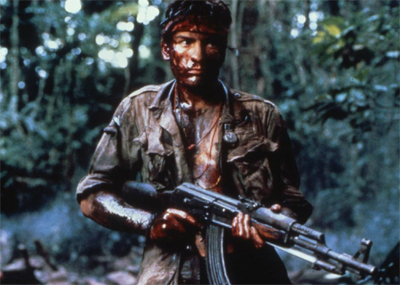
I honestly think that Platoon might be my favourite war film ever made. It’s almost certainly my favourite Vietnam film ever made, despite my considerable respect for Apocalypse Now. However, though Stone’s classic is steeped in allegory and metaphor (see the above quote), I think that it works better as a personal account of the conflict, rather than Coppola’s attempt to capture the surreal nature of the war on celluloid. Stone actually served a tour over there, and I think that there’s a lot of his own personal perspective poured into the film, which makes it feel like quite a raw and powerful piece of cinema.

War is dirty business...

Continue reading

On Second Thought: Apocalypse Now (Redux)

I wrote in my review of the original version of the movie that the two-and-a-half-hour cut captured a great deal of the insanity that seems to have been a defining characteristic of the Vietnam War, with the movie feeling like a crazed surrealist trip into madness, a collection of abstract meditations on the American condition that felt compressed at over two hours. If that is the case, Apocalypse Now Redux captures another aspect of the conflict. It’s now less insane, but the instability and absurdity appear more systemic and endemic. It’s bloated, terrifying, harrowing and seemingly eternal.

Much like the war itself.

Back into the Heart of Darkness...

Continue reading

Non-Review Review: Apocalypse Now

Apocalypse Now was what might be described as a “troubled” production. Francis Ford Coppola was never intended to direct the film, which ran into trouble with local weather and local politics, undergoing script changes on a daily basis, an overweight and overpaid Marlon Brando who refused to read either the script or the book it was based on (leading Coppola to read it to him), Dennis Hopper’s drug addiction and countless other factors. Actor Martin Sheen at one point had a massive heart attack and had to walk a quarter of a mile for help, which Coppola had to cover up (claiming he collapsed due to exhaustion and filming with extras and voice doubles) for fear of losing funding. Al Pacino had been considered for the role, but had the foresight to turn it down, with Coppola suggesting, “Al would do the film, if we could film it in his apartment.” If that’s true, he might be the smartest person associated with the production.

I mention this, because I think a significant amount of that trouble seems to feed through the film. There’s a sense that isn’t a safe production, which is somewhat fitting, given the subject matter.

Up the creek...

Continue reading