• Following Us

  • Categories

  • Check out the Archives


  • Awards & Nominations

Doctor Who: Four to Doomsday (Review)

To celebrate the fiftieth anniversary of the longest-running science-fiction show in the world, I’ll be taking weekly looks at some of my own personal favourite stories and arcs, from the old and new series, with a view to encapsulating the sublime, the clever and the fiendishly odd of the BBC’s Doctor Who.

Four to Doomsday originally aired in 1982.

Come along, children. Not in front of our hosts.

– the Doctor finally manages to strike the right tone with his companions

Four to Doomsday is an interesting story, if only because it’s so rarely discussed. The second story of a particular Doctor seems to set the tone for their era. William Hartnell’s second story, The Daleks, introduced the iconic pepperpots. Patrick Troughton’s second serial, The Highlanders, introduced the companion Jamie, who would remain with him for the rest of his tenure. Jon Pertwee’s second story, The Silurians, saw Barry Letts taking over the role of producer. Tom Baker’s second story, The Ark in Space, is one of the most memorable and definitive instances of horror in the history of the show. Colin Baker had the misfortune to have Attack of the Cybermen as his second story, an adventure that set the tone for his time in the TARDIS. Sylvester McCoy didn’t really develop until his second season, but he’s probably the exception that proves the rule.

Peter Davison’s Four to Doomsday, on the other hand, just sort of… is.

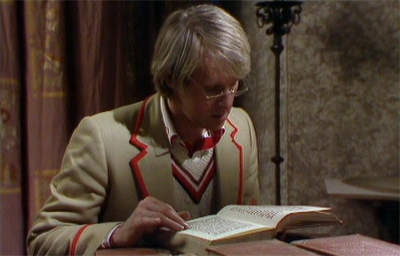
Ground control to Major... dammit, why couldn't I get this image a year earlier in the show's run?

Ground control to Major… dammit, why couldn’t I get this image a year earlier in the show’s run?

Continue reading

Doctor Who: Castrovalva (Review)

To celebrate the fiftieth anniversary of the longest-running science-fiction show in the world, I’ll be taking weekly looks at some of my own personal favourite stories and arcs, from the old and new series, with a view to encapsulating the sublime, the clever and the fiendishly odd of the BBC’s Doctor Who.

Castrovalva originally aired in 1982.

Welcome aboard. I’m the Doctor. Or will be if this regeneration works out.

– the Doctor greets Adric

Tom Baker did seven years of Doctor Who. That is impressive. No matter which way you look it, and no matter how cynical you might be, it’s hard to argue that Baker’s departure wasn’t a fundamental and radical change to the series. In fact, his influence is so great that Castrovalva even opens with a rare pre-credits sequence, just to make sure that the viewers know that Baker is gone. (Despite the fact that John Nathan Turner apparently asked that the scene be shot so that the new season could open without having to show Tom Baker.)

Baker was going to be a tough act to follow. In fact, to many people, Tom Baker is still the Doctor. I don’t mean that in a sort of “stubborn fans refusing to acknowledge change” sort of way. I mean that in a “when The Simpsons make a Doctor Who reference they use Tom Baker” sort of way. He cast one hell of a shadow, and it’s hard to truly fathom how daunting it must have been to try and step out from that show.

That Peter Davison manages to do so is nothing short of amazing. Equally impressive is the fact that Castrovalva manages to be its own story. While it suffers – as with so many Bidmead scripts – from the fact that the technical limitations of the show can’t keep pace with his ideas, there’s still a lot to love here. And not just Peter Davison. Though he helps.

“Oh! The brainy specs!”

Continue reading

Doctor Who: The Keeper of Traken (Review)

To celebrate the fiftieth anniversary of the longest-running science-fiction show in the world, I’ll be taking weekly looks at some of my own personal favourite stories and arcs, from the old and new series, with a view to encapsulating the sublime, the clever and the fiendishly odd of the BBC’s Doctor Who.

The Keeper of Traken originally aired in 1981. It was the first instalment in the “Master” trilogy.

He dies, Doctor. The Keeper dies!

– Tremas heralds the end of an era

Of course, the entire season has been less than subtle about the point, but The Keeper of Traken is the point at which Tom Baker’s final season builds to critical mass, and reaches the point of no return. Entropy, decay and death have all been crucial ingredients in the year’s collection of adventures, but The Keeper of Traken is the point at which it seems like our character has set himself on an incontrovertible course, a path from which he cannot diverge. Baker’s approaching departure gives The Keeper of Traken a great deal of weight, and helps balance a story that might otherwise seem excessive or overblown. There’s melodrama here, but it feels strangely appropriate.

Lawrence Miles has argued that Logopolis was the funeral for the Fourth Doctor. If so, The Keeper of Traken is his wake – and it’s fitting that Irish poet and writer Johnny Byrne should provide this strangely lively (if morbid) celebration.

Hell of a wake...

Hell of a wake…

Continue reading

Doctor Who: Journey to the Centre of the TARDIS (Review)

“Good guys do not have zombie creatures. Rule one, basic storytelling.”

– Clara understands the way the universe works

And here our big theory that this anniversary season is a “greatest hits” collection runs into a bit of bother. Okay, Cold War was definitely a Troughton-era throwback. And Hide had a definite Hinchcliffe-and-Holmes feeling to it. (“The Baker Street irregulars” in 1974.) Maybe you could stretch it a little bit and argue that The Bells of St. John is a tribute to the Pertwee era by way of Russell T. Davies; and The Rings of Akhaten definitely feels a little like a classic bit of Hartnell-era world-building.

Making the case for The Journey to the Centre of the TARDIS is just a little bit harder. After all, The Crimson Horror is another throwback to Hinchcliffe and Holmes, while Nightmare in Silver is another “base under siege by classic monster” tribute to Troughton. So there’s only one missing piece here. If that “greatest hits” argument holds, then Journey to the Centre of the TARDIS must be one gigantic shout out to the John Nathan Turner era.

Hear me out.

A shining beacon of light...

A shining beacon of light…

Continue reading

Doctor Who: The Deadly Assassin (Review)

To celebrate the fiftieth anniversary of the longest-running science-fiction show in the world, I’ll be taking weekly looks at some of my own personal favourite stories and arcs, from the old and new series, with a view to encapsulating the sublime, the clever and the fiendishly odd of the BBC’s Doctor Who.

The Deadly Assassin originally aired in 1976.

I deny this reality.

– the Doctor

The Deadly Assassin is a rather boldly experimental episode of Doctor Who. It’s the first story told without a companion character, and it also ventures quite forcefully into the realm of surrealism. It offers a rather bold deconstruction of the Time Lords, a rather cynical depiction of the aliens who had seemed all-powerful in stories like The War Games or The Three Doctors. More than that, though, The Deadly Assassin feels – appropriately enough – like a treatise on the inevitable death of Doctor Who.

Located in the middle of the fourteenth of twenty-six seasons, and broadcast thirteen years from both the start and the end of the show’s initial run, The Deadly Assassin seems to be positioned at the very heart of Doctor Who.

A rough outline of what's going on...

A rough outline of what’s going on…

Continue reading

Doctor Who: The Sound of Drums (Review)

To celebrate the fiftieth anniversary of the longest-running science-fiction show in the world, I’ll be taking weekly looks at some of my own personal favourite stories and arcs, from the old and new series, with a view to encapsulating the sublime, the clever and the fiendishly odd of the BBC’s Doctor Who.

The Sound of Drums originally aired in 2007.

Doctor.

Master.

I like it when you use my name.

You chose it. Psychiatrist’s field day.

As you chose yours. The man who makes people better. How sanctimonious is that?

– the Doctor and the Master

The Sound of Drums is really more interesting than it is successful. Building off Utopia as the second part of a three-part finalé, building the longest single story in the revived Doctor Who, The Sound of Drums does an excellent job moving the characters along and getting everything where it needs to be for the requisite cliffhanger. Unfortunately, Davies’ weaknesses when it comes to plotting are at play here. While Utopia took advantage of a leisurely pace and conventional plot in order to do some nice set-up, The Sound of Drums doesn’t have that luxury. Utopia came out of left-field, with the last ten minutes taking the audience by surprise. Now the audience knows the game is afoot, so the rules have changed.

The Sound of Drums kicks off with everything in full swing, and Davies has to ratchet up the tension from there. The result is that Davies does solid character work, but that the plot points and set-ups occasionally feel a bit forced. That’s especially true when it comes to the ideas that will be important to the resolution of The Last of the Time Lords.

The End of the World... oh, wait, we already did that one...

The End of the World… oh, wait, we already did that one…

Continue reading

Doctor Who: Resurrection of the Daleks (Review)

To celebrate the fiftieth anniversary of the longest-running science-fiction show in the world, I’ll be taking weekly looks at some of my own personal favourite stories and arcs, from the old and new series, with a view to encapsulating the sublime, the clever and the fiendishly odd of the BBC’s Doctor Who.

Resurrection of the Daleks originally aired in 1984.

The universe is at war, Doctor. Name one planet whose history is not littered with atrocities and ambition for empire. It is a universal way of life.

Which I do not accept.

Then you deny what is real.

– yes, in case you’re wondering, the show did let Davros win a philosophical debate with the Doctor

It’s a bit of a cliché to suggest that writer and script editor Eric Saward didn’t actually like Doctor Who. It’s a bit of sensationalist nonsense that appears quite frequently in discussing his contributions to the series. The evidence most often cited in favour of this admittedly exaggerated position points out that Saward had a tendency to marginalise the Doctor within his stories, to portray the character as inefficient or ineffective within the context of an increasingly cynical universe. This characterisation of the Doctor as inherently weak really came to a head during the Colin Baker period of the show, but you can see traces of it during the Peter Davison era, most notably in Earthshock.

However, Resurrection of the Daleks also provides a pretty compelling case study, if only because it makes a compelling case for the Doctor as a massive hypocrite and a coward. You have to worry when the script seems to side more with Davros’ outlook on life than with that of the title character.

Putting the Fifth Doctor to the test...

Putting the Fifth Doctor to the test…

Continue reading

Doctor Who: Victory of the Daleks (Review)

To celebrate the fiftieth anniversary of the longest-running science-fiction show in the world, I’ll be taking weekly looks at some of my own personal favourite stories and arcs, from the old and new series, with a view to encapsulating the sublime, the clever and the fiendishly odd of the BBC’s Doctor Who.

Victory of the Daleks originally aired in 2010.

Would! you! care! for! some! TEA???!!!

– the Daleks

Ah, the Daleks. They tend to rise and fall. They get built up and then they fall back down. Like the show itself, they come and go in cycles. The Dalek Invasion of Earth has the psychotic pepperpots invade Earth, while The Chase reduces them to little more than comic foils. Destiny of the Daleks makes jokes about them being unable to climb stairs, while Remembrance of the Daleks then proves that they can. In 2005, both Dalek and The Parting of the Ways invested considerable effort in making them scary again. The show eroded that away over time, turning them into bitchy foils for the Cybermen in Doomsday for the Doctor to hover up and competing to create the most phallic monster ever in Evolution of the Daleks.

Steven Moffat took over the show in 2010, and that means that he also took over the Daleks. Tending to the Doctor also means tending to his worst enemies. And, to be fair, that’s a bit what Victory of the Daleks feels like. It feels like an obligation, a bit of business to get out of the way quickly (the first episode not penned by Moffat) so that the fun stuff can commence.

Exterminate the rainbow...

Exterminate the rainbow…

Continue reading

Doctor Who: Death to the Daleks (Review)

To celebrate the fiftieth anniversary of the longest-running science-fiction show in the world, I’ll be taking weekly looks at some of my own personal favourite stories and arcs, from the old and new series, with a view to encapsulating the sublime, the clever and the fiendishly odd of the BBC’s Doctor Who.

Death to the Daleks originally aired in 1974.

Keep away! Keep away!

– the Daleks have an understandable reaction to appearing in another Terry Nation script

I’ve remarked a bit that Pertwee’s final year feels a little like a victory lap, a clear attempt to revisit familiar, sometimes to provide a sense of closer. For example, Invasion of the Dinosaurs feels like the last true U.N.I.T. story, with betrayal and disillusionment closing that narrative strand. Similarly, Planet of the Spiders closes out the recurring New Age Buddhist iconography that the Barry Letts has been injecting into the show. However, some of these decisions to return to familiar concepts feel a little superfluous. Did we need an extended sequel to Curse of Peladon, for example?

And did we really need another throwback Terry Nation Dalek story, only a year after the last throwback Terry Nation Dalek story?

The clue is in the title...

The clue is in the title…

Continue reading

Doctor Who: The Time Warrior (Review)

To celebrate the fiftieth anniversary of the longest-running science-fiction show in the world, I’ll be taking weekly looks at some of my own personal favourite stories and arcs, from the old and new series, with a view to encapsulating the sublime, the clever and the fiendishly odd of the BBC’s Doctor Who.

The Time Warrior originally aired in 1974.

Look, will you excuse me? I’ve got to go and find a young girl. I’ll see you later, I hope.

Young girl? I should have thought he was a bit old for that sort of thing. Oh well.

– the Doctor and Rubeish discover that Jo’s departure isn’t affecting him too much

The end of an era is fast approaching. Jon Pertwee departed Doctor Who after spending five years in the title role. The end of his fourth year saw the departure of his longest-serving companion, Jo Grant. The start of his final year would see the introduction of Sarah Jane Smith, perhaps the most iconic companion of all time. However, watching the first serial of his last year – The Time Warrior – there is a sense of pending change in the air, a sense that show in the cusp of a very significant shift. The Time Warrior isn’t necessarily explicit about this, but you can almost feel it.

Time is running out...

Time is running out…

Continue reading