• Following Us

  • Categories

  • Check out the Archives


  • Awards & Nominations

Doctor Who: Meglos (Review)

To celebrate the fiftieth anniversary of the longest-running science-fiction show in the world, I’ll be taking weekly looks at some of my own personal favourite stories and arcs, from the old and new series, with a view to encapsulating the sublime, the clever and the fiendishly odd of the BBC’s Doctor Who.

Meglos originally aired in 1980.

To control the output, it will be necessary to increase the violence of the emissions.

Then you’ll be in danger yourself.

Well, hardly. I’m a Time Lord. Having lived in the future I can hardly die in the present.

That can’t be true. That’s a philosophical paradox.

No, it’s merely beyond your comprehension.

– Meglos and Deedrix get their “parody” on

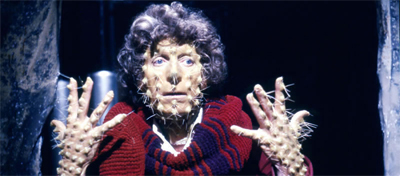
Meglos is one of those stories that has undergone something of an alternative interpretation among Doctor Who fans. Much like The Web Planet went from “a brave attempt to realise a truly alien world” to a “complete and utter embarrassment”, Meglos has gone from “that episode where a talking cactus tries to take over the universe” to “that parody where a talking cactus tries to take over the universe.” In fairness, looking at the serial, it is very hard not to see Meglos as an intentional and subversive parody of a bad Doctor Who story, but I have to concede that it doesn’t stop the adventure from being a bad Doctor Who story itself.
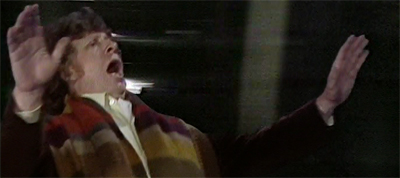
Okay, not every review this week is going to open with a close-up of Tom Baker in distress...

Continue reading

Doctor Who: The Leisure Hive (Review)

To celebrate the fiftieth anniversary of the longest-running science-fiction show in the world, I’ll be taking weekly looks at some of my own personal favourite stories and arcs, from the old and new series, with a view to encapsulating the sublime, the clever and the fiendishly odd of the BBC’s Doctor Who.

The Leisure Hive originally aired in 1980.

Look what you’ve done.

What have I done?

You’ve got the century wrong, you’ve got the season wrong and you’ve got K9’s sea-water defences wrong.

Well, I can’t get everything right.

Just something would be a help.

– Romana and the Doctor really do seem like an old married couple, don’t they?

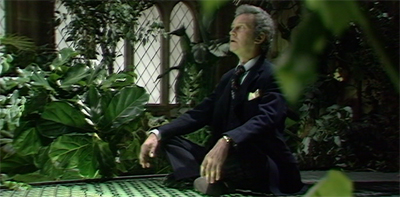
The Leisure Hive represented a bold new beginning for the show, as it saw John Nathan-Turner move into the role of producer, very quickly putting his mark on the show with a new theme tune and opening sequence, a stronger emphasis on science-fiction and arguably a very “gimmick-y” approach to the show itself. Nathan-Turner would go on to be the longest-serving – and most controversial – producer of the show, serving in the role until the series’ untimely cancellation in 1989. It really is quite tough to discuss The Leisure Hive without getting side-tracked on to any number of tangents, isn’t it?

Is Baker getting to old for the role?

Continue reading

Doctor Who: Journey to the Centre of the TARDIS (Review)

“Good guys do not have zombie creatures. Rule one, basic storytelling.”

– Clara understands the way the universe works

And here our big theory that this anniversary season is a “greatest hits” collection runs into a bit of bother. Okay, Cold War was definitely a Troughton-era throwback. And Hide had a definite Hinchcliffe-and-Holmes feeling to it. (“The Baker Street irregulars” in 1974.) Maybe you could stretch it a little bit and argue that The Bells of St. John is a tribute to the Pertwee era by way of Russell T. Davies; and The Rings of Akhaten definitely feels a little like a classic bit of Hartnell-era world-building.

Making the case for The Journey to the Centre of the TARDIS is just a little bit harder. After all, The Crimson Horror is another throwback to Hinchcliffe and Holmes, while Nightmare in Silver is another “base under siege by classic monster” tribute to Troughton. So there’s only one missing piece here. If that “greatest hits” argument holds, then Journey to the Centre of the TARDIS must be one gigantic shout out to the John Nathan Turner era.

Hear me out.

A shining beacon of light...

A shining beacon of light…

Continue reading

Doctor Who: Stones of Blood (Review)

To celebrate the fiftieth anniversary of the longest-running science-fiction show in the world, I’ll be taking weekly looks at some of my own personal favourite stories and arcs, from the old and new series, with a view to encapsulating the sublime, the clever and the fiendishly odd of the BBC’s Doctor Who.

Stones of Blood originally aired in 1978. It was the third part of The Key to Time saga.

Doctor, might I ask you  a personal question?

Well, I don’t see how I could stop you from asking.

Are you from outer space?

No.

Oh.

I’m more from you’d call inner time.

Ah.

– Professor Rumford and the Doctor clarify things

Stones of Blood was a bit of a landmark for the television show. Not only was it the 100th Doctor Who story broadcast, but it also aired remarkably close to the show’s fifteenth anniversary. The Three Doctorshad demonstrated that the show could celebrate its anniversaries in style, but producer Graham Williams seemed to want a more restrained celebration of the show’s run – vetoing an early scene in the TARDIS where Romana and K-9 give the Doctor a birthday cake and a present (a new scarf). Instead, it was decided that the show would celebrate its time on the air by returning to two of its more defining genres, blending those two distinct types of story into one four-part adventure. So we end up with a story that is half gothic horror and half outer space adventure.

A celebration, out of the blue!

Continue reading

Doctor Who: The Pirate Planet (Review)

To celebrate the fiftieth anniversary of the longest-running science-fiction show in the world, I’ll be taking weekly looks at some of my own personal favourite stories and arcs, from the old and new series, with a view to encapsulating the sublime, the clever and the fiendishly odd of the BBC’s Doctor Who.

The Pirate Planet originally aired in 1978. It was the second part of The Key to Time saga.

Excuse me, are you sure this planet’s meant to be here?

– The Doctor

I have to admit, I admire The Pirate Planet for its lofty aim. Douglas Adams’ script is vast and impressive and epic, incorporating and number of brilliant high concept ideas, traditional science-fiction story-telling devices, and healthy sense of humour into one Doctor Who story. Unfortunately, the production is restricted both by the technical limitations of the time, but also by the sense that there’s simply too much going on over the course of this four-episode adventure. Still, it’s as bold, fun and imaginative as any Doctor Whostory, and showcases the series at its most ambitious. There’s nothing wrong with that.

Pulling a fast one...

Continue reading

Doctor Who: The Ribos Operation (Review)

To celebrate the fiftieth anniversary of the longest-running science-fiction show in the world, I’ll be taking weekly looks at some of my own personal favourite stories and arcs, from the old and new series, with a view to encapsulating the sublime, the clever and the fiendishly odd of the BBC’s Doctor Who.

The Ribos Operation originally aired in 1978. It was the first part of The Key to Time saga.

Your name!

What about my name?

It’s too long… by the time I’ve called out “Look out Romanadv…” – what’s your name again?

Romanadvoratrelundar!

By the time I’ve called that out you could be dead! I’ll call you Romana.

I don’t like Romana!

It’s either Romana or Fred!

All right, call me Fred!

Good! Come along Romana!

The Key to Time was a rather ambitious project for the time – the idea being that an entire series of the show would centre around one core arc, suggested in the first story, developed through the rest of the season, and tied up at the end of the year. It helps, when you’re doing something like that, to have an experienced hand at the reins. While The Ribos Operation doesn’t stand as Robert Holmes’ finest contribution to the series, it’s a suitable introduction to the adventure.

Time Lord and Lady...

Continue reading

Doctor Who: Hide (Review)

Say we actually find her. What do we say to her?

We ask her what she is, how she came to be.

Why?

Because I don’t know and ignorance is… what’s the opposite of bliss?

Carlisle.

Yes, Carlyle. Ignorance is Carlyle.

– the Doctor and Clara

Hide is the best episode of Doctor Who to air since The God Complex, almost two years ago. Writing an affectionate tribute to gothic horror Doctor Who, Hide allows even the most skeptical member of the audience to forgive writer Neil Cross for his somewhat clunky script for The Rings of Akhaten. It’s a nostalgic and atmospheric trip back in time, and a reminder of just exactly what this show is capable of, offering a creepy haunted house horror that manages to morph into an epic love story by the time the credits have rolled.

What lies beyond?

What lies beyond?

Continue reading

Doctor Who: Victory of the Daleks (Review)

To celebrate the fiftieth anniversary of the longest-running science-fiction show in the world, I’ll be taking weekly looks at some of my own personal favourite stories and arcs, from the old and new series, with a view to encapsulating the sublime, the clever and the fiendishly odd of the BBC’s Doctor Who.

Victory of the Daleks originally aired in 2010.

Would! you! care! for! some! TEA???!!!

– the Daleks

Ah, the Daleks. They tend to rise and fall. They get built up and then they fall back down. Like the show itself, they come and go in cycles. The Dalek Invasion of Earth has the psychotic pepperpots invade Earth, while The Chase reduces them to little more than comic foils. Destiny of the Daleks makes jokes about them being unable to climb stairs, while Remembrance of the Daleks then proves that they can. In 2005, both Dalek and The Parting of the Ways invested considerable effort in making them scary again. The show eroded that away over time, turning them into bitchy foils for the Cybermen in Doomsday for the Doctor to hover up and competing to create the most phallic monster ever in Evolution of the Daleks.

Steven Moffat took over the show in 2010, and that means that he also took over the Daleks. Tending to the Doctor also means tending to his worst enemies. And, to be fair, that’s a bit what Victory of the Daleks feels like. It feels like an obligation, a bit of business to get out of the way quickly (the first episode not penned by Moffat) so that the fun stuff can commence.

Exterminate the rainbow...

Exterminate the rainbow…

Continue reading

Doctor Who: The Seeds of Doom (Review)

To celebrate the fiftieth anniversary of the longest-running science-fiction show in the world, I’ll be taking weekly looks at some of my own personal favourite stories and arcs, from the old and new series, with a view to encapsulating the sublime, the clever and the fiendishly odd of the BBC’s Doctor Who.

The Seeds of Doom originally aired in 1976.

Very impressive. What do you do for an encore, Doctor?

I win.

– Chase and the Doctor

“The mixture of styles is charming,” Miss Ducat notes of Harrison Chase’s impression mansion, and it’s also true of the story itself. I think that part of the reason that The Seeds of Doom works so well is because it’s actually a rather wonderful blend of any number of pulp subgenres, mixing a spy adventure, a trashy sci-fi adventure, an end-of-the-world catastrophe story, a gothic horror tale and an alien invasion saga, all within one six-part story. The story’s meglomaniac, Harrison Chase, might believe hybrids are “a crime against nature” (which opens up all sorts of avenues of plant racism), but I think this works quite well.

Hamilton Chase goes green…

Continue reading

Doctor Who: The Brain of Morbius (Review)

To celebrate the fiftieth anniversary of the longest-running science-fiction show in the world, I’ll be taking weekly looks at some of my own personal favourite stories and arcs, from the old and new series, with a view to encapsulating the sublime, the clever and the fiendishly odd of the BBC’s Doctor Who.

The Brain of Morbius originally aired in 1976.

How did you get her here, by the way?

The power of the Sisterhood.

Really? What, you mean you still practise teleportation? How quaint. Now, if you got yourself a decent forklift truck–

Doctor, you have but a little time left. Will you waste it prattling nonsense or confess your guilt.

What do you mean, I have but a little time left?

Before you die.

But I’m only seven hundred and forty nine. Life doesn’t begin until seven hundred and —

At the next sun. That is agreed.

Not by me, it isn’t. I haven’t even been consulted.

– The Doctor, Ohica and Maren are clear on a few things

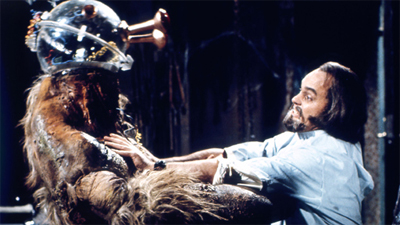
The Brain of Morbius continues the trend of phenomenally strong episodes in Baker’s sophomore season. Barring The Android Invasion, it’s a fairly stellar run of adventures, and I think that it’s these stories that a lot of people (casual follower and hardened fanatic alike) think of when they remember Tom Baker’s celebrated tenure in the role. Producer Philip Hinchcliffe continues his “gothic adventures… in space!” trend from Planet of Evil, this time offering a futuristic take on a Hammer-Horror-style Frankenstein. And the results are as fun, as wonderful and as grotesque as you might have imagined.

They did the monster mash…

Continue reading