• Following Us

  • Categories

  • Check out the Archives


  • Awards & Nominations

Star Trek: The Next Generation – The Measure of a Man: Extended Cut (Review)

This January and February, we’ll be finishing up our look at the second season of Star Trek: The Next Generation and moving on to the third year of the show, both recently and lovingly remastered for high definition. Check back daily for the latest review.

We’ll be supplementing our coverage of the episodes with some additional materials – mainly novels and comics and films. This is one such entry.

This is a rare treat.

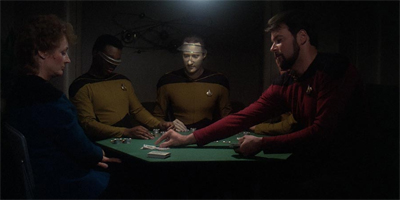
The Measure of a Man is generally regarded as one of the best episodes that Star Trek: The Next Generation ever produced, and a crown jewel in the entire Star Trek franchise. As such, it’s a prime candidate for this sort of lavish restoration treatment, with the blu ray collection featuring not only the televised version of the episode, but a special extended edition.

This extended edition was the version originally filmed and edited together, until the production team realised that it ran almost a quarter-of-an-hour over the slot allocated to the show on syndicated airing.
tng-themeasureofaman23

Continue reading

Star Trek: The Next Generation – The Measure of a Man (Review)

This January and February, we’ll be finishing up our look at the second season of Star Trek: The Next Generation and moving on to the third year of the show, both recently and lovingly remastered for high definition. Check back daily for the latest review.

Ah, The Measure of a Man.

It’s the first point in the run of Star Trek: The Next Generation where we’ve reached an episode that could legitimately be ranked as one of the best that the show would ever produce. Even today, the episode remains a favourite of Star Trek fans around the world, and a superb demonstration of what the series is capable of. Almost half-way into the second season, we get a glimpse of what The Next Generation could be, and how it balance its own identity against the proud philosophical traditions of its parent series.

It’s also quite brilliant.

A Data with destiny...

A Data with destiny…

Continue reading

My 12 for ’13: Star Trek Into Darkness & Fighting for the Future…

This is my annual countdown of the 12 movies that really stuck with me this year. It only counts the movies released in Ireland in 2013, so quite a few of this year’s Oscar contenders aren’t eligible, though some of last year’s are.

This is number 6…

Star Trek Into Darkness won’t win any awards for scripting or plotting. It’s very hard to succinctly explain the various overlapping evil plans directed by the movie’s two competing villains – who knows what at which point, and how that makes sense in the context of their objectives. Star Trek Into Darkness is a bit of a hot mess when it comes to storytelling – an overly convoluted plot that spends far too much time homaging what come before, when it should be boldly going somewhere new.

And yet, despite that, there is an ambition to Star Trek Into Darkness, a willingness to embrace big ideas and questions about cynicism and optimism, about hope and fear, about the attitude that people adopt towards the future. At the most basic level, that’s what Star Trek is. Into Darkness doesn’t have the same space as a television show to delve into those questions, nor to offer the same degree of nuance.

However, it’s a willingness to ask them that is quite endearing.

startrekintodarkness21

Continue reading

Star Trek: Deep Space Nine – The Maquis: Soldier of Peace (Review)

Star Trek: Deep Space Nine is twenty years old this year. To celebrate, I’m taking a look at the first and second seasons. Check back daily for the latest review or retrospective.

We’ll be supplementing our coverage of the episodes with some additional materials – mainly novels and comics and films. This is one such entry.

The Maquis: Soldier of Peace is a rather interesting little miniseries, produced while Malibu comics held the rights to Star Trek: Deep Space Nine spin-off comics in the early nineties. Malibu owned the rights to the earliest comics, publishing just over thirty issues of the main Deep Space Nine title between August 1993 and December 1995. Due to Paramount’s desire to exploit the license as much as possible, Malibu only had access to the Deep Space Nine rights, and not to Star Trek: The Next Generation or the original Star Trek.

Malibu would eventually be bought by Marvel, allowing the company to briefly publish Star Trek comics related to all on-going series. However, the company managed to generate an impressive amount of content in the time that it held the rights. Cynics would suggest that company was trying to cash in on the comics boom of the nineties, trying all manner of gimmicks, including one-shots and even a “celebrity” prestige series featuring stories written by Mark Lenard or Aron Eisenberg.

As such, these comics offer an interesting snapshot of where Deep Space Nine was at this point in its history.

The three amigos...

The three amigos…

Continue reading

Star Trek: Deep Space Nine – Necessary Evil (Review)

Star Trek: Deep Space Nine is twenty years old this year. To celebrate, I’m taking a look at the first season. Check back daily for the latest review or retrospective.

Commence Station Security log. Stardate 47282.5. At the request of Commander Sisko, I will hereafter be recording a daily log of law enforcement affairs. The reason for this exercise is beyond my comprehension, except perhaps that humans have a compulsion to keep records and lists and files. So many, in fact, that they have to invent new ways to store them microscopically, otherwise their records would overrun all known civilisation. My own very adequate memory not being good enough for Starfleet, I am pleased to put my voice to this official record of this day. Everything’s under control. End log.

Necessary Evil continues to deliver on the promise of “things you can’t do anywhere but Star Trek: Deep Space Nine that Michael Piller made at the start of the show’s second season. It’s a genuinely ambitious piece of Star Trek, all the stronger for the fact that it’s idea that could go horribly and spectacularly wrong. Movies like Blade Runner demonstrated that it is possible to blend the aesthetics of science-fiction and film noir, but it seems like a mix that would sit rather uncomfortably in the bright utopian future of Star Trek.

However, Deep Space Nine was never afraid to experiment with its format. This wasn’t always successful, but it did give the show a unique flavour. And when it did work, as it does here, it offered something new and exciting to the franchise’s playbook.

Time for a Changeling...

Time for a Changeling…

Continue reading

Star Trek: Deep Space Nine – Melora (Review)

Star Trek: Deep Space Nine is twenty years old this year. To celebrate, I’m taking a look at the first season. Check back daily for the latest review or retrospective.

It’s hard to believe, based on what we’ve witnessed so far, but one day viewers will be able to think “oh, a Bashir episode!” without an involuntary shudder. There will come a time when the writing staff figure out how to write a Bashir-centric episode. In fact, they’ll even revisit this central premise in the show’s final season, in a way that is much less creepy because at least it acknowledges the creepiness. However, we’re a long way from that.

It’s not that Bashir is a bad character. In fact, I’m very fond of him. I think that this version of the character works very well as part of an ensemble, or even teamed up with another major character to carry a story. However, I don’t think that the show has quite figured out how to tell a Bashir-centric story yet. Most notably because – like The Passenger before it – Melora isn’t really about Bashir. At least not in a way that isn’t creepy and disturbing and unnerving.

Instead, Bashir is mostly a vehicle for the guest character of the week, who lends the episode her name and serves as the focal point of some incredibly condescending and patronising writing which doesn’t make the optimistic future of Star Trek look particularly bright.

Floating in a most peculiar way...

Floating in a most peculiar way…

Continue reading

Star Trek: Deep Space Nine – Vortex (Review)

Star Trek: Deep Space Nine is twenty years old this year. To celebrate, I’m taking a look at the first season. Check back daily for the latest review or retrospective.

Something very interesting happens in the second half of Star Trek: Deep Space Nine‘s first season. It seems like the writers and producers are making a conscious effort to develop the show’s characters, themes and the world that these inhabit. Plot threads are hinted at, only to be left dangling. Ideas are broached, and tucked away for another day. Given that Star Trek: The Next Generation waited until the third season to broach serialisation in Sins of the Father, the approach taken here is quite striking.

These three episodes are more notable for what they set up rather than what they actually accomplish on their own terms. These adventures lay groundwork, or at least hint at laying groundwork, that will pay off throughout the show’s extended seven-year run. Okay, not exactly. There are some redundant elements here that never actually pay off, but Vortex, Battle Lines and The Storyteller all play into the show’s bigger story arc, even if it seems the writers aren’t entirely sure what those story arcs are.

It's murky out there...

It’s murky out there…

Continue reading

Star Trek: Deep Space Nine – The Passenger (Review)

Star Trek: Deep Space Nine is twenty years old this year. To celebrate, I’m taking a look at the first season. Check back daily for the latest review or retrospective.

And here we hit what amounts to the rock bottom of Star Trek: Deep Space Nine‘s first season. The Passenger and Move Along Home exist as the two weakest stories in this first season, and the point from which Deep Space Nine begins to map a path towards recovery, climaxing in the best final two episodes of any first season in the history of Star Trek. We’re a long way from that, and we seem furthest from it here.

While Move Along Home is a legitimately bad episode, one with flaws that probably should have been spotted in any of the episode’s troubled development history, The Passenger suffers because it is the most bland and generic of the first season Deep Space Nine episodes. It accomplishes nothing, but it feels worse because its ambitions were so low. It’s the kind of story that could easily have been told on any Star Trek show, or any science-fiction series, but with no sense of local colour to give it distinctive flavour.

The Passenger is just as bland as the title makes it sound.

The not-so-good Doctor...

The not-so-good Doctor…

Continue reading

Star Trek: Deep Space Nine – Q-Less (Review)

Star Trek: Deep Space Nine is twenty years old this year. To celebrate, I’m taking a look at the first season. Check back daily for the latest review or retrospective.

And the first season of Deep Space Nine continues its trend towards mediocrity. I feel I should qualify that. The first season of Deep Space Nine is never truly terrible. Even the (very) dodgy Move Along Home is superior to any number of episodes from the first season of Star Trek: The Next Generation, like Code of Honour or Angel One. The first season of Deep Space Nine just winds up feeling like it’s treading water, as if it is trying too hard to emulate The Next Generation, instead of exploring the unique storytelling opportunities offered by the show’s setting.

Q-Less is arguably the most obvious example of these attempts at imitation. While episodes like Babel and The Passenger could have been reworked as episodes of The Next Generation with a minimum of fuss, Q-Less rather cynically takes two recurring guest stars from The Next Generation and allows them to steal focus from an ensemble that is still finding its feet. It feels not only a little ill-judged, but also a bit rude.

Guess Q...

Guess Q…

Continue reading

Star Trek: Deep Space Nine – Prophecy & Change: Ha’Mara by Kevin G. Summers (Review)

Star Trek: Deep Space Nine is twenty years old this year. To celebrate, I’m taking a look at the first season. Check back daily for the latest review or retrospective.

We’ll be supplementing our coverage of the episodes with some additional materials – mainly novels and comics and films. This is one such entry.

Comparing and contrasting the anniversary short story anthologies for Star Trek: The Next Generation and Star Trek: Deep Space Nine can be highly informative. The Sky’s the Limit, released to celebrate the twentieth anniversary of The Next Generation, features fourteen stories. Most of these stories serve as prologues or epilogues to existing Next Generation episodes. Suicide Note provides closure to The Defector; Turncoats follows a character from Face of the Enemy after the camera stops rolling; Four Lights is an epilogue to Chain of Command.

In contrast, Prophecy and Change, released to celebrate the tenth anniversary of Deep Space Nine, tends to focus on short stories that fit gracefully between episodes – fleshing out connective tissue and explaining how one plot development or character decision led to another. That says quite a lot about the two shows and the way that their stories were told, with much of Prophecy and Change feeling ling deleted scenes or inserts loosely inserted between what was seen in television.

Ha’Mara is the first short story of the collection, following the introduction and the mysterious Revisited – a book-ending wrap-around written by an author who has yet to be publicly identified. Written by Kevin G. Summers, who provided Isolation Ward 4 to Strange New Worlds IV, the short story is set in the immediate aftermath of Emissary, attempting to smooth over the rough edges transitioning from the pilot to the rest of the show.

ds9-prophecyandchange

Continue reading