• Following Us

  • Categories

  • Check out the Archives


  • Awards & Nominations

Star Trek – The Romulan Way by Diane Duane and Peter Morwood (Review)

This January and February, we’ll be finishing up our look at the second season of Star Trek: The Next Generation and moving on to the third year of the show, both recently and lovingly remastered for high definition. Check back daily for the latest review.

We’ll be supplementing our coverage of the episodes with some additional materials – mainly novels and comics and films. This is one such entry.

The Romulan Way is the second book in Diane Duane’s “Rihannsu” cycle – although the first book in the series, My Enemy, My Ally was only retroactively distinguished from standard Star Trek tie-ins. Much like My Enemy, My Ally had been roughly contemporaneous with John M. Ford’s The Final Reflection, Duane’s follow-up was published around the same time as Ford’s own sequel to his earlier work, How Much for Just the Planet? Expanding on My Enemy, My Ally, The Romulan Way sees Duane delving more thoroughly into Romulan history and culture.

The Romulan Way was published amid a sea of change at Paramount and Pocket Books in the late eighties, with shifting mandates and objectives for these tie-in books that represented a conscious effort to hem in some of the more creative tendencies of mid-eighties Star Trek novelist. To demonstrate how rapidly things were changing, both The Romulan Way and How Much for Just the Planet? were both published within three years of their predecessors. After this point, it would take Duane another thirteen years to write the third volume in her saga, and John M. Ford would never write another Star Trek tie-in again.

It’s very hard to condone any publishing philosophy that leads to results like that.
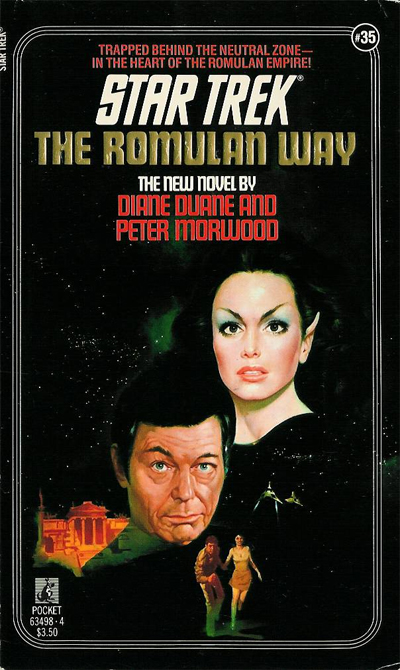
tos-theromulanway

Continue reading

Star Trek: The Next Generation – Booby Trap (Review)

This January and February, we’ll be finishing up our look at the second season of Star Trek: The Next Generation and moving on to the third year of the show, both recently and lovingly remastered for high definition. Check back daily for the latest review.

Booby Trap is a bit of a mess. The writing credits for the episode, featuring four different writers credited with getting the idea from basic story to finished script. This wasn’t at all unusual in the show’s third season – consider the writing credits for Yesterday’s Enterprise – but it gives an indication of the chaos unfolding behind the scenes on the third season of Star Trek: The Next Generation.

It’s Michael Piller’s second credited script, and his first writing credit since he took over the writers’ room. (Although he did, along with Melinda Snodgrass, do a pass on Ronald D. Moore’s script for The Bonding.) As such, it is written with a very clear idea of where Piller wants to take the show, one that shines through a somewhat uneven and all-over-the-place plot, which often feels like several different scripts blended into one.

Building on what came before...

Building on what came before…

Continue reading

Star Trek: The Next Generation (DC Comics, 1989) #19 – The Lesson (Review)

This January and February, we’ll be finishing up our look at the second season of Star Trek: The Next Generation and moving on to the third year of the show, both recently and lovingly remastered for high definition. Check back daily for the latest review.

We’ll be supplementing our coverage of the episodes with some additional materials – mainly novels and comics and films. This is one such entry.

One of the biggest problems that the writing staff had on Star Trek: The Next Generation was the insistence that the show was episodic. Themes and characters were rarely carried from week to week. Occasionally, a plot point or character might recur, but the bulk of the show was intentionally designed to be readily accessible in just about any order imaginable. In the era of HBO and “televisual novels”, this approach seems quite quaint, but it was very much the reality of late eighties and early nineties television.

However, there were no such restrictions on comic book story telling. Far from downplaying continuity and long-term plotting, mainstream American comics pride themselves on their serialised nature. It’s quite common for characters to suddenly reappear after absences of considerable time, and for writers to make callbacks to events that occurred decades ago. Publishing twelve issues a year, typically from the same author, The Next Generation comic book did afford the opportunity for a slightly different type of storytelling.

All set...

All set…

And, to be fair, that was one of the strengths of Michael Jan Friedman’s approach to The Next Generation comic book. He was fond of focusing on supporting characters, or giving page space to characterisation, or even basking in the show’s continuity in a way that wasn’t possible on television. Sure, Friedman could occasionally get a little obsessive in his continuity references, and could occasionally have difficulty tying everything into a cohesive story, but this was one way the author capitalised on the shift in the medium.

The Lesson is a single-issue story that is all the more intriguing for essentially existing as a series of character moments, with little in the way of an over-arching plot. The writing is a little clumsy and on-the-nose, with the comic earnestly offering its readers a rather ham-fisted message of the week, but it’s notable for the way that Friedman seems to bask in the freedom afforded to him by virtue of the fact that he’s writing a comic book (rather than an episode) of The Next Generation.

They've really bonded...

They’ve really bonded…

Continue reading

Star Trek (DC Comics, 1989) #19 – Once a Hero… (Review)

This January and February, we’ll be finishing up our look at the second season of Star Trek: The Next Generation and moving on to the third year of the show, both recently and lovingly remastered for high definition. Check back daily for the latest review.

We’ll be supplementing our coverage of the episodes with some additional materials – mainly novels and comics and films. This is one such entry.

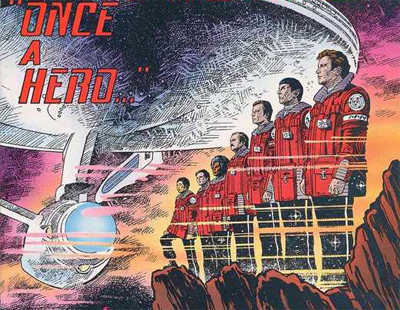
Once a Hero… is a notable story for a number of reasons. The most obvious is that it’s Peter David’s last issue of DC’s monthly Star Trek comic, departing the comic book after a pretty bitter disagreement with Richard Arnold, who was overseeing Star Trek licensing at the time. Given that David wrote The Incredible Hulk for twelve years and remains a prolific and well-liked comic book creator among the comic community, as well as a guiding light in Star Trek tie-in fiction, that’s a pretty damning indictment of Richard Arnold right there.

However, Once a Hero… is also notable for being an in-depth exploration and reflection on the “red shirt” narrative convention that the franchise loved so dearly.

A grave adventure...

A grave adventure…

Continue reading

Star Trek: The Next Generation – The Ensigns of Command by Melinda Snodgrass (Review)

This January and February, we’ll be finishing up our look at the second season of Star Trek: The Next Generation and moving on to the third year of the show, both recently and lovingly remastered for high definition. Check back daily for the latest review.

We’ll be supplementing our coverage of the episodes with some additional materials – mainly novels and comics and films. This is one such entry.

One of the benefits of the internet age is the wealth of material that it makes available with comparative ease. Interviews are widely distributed, clips are circulated, and it’s often not too hard to find primary or well-sourced secondary materials available with a simple search. As such, it’s a lot easier to pry into the history and legacy of cult film and television than it has ever been before. Leaping back in Star Trek: The Next Generation more than two decades after it originally aired allows the viewer more insight than they would ever have had back then.

The third season of The Next Generation is widely (and rightly) regarded as one of the strongest seasons in the history of the franchise. Only the first two seasons of the original Star Trek, a few more seasons of The Next Generation and couple of years of Star Trek: Deep Space Nine can claim to compete on a level of quality and consistency with this twenty-six episode rejuvenation of the series that had faltered in its first two years.

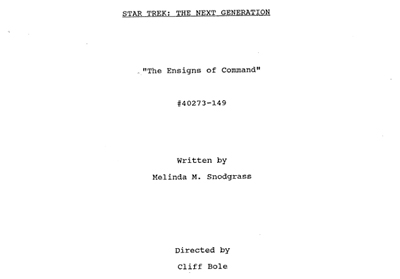
Watching The Ensigns of Command, it’s hard to fathom how deeply troubled the production was. The episode was plagued by problems from scripting through to post-production. Writer Melinda Snodgrass has made no secret of her dissatisfaction with the episode. Although her name appears on the finished script, the episode had been heavily re-written. Snodgrass has made her original script available on-line via her website, and it makes for an interesting glimpse at what might have been.

tng-theensignsofcommand22

Continue reading

Star Trek: The Next Generation – Evolution (Review)

This January and February, we’ll be finishing up our look at the second season of Star Trek: The Next Generation and moving on to the third year of the show, both recently and lovingly remastered for high definition. Check back daily for the latest review.

Evolution kicks off the third season of Star Trek: The Next Generation, and marks the point at which the spin-0ff really comes into its own. It’s remarkable how consistent in quality the third season is, despite the trouble brewing behind the scenes. It’s also remarkable how quickly the show finds its footing after two years of stumbling clumsily in the right direction. Within the first five episodes of the third season, The Next Generation has clearly found its voice.

However, a change is obvious even from Evolution. Michael Piller would take over the reigns four episodes into the season, but he also co-wrote the script to the season premiere. While Piller polished quite a few of the scripts passing through The Next Generation‘s third season, it is interesting that his credited work book-ends the season, setting the tone and leaving a clear impression.

While Evolution is not the strongest episode of the season to come, it does have a much stronger sense of self and purpose than anything that has really come before. It isn’t a bold or ground-breaking script by any measure; it’s actually a relatively simple story. It just tells that story with a wonderful resonance, clarity and efficiency, commodities that have been sorely lacking from The Next Generation to date.

Hold on, it's time for a change...

Hold on, it’s time for a change…

Continue reading

Star Trek: The Next Generation (DC Comics, 1989) #1-2 – Return to Raimon/Murder, Most Foul (Review)

This January and February, we’ll be finishing up our look at the second season of Star Trek: The Next Generation and moving on to the third year of the show, both recently and lovingly remastered for high definition. Check back daily for the latest review.

We’ll be supplementing our coverage of the episodes with some additional materials – mainly novels and comics and films. This is one such entry.

DC Comics’ limited six-issue tie-in to the launch of Star Trek: The Next Generation might have made an interesting read, but it was a success for the company. It was such a success that the company decided to launch an on-going monthly series tying into Star Trek: The Next Generation. It launched in October 1989, just as the show’s third season was starting on television. It continued throughout the show’s run, wrapping up eighty issues later in February 1996, when Marvel bought the license.

For the bulk of its run, The Next Generation was written by Michael Jan Friedman. Barring a couple of fill-ins scattered across the six-and-a-half year run, Friedman churned out monthly stories with remarkable consistency. Indeed, DC’s second volume of Next Generation would be the most consistent comic book tie-in published during any of the spin-off shows, with the licence for the franchise bouncing around Marvel, Malibu, Wildstorm and IDW in the late nineties and early years of the twenty-first century.

There’s something strangely appropriate about publishing Return to Raimon in tandem with the launch of The Next Generation‘s third season. The third season of The Next Generation is generally regarded as the point where the show really came of age, and the season that laid the foundation for that entire generation of Star Trek spin-offs. It was the point at which the vision of Star Trek proposed by The Next Generation finally came into its own, so it seems fitting that it’s also the point at which one of the franchise’s most consistent and long-running tie-ins begins.

New worlds...

New worlds…

Continue reading

Star Trek: The Next Generation – Season 2 (Review)

This January and February, we’ll be finishing up our look at the second season of Star Trek: The Next Generation and moving on to the third year of the show, both recently and lovingly remastered for high definition. Check back daily for the latest review.

Although, as Rick Berman argues in the documentary Making It So, the first season of Star Trek: The Next Generation “was at least in syndicated ratings terms, extremely successful”, there was trouble brewing behind the scenes. The show lost two-thirds of its regular female cast members, and the season ended with a whimper rather than a bang as the 1988 Writers’ Strike cutting into the development of the final couple of scripts.

The second season was no less plagued by problems, even as the show proved a ratings and commercial success. The show’s writers’ room was in disarray, with conflicts erupting between Tracy Tormé and Maurice Hurley over scripting for the show – leading to the use of both of Tormé’s WGA-approved pseudonyms on consecutive scripts from the writer. Episodes were coming over budget and behind schedule, necessitating a clip show to round out the season.

tng-qwho17

Even on the set itself, new cast member Diana Muldaur had difficulty fitting in the cast, and did not wish to return after the second season. Katherine Pulaski would disappear from the show (and the franchise) with little fuss – her last appearance being in the rather disappointing Shades of Grey. While The Next Generation was successful by just about any objective external measure, it had yet to really find its own internal balance.

Still, the second season of The Next Generation did show hints of improvement. The show was finding its feet. While the average quality of the episodes was nothing like what it would become in the show’s third season, even the more middling instalments of the show’s second season (like Contagion or Where Silence Has Lease or Peak Performance) were leaps and bounds ahead of where the show had been in the first season. It was getting where it needed to go, but not nearly fast enough.

tng-timesquared19

Continue reading

Star Trek: The Next Generation – Shades of Grey (Review)

This January and February, we’ll be finishing up our look at the second season of Star Trek: The Next Generation and moving on to the third year of the show, both recently and lovingly remastered for high definition. Check back daily for the latest review.

Well. That’s over now. Star Trek: The Next Generation limps across the finish line of its second season with a compilation clip show designed to save money and keep the season’s episode count up. Shades of Grey is frequently cited as the worst episode not just of the second season of The Next Generation, but of the show as a whole. While it’s hard to entirely agree with this assessment – Shades of Grey is cynical and lazy, but it’s neither as sexist as Angel One or The Child nor as racist as Code of Honour or Up the Long Ladder – it is possible to see where that argument comes from.

Like the first season before it, there’s a sense that the second season of The Next Generation might have been better had it ended an episode earlier. Indeed, the second season could have ended with Q Who? and the only episode anybody would really miss would be The Emissary. Unfortunately, one imagines the syndication agreements and network policy made this impossible. While one suspects many of those involved would be happy if Shades of Grey simply faded from existence, it remains part of the show’s syndication package.

This is a little like what this episode feels like...

This is a little like what this episode feels like…

Continue reading

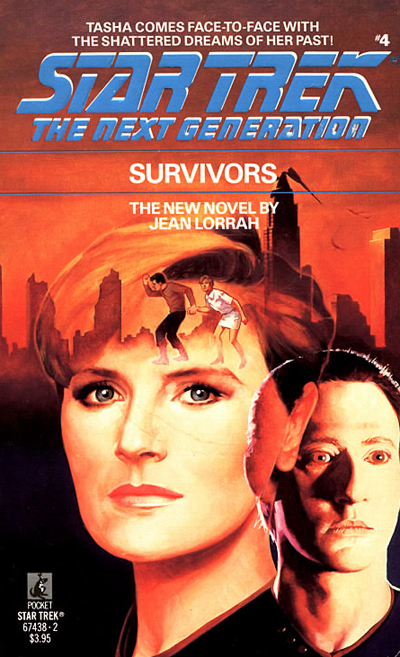
Star Trek: The Next Generation – Survivors by Jean Lorrah (Review)

This January and February, we’ll be finishing up our look at the second season of Star Trek: The Next Generation and moving on to the third year of the show, both recently and lovingly remastered for high definition. Check back daily for the latest review.

We’ll be supplementing our coverage of the episodes with some additional materials – mainly novels and comics and films. This is one such entry. This is actually supplementary to the first season of the Next Generation, specifically the episode Skin of Evil.

Writing tie-in fiction is tougher than a lot of people seem to think it is. There’s a notion that you’re playing in somebody else’s sandbox, and that you’re confined and restricted by what has and what has not appeared on screen, knowing that your work will always be secondary. As such, I can’t imagine how tough it must have been for Jean Lorrah to write Survivors. Only the fourth tie-in novel for Star Trek: The Next Generation, it was released in January 1989, around a quarter of the way through the show’s second season. Given the time it would take to edit and publish a paperback, it seems that Lorrah likely had to have the novel ready quite early in the life of The Next Generation.

It’s one thing to try to accurately capture the voice of well-defined characters on a long-running show, but it must be infinitely more difficult when writing based off sketchy early episodes that aren’t always consistent in their own characterisation.

tng-survivors

Continue reading