• Following Us

  • Categories

  • Check out the Archives


  • Awards & Nominations

Star Trek: Voyager – Elogium (Review)

This September and October, we’re taking a look at the jam-packed 1994 to 1995 season of Star Trek, including Star Trek: Deep Space Nine and Star Trek: Voyager. Check back daily for the latest review.

Elogium is the first script from writer Kenneth Biller, even if it was his second script produced and his third script to air. Adapted from a script by Jeri Taylor from a freelance pitch from Jimmy Diggs, Elogium has gone through quite a few sets of hands before reaching the screen. In many respects, Biller’s script went through the opposite approach of many writers working on Star Trek for the first time.

Ronald D. Moore’s script for The Bonding and René Echevarria’s teleplay for The Offspring both went through story editor Melinda Snodgrass and executive producer Michael Piller for varying amounts of re-writes before their ideas reached the screen. In contrast, Biller’s début assignment is re-writing a script written by an executive producer from a freelance pitch. It’s no wonder that Elogium turned into such a mess.

Love in a turbolift...

Love in a turbolift…

The episode was produced towards the tail end of the first season of Star Trek: Voyager, and it’s almost a shame that it was held back into the second season. While hardly an episode deserving of repeat airing over the summer, it was also a pretty poor way of welcoming viewers into the show’s second season. It’s a problem with all of the hold-overs, except for Projections. The other three episodes carried over are among the weakest episodes of a troubled season. Elogium might not be quite as dull as Twisted or as unfocused as The 37’s, but it is a deeply creepy episode of television.

The two episodes produced during the second season to air in the first six weeks – Initiations and Non Sequitor – might not represent franchise high-points, but they are well-produced hours of television that suggest Voyager might be finding its feet. The hold-overs from the first season undermine that sense of progress.
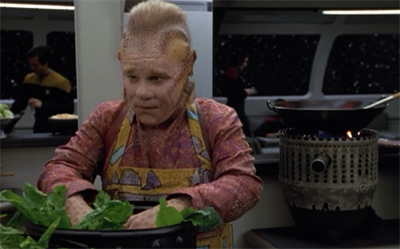
Neelix was shocked to discover that Ocampan children were not found under cabbage patches...

Neelix was shocked to discover that Ocampan children were not found under cabbage patches…

Continue reading

Star Trek: Voyager – Projections (Review)

This September and October, we’re taking a look at the jam-packed 1994 to 1995 season of Star Trek, including Star Trek: Deep Space Nine and Star Trek: Voyager. Check back daily for the latest review.

Projections is really the first episode of Star Trek: Voyager that feels like it is the right script coming from the right staff writer. At the start of the show’s first season, it seemed like writing assignments were handed out almost at random, with no real acknowledgement of the relative strength of any of the writers involved.

Brannon Braga is one of the best science-fiction high-concept writers in the history of franchise, but he was assigned the character-driven second episode Parallax and the issue-driven Emanations; Michael Piller’s personal strengths were always more firmly aligned with character development, so it felt strange to see him writing the time travel adventure Time and Again and the anomaly of the week in The Cloud.

All by myself...

All by myself…

Pushing the boundaries of a writing staff is something worth doing – forcing various members of the team to ease themselves out of their comfort zone – but it felt counter-productive to do this during the first season of a new Star Trek show. After all, the first season is about putting the best foot forward, and many of the early scripts for the show feel like they were handed to the wrong writers during the development process.

With Projections, it feels like Brannon Braga finally has a Voyager script that plays entirely to his strengths as a writer. It is arguably his most character-driven script on the franchise to date, but it also anchored in a pretty fascinating existential dilemma. In many respects, it is a spiritual companion to Frame of Mind, a sixth season episode of Star Trek: The Next Generationpreoccupied with questions about what reality actually might be.

Everything falls apart...

Everything falls apart…

Following on from Heroes and Demons, Projections is only the second episode of Voyager to focus on the character of the Doctor. However, much like Heroes and Demons, it demonstrates the versatility of the character and the range of the actor. Projections is a very clever script that relies on its central character to really carry it across the line. At this point in Voyager‘s run, Robert Picardo seems to be one of the few members of the ensemble who could really pull it off.

The result is one of the (if not the) strongest episode of the show’s first two seasons – somewhat appropriate, given the way the show straddles the gap between the first and second seasons.

He's not all there...

He’s not all there…

Continue reading

Star Trek: Voyager – Initiations (Review)

This September and October, we’re taking a look at the jam-packed 1994 to 1995 season of Star Trek, including Star Trek: Deep Space Nine and Star Trek: Voyager. Check back daily for the latest review.

Broadcast as the second episode of the second season, Initiations was the first episode produced as part of the second season of Star Trek: Voyager. As three of the four shows carried over from the first season – Projections, Elogium and Twisted – were essentially budget-saving bottle shows, the plan was to shuffle some location-heavy episodes into the broadcast order to offer something a bit more exciting and engaging.

Initiations also marked the return of producer Michael Piller to the fold. Piller had left Voyager mid-way through the first season to work on another science-fiction show for UPN. After Legend was cancelled, Piller returned to work on Voyager and found himself presiding over a very troubled second season. The second season of Voyager would be the last time that Piller was actively involved in a season of Star Trek, and so it feels like a pretty momentous occasion for the franchise.

While not spectacular, and suffering from some lingering Kazon-related problems, Initiations is still an effective forty-five minutes of television.

Stargazing...

Stargazing…

Continue reading

Star Trek: Voyager – The 37’s (Review)

This September and October, we’re taking a look at the jam-packed 1994 to 1995 season of Star Trek, including Star Trek: Deep Space Nine and Star Trek: Voyager. Check back daily for the latest review.

The 37’s did not close out the first broadcast season of Star Trek: Voyager, as the producers had intended. The last episode produced in the first season run, it was held back in the schedule into the second season – a decision made by UPN to allow Voyager to get an early start the following autumn. Still, the decision to reposition The 37‘s as the premiere of the broadcast season is quite telling.

Airing ahead of the three episodes produced before it, and ahead of any episodes produced specifically for the second season, there’s a sense that the production team intend The 37’s to be an important episode. After all, the season premiere is just as important as the season finalé in the basic structure of a broadcast season. The finalé serves as a capstone for what has come before, while (hopefully) indicating what might follow. The premiere is a way of setting up what is yet to come.

We have lift-off...

We have lift-off…

So the positioning on The 37’s is interesting, because it indicates just how much the production team had invested in the episode. This is a big episode of Voyager, this is an important episode of Star Trek. As such, it makes for a completely unsatisfying experience. The 37’s isn’t a bad episode by any measure – it has a few interesting ideas and a few memorable elements – but it’s not ambitious. It doesn’t radically change Voyager, but it also doesn’t distil it. It doesn’t offer the sense of purpose lacking for morst of the first season.

The 37’s just sort of is. It’s an episode that would be functional shuffled into the middle of a season – a few episodes earlier or later than broadcast. However, it simply doesn’t work when scheduled into a high-profile slot, particular when it has been moved so consciously and so purposefully.

A second pilot?

A second pilot?

Continue reading

Star Trek: Deep Space Nine – The Lives of Dax: The Music Between the Notes (Curzon) by Steven Barnes

This September and October, we’re taking a look at the jam-packed 1994 to 1995 season of Star Trek, including Star Trek: Deep Space Nine and Star Trek: Voyager. Check back daily for the latest review.

Star Trek: Deep Space Nine struggled with the character of Dax on-and-off for the first three years. Terry Farrell found herself at the centre of interesting character-driven stories with Playing God and Facets, but the show tended to treat the Dax symbiont as a macguffin that just happened to be inside Jadzia. Episodes like Dax, Invasive Procedures and Equilibrium tended to marginalise Jadzia so that the symbiont itself could be pushed to the centre of a story driven by other members of the ensemble.

However, Dax is a character with absolutely phenomenal potential. There is something absolutely fascinating idea of a creature that has lived for centuries, and seen generations of history unfold within its lifetime.The symbiont has witnessed countless changes and pivotal moments. Dax has seen civilisations fall and alliances form; Dax has seen old enemies become true friends, and watched civilisations reach out into the cosmos.

The realities of a seven-season television show mean that Deep Space Nine never really got to explore the fact that Dax was living history. Perhaps Blood Oath and Trials and Tribble-ations come closest, using Dax as a rather logical bridge spanning almost a century of continuity. One of the joys of the Star Trek universe is how expansive and how limitless it is. Infinite diversity and all that. While even Dax cannot have seen everything, Deep Space Nine never felt like it captured the sense of Dax as living history.

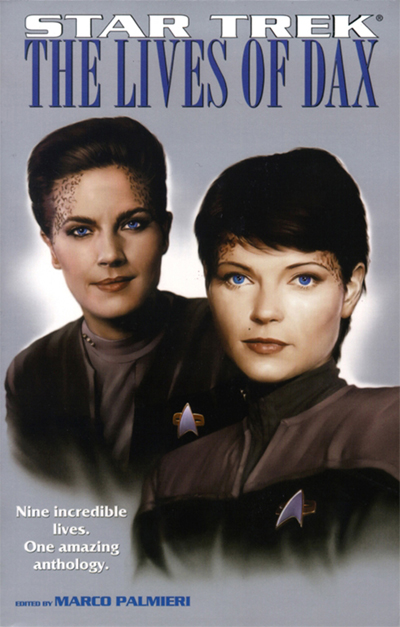
At its best, Pocket Books’ The Lives of Dax anthology captures this sense of change and movement. The books spans the width and breadth of the Star Trek franchise, as lived through the life of one single organism. It is beautiful.

ds9-thelivesofdax1 Continue reading

Star Trek: Deep Space Nine – Shakaar (Review)

This September and October, we’re taking a look at the jam-packed 1994 to 1995 season of Star Trek, including Star Trek: Deep Space Nine and Star Trek: Voyager. Check back daily for the latest review.

There are really two versions of Shakaar.

There is the episode that Shakaar very clearly wants to be. It’s intended to offer Kira a bit of closure, following on from the events of Life Support. It’s very clearly meant to explore Kira’s grieving process and to allow her to come to terms with the loss she suffered. After all, the episode opens establishing that Kira still mourns Bareil, while the episode closes with Kira extinguishing the memorial candle she lit for him. (Which does invite the audience to wonder if it was burning the whole time she was on Bajor.)

Carrying a torch...

Carrying a torch…

As such, it makes sense to offer Kira an opportunity to get back to her roots – to suggest that Kira might secretly want to return to the relative simplicity of a rebel fighter resisting an oppressive government; fighting a war is a lot less complex than navigating the peace. Kira’s reunion with the Shakaar Resistance Cell is meant to offer her a way to escape into something comfortable, to avoid moving forward; because moving forward is tough and painful. Shakaar should be about Kira learning that she has to push forward. It should be a companion piece to Progress.

The episode can’t quite manage this. Instead, we end up with an episode about how Kira gets swept off her feet by a dashing hunk of a man – an episode that leaves the viewer with the unfortunate implication that Kira only needed to find another weirdly paternal man to help her get past the death of the man she loved. Shakaar is an episode with a host of interesting ideas, but isn’t quite sure how to best bring those ideas to the screen.

You Winn some, you lose some...

You Winn some, you lose some…

Continue reading

Star Trek: Voyager – Learning Curve (Review)

This September and October, we’re taking a look at the jam-packed 1994 to 1995 season of Star Trek, including Star Trek: Deep Space Nine and Star Trek: Voyager. Check back daily for the latest review.

So, Learning Curve is the last episode broadcast as part of Star Trek: Voyager‘s first season. It’s hard to get too excited about – or be too disappointed by – that.

Learning Curve is a bit of limp finalé to a mediocre season. Like a lot of the season before it, it’s a passable execution of what should have been a fantastic concept. (Boy, that really is Voyager in a nutshell, isn’t it?)

Is the show finally starting to gel?

Is the show finally starting to gel?

Learning Curve‘s position in the broadcast order was apparently a bit of blind luck. It was actually the fifth-last episode produced of the show’s first season. It just found itself broadcast in the “season finalé” slot when UPN decided to hold back the remaining four episodes of the season until the Fall, to broadcast leading into the second season.

However, despite this, Learning Curve seems as good a choice as any to close out the first season – and certainly a better choice than Brannon Braga and Jeri Taylor’s preferred candidate, The 37’s. It returns to the conflict between Starfleet and the Maquis promised in Caretaker, but only fleetingly acknowledged in episodes like Parallax or State of Flux. Although the execution leaves a lot to be desired, it does create a sense that the show has come something of a full circle.

It's Chakotay or the high way...

It’s Chakotay or the high way…

Continue reading

Star Trek: Deep Space Nine – Family Business (Review)

This September and October, we’re taking a look at the jam-packed 1994 to 1995 season of Star Trek, including Star Trek: Deep Space Nine and Star Trek: Voyager. Check back daily for the latest review.

Family Business is surprisingly good, standing as one of the strongest Ferengi-centric episodes produced during the run of Star Trek: Deep Space Nine. This is largely down to how Family Business treats its central characters. While still broadly played as a farce, Family Business is rooted in character. Like House of Quark (and unlike Prophet Motive), the episode takes care to treat its characters with a great deal of respect.

This isn’t an episode constructed around stock comedy tropes and trying to get the audience to laugh at one-note caricatures. Instead, it’s an episode firmly built around exploring Quark as a character in his own right. Family Business makes the decision to treat Quark (and its other Ferengi characters) with respect, and it’s a decision that ultimately pays dividends.

Naked ambition...

Naked ambition…

Continue reading

Star Trek: Deep Space Nine – Explorers (Review)

This September and October, we’re taking a look at the jam-packed 1994 to 1995 season of Star Trek, including Star Trek: Deep Space Nine and Star Trek: Voyager. Check back daily for the latest review.

Explorers is a wonderful piece of Star Trek: Deep Space Nine, an episode produced by a show entirely comfortable with itself. Indeed, the entire point of Explorers seems to be stressing just how comfortable Deep Space Nine has become in its own skin. It’s a leisurely and relaxed celebration of what makes the show unique in the Star Trek franchise, wallowing in the things that make Deep Space Nine the show that it is.

With a smart script by René Echevarria adapted from a solid premise by Hilary J. Bader, Explorers is an episode that never feels like it has anything to prove. And that’s the charm of it all.

Open to new cultures...

Open to new cultures…

Continue reading

Star Trek: Deep Space Nine – The Die is Cast (Review)

This September and October, we’re taking a look at the jam-packed 1994 to 1995 season of Star Trek, including Star Trek: Deep Space Nine and Star Trek: Voyager. Check back daily for the latest review.

The Die is Cast is, like Improbable Cause before it, a wonderful piece of television.

As with most Star Trek: The Next Generation and Star Trek: Deep Space Nine two-parters, The Die is Cast maintains continuity and consistency with its predecessor, but it feels like a very different episode than Improbable Cause. After all, the curtain has been pulled back. The assassination attempt is no longer the driving force of the narrative (in fact, it’s barely referenced), with the plot focusing on Enabrain Tain’s pre-emptive strike against the Dominion.

A bruised ego...

A bruised ego…

It’s interesting that it falls to the Cardassians and the Romulans to drive the Dominion plot onwards. There’s been no real development of this long-form plot since Sisko and his crew escaped at the end of The Search, Part II. Episodes like The Abandoned and Heart of Stone have seen the crew encountering individual members of the Dominion, and shows like Visionary have had characters sitting around talking about them, but nothing has actually happened. It is mostly business as usual.

As such, the episode’s title feels beautifully appropriate – it’s the crossing of a threshold, a point from which there can be no return. Not just for Tain or the Cardassians, but the show itself.

Odo's sympathy for Garak runs dry...

Odo’s sympathy for Garak runs dry…

Continue reading