• Following Us

  • Categories

  • Check out the Archives


  • Awards & Nominations

Star Trek: Enterprise – Broken Bow (Review)

Next year, Star Trek is fifty years old. We have some special stuff planned for that, but – in the meantime – we’re reviewing all of Star Trek: Enterprise this year as something of a prequel to that anniversary. This January, we’re doing the first season. Check back daily for the latest review.

Broken Bow is probably the strongest pilot in the Star Trek canon, with Emissary and The Cage vying for second place.

That’s not saying a lot. Broken Bow is still a troubled production with some rather sizeable issues marring what is otherwise an ambitious début for a new Star Trek show. Watching, Broken Bow – as with watching most of the first few years of Star Trek: Enterprise (or just Enterprise) – it feels like the show is at war with itself. It wants to be something new and fresh and exciting, but it also wants to be an important part of this larger tapestry. And the episode has difficulty reconciling that.
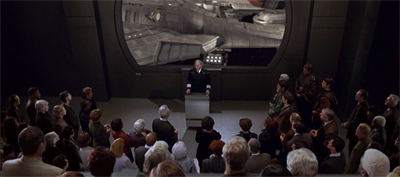
New (old) frontier...

New (old) frontier…

So we get new aliens like the Suliban, but a plot that revolves around the Klingons; we get an entirely new crew with a Vulcan science officer and Southern gentleman as the Captain’s best friend; we get a ship without most of the conveniences that we take for granted on Star Trek, but with substitutes and a resolution that relies on technological gimmickry; we get to explore an uncharted part of the Star Trek canon, but with the intrusion of the future to help make it feel a little more familiar.

From the first episode, Star Trek: Enterprise seems to exist as a show trapped between what it could have been and what it has to be. It’s a premise rich with potential, but which still feels a little too much like everything that came before.
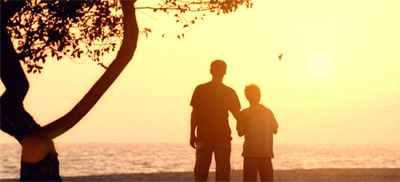
Into the sunset...

Into the sunset…

Continue reading

Star Trek – The Ultimate Computer (Review)

The first Star Trek pilot, The Cage, was produced in 1964. To celebrate its fiftieth anniversary, this December we are reviewing the second season of the original Star Trek show. You can check out our first season reviews here. Check back daily for the latest review.

The Ultimate Computer is the second classic produced by John Meredyth Lucas, following on from The Immunity Syndrome. (Although it is credited to him, Journey to Babel was actually overseen by Gene L. Coon.) Like The Immunity Syndrome before it, The Ultimate Computer is a bottle show, filmed on the show’s standing set. It features a relatively small guest cast, even trimming the number of extras appearing on the Enterprise sets.

It seems that these sorts of constraints and pressures brought out the best in Lucas. Lucas steps behind the camera on The Ultimate Computer, and helps to bring the show to life. Although he is using familiar sets, he often figures out ways to shoot them that feel original and fresh – no mean accomplishment two years into the show’s run. The guest cast that Lucas has assembled is superb – with William Marshall turning in one of the best one-shot guest appearances in the history of Star Trek.

Does not compute...

Does not compute…

However, what is most notable about The Ultimate Computer is the funereal atmosphere that haunts the episode. There is a solemn and reflective tone to the episode, particularly during the early tests of the M-5 computer. The Enterprise is dark, abandoned, empty. Kirk is reflective. As with Bread and Circuses at the end of Gene L. Coon’ tenure, Spock offers McCoy an olive branch. In many respects, The Ultimate Computer seems to hark forward to the film series, with Kirk wondering how he might define himself if he is not a starship captain.

Appropriately enough for a series staring down the barrel at cancellation, The Ultimate Computer would have made for a pretty great finalé.

"Dammit, I told you we should have used a surge protector..."

“Dammit, I told you we should have used a surge protector…”

Continue reading

Star Trek – Patterns of Force (Review)

The first Star Trek pilot, The Cage, was produced in 1964. To celebrate its fiftieth anniversary, this December we are reviewing the second season of the original Star Trek show. You can check out our first season reviews here. Check back daily for the latest review.

Patterns of Force is a rather strange little episode, the type of weird and iconic adventure that Star Trek tended to do quite well. It’s very much an off-the-wall adventure, of the kind that none of the spin-off shows would attempt. “Planet of the Nazis” is a concept that belongs alongside other second-season episodes like “Planet of the Romans” or “Planet of the Gangsters.” It’s a very goofy premise, one that requires considerable suspension of disbelief before the episode even starts.

And, yet, despite the many serious problems with Patterns of Force, this is an episode that very clearly and very forcefully has something to say. Reflecting the world in which it aired, Star Trek is a show that is largely defined by the Second World War. In The City on the Edge of Forever, it was revealed that the Second World War had to happen to beckon the bright and optimistic future of Star Trek. Almost forty years later, the final televised season of the franchise would return to that idea in its opening episode.

"Computer, query. What is Godwin's Law?"

“Computer, query. What is Godwin’s Law?”

Kirk’s “final frontier” was Kennedy’s “new frontier” extrapolated centuries into the future, an optimistic and very American vision of what the twenty-third century might hold. Given that the show aired two decades following the end of the Second World War, the conflict that made America the most powerful global superpower, it makes sense that the conflict should cast a shadow over Star Trek. Various members of the production had served in the conflict, and it remained part of the national consciousness.

So an episode pitting Kirk and Spock against honest-to-goodness space Nazis seemed inevitable.

"Well, there goes syndication in Germany..."

“Well, there goes syndication in Germany…”

Continue reading

Star Trek – Return to Tomorrow (Review)

The first Star Trek pilot, The Cage, was produced in 1964. To celebrate its fiftieth anniversary, this December we are reviewing the second season of the original Star Trek show. You can check out our first season reviews here. Check back daily for the latest review.

Return to Tomorrow is similar to By Any Other Name in a number of ways.

Most superficially, it’s an episode about aliens in human bodies, who find themselves learning (or, in this case, remembering) how to appreciate all that mankind has to offer. The plot similarity is rather broad, but it seems strange that By Any Other Name and Return to Tomorrow would be produced right after one another, and that no significant effort would be made to space them apart on initial broadcast. (Both aired in February of 1968.)

Leonard Nimoy only gets to smile once a year, so the show makes the most of it...

Leonard Nimoy only gets to smile once a year, so the show makes the most of it…

However, there are more fundamental and underlying similarities between Return to Tomorrow and By Any Other Name. Both are episodes that are very much engaged with the underlying philosophy of the franchise, particularly concerning humanity’s place in the universe. Indeed, there’s an argument to be made that Return to Tomorrow and By Any Other Name both work much better as statements of philosophical intent than they do as stories in their own right.

Co-written by Gene Roddenberry, Return to Tomorrow is a rather generic piece of television, but one that feels like a considered statement of the franchise’s central themes.

"Things are going to be a little different around here..."

“Things are going to be a little different around here…”

Continue reading

Star Trek – By Any Other Name (Review)

The first Star Trek pilot, The Cage, was produced in 1964. To celebrate its fiftieth anniversary, this December we are reviewing the second season of the original Star Trek show. You can check out our first season reviews here. Check back daily for the latest review.

By Any Other Name is very much a stock episode of Star Trek. It hits on all manner of familiar themes and ideas. It’s a story about powerful aliens who seem to overpower the crew, only to be outmanoeuvred themselves. It is about the Enterprise literally going where no human has gone before. It is about how humans are undeniably and incomparably special – about how becoming human opens up the aliens to a world of sense and experience.

However, By Any Other Name never really has anything particularly insightful to say about any of this stuff. The script to the episode is a mess, despite the best efforts of D.C. Fontana to develop the character beats. For a show based around such core Star Trek concepts and storytelling devices, By Any Other Name is surprisingly all over the place, with a wildly dissonant tone and a sense that the script was desperately padded in order to extend it out to the requisite fifty minutes.

"No dice, Captain..."

“No dice, Captain…”

By Any Other Name is not a terrible episode of Star Trek, but it’s not a particularly good one either. It is just “there.” In many ways, it feels like an example of an episode designed to fill a gap in twenty-odd-episodes-a-year schedule. After all, the last eight episodes of the season were pushed into production at short notice when NBC opted to pick up the show for the rest of the season during the production of The Gamesters of Triskelion. It makes sense that the episodes in this final stretch of the third season are somewhat rough.

By Any Other Name is a familiar Star Trek plot with a somewhat bloated script and a sense that the show is just trying to eat up minutes between here and the end of the season.

"It appears the rock knows as little as we do, sir..."

“It appears the rock knows as little as we do, sir…”

Continue reading

Star Trek – A Piece of the Action (Review)

The first Star Trek pilot, The Cage, was produced in 1964. To celebrate its fiftieth anniversary, this December we are reviewing the second season of the original Star Trek show. You can check out our first season reviews here. Check back daily for the latest review.

A Piece of the Action is the last script credited to Gene L. Coon.

Of course, Coon would write two episodes for (and contributed two more stories to) the show’s troubled final season under the alias Lee Cronin. However, A Piece of the Action could be seen as the last hurrah for Gene L. Coon’s vision of Star Trek. The writer and producer had helped to shape and define many of the ideas that Star Trek fans take for granted. A lot of the core Star Trek ideas that have permeated into popular culture – the Federation, the Klingons – originated with Coon.

Dey call his Boss Koik...

Dey call him Boss Koik…

While Coon is often overlooked when it comes to crediting those responsible for creating Star Trek as fans have come to know it, history has tended to gloss over his wry subversive streak. In many ways, Coon could be said to be the godfather of Star Trek: Deep Space Nine. Had he not passed away at the tragically young age of forty-nine, Coon might have been coaxed back to write a first season episode of Deep Space Nine alongside Dorothy Fontana. Coon was, after all, the first Star Trek writer to shrewdly and knowingly problematicise the Federation.

So it feels appropriate that the last Star Trek script credited to Coon should have Kirk proposes the Federation as an intergalactic racket.

Top gun...

Top gun…

Continue reading

Star Trek – The Galactic Whirlpool by David Gerrold (Review)

The first Star Trek pilot, The Cage, was produced in 1964. To celebrate its fiftieth anniversary, this December we are reviewing the second season of the original Star Trek show. You can check out our first season reviews here. Check back daily for the latest review.

David Gerrold is one of the very few Star Trek writers to become an established science-fiction writer after his work on the television show.

Sure, writers like Ronald D. Moore and Brannon Braga have continued to work in genre television and film, but Gerrold is unique in that he has built up a reputation as a formidable science-fiction novelist. “By any reasonable definition David Gerrold is a major figure in science fiction,” the New York Times has argued. It seems hard to disagree. If Roddenberry had produced Star Trek a decade or so later, he may have been approaching David Gerrold the same way he approached Ray Bradbury or Theodore Sturgeon.

Gerrold joined the writing staff in the second season of Star Trek, following a number of failed pitches. The writer managed to sell The Trouble With Tribbles, which became one of the most iconic and memorable Star Trek episodes ever written. He was such a success that he was drafted in to punch up I, Mudd – the script going into production before The Trouble With Tribbles. Gerrold would hang around for the third season of the show and would become one of the defining voices on Star Trek: The Animated Series with D.C. Fontana.

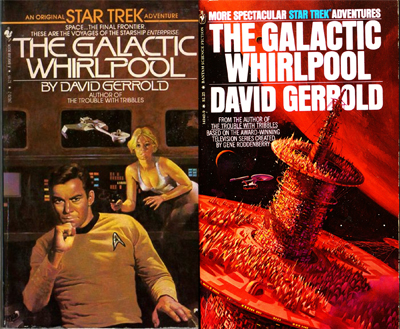
galacticwhirlpool

Gerrold remained busy in the long gap before Star Trek: The Next Generation, writing a string of well-regarded one-off science fiction novels in the seventies; however, perhaps his best-known work in the interregnum was The War With the Chtorr, his series of novels documenting an alien invasion of Earth. When he fell out with Gene Roddenberry over the production of The Next Generation, Gerrold would launch his popular Star Wolf series – a bunch of novels adapted from a television pitch that feel very much like his vision of The Next Generation.

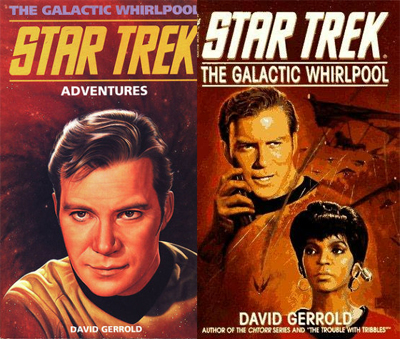
However, despite this success outside Star Trek, Gerrold remains quite attached to that massive shared universe. Indeed, he recently adapted his own infamously lost Next Generation script – Blood and Fire – for Star Trek: Phase II. However, this was not Gerrold’s first “non-televised” piece of Star Trek. The author was responsible for The Galactic Whirlpool, the fourteenth Bantam Star Trek novel published in 1980. The novel was published shortly before the license was handed over to Pocket Books, and is a remarkable accomplishment.

galacticwhirlpool2 Continue reading

Star Trek – Obsession (Review)

The first Star Trek pilot, The Cage, was produced in 1964. To celebrate its fiftieth anniversary, this December we are reviewing the second season of the original Star Trek show. You can check out our first season reviews here. Check back daily for the latest review.

The Star Trek franchise really does like Moby Dick, doesn’t it?

The show had done its first appropriation of Herman Melville’s iconic story of obsession and revenge earlier in the second season with The Doomsday Machine. In that episode, Commodore Decker sought to avenge the loss of his crew upon an unstoppable planet-killing machine. However, the basic formula quickly worked its way into the franchise’s blood. Obsession casts Kirk in the role of Ahab, albeit with a radically different ending and tone. After all, it is very cast Ahab as the heroic lead of a weekly television show.

"It's behind you!"

“It’s behind you!”

Star Trek II: The Wrath of Khan would return to Moby Dick for inspiration. Khan would even paraphrase from the book, without a hint of self-awareness or irony. After that point, it seemed like the franchise was more interested in mimicking the themes of The Wrath of Khan , which inevitably meant carrying over the themes of Moby Dick as well. Nevertheless, Star Trek: Voyager did its own variant of Moby Dick in Bliss and Star Trek: First Contact would reference the book directly.

Obsession is a competent if unspectacular episode, one that suffers from the fact that it has been done better and more compellingly in recent memory. However, given all the changes taking place behind the scenes, Obsession flows surprisingly well.

It really sucks to be a red shirt, eh?

It really sucks to be a red shirt, eh?

Continue reading

Star Trek: Alien Spotlight – Tribbles (Review)

The first Star Trek pilot, The Cage, was produced in 1964. To celebrate its fiftieth anniversary, this December we are reviewing the second season of the original Star Trek show. You can check out our first season reviews here. Check back daily for the latest review.

There is something delightfully gonzo about trying to write a comic book from the perspective of a bunch of Tribbles.

IDW’s Alien Spotlight series did not always work as well as it might, but the delightful done-in-one format of stand-alone stories told from the perspective of iconic Star Trek aliens allowed for a bit more versatility and flexibility than the line was normally afforded. Alien Spotlight: Cardassians was set after the end of Star Trek: Deep Space Nine. Alien Spotlight: Borg featured a delightfully clever logical paradox and a Borg invasion. Alien Spotlight: Klingons allowed Keith R.A. DeCandido to work his magic with the Klingons. Alien Spotlight: Romulans served as a springboard for John Byrne towards his Romulans saga.

You think you've got tribbles?

You think you’ve got tribbles?

There were more than a few disappointments along the way, but the Alien Spotlight series stands as one of the highlights of IDW’s Star Trek licensing. Alien Spotlight: Tribbles is a very odd piece of work. It is the kind of high-concept story that might feel like a gimmick and feels stretched over a single issue, let alone an arc. However, it is just silly enough that it works. Telling the story of a conflict between a bunch of Klingons and a human freighter crew through the eyes of the Tribbles is a fascinating idea.

While there is a sense that writer Stuart Moore occasionally has to stretch to get the story to where it needs to go, but Alien Spotlight: Tribbles is a delightfully charming (if perhaps a little too light) Star Trek diversion.

Laugh it up, fur ball...

Laugh it up, fur ball…

Continue reading

Star Trek – The Gamesters of Triskelion (Review)

The first Star Trek pilot, The Cage, was produced in 1964. To celebrate its fiftieth anniversary, this December we are reviewing the second season of the original Star Trek show. You can check out our first season reviews here. Check back daily for the latest review.

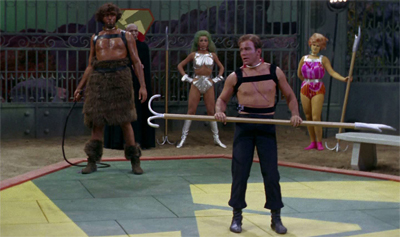
The Gamesters of Triskelion is not a great episode of Star Trek. Although filmed after Obsession, even if the production order lists it before that episode, The Gamesters of Triskelion feels like we’re watching producer John Meredyth Lucas finding his feet. It’s an episode that feels light and looks relatively cheap, formed from a collection of clichés that would already be familiar to Star Trek fans or fans of pulp science-fiction.

Perhaps the best thing that can be said about The Gamesters of Triskelion is that it has a decidedly pulpy charm to it. The entire episode looks like it was lifted from the cover to some trashy paperback, and the plot is recycled from stock science-fiction concepts and themes. While this isn’t enough to sustain an entire fifty minutes of television, it does allow the episode to feel a little distinctive and memorable… if not necessarily in a good way.

Shat happens...

Shat happens…

It is amazing how much of the franchise’s memorable iconography and imagery comes from weaker episodes of the classic Star Trek. It’s a testament to the show’s production design team, that could always find a way to make Star Trek look impressive, even on a tight budget and a short schedule. There’s also something enduring about the bizarre images that Star Trek could throw up on screen, even when the scripts were lacking; from space!Lincoln in The Savage Curtain to half-black/half-white racism in Let That Be Your Last Battlefield.

Of course, there are episodes that are both great and iconic at at the same time, like Mirror, Mirror. Still, rewatching the show, it is hard to believe just how much of the popular perception of Star Trek comes from episodes that are of… questionable quality. After all, The Gamesters of Triskelion seems to have made an impression. It seems to be a go-to reference for Matt Groening’s television shows.

Throwing a bit of stick about...

Throwing a bit of stick about…

Continue reading