• Following Us

  • Categories

  • Check out the Archives


  • Awards & Nominations

Star Trek: Voyager – Distant Origin (Review)

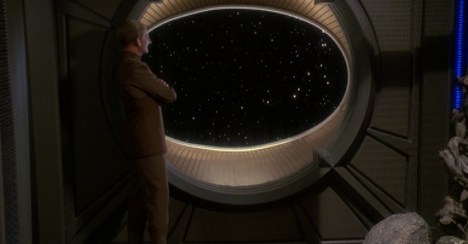
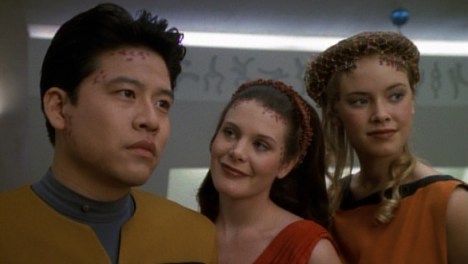
Like Remember before it, Distant Origin is a really great example of how Star Trek: Voyager‘s efforts to build a “generic Star Trek series can produce memorable and satisfying episodes of television.

There is very little about Distant Origin that demands to be set in the Delta Quadrant. In fact, Distant Origin arguably makes less sense as an episode set in the Delta Quadrant than it would as an episode set in the Alpha or Beta Quadrants. Episodes like The 37’s and Distant Origin (and the lies at the heart of Favourite Son) seem to suggest a lot of traffic between Earth and the Delta Quadrant beyond the Caretaker. It seems strange the Voth would migrate so far in search of a place to call home.
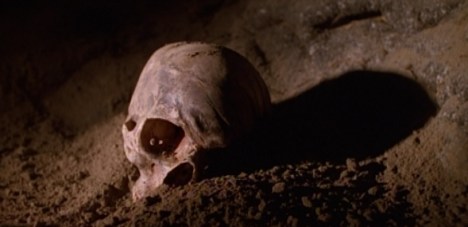
Skullduggery.

Skullduggery.

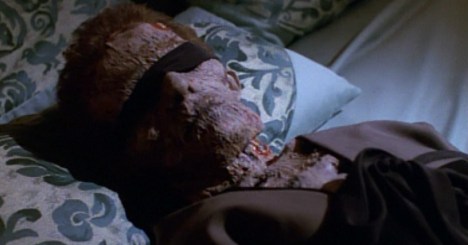
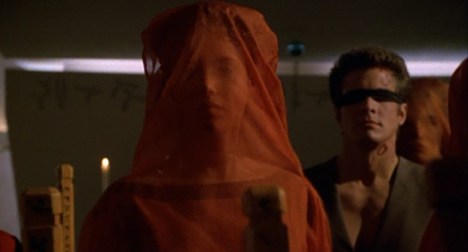
However, for all that Distant Origin feels like a strange fit for the series’ Delta Quadrant setting, it feels very much like quintessential Star Trek. Like Remember earlier in the season, Distant Origin is very much an old-fashioned Star Trek allegory that uses characters in cheesy make-up to comment upon contemporary issues. In Remember, it was the reality of holocaust denial. In Distant Origin, it is the age-old conflict of science-against-political-expedience. There is an endearing timelessness to the metaphor at the centre of the story.

With its dinosaur characters, its fixation upon evolution, and its doctrine of “origin”, Distant Origin seems very specifically tailored to the heated debates around science and creationism in American culture. However, the allegory is powerful enough that it maintains a potency even beyond that. Distant Origin has aged remarkably well, working effectively as a metaphor for climate change denial or even for historical revisionism in favour of the national myth. Distant Origin is both a season and a series highlight.
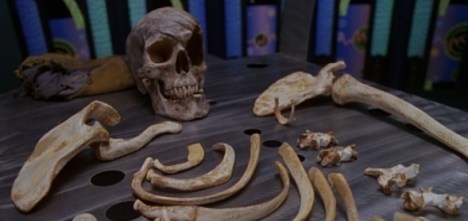
The bones of a theory.

The bare bones of a theory.

Continue reading

Star Trek: Deep Space Nine – Soldiers of the Empire (Review)

Soldiers of the Empire is a very effective illustration of just how far Star Trek: Deep Space Nine was willing to push the Star Trek franchise.

It is an episode that unfolds primarily on a Klingon Bird of Prey. This is nothing new. After all, Star Trek: The Next Generation produced A Matter of Honour in its second season, assigning Riker to serve on a Klingon ship as part of an exchange programme. However, that episode was told primary from a human perspective, the story centring on Riker adjusting and adapting to an alien culture before saving the day. When Worf joined the Klingon fleet in Redemption, Part II, the story kept cutting back to life on the Enterprise in his absence.

"Mahk-cha!"

“Mahk-cha!”

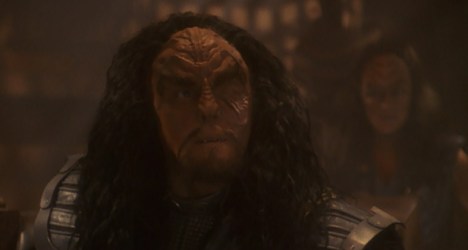
In contrast, Soldiers of the Empire is primarily focused upon the Klingon cast and the Klingon crew. Worf and Dax join the IKS Rotarran to support General Martok in his first command since escaping the Dominion prison camp at the end of By Inferno’s Light, but they are very much bystanders. Although Worf and Dax provide vital narrative functions in introducing the audience to Klingon customs and cultures, the narrative arc of the show belongs to Martok and the crew of the Rotarran. This is not a story about Worf and Dax, this is a story about Martok.

The result is an episode that really pushes the limits of the storytelling possibilities on Deep Space Nine, a reminder that the production team remain as ambitious as ever in the show’s fifth season. Soldiers of the Empire suffers from a few minor plotting issues, but it is exciting and compelling in a way that captures the very best of Deep Space Nine.

A sharp stabbing pain.

A sharp stabbing pain.

Continue reading

Star Trek: Voyager – Real Life (Review)

Real Life is in some ways a departure for Star Trek: Voyager.

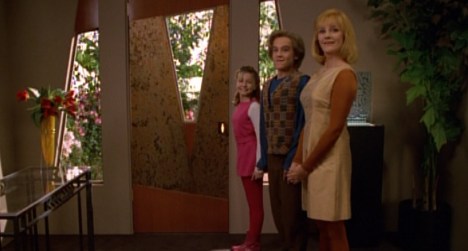
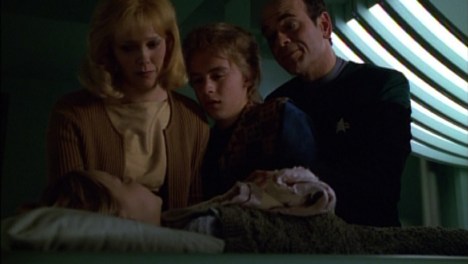
That much is obvious from the teaser, which introduces three new characters on a new set. More than that, the three characters comprise a nuclear family and the set is built to resemble the stereotypical American family home. It is a very strange image, even before the characters begin talking like they escaped from The Brady Bunch. In what might be the best teaser of the entire third season, it is revealed that the EMH has fashioned himself a holographic family and is “commuting” to work in sickbay from the holodeck.

Projections.

Projections.

It is certainly an interesting idea, one that consciously brushes up against the kinds of limitations and expectations that Voyager has faced. It feels experimental, quite removed from the broader third season attempts to position Voyager as the most generic of the Star Trek spin-offs. This does not look or feel like any other episode in the franchise’s history. Indeed, with its focus on family dynamics and conflict, it feels like an extension of Ronald D. Moore’s work on episodes like Family and Doctor Bashir, I Presume.

This makes the episode’s failure to follow through on any of that potential even more disappointing. The third season of Voyager has dramatically scaled down its ambition following the spectacular misfires of the second season. The show is no longer attempting to create long-form stories or introduce iconic new recurring alien species, instead setting more modest goals for itself. There is something disheartening in seeing Voyager set more modest challenges for itself in episodes like Macrocosm or Fair Trade, only to spectacularly bungle the handling of those challenges.

Family matters.

Family matters.

Real Life is another example of the trend. The premise is interesting, and the episode hits on any number of intriguing ideas. There is a great story to be told using this premise, exploring core themes about the human condition in a way that is quite different from the normal storytelling on Voyager. However, the episode flirts with the premise and then balks at it. Real Life is terrified of the implications of its story, padding out the plot with an unnecessary techno-babble-laden diversion and casually discarding the holographic family at the end of the script.

Real Life is an underwhelming story, rendered all the more disappointing for the promise that it squanders.

Photon father.

Photon father.

Continue reading

Star Trek: Deep Space Nine – Ferengi Love Songs (Review)

Ferengi Love Songs has one really good joke. In the episode’s defence, it might just be a great joke.

The most striking moment in Ferengi Love Songs comes eight minutes into the episode. In fact, the teaser rushes along so fast that it feels like the production team were pushing for that moment to serve as the sting that would segue into the opening credits. Instead, it arrives during an otherwise short and indistinct first act, providing an effective ad break on syndication. Still, the image is strong enough that it lingers. The image is the sequence in Quark discovers that the Grand Nagus, the most powerful of Ferengi, is hiding in his closet.

Imagine me and you, I do, I think about you day and night, it's only right...

Imagine me and you, I do,
I think about you day and night, it’s only right…

It is a great comedy moment, in both concept and execution. The idea of the leader of a vast interstellar empire hiding in somebody’s bedroom is ridiculous in a way that Star Trek is very rarely ridiculous, at least during the Rick Berman era. It is very much a stock sit-com trope, except it has been dressed up in the trappings of a franchise that has a long record of taking itself incredibly seriously. There is an endearing absurdity to the gag that feels almost like the Star Trek: Deep Space Nine writers are affectionately poking fun at the franchise’s self-seriousness.

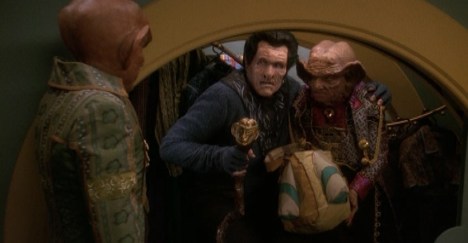
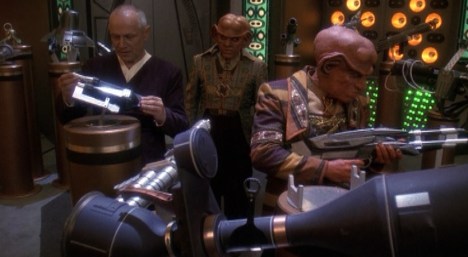
Even the execution of the joke works very well. Quark absent-mindedly opens his closet and puts his travel bag inside. The Grand Negus is waiting inside and accepts the bag that is offered. Quark closes the closet, and then does a double-take. He reopens the closet, at which point the Grand Nagus points out that Quark shouldn’t even be here. In a panic, Quark immediately grabs his bag and prepares to leave his house (and the planet) before he properly processes what has happened. “What’s the Nagus doing in my closet?”

He comes with a lot of baggage.

He comes with a lot of baggage.

It is a scene that might have been lifted from some forgotten thirties screwball comedy, which makes sense considering the interests of the Deep Space Nine production team. Rene Auberjonois directs the sequence in which to play into that absurdity, and Armin Shimerman proves quite game at delivering double-takes and exaggerated moments of realisation. It is a great gag, skilfully executed, that is brilliantly silly in the way that Deep Space Nine is not afraid to be.

The biggest problem with Ferengi Love Songs is the challenge of where it needs to go from that brilliant little gag. There is an interesting kernel of a story idea here, the writers’ obvious affection for these Ferengi characters shining through. Unfortunately, none of that fits with the tone of the episode’s central gag, which leads a plot that feels strangely dissonant as it tries to wring drama and conflict from the image of the Grand Nagus crouched over in Quark’s closet.

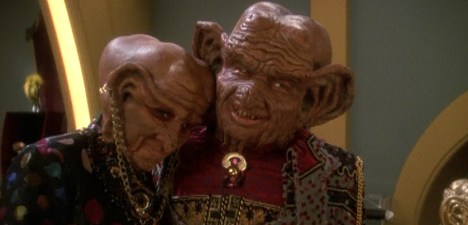
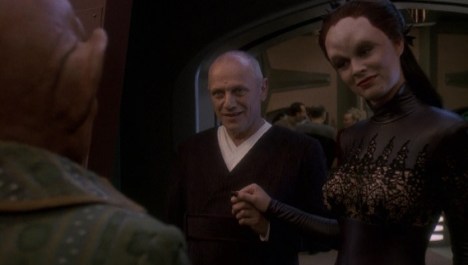
Strange bedfellows...

Strange bedfellows…

Continue reading

Star Trek: Voyager – Before and After (Review)

You might be interested in our other reviews from the third season of Star Trek: Voyager:

Before and After is an episode that should be more interesting than it ultimately is.

There is no small irony in the fact that the one future constant suggested by Before and After would be gone by the third episode of the following season, while the generic tone of the episode’s future flashes would prove entirely accurate. In some ways, Voyager was a paradox. It was generally quite professional and sleek, the show’s polished exterior seeming a little too lifeless and sterile at times. However, this was all an elaborate and well-rehearsed illusion. Behind the scenes, Voyager was a turbulent and chaotic piece of television.

voy-beforeandafter22a

Those conversations and would tweak some of the future suggested by Before and After. Jennifer Lien would depart, and Kes would be retired. Jeri Ryan would be hired, and Seven of Nine would join the crew. Much like what had happened with Deep Space Nine, the planned third season cliffhanger would be thwarted and pushed into the fourth season to make way for a much more bankable story. On Deep Space Nine, Homefront and Paradise Lost were shunted for The Way of the Warrior. On Voyager, Year of Hell, Part I would be brushed aside for Scorpion, Part I.

At the same time, it was clear that Paramount was wary and uncertain of what the future might hold for the franchise. Viewing figures had begun a decline that would continue until the end of Enterprise. The writers on Deep Space Nine had been instructed by the studio to add an existing character and focus on the Klingons early in their fourth season, hoping to shore up viewers. Similar discussions were taking place behind the scenes on Voyager, with the network and producers looking to spice things up on the series.

voy-beforeandafter35a Continue reading

Star Trek: Deep Space Nine – Business as Usual (Review)

Business as Usual is, appropriately enough, a very typical Star Trek morality play.

It is a relatively rare example of Star Trek: Deep Space Nine engaging in the sort of pointed social commentary that many fans expect of the genre, the rather straightforward moral lesson couched in science-fiction trappings; The Devil in the Dark as a commentary on “the other”, A Taste of Armageddon as a condemnation of the Vietnam War, Let That Be Your Last Battlefield as a critique of racism in general. There are all but expected in a Star Trek show, but Deep Space Nine rarely plays them particularly straight.

Disarming conversationalists...

Disarming conversationalists…

Deep Space Nine has told issue-driven stories before, with In the Hands of the Prophets serving to explore the gap between creationists and those who believe in evolution or Past Tense, Part I and Past Tense, Part II constructed as a direct commentary on Los Angeles’ plans to lock up their homeless population. However, the series tend to favour broader commentaries about grander themes. The show arguably as a timeless quality because it tends not to dwell too heavily upon specific ideas, instead meditating on particular themes like authority and conflict.

Indeed, Star Trek: Voyager is a lot more traditional in this respect. That writing staff has a clear fondness for the archetypal Star Trek morality play, constructing episodes as metaphors for contemporary issues; Remember explores Holocaust denial, Distant Origin deals with creationism, Displaced offers a reactionary take on immigration. Even non-issue-driven episodes like Darkling and Fair Trade make a point to stress the franchise’s utopian values in a manner much more overt than Deep Space Nine.

The hard sell.

The hard sell.

With that in mind, Business as Usual feels strangely old-fashioned. It is very much an episode of Deep Space Nine in terms of setting and character, in that no other Star Trek show would have a lead character knowingly and willingly become an arms dealer. However, it feels very much like an archetypal Star Trek show in that it is an episode about how the arms trade is implicitly immoral and horrific. It is a very worthwhile message, and in no way diminished by its obviousness, but it does feel surprisingly clear cut when compared to episodes like The Ship or Rapture.

Business as Usual is essentially a very conventional Star Trek story that is elevated by one of the best guest casts in the history of the franchise.

"No, Mister Quark, I expect you to buy!"

“No, Mister Quark, I expect you to buy!”

Continue reading

Star Trek: Deep Space Nine – A Simple Investigation (Review)

A Simple Investigation is a quiet little episode.

This is particularly true in the context of the crowded second half to the fifth season of Star Trek: Deep Space Nine. In Purgatory’s Shadow and By Inferno’s Light radically upended the status quo and set the fifth season on a march towards A Call to Arms. The threat of war looms large over the second half of the season, following the admission of Cardassia into the Dominion. There is a creeping sense of inevitability to episodes like Blaze of Glory and Soldiers of the Empire.

Strange bedfellows...

Strange bedfellows…

At the same time, Deep Space Nine takes a little while to adjust to that dramatic shift. The Dominion and Cardassia only come back into focus with Ties of Blood and Water, the episode that reintroduces Weyoun to the series. Still, episodes like Doctor Bashir, I Presume and Business as Usual have a sense of weight to them as they offer up high-stakes family drama and arms-dealing morality plays. In contrast, A Simple Investigation feels relatively low key. It is not an episode with profound consequences or shocking revelations.

Instead, A Simple Investigation plays as a small-scale cyberpunk noir romance in which Odo falls head-over-heels in love with a guest star whom he will never see again. With all the chaos unfolding across the length and breadth of the fifth season, A Simple Investigation feels surprisingly… simple. The problems of these little people don’t amount to a hill of beans in this crazy world, but A Simple Investigation still takes the time to fixate upon them.

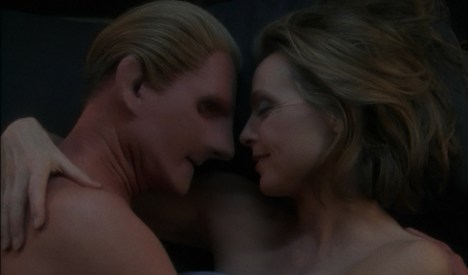
Star struck.

Star struck.

Continue reading

Star Trek: Voyager – Favourite Son (Review)

Favourite Son feels like the culmination of something that has been festering across the third season of Star Trek: Voyager.

The Star Trek franchise is generally regarded as progressive and forward-thinking. There is some debate to be had about whether this is an accurate summary of the franchise, given some of the creative decisions made over the course of its half-century run. However, there are times at which the franchise feels particularly liberal and points at which it feels particularly reactionary. A product of the mid-nineties, running through to the turn of the millennium, Voyager tends to feel very conservative in places.

This is a little bit what watching the episode feels like.

This is a little bit what watching the episode feels like.

In the second season, this reactionary tendency played out through the treatment of the Kazon in episodes like Initiations and Alliances. In the third season, with the Kazon long gone, it seems that Voyager has turned its reactionary gaze upon its female cast members. To be fair, the show’s first two seasons had any number of unfortunate creative decisions when it came to various female characters. Most notably, the decision to turn Seska into a baby-crazed maniac in Manoeuvres did not bode for the first female-led Star Trek series.

Nevertheless, a misogynist streak has manifested itself across the third season as a whole. In some cases, this has been relatively subtle; like the awkward insistence upon sexualising three-year-old Kes in the eyes of her two mentor figures in Warlord and Darkling. In other cases, this has been the entire point of the plot; like the decision to have Q try to sleep with the franchise’s first female lead and introduce his shrewish wife in The Q and the Grey or to introduce a psycho stalker in Alter Ego.

The original red wedding.

The original red wedding.

Other times, this sexist attitude has bubbled through the background of various episodes to the point that it builds to critical mass. Torres is victimised by her male colleagues over the course of three straight episodes, and none of them are held accountable; she is sexually assaulted by Vorik in Blood Fever, stunned by Chakotay in Unity, and tortured by the evil!EMH in Darkling. In each of those cases, the show seems to shrug off the violence committed by male characters against one of the show’s female leads.

All of these elements come to the fore in Favourite Son, an episode that would have been painfully retrograde had it aired as part of the original series during the sixties. Favourite Son is that most uncomfortable myth dressed up in science-fiction drag, the tale of an island of beautiful women using their sexual prowess to lure men into their clutches to emasculate them. It is terrifying to think that this episode made it to air in the late nineties.

A beautiful dream.

A beautiful dream.

Continue reading

Star Trek: Voyager – Rise (Review)

Rise is in many ways a very typical episode of Star Trek: Voyager.

It is an episode that certainly has an interesting premise. For all its myriad flaws, Voyager tended to have a genuine interest in playing with science-fiction concepts. At its worst, this attitude manifested itself through the various “anomaly of the week” stories that followed a familiar pattern of the ship encounter some sort of strange phenomenon with predictable results. Often this phenomenon involved time travel or interstellar dust clouds, a trend that could be traced back to early episodes like Time and Again or The Cloud.

That crashing feeling.

That crashing feeling.

However, Voyager did occasionally use its interest in science-fiction storytelling to construct interesting stories. Deadlock might have set a damning precedent for the show, but it was compelling television. Blink of an Eye is a very clever little story. In true Star Trek fashion, Voyager would even use these science-fiction ideas to construct engaging allegories like the exploration of holocaust denial in Remember or the meditation on creationism in Distant Origin.

These concepts gave the series a sense of texture. They served to distinguish the show from its siblings. For example, Star Trek: Deep Space Nine was generally less interested in science-fiction high concepts than in characterisation and politics. When those sci-fi elements did show up, they were usually to torture O’Brien in episodes like Whispers, Visionary, Hard Time and Time’s Orphan. Of course, Deep Space Nine had sci-fi concept-driven stories like Playing God or One Little Ship, but they tended to stand out more from the series around them.

Up on the roof's the only place I know...

Up on the roof’s the only place I know…

Rise has a suitably high concept, a core idea that could easily have been lifted from the pages of the same pulp magazines that inspired The Cloud Minders. The episode is essentially a paranoid thriller unfolding within a confined space, but that confined space just happens to be a giant elevator that stretches from the surface of the planet into orbit. The premise is ridiculous, feeling like it was lifted from forties or fifties periodicals with giant insects and half-naked men on the cover. In other words, it feels of a piece with Innocence or The Thaw or Tuvix.

It is too much to argue that Rise has a brilliant concept, but it at least has an intriguing one. While it might be hard to use the basic elements of Rise to construct a classic, it should be relatively straightforward to construct a thrilling episode of television. Unfortunately, Rise simply does not work. More than that, Rise does not work for the most boring of reasons. As with a lot of Voyager, the episode is an interesting premise undercut by both a deeply flawed (and half-hearted) execution and the show’s own long-standing structural weaknesses. This happens all too often.

A dark moment for the series.

A dark moment for the series.

Continue reading

Star Trek: Deep Space Nine – Doctor Bashir, I Presume (Review)

Doctor Bashir, I Presume is a strange little episode.

It directly follows In Purgatory’s Shadow and By Inferno’s Light, a two-part story in which it was revealed that Doctor Julian Bashir had been abducted by the Dominion at some point during the fifth season and replaced with a changeling infiltrator. Although the maths can be a little difficult to work out, it is suggested that Bashir was replaced by a changeling at some point before Rapture. With that in mind, it seems strange that the very next episode of Star Trek: Deep Space Nine should reveal that the recently returned Julian Bashir is himself an imposter.

"Oh, shiny."

“Oh, shiny.”

However, even on its own terms, Doctor Bashir, I Presume is a very odd piece of television. The hook of the episode is a guest appearance from Robert Picardo as Lewis Zimmerman. Picardo is making a crossover appearance from Star Trek: Voyager where he played the EMH, who had also made an appearance in Star Trek: First Contact. Picardo is a fine dramatic actor, but the character is notable for being comic relief. Doctor Bashir, I Presume begins as a light-hearted quirky piece, turning sharply at the half-way point to become a gritty science-fiction family drama.

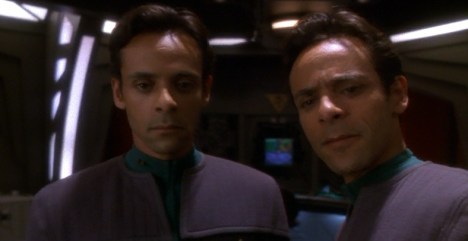
All of this is quite jarring. However, Doctor Bashir, I Presume works surprising well. A large part of that is down to how strange the episode is, often feeling like an intimate family drama about recrimination and disappointment set against the backdrop of a massive science-fiction franchise.

A selfie with himself.

A selfie with himself.

Continue reading