• Following Us

  • Categories

  • Check out the Archives


  • Awards & Nominations

Star Trek: Deep Space Nine – The Siege of AR-558 (Review)

The thing that Ira and I both wanted to do, was to make war as gritty as possible. You can make what somebody called the Gameboy wars, the Nintendo War, too clean and too cute. Nobody pays a price. You see ships blowing up, and that is kind of cool. But you don’t get the feeling of what a war is. Everybody said it was our Saving Private Ryan, but we’d come up with it before we were even aware of what they were doing on Saving Private Ryan. It really wasn’t that for us. It was really much more about Starfleet, and what those guys go through, and what it must be like in that time, and how to make that work on a gritty level. Rick Kolbe did a remarkable job directing it. Avery again did a marvelous performance in terms of being the captain in a very difficult situation, and making all of those difficult choices that you have to make under those circumstances.

– Hans Beimler, Cinefantastique
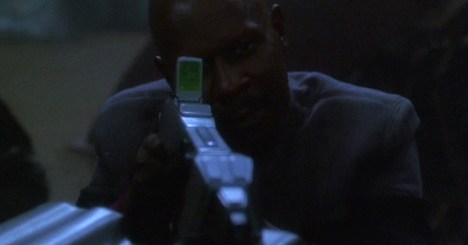
Siege the day.

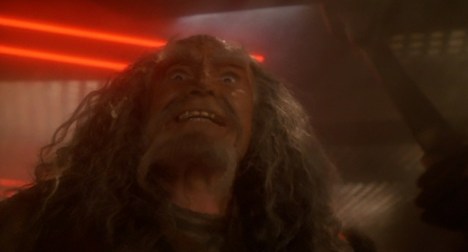
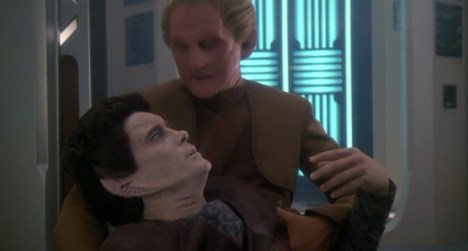
The Siege of AR-558 is a masterful piece of Star Trek, and one of the finest episodes of Star Trek: Deep Space Nine.

In some ways, The Siege of AR-558 is an episode that has been necessary since the outbreak of the Dominion War at the end of Call to Arms. It is a story that had to be told at some point in the two-year stretch from A Time to Stand to What You Leave Behind. Had the writers and producers on Deep Space Nine opted not to tell a story like this within the framework of the Dominion War, they would have undermined the series as a whole and undercut a lot of the justifications for constructing an epic two-year war arc.
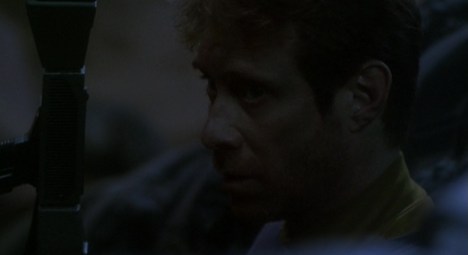
Mumy dearest.

It could reasonably be argued that The Siege of AR-558 is not unprecedented. In many ways, the episode is an extension of a narrative style that had been attempted at various points in the show’s recent history, the familiar “war is hell” story that drove episodes like The Ship, ... Nor the Battle to the Strong and Rocks and Shoals. It is very hard to look at the final three seasons of Deep Space Nine as a narrative glorifying warfare, the series often cynical about such violence.

At the same time, The Siege of AR-558 pushes that idea further than any earlier episode. The Siege of AR-558 is a story that unequivocally confirms that the Dominion War is a nightmarish and existential threat to the Federation with a profound moral and physical cost. While this idea has been reiterated repeatedly in stories like Far Beyond the Stars or In the Pale Moonlight, The Siege of AR-558 frames its argument in more visceral terms. It is an episode not about the abstract concept of war, but of its horrifying realities.

An explosive combination.

The Siege of AR-558 is not a morality play that operates at a remove from the violence. The Siege of AR-558 is not an episode in which war is reduced to a mathematical model. The Siege of AR-558 is not an episode in which important people sit around a table and engage in vigourous debate about plans of attack. Instead, The Siege of AR-558 is a story about the horrifying realities of combat, of the fear and dread felt by those on ground, of the seemingly pointless bloodshed that results from all of this politicking and scheming.

The Siege of AR-558 is a war story.

A shot in the dark.

Continue reading

Star Trek: Voyager – Once Upon a Time (Review)

Once Upon a Time is another example of thwarted ambition on Star Trek: Voyager.

The original pitch for the episode was incredibly ambitious and narratively experimental, a Star Trek story told exclusively from the perspective of a child character trying to make sense of a world from which the adults are trying to protect her. In many ways, it recalls the original pitch for Macrocosm, an episode that Brannon Braga had originally hoped to write as a piece of silent television. However, like that earlier episode, the original plan for Once Upon a Time was vetoed in favour of something far more conventional.

Toyetic, isn’t he?

In many ways, this conservatism was a reminder of just how far Voyager was being left behind, of how the dominant production strand of the Star Trek franchise was failing to keep pace with the changing media landscape around it. Genre television had been a hotbed for experimentation in the nineties. Twin Peaks changed television, allowing the medium to embrace surrealism and weirdness in a way never seen before. Series like Babylon 5 and Star Trek: Deep Space Nine returned serialisation to prime time, after it had fallen out of fashion.

Over the course of the decade, genre shows were willing to push the boundaries of what was possible in television, proving dynamic in a way that would be hugely influential for the more high-brow “prestige” series that followed. Even shows like The X-Files, Space: Above and Beyond and Buffy: The Vampire Slayer indulged in the occasional experimental episodes like The Post-Modern Prometheus, Triangle, Who Monitors the Birds?, Hush and Once More With Feeling. There was a revolution taking place in television during the nineties.

It’ll never catch on.

Of course, that particular television revolution was already in its final days as the decade drew to a close. The next big innovation in television storytelling was just around the corner, with The Sopranos only a few months away from broadcast. Once that happened, the television revolution would shift away from science-fiction and horror shows on free-to-access broadcasters and towards more critically-respected genres on more prestigious (and exclusive) networks. Voyager would have been late to the party anyway, but instead decided to skip it anyway.

Once Upon a Time is an ambitious premise watered down to mediocre execution. It is Voyager in a nutshell.

Why, I Flotter…

Continue reading

Star Trek: Deep Space Nine – Once More Unto the Breach (Review)

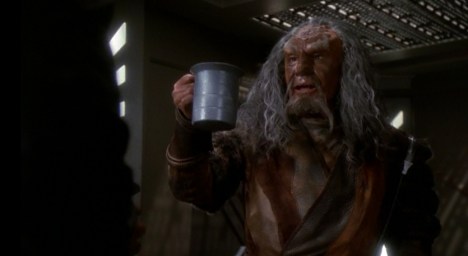
Once More Unto the Breach bids a fond farewell to Kor, the Star Trek franchise’s original Klingon.

To be fair, Star Trek: Deep Space Nine had never been particularly shy about killing off recurring characters, with Enabran Tain dying in In Purgatory’s Shadow, Michael Eddington expiring in Blaze of Glory, and Tora Ziyal being murdered in Sacrifice of Angels. Contractual negotiations had guaranteed the death of Jadzia Dax in Tears of the Prophets. Certainly, Kor was not a major player in the larger fabric of the show when compared to these figures, having only previously appeared in Blood Oath and The Sword of Kahless.

The return of a Kor character.

However, there is a certain gravity to the character owing to the fact that he could trace his appearance all the way back to Errand of Mercy in the very first season of the franchise. Kor was very much the first Klingon, even if he was neither the first Klingon to appear on screen nor the first Klingon to truly resemble the modern template. Kor was a part of the franchise’s history, part of its context. John Colicos had a fairly significant impact on popular culture, but has particularly important to Star Trek.

There would be bigger deaths over the course of the seventh season. Actors who had been with the franchise for years would go out in a blaze of glory. Recurring guest stars would see their stories come to an end. Some of those endings would be happy, whereas others would be more ignoble. Nevertheless, there is a something powerful about the passing of Kor in Once More Unto the Breach. It feels very much like an ending.

No Country for Old Klingons.

Continue reading

Star Trek: Voyager – In the Flesh (Review)

In the Flesh is a curiously nostalgic episode of Star Trek: Voyager.

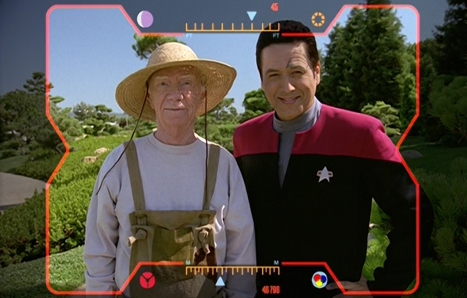
Nostalgic in a number of different ways. Most obviously, it opens on what appears to be Earth, bringing the Voyager crew to something resembling home. The campus recalls visits to Starfleet Command in earlier episodes of Star Trek: The Next Generation and Star Trek: Deep Space Nine like The First Duty, Homefront and Paradise Lost. There is even a prominent guest appearance from Boothby, the groundskeeper who was referenced as early as Final Mission. When it is eventually revealed to be a ruse, it is explained as a ruse orchestrated by old villains Species 8472.

Picture imperfect.

However, In the Flesh feels nostalgic in a deeper sense, extending even beyond the Star Trek canon. There is something very retro about the threat presented here, about a top secret facsimile of a distant world being used to train infiltrators in a deep space cold war. In the Flesh feels like a piece of fifties paranoia, with specific creative choices evoking film noir storytelling and even the aesthetic of Invasion of the Body Snatchers or Night of the Living Dead. The most prominent guest star is Ray Walston, a veteran of cult sixties sci-fi show My Favourite Martian.

To be fair, Voyager has always had a strong nostalgic streak for pulpy fifties and sixties science-fiction, but it is strange to see it so pronounced. In its own weird way, it fits with the general nostalgic tone of the fifth season as a whole.

Look at the “8” in their eyes.

Continue reading

Star Trek: Deep Space Nine – Treachery, Faith and the Great River (Review)

Treachery, Faith and the Great River is a beautiful piece of Star Trek: Deep Space Nine.

It is a meditation on everything suggested by the title, recurring themes across the seven-season run of Deep Space Nine. Indeed, it is a reflection on how each of those three concepts all tie back to the same notion of belief. Treachery is what happens when belief is betrayed, faith is what happens when belief is held without validation, and the great river reflects a more generic belief in the balance and distribution of the wider universe. Treachery, Faith and the Great River is a story about belief and the various forms that it takes, and the rewards that it offers.

“And how can man die better than facing fearful odds, for the ashes of his fathers, and the temples of his Gods?”

In many ways, Treachery, Faith and the Great River marks a return to the sort of softer religious belief that defined the early seasons of Deep Space Nine. It is an episode that engages with the challenges of faith, rather than taking it at face value. It is no small irony that an episode as nuanced as Treachery, Faith and the Great River should be credited to the writers responsible for The Reckoning. In many ways, Treachery, Faith and the Great River asks what it means to truly believe in something, even knowing that this belief might never be rewarded.

Treachery, Faith and the Great River is a story about looking for the divine, and the answers that are offered in return.

Weyoun Six, Weyoun Seven…
All good clones go to heaven…

Continue reading

Star Trek: Voyager – Extreme Risk (Review)

Extreme Risk is another example of Star Trek: Voyager squandering an intriguing premise.

Hunters introduced a number of new and intriguing ideas to Voyager. Suddenly, Janeway was no longer in a long-term relationship with Mark, which made it possible for her to consider romantic entanglements in the Delta Quadrant. Suddenly Starfleet was aware that Voyager was still in one piece, rather than missing in action. These creative choices opened up new storytelling possibilities, paving the way for episodes like Counterpoint or Pathfinder.

Diving right in.

However, the most interesting revelation in Hunters was that the Maquis had been destroyed while Voyager was lost in the Delta Quadrant. This was not a surprise to Star Trek fans who had been watching Star Trek: Deep Space Nine, given that this development had been covered in Blaze of Glory. However, it should have been a big deal to the characters on Voyager. Chakotay and Torres were members of the Maquis. Tuvok had been a spy working for Starfleet in the Maquis. Even Paris had spent some time in the organisation. This news should have been a big deal.

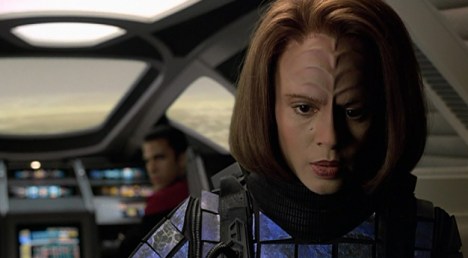
Extreme Risk feels like an interesting development of this idea, albeit one that has been greatly delayed. How would the Maquis crew members react to the news that most of their friends were dead and that the rest were in Federation custody? Voyager has never been a show particularly engaged with long-term consequences, but there is an interesting story to be told there. Extreme Risk tells one such story, suggesting that the new plunged Torres into a depression that led her to self-harm. It is certainly an intriguing and compelling story hook.

Building a better future.

However, Extreme Risk fumbles the delivery in a number of ways. It makes the standard Voyager mistake of assuming that character-driven plots still have to have a compelling action-adventure element to them, and so provides a very generic subplot about a probe that has been lost in the atmosphere of a gas giant and the resulting “old-fashioned space race” that results, including the construction of a new ship. As a result, the plotting of the episode feels very trite, offering Torres a very convenient clear-cut redemption arc at the climax.

That said, the biggest problem with Extreme Risk is much more basic than the awkward juggling of primary and secondary plots. As with Night before it, Extreme Risk demonstrates that the rigidly episodic structure of Voyager is woefully ill-equipped to tell a profound (and sincere) story about the struggles of living with clinical depression.

She knows kung fu.

Continue reading

Star Trek: Deep Space Nine – Take Me Out to the Holosuite (Review)

Star Trek: Deep Space Nine is populated by losers.

There are exceptions to this blanket statement, of course. By some measures, the crew of this fringe outpost are quite distinguished. Benjamin Sisko is the Emissary of the Prophets and is a decorated combat veteran. Worf served as Chief of Security on the Federation flagship. Julian Bashir has been genetically engineered to make him stronger and faster than the average human. The Dax symbiont was heavily involved in the negotiation of the peace agreement between the Federation and the Klingon Empire.

A whole different ball game.

However, even these examples of success and prestige are somewhat tempered. Sisko arrived on this backwater outpost as a man considering resigning. Worf is a terrible father and a widower. Bashir spent most of his life hiding his abilities, to the point that he has been forced to pretend to be less than he was; although he is now “out”, his genetic engineering has arguably served to further marginalise him within Starfleet. The Dax symbiont is now joined to Ezri Tegan, a young woman who had never planned to be a host.

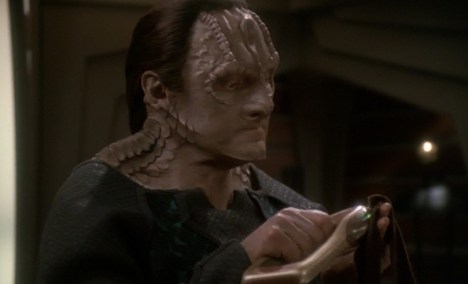
In the larger context of the Star Trek universe, Deep Space Nine feels like the island of misfit toys. Odo was found drifting alone through the void; when he finally found his people, he discovered that they were monstrous fascists; when he killed one of his own people, he was forced into exile. Quark is stuck managing a bar that can barely turn a profit, watching others get ahead. Garak was forced into exile by his own father, and is now a traitor to his own people. Martok lost his eye in a Dominion prison camp.

Playing games.

This is in marked contrast to the characters who usually populate the franchise. JJ Abrams’ rebooted Star Trek essentially makes a point to feature at least one sequence demonstrating how each crew member is the top of their given field. Star Trek: The Next Generation was set in one of the most professional working environments in television history. Star Trek: Voyager might have been populated by rebels and scientists, but they still trounced the Borg on a regular basis. Star Trek: Enterprise was a crew of the best and the brightest.

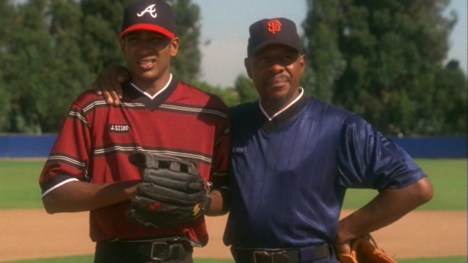
There are a lot of things to love about Take Me Out to the Holosuite, and one of them is the fact that it understands that Deep Space Nine is populated by losers. Take Me Out to the Holosuite also understands that this is part of what makes Deep Space Nine so winning.

Game on.

Continue reading

Star Trek: Voyager – Drone (Review)

Drone is a solid episode, one elevated by two central performances.

In many respects, Drone is a standard Star Trek: Voyager episode. It is something of an archetypal Star Trek story, an exploration of the human condition in which the regular characters must bestow upon a naive and inexperienced alien what it means to be human. There are countless examples in the canon, from Picard’s relationship with Data in Star Trek: The Next Generation to more specific examples like the relationship between Data and Lal in The Offspring. However, Drone has a more direct antecedent, with One evoking Hugh from I, Borg.

The view is always greener on the other side…

Drone is also very heavily plot-driven, although it is decidedly cleaner and leaner in execution than many Voyager episodes. Compared to the other Star Trek series, Voyager can often feel like a list of plot developments arranged to pad out forty-five minutes of television. This approach to storytelling can often seem quite frantic, with episodes like Worst Case Scenario, Waking Moments, Demon or Night effectively switching plot in the middle of the episode to keep it going. Drone is a much more linear story, much tighter in its construction and its flow.

The result is an effective piece of television, one strongly anchored in the two central performances of J. Paul Boehmer and Jeri Ryan.

“Was he going on to you about the alcoves?”

Continue reading

Star Trek: Deep Space Nine – Afterimage (Review)

Afterimage is a necessary episode, in part because Ezri Dax is a necessary character.

Adding a new character to a show in the middle of its run is always a challenge. The addition of Seven of Nine to Star Trek: Voyager had generated considerable tension, both around what the show wanted to be and in terms of the cast working on the series. It can be difficult to strike a balance, to figure out how much attention to devote to this new arrival, to give them some focus without stealing focus from the surrounding cast. It is a tightrope for the writers to walk, one compounded by the relative novelty of this late addition, the new toy in the writers’ toy box.

Make it sew.

This problem is compounded when the new addition arrives at the start of the final season. In any final season, space is at a premium. The production team are racing towards the finish line, trying to service all the dangling plot threads and complete all the important plot arcs. Every beat is important, every story vital. Final seasons are about providing closure, about wrapping things up. Introducing a new character in the midst of all that is a daunting responsibility, a challenge with very high stakes.

The writers at Star Trek: Deep Space Nine were working at something of a disadvantage and to a deadline. However, they did have some handicaps. Most notably, the production team had already successfully integrated a new character into the ensemble, when Worf joined the cast in The Way of the Warrior. More than that, there was some luxury in the fact that Ezri Dax would not be an entirely new character. She would be a logical extension of the premise that was built in Jadzia Dax. She was at least partially familiar, and her concept had been properly seeded.

On airlock down.

Still, introducing Ezri Dax into the final season of Deep Space Nine would prove difficult. The production team would often struggle to strike a balance between writing stories that extended (and concluded) the arcs of other major characters while also writing episodes that introduced and established the character of Ezri. It could often seem like Ezri’s journey was just beginning, right as everybody else’s was coming to a close. The final season of a seven-year show is seldom the perfect place for a new beginning.

As such, Afterimage is more an episode driven by necessity than by desire, a story that has to be told because of factors that were outside the control of the production team. The result is solid, if not exceptional. It is an episode that works best at establishing a new character and new dynamics, suffering just a little bit from clumsy storytelling in the process.

Holo pleasures.

Continue reading

Star Trek: Voyager – Night (Review)

Star Trek: Voyager typically bridged its seasons with epic two-parters, a sprawling single narrative told over two forty-five minute episodes separated by the three-month summer hiatus. In fact, it was somewhat striking when the production team chose to end the fourth season with Hope and Fear, a standalone episode with a very definite conclusion. However, it becomes even more ironic once the fifth season opens with Night. Rather than one story split over two episodes, Night feels like two narratives compressed into a single chunk of television.

Of these two narratives, one is definitely more interesting than the other. The first half of Night essentially focuses on the ship and crew as they venture through an empty (and starless) section of space known as “the Void.” No light can get in. Nothing seems to live in there. There are no anomalies to investigate. “Anything to report?” Tuvok asks Kim. Kim responds, “Not even a stray electron.” It is so dull that even Tom classifies the detection of “a sudden increase in theta radiation” as “excitement.”

Starless, starless night.

This is an interesting approach to storytelling, particularly for a show so focused on plot. More than any other series in the franchise, Voyager runs on plot beats. Stories tend to progress from one revelation and escalation to the next, affording little room for character development or exploration. As such, the first half of Night seems like a very ambitious piece of work, an introspective character-driven drama where there are no plot beats to distract from character. It is a very brave and compelling set-up.

Of course, Night somewhat fumbles the ball in this first half. The thread is never explored as thoroughly as it might be, the character never allowed to properly express themselves. There is far too much emphasis on the holodeck, and the ship’s ability to simulate comforts and illusions even in this most depressing of surroundings. However, compared to the way that Voyager usually tells stories, the first half of Night is refreshing. Ironically, it is genuinely exciting, because it feels like the writers are pushing outside their comfort zone.

A darker side of Janeway.

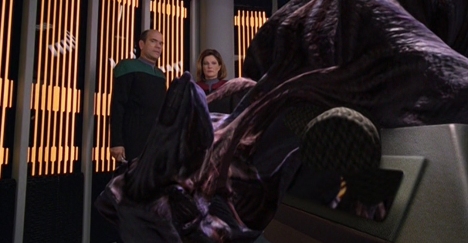
Unfortunately, it cannot last. Night can only resist the comfort of plot for so long. Eighteen minutes into the hour, the second plot kicks into gear. It is a much more conventional Voyager episode, particularly for these later seasons. There is a broadly drawn piece of social commentary that ties into the both Voyager‘s New Age sensibilities and its attitude towards the Delta Quadrant as a whole. There are new aliens introduced, that will become recurring foils. It is all very standard, and all very rushed. The second half of Night makes up for those missed plot beats.

The result is an episode that is deeply frustrating, a game of two halves were each horribly undercuts the other.

A black-and-white issue.

Continue reading