• Following Us

  • Categories

  • Check out the Archives


  • Awards & Nominations

Star Trek: Voyager – Unforgettable (Review)

Unforgettable has perhaps the most ironic title in the Star Trek canon.

The episode is very generic in nature, very much in keeping with the style of Star Trek: Voyager. It is a love story centring on the character Chakotay, although he seems to have been selected as the focus of the episode by chance. There is nothing about Unforgettable that would not work as well as an episode built around Harry Kim or Neelix or even Tuvok. It is an episode with an alien of the week, with a strange society that leads to a dilemma that can be neatly resolved within the forty-five minutes allotted to the episode, leaving no lasting mark on the series.

Forget me not…

Unforgettable has any number of interesting ideas. The Ramuran are an interesting high concept, an alien race with the power to erase themselves from the memories of those they encounter. That should be an interesting story hook, particularly given Voyager‘s recurring fascination with memory and identity. This is also an episode built around a guest appearance from cult icon Virginia Madsen. Madsen is a fantastic guest star for Voyager, an actor who really deserves a meaty and memorable role, like Andy Dick was afforded with Message in a Bottle.

Unfortunately, none of these ideas coalesce. Unforgettable is a bland romantic episode that moves a glacial pace towards an inevitable outcome, either unable or unwilling to exploit either its clever concept or its top-tier guest star to tell a memorable story. Unforgettable is ultimately anything but.

Memories are made of these.

Continue reading

Star Trek: Voyager – The Omega Directive (Review)

The Omega Directive plays like Star Trek: Voyager is trying to push itself.

It is an episode which finds Janeway acting secretively and unilaterally, casually brushing aside the Prime Directive in service of some hidden agenda. This is a very big deal. On the original Star Trek, it frequently seemed like the Prime Directive was something for Kirk to outwit. However, since Star Trek: The Next Generation, the franchise has taken the rule to have a lot more moral weight. Even more precisely, since Caretaker, Janeway has emphasised that it is not her place to intervene directly in the affairs of alien civilisations.

The be-all and end-all.

So there sound be something very shocking about Janeway keeping secrets from her crew and forsaking the moral principle that had been the cornerstone of her first few years in command. Given how conventional Voyager has been, how carefully the show has pitched itself as the most archetypal of Star Trek shows, this should be a pretty big deal. What would get Janeway to consciously (and even enthusiastically) cross those lines? How far would she go? What else is she concealing from the people around her? It should be a powerhouse episode of television.

However, The Omega Directive falls flat. Part of the problem is timing, with The Omega Directive sandwiched between Inquisition and In the Pale Moonlight in terms of the overall franchise chronology. Star Trek: Deep Space Nine had been transgressing and subverting franchise norms for years at this point. The Omega Directive feels like something relatively small-scale, juxtaposed against the activities of Section 31 or Sisko’s complicity in murder. The Omega Directive thinks that it is playing in the same league, but it is not even the same sport.

An explosive new development.

More than that, there is a clumsiness to The Omega Directive. The episode touches on a number of interesting ideas, but the story’s thematic weight is quite consciously removed from the core premise. The Omega Directive works best as a weird episode touching on Borg spirituality, and on the question of the Collective’s motivations, but the episode invests so much energy in the black-ops norm-shattering framing device that these elements do not feel like satisfying pay-off. The core themes of The Omega Directive feel like they belong in another episode.

The Omega Directive is a wasted opportunity, its underwhelming subversive trappings distracting from what might have been a compelling meditation on faith and belief.

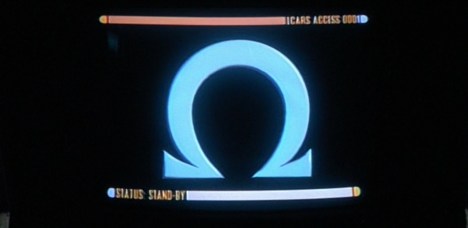
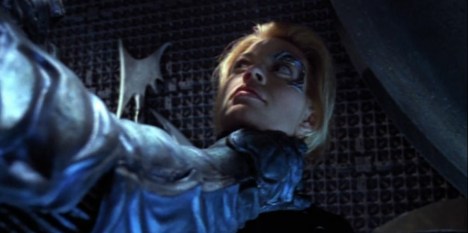
That healthy blue glow.

Continue reading

Star Trek: Voyager – Vis á Vis (Review)

Well, it was nice while it lasted.

The fourth season of Star Trek: Voyager had a nice little strand of continuity running through the fourth season, from the discovery of the relay stations and first contact with the Hirogen in Message in a Bottle through to the reaching of an accord with the Hirogen in The Killing Game, Part II. That six-episode run had demonstrated a remarkable attention to detail on the part of the production team. Even the relatively stand-alone episode Retrospect alluded to the ending of Prey and the threat of the Hirogen lingering from Hunters.

Ch-ch-changes…

However, Vis á Vis represents a return to business as usual for the series. It is a light stand-alone episode that completely eschews any sense of continuity or character development. Credited to production assistant Robert J. Doherty, Vis á Vis feels like a weird throwback to the middle of the second season, a retrograde character-driven episode rooted in a version of Tom Paris that has not existed since Investigations at the absolute latest. The result is a weird body-swapping episode where the regular cast member seems out of character to begin with.

Vis á Vis is an outdated Voyager episode, even beyond the lame body-swap premise.

Grease is not the word.

Continue reading

Star Trek: Voyager – The Killing Game, Part II (Review)

In some ways, The Killing Game, Part I and The Killing Game, Part II feel like a perfect companion piece to Year of Hell, Part I and Year of Hell, Part II.

Building upon the high-concept large-scale template established by Future’s End, Part I and Future’s End, Part II during the third season, these two two-part episodes established a blockbuster template for Star Trek: Voyager going forward. They solidified Brannon Braga’s vision for the series, and effectively laid out a blueprint for his widescreen spectacle-driven reimagining of the final three seasons. Like Year of Hell, Part I and Year of Hell, Part II before them, The Killing Game, Part I and The Killing Game, Part II are blockbuster Star Trek.

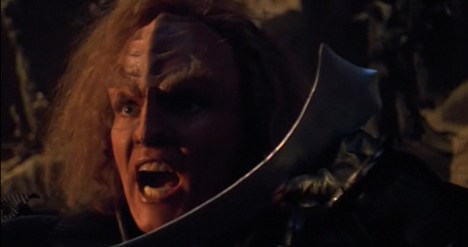
Time’s up.

Star Trek: The Next Generation and Star Trek: Deep Space Nine had produced any number of two-part episodes over the course of their runs. In fact, The Best of Both Worlds, Part I and The Best of Both Worlds, Part II had helped to cement the two-part story as impressive tool in the franchise’s storytelling arsenal. On both VHS and blu ray, these two-part stories were constantly repackaged as mini-movies; Redemption, Part I and Redemption, Part II, Unification, Part I and Unification, Part II, Chain of Command, Part I and Chain of Command, Part II.

However, Voyager represented a very clear evolution in the way that the production team approached these stories. Basics, Part I and Basics, Part II were the exception that proved the rule, the last holdover of the Michael Piller era. Largely driven by Brannon Braga and Joe Menosky, the later Voyager two-parters took on a decidedly more blockbuster sensibility. They could easily be packaged as mini feature films, and might even work better in those formats than as two standalone narratives. They were bigger and bolder than earlier two-parters had been.

Holo promises.

Future’s End, Part I and Future’s End, Part II provided the model for these big “event” two-parters. Scorpion, Part I and Scorpion, Part II applied to the Borg in order to offer an even bigger bang for their buck. Year of Hell, Part I and Year of Hell, Part II took the ship and crew to their limit to tell a story set over an entire year. The Killing Game, Part I and The Killing Game, Part II pushed the idea even further, with UPN opting to show both parts of the story on the same night as something like a television movie. It was a big deal.

Deep Space Nine had broadcast The Way of the Warrior as a television movie, but it was a season premiere and effectively a second (or even third) pilot. The Killing Game, Part I and The Killing Game, Part II comprised a high-concept mid-season two parter. They were arguably a stock Voyager episode, only bigger. In the years ahead, Dark Frontier, Part I and Dark Frontier, Part II would follow the same pattern. So would Flesh and Blood, Part I and Flesh and Blood, Part II. The Killing Game, Part I and The Killing Game, Part II established a trend.

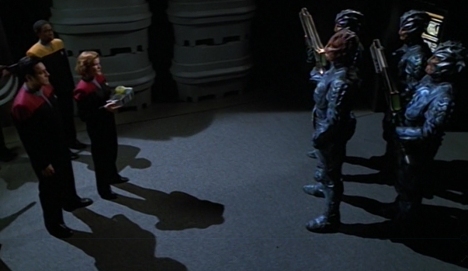
Super evil alien space Nazi.

Continue reading

Star Trek: Voyager – The Killing Game, Part I (Review)

In some ways, The Killing Game, Part I and The Killing Game, Part II feel like a perfect companion piece to Year of Hell, Part I and Year of Hell, Part II.

As with Future’s End, Part I and Future’s End, Part II during the third season, these two two-part episodes are very much larger-than-life archetypal Star Trek storytelling. While Future’s End, Part I and Future’s End, Part II riffed on Star Trek IV: The Voyager Home, and Year of Hell, Part I and Year of Hell, Part II borrowed liberally from Star Trek II: The Wrath of Khan, The Killing Game, Part I and The Killing Game, Part II draw from a broader pool of franchise iconography for a Star Trek: Voyager spectacular.

A cut above.

As with Future’s End, Part I and Future’s End, Part II or Year of Hell, Part I and Year of Hell, Part II, The Killing Game, Part I and The Killing Game, Part II are very much concerned with themes of memory and history. Much like Henry Starling or Annorax, the Hirogen are presented as villains waging a war upon history. They have no history or culture, usurping that of the crew and distorting it to serve their own whims and desires. Of course, The Killing Game, Part I and The Killing Game, Part II features no literal time travel, merely holographic.

However, The Killing Game, Part I and The Killing Game, Part II is more than just archetypal Voyager. These preoccupations with memory and history are wrapped up in a whole host of broad and iconic Star Trek idea. Although the two-parter features a number of different plot threads, including the recreation of a classic Klingon conflict, the bulk of the action unfolds in a holographic simulation of the Second World War. Once again, the Star Trek franchise returns to that conflict as a formative and defining moment.

For the world is hollow and I have touched the sky.

Indeed, the two-parter even makes a point to weave the franchise’s core humanism into its sprawling epic pseudo-historical conflict. As much as The Killing Game, Part I and The Killing Game, Part II are driven by spectacle, writers Brannon Braga and Joe Menosky are careful to integrate classic Star Trek themes into the episode. While the story begins with the Voyager crew defeated and subjugated by the Hirogen, it ends with a peaceful settlement. Janeway grants the Hirogen a chance to save their people. Coexistence seems possible.

As such, The Killing Game, Part I and The Killing Game, Part II feels like an intentionally broad smorgasbord of Star Trek themes and iconography. It feels very much like the culmination of the journey that Voyager has been on since the start of the third season, with the production team aspiring to produce a show that might not have its own distinct texture or identity but which retains an archetypal “Star-Trek-ian” quality.

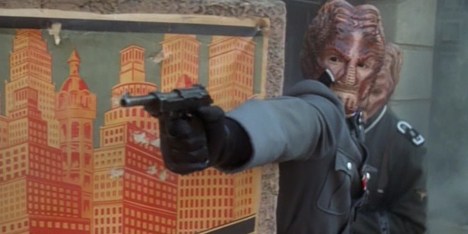
Evil alien space Nazis!

Continue reading

Star Trek: Voyager – Retrospect (Review)

Star Trek: Voyager is a very nineties show. Sometimes that is endearing. Sometimes it is not.

Retrospect is an episode that made a great deal more sense in the context of the nineties. It was still troublesome and reactionary, structuring its central allegory in a way that was deeply problematic. However, Retrospect made a certain amount of sense when considered in light of the McMartin Preschool scandal and the satanic panic driven by regression hypnosis in the early part of the decade. Retrospect is very clearly an attempt to turn that talking point into a twenty-fourth century allegory about witch hunts and persecution.

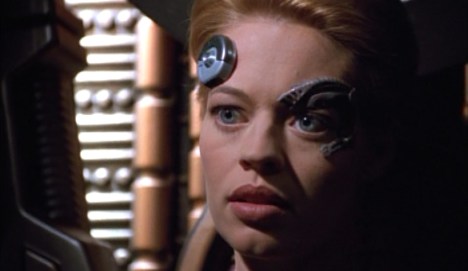
Assimilate this…

However, there are a number of poor choices made over the course of the episode. The most obvious is build the episode around the character of Seven of Nine. There are any number of reasons why this would be written as a Seven of Nine episode, given that she is the breakout character of the fourth season. However, episodes like The Gift and The Raven have made a conscious effort to portray Seven of Nine as an abuse surviving living with genuine trauma. To put her at the centre of an episode about false allegations of abuse feels ill-judged.

Similarly, the emphasis on the subject of these accusations and his ruined life feels more than a little tone-deaf, even in the context the nineties satanic panic. Retrospect is not an episode about Seven of Nine processing abuse or even coping with distorted memories. It is ultimately the story about how the falsified accusations of abuse (from a character who is a verified abuse victim) can serve to destroy the lives of innocent men. Indeed, the emphasis on the EMH as a proxy for Seven of Nine downplays her own agency in this plot.

Memory Beta.

These aspects are troubling even in the context of an episode about the dangers of using hypnotherapy as the basis of these charges. However, the scandal has slipped from public consciousness in the years since Retrospect was initially broadcast. When the audience hears about women false accusations against men, it evokes the long-standing myth that men are frequent victims of falsified reports about sexual assault that ruin lives. This was creepy and uncomfortable subtext was obvious at time of broadcast, but has only become more pronounced in the years since.

Retrospect would have been a very clumsy and ill-judged allegory in the context of the mid-to-late-nineties. Decades removed from that original context, it seems almost reprehensible.

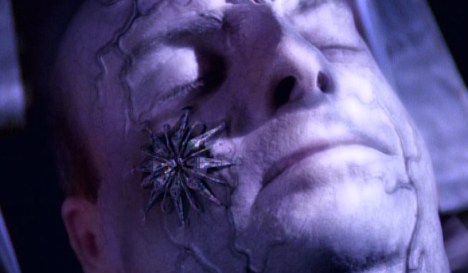
Blinding flash of the obvious.

Continue reading

Star Trek: Voyager – Hunters (Review)

Hunters is a weird episode of Star Trek:Voyager, perhaps most notable for the manner in which it flirts with serialisation.

More than any other episode of the fourth season, with the possible exception of The Gift, this mid-season episode seems to exist primarily in relation to the episodes around it. The script is very consciously a sequel to Message in a Bottle, with the crew discovering the ancient network of space stations is a two-way radio back to the Alpha Quadrant. It also introduces the Hirogen, an alien species that will recur in Prey, The Killing Game, Part I and The Killing Game, Part II. The story also sets up a narrative thread that will pay off in Hope and Fear, the season finale.

“Prey, tell.”

More than that, Hunters is an episode that is very consciously engaged with dangling threads of continuity. It resolves the relationship between Janeway and Mark that has haunted the lead character since Caretaker, offers Tom Paris some hint of reconciliation with the father who seemed so disappointed in Persistence of Vision, and even resolves the Maquis plot thread by tying back to Blaze of Glory. This is an episode that exists as something of a storytelling nexus point, a variety of intersecting threads all tied together as part of a single narrative.

Voyager had largely eschewed any attempt at long-form storytelling, perhaps in response to the trauma of the troublesome Kazon arc in the second season that led to ill-judged misfires like Alliances and Investigations. However, those early attempts at serialisation were heavily plot-driven, a series of stories building towards a number predetermined plot points. In contrast, the serialisation suggested by Hunters is looser; a collection of character beats, some earlier details that had largely been forgotten, some elements that might be useful in the future.

The farthest woman from home.

That said, Hunters seems just as cautious about long-form storytelling as The Gift was. As much as Hunters revives old story lines and character beats, it also makes a conscious effort to close many of them. Hunters makes it very clear that this level of serialisation will not be the default for the series going forward. The episode tidies away more loose threads than it unravels. The relationship between Kathryn Janeway and Mark Johnson is brought back purely so it can be ended. The Maquis are mentioned only to confirm they have been destroyed.

Still, there is something oddly intriguing about Hunters, a mostly quiet episode that exists primarily as both prelude and coda rather than a narrative in its own right. It is a quieter, stranger Voyager episode, even while introducing a race of giant space!hunters.

Gripping stuff.

Continue reading

Star Trek: Voyager – Message in a Bottle (Review)

Message in a Bottle is an intriguing episode, although not necessarily for the most obvious of reasons.

Working with Andy Dick can be tough.

Working with Andy Dick can be tough.

Message in a Bottle is notable for its stunt casting, featuring controversial comedian Andy Dick as the Emergency Medical Hologram, Mark II. Given his background and his interests, Andy Dick is a very strange choice for a Star Trek guest role. Then again, it takes all sorts; Star Trek: Deep Space Nine cast Iggy Pop in The Magnificent Ferengi and Star Trek: Voyager finds room for the Rock in Tsunkatse. However, the last time the franchise attempted to cast a famous comedian, Star Trek: The Next Generation ended up with The Outrageous Okona.

Understand, Andy Dick tends to be the focal point for discussion around Message in a Bottle. However, the episode is notable for other reasons. In a weird way, Message in a Bottle kicks off a very loose serialised arc that plays through the next handful of episodes. It introduces the communications grid that plays a major role in Hunters, and features the first glimpse of the Hirogen. The Hirogen go on to play a major role in episodes like Prey, The Killing Game, Part I and The Killing Game, Part II.

"What the hell are YOU doing in my Star Trek show?"

“What the hell are YOU doing in my Star Trek show?”

Message in a Bottle also comes at the half-way point in Voyager‘s run, speaking in terms of structure rather than episode count. Message in a Bottle is positioned mid-way through the middle season of Voyager‘s seven year run. Although the count is skewed somewhat by the series’ abridged first season, it feels like the last point at which Voyager is closer to its beginning than to its end. As such, there is something strangely appropriate in the fact that Message in a Bottle allows Voyager to reconnect with Starfleet and the Alpha Quadrant.

This is perhaps the point where the end of the journey “seems a little closer.”

"This never would have happened if they'd just gone with the Bashir model!"

“This never would have happened if they’d just gone with the Bashir model!”

Continue reading

Star Trek: Voyager – Waking Moments (Review)

Waking Moments feels very much like a first or second season episode of Star Trek: Voyager that somehow entered production in the middle of the fourth season.

A lot of this is down to the simple texture of the episode. Waking Moments centres around a decidedly “weird” alien species, a touch that recalls the early mysteries of Delta Quadrant life suggested by episodes like Phage, The Cloud, Heroes and Demons, Cathexis and even Emanations. These are aliens that do not conform to standard Star Trek logic, stalking their prey through dreams rather than with advanced technology. In fact, the emphasis on dreams in Waking Moments harks back to the vague New Age sentiment of Michael Piller’s time on Voyager.

No, Chakotay. Hunters and Prey are next week.

No, Chakotay. Hunters and Prey are next week.

In fact, Waking Moments returns to a very New Age cliché version of Chakotay. Following on directly from Mortal Coil, Chakotay is once again repeating “ah-koo-chee-moya” and talking about “vision quests.” He mentions his father as a connection to his Native American heritage for the first time since Basics, Part I, and even evoked Tattoo in discussing his rejection of shared activities in his youth. Waking Moments feels like an episode that was originally written while Michael Piller was overseeing the show, but has finally made it to air.

Of course, Waking Moments feels rather retrograde in other ways. It is a very clumsy ensemble piece that treats tired old plot twists as innovative and exciting, moving along at a leaden pace without any sense of what makes this story interesting or compelling in its own right. Waking Moments is a surprisingly tiring piece of television.

An artist's impression of the audience watching Waking Moments.

An artist’s impression of the audience watching Waking Moments.

Continue reading

Star Trek: Voyager – Mortal Coil (Review)

In its own weird way, Mortal Coil effectively amounts to a Star Trek: Voyager Christmas Special.

It unfolds in the lead up to the Talaxian festival of Prixin, which Neelix describes as “the Talaxian celebration of family. We observe it every year on Voyager.” Bringing friends and family together on an annual basis with ritualised food preparation and salutations, it serves as analogous to Thanksgiving or Christmas. Indeed, this sort of thinly-disguised Christmas celebration is a science-fiction stable. Perhaps “Life Day” from Star Wars Holiday Special is the most obvious example. To solidify this Yuletide sensibility, Mortal Coil aired the week before Christmas.

Choking on his Borgophobia.

They just keep killing Neelix.

There is something decidedly wry about the one and only Star Trek Christmas Special. (And no, the Christmas Party in Dagger of the Mind doesn’t really count.) This is after all an episode in which a regular character loses his faith in the existence of an afterlife and attempts to commit suicide in a transporter room. It is a strange choice for a seasonal story. In some ways, it feels very much like a Bryan Fuller script, a subversion of the traditional Christmas narrative. After all, Fuller has talked about Hannibal as an exploration of heterosexual male friendship. Just one with murder and cannibalism thrown in.

Mortal Coil is a fascinating episode, albeit one that feels decidedly clumsy in its execution. The episode hesitates and wavers on what it wants to say, offering a wishy-washy conclusion to a very powerful premise. Still, Mortal Coil is intriguing for its oddness.

I met a man who wasn't there.

I met a man who wasn’t there.

Continue reading