• Following Us

  • Categories

  • Check out the Archives


  • Awards & Nominations

Star Trek: Voyager – Once Upon a Time (Review)

Once Upon a Time is another example of thwarted ambition on Star Trek: Voyager.

The original pitch for the episode was incredibly ambitious and narratively experimental, a Star Trek story told exclusively from the perspective of a child character trying to make sense of a world from which the adults are trying to protect her. In many ways, it recalls the original pitch for Macrocosm, an episode that Brannon Braga had originally hoped to write as a piece of silent television. However, like that earlier episode, the original plan for Once Upon a Time was vetoed in favour of something far more conventional.

Toyetic, isn’t he?

In many ways, this conservatism was a reminder of just how far Voyager was being left behind, of how the dominant production strand of the Star Trek franchise was failing to keep pace with the changing media landscape around it. Genre television had been a hotbed for experimentation in the nineties. Twin Peaks changed television, allowing the medium to embrace surrealism and weirdness in a way never seen before. Series like Babylon 5 and Star Trek: Deep Space Nine returned serialisation to prime time, after it had fallen out of fashion.

Over the course of the decade, genre shows were willing to push the boundaries of what was possible in television, proving dynamic in a way that would be hugely influential for the more high-brow “prestige” series that followed. Even shows like The X-Files, Space: Above and Beyond and Buffy: The Vampire Slayer indulged in the occasional experimental episodes like The Post-Modern Prometheus, Triangle, Who Monitors the Birds?, Hush and Once More With Feeling. There was a revolution taking place in television during the nineties.

It’ll never catch on.

Of course, that particular television revolution was already in its final days as the decade drew to a close. The next big innovation in television storytelling was just around the corner, with The Sopranos only a few months away from broadcast. Once that happened, the television revolution would shift away from science-fiction and horror shows on free-to-access broadcasters and towards more critically-respected genres on more prestigious (and exclusive) networks. Voyager would have been late to the party anyway, but instead decided to skip it anyway.

Once Upon a Time is an ambitious premise watered down to mediocre execution. It is Voyager in a nutshell.

Why, I Flotter…

Continue reading

Star Trek: Voyager – In the Flesh (Review)

In the Flesh is a curiously nostalgic episode of Star Trek: Voyager.

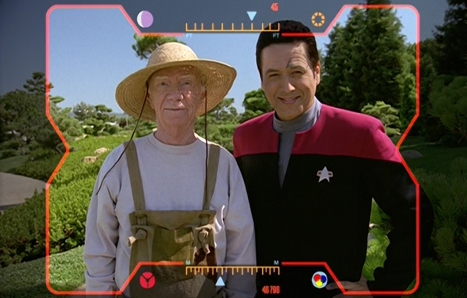
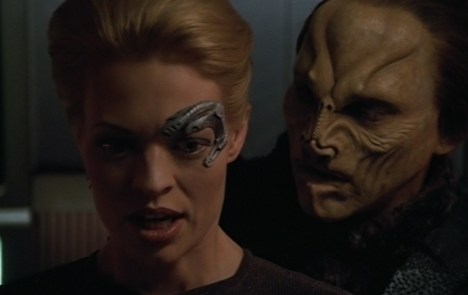
Nostalgic in a number of different ways. Most obviously, it opens on what appears to be Earth, bringing the Voyager crew to something resembling home. The campus recalls visits to Starfleet Command in earlier episodes of Star Trek: The Next Generation and Star Trek: Deep Space Nine like The First Duty, Homefront and Paradise Lost. There is even a prominent guest appearance from Boothby, the groundskeeper who was referenced as early as Final Mission. When it is eventually revealed to be a ruse, it is explained as a ruse orchestrated by old villains Species 8472.

Picture imperfect.

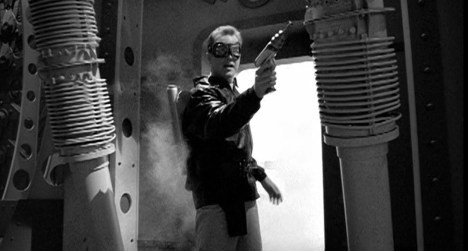
However, In the Flesh feels nostalgic in a deeper sense, extending even beyond the Star Trek canon. There is something very retro about the threat presented here, about a top secret facsimile of a distant world being used to train infiltrators in a deep space cold war. In the Flesh feels like a piece of fifties paranoia, with specific creative choices evoking film noir storytelling and even the aesthetic of Invasion of the Body Snatchers or Night of the Living Dead. The most prominent guest star is Ray Walston, a veteran of cult sixties sci-fi show My Favourite Martian.

To be fair, Voyager has always had a strong nostalgic streak for pulpy fifties and sixties science-fiction, but it is strange to see it so pronounced. In its own weird way, it fits with the general nostalgic tone of the fifth season as a whole.

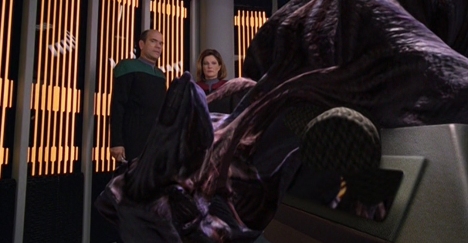
Look at the “8” in their eyes.

Continue reading

Star Trek: Voyager – Extreme Risk (Review)

Extreme Risk is another example of Star Trek: Voyager squandering an intriguing premise.

Hunters introduced a number of new and intriguing ideas to Voyager. Suddenly, Janeway was no longer in a long-term relationship with Mark, which made it possible for her to consider romantic entanglements in the Delta Quadrant. Suddenly Starfleet was aware that Voyager was still in one piece, rather than missing in action. These creative choices opened up new storytelling possibilities, paving the way for episodes like Counterpoint or Pathfinder.

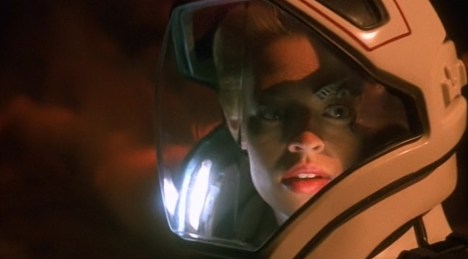
Diving right in.

However, the most interesting revelation in Hunters was that the Maquis had been destroyed while Voyager was lost in the Delta Quadrant. This was not a surprise to Star Trek fans who had been watching Star Trek: Deep Space Nine, given that this development had been covered in Blaze of Glory. However, it should have been a big deal to the characters on Voyager. Chakotay and Torres were members of the Maquis. Tuvok had been a spy working for Starfleet in the Maquis. Even Paris had spent some time in the organisation. This news should have been a big deal.

Extreme Risk feels like an interesting development of this idea, albeit one that has been greatly delayed. How would the Maquis crew members react to the news that most of their friends were dead and that the rest were in Federation custody? Voyager has never been a show particularly engaged with long-term consequences, but there is an interesting story to be told there. Extreme Risk tells one such story, suggesting that the new plunged Torres into a depression that led her to self-harm. It is certainly an intriguing and compelling story hook.

Building a better future.

However, Extreme Risk fumbles the delivery in a number of ways. It makes the standard Voyager mistake of assuming that character-driven plots still have to have a compelling action-adventure element to them, and so provides a very generic subplot about a probe that has been lost in the atmosphere of a gas giant and the resulting “old-fashioned space race” that results, including the construction of a new ship. As a result, the plotting of the episode feels very trite, offering Torres a very convenient clear-cut redemption arc at the climax.

That said, the biggest problem with Extreme Risk is much more basic than the awkward juggling of primary and secondary plots. As with Night before it, Extreme Risk demonstrates that the rigidly episodic structure of Voyager is woefully ill-equipped to tell a profound (and sincere) story about the struggles of living with clinical depression.

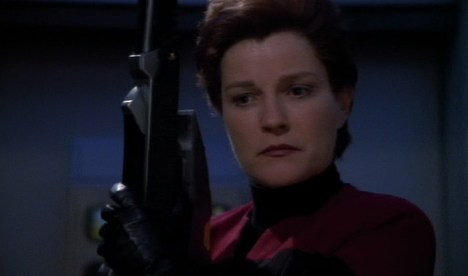
She knows kung fu.

Continue reading

Star Trek: Voyager – Drone (Review)

Drone is a solid episode, one elevated by two central performances.

In many respects, Drone is a standard Star Trek: Voyager episode. It is something of an archetypal Star Trek story, an exploration of the human condition in which the regular characters must bestow upon a naive and inexperienced alien what it means to be human. There are countless examples in the canon, from Picard’s relationship with Data in Star Trek: The Next Generation to more specific examples like the relationship between Data and Lal in The Offspring. However, Drone has a more direct antecedent, with One evoking Hugh from I, Borg.

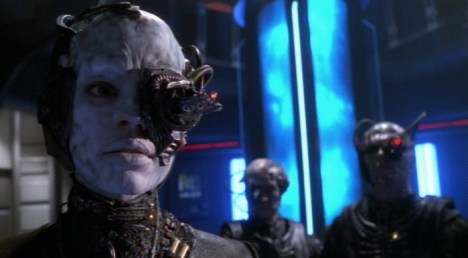
The view is always greener on the other side…

Drone is also very heavily plot-driven, although it is decidedly cleaner and leaner in execution than many Voyager episodes. Compared to the other Star Trek series, Voyager can often feel like a list of plot developments arranged to pad out forty-five minutes of television. This approach to storytelling can often seem quite frantic, with episodes like Worst Case Scenario, Waking Moments, Demon or Night effectively switching plot in the middle of the episode to keep it going. Drone is a much more linear story, much tighter in its construction and its flow.

The result is an effective piece of television, one strongly anchored in the two central performances of J. Paul Boehmer and Jeri Ryan.

“Was he going on to you about the alcoves?”

Continue reading

Star Trek: Voyager – Night (Review)

Star Trek: Voyager typically bridged its seasons with epic two-parters, a sprawling single narrative told over two forty-five minute episodes separated by the three-month summer hiatus. In fact, it was somewhat striking when the production team chose to end the fourth season with Hope and Fear, a standalone episode with a very definite conclusion. However, it becomes even more ironic once the fifth season opens with Night. Rather than one story split over two episodes, Night feels like two narratives compressed into a single chunk of television.

Of these two narratives, one is definitely more interesting than the other. The first half of Night essentially focuses on the ship and crew as they venture through an empty (and starless) section of space known as “the Void.” No light can get in. Nothing seems to live in there. There are no anomalies to investigate. “Anything to report?” Tuvok asks Kim. Kim responds, “Not even a stray electron.” It is so dull that even Tom classifies the detection of “a sudden increase in theta radiation” as “excitement.”

Starless, starless night.

This is an interesting approach to storytelling, particularly for a show so focused on plot. More than any other series in the franchise, Voyager runs on plot beats. Stories tend to progress from one revelation and escalation to the next, affording little room for character development or exploration. As such, the first half of Night seems like a very ambitious piece of work, an introspective character-driven drama where there are no plot beats to distract from character. It is a very brave and compelling set-up.

Of course, Night somewhat fumbles the ball in this first half. The thread is never explored as thoroughly as it might be, the character never allowed to properly express themselves. There is far too much emphasis on the holodeck, and the ship’s ability to simulate comforts and illusions even in this most depressing of surroundings. However, compared to the way that Voyager usually tells stories, the first half of Night is refreshing. Ironically, it is genuinely exciting, because it feels like the writers are pushing outside their comfort zone.

A darker side of Janeway.

Unfortunately, it cannot last. Night can only resist the comfort of plot for so long. Eighteen minutes into the hour, the second plot kicks into gear. It is a much more conventional Voyager episode, particularly for these later seasons. There is a broadly drawn piece of social commentary that ties into the both Voyager‘s New Age sensibilities and its attitude towards the Delta Quadrant as a whole. There are new aliens introduced, that will become recurring foils. It is all very standard, and all very rushed. The second half of Night makes up for those missed plot beats.

The result is an episode that is deeply frustrating, a game of two halves were each horribly undercuts the other.

A black-and-white issue.

Continue reading

Star Trek: Voyager – Season 4 (Review)

The fourth season is probably the show’s best season.

Of course, that is arguably damning with faint praise. By any measure, the fourth is probably weaker than at least four seasons of Star Trek: The Next Generation and four seasons of Star Trek: Deep Space Nine. It is also weaker than the first two seasons of Star Trek or the final two seasons of Star Trek: Enterprise. In the grand scheme of things, that places the best season of Star Trek: Voyager around the franchise median. Somehow, this feels entirely appropriate.

The fourth season of Voyager has some of the show’s best episodes. As such, it also has some of the franchise’s best episodes. Scorpion, Part I and Scorpion, Part II are spectacular television, while Year of Hell, Part I and Year of Hell, Part II offer a glimpse of the show that Voyager could have been while also developing some of the series’ core themes. There are also truly great standalone episodes like Nemesis, Prey, and Living Witness. More than that, there is a lot of really fun storytelling as well, with lighter episodes like Concerning Flight and Message in a Bottle.

However, there is also an unevenness to the season. While there are arguably fewer truly terrible episodes than in the earlier seasons, there are a couple of true stinkers like Retrospect or Vis á Vis. More than that, there are quite a few disposable and dull episodes, stories quickly forgotten after the end credits. Stories like Scientific Method, Random Thoughts, Waking Moments, Unforgettable and Demon fail to make a lasting impression. They just fill up the season order adding very little beyond a familiar Star Trek beat sheet.

In some ways, this is the central tension of the fourth season, one reflected in the addition of Seven of Nine and the focus on Borg culture. The fourth season of Voyager is caught between mediocrity and brilliance, between being a perfectly serviceable mid-tier Star Trek show and being something a little more ambitious. The fourth season is a weird synthesis of generic Star Trek and something unique, reflecting the fusion of organic and mechanical that defines the Borg Collective.

The fourth season of Voyager ultimately retreats back to the comfort and safety offered by familiarity, but there are moments when it looks like the show might finally be ready to take flight. Unfortunately, it never really gets off the ground, but there is something heartwarming in the effort.

Continue reading

Star Trek: Voyager – Hope and Fear (Review)

Hope and Fear is a reasonably solid conclusion to the fourth season of Star Trek: Voyager.

To be fair, the episode has a number of very clever ideas. There are a number of creative choices in Hope and Fear that feel entirely appropriate for the final episode of what has been a relatively strong season. Various concepts and ideas are brought back into play, from Janeway’s alliance with the Borg in Scorpion, Part II through to her conversion of Seven of Nine in The Gift and up to the secret coded message from Starfleet suggested in Hunters. It makes sense to bring all of these ideas back into play for the grand finale.

The fourth season comes to a head.

More than that, it makes sense to build the episode around the dynamic between Janeway and Seven. One of the recurring tensions in the fourth season, both behind the scenes and in front of the camera, has been the debate about the prominence of Seven of Nine. In the year since she was introduced, Seven has effectively become one of the three most important members of the cast. There is a credible argument to be made that she is the most important member of the cast, an anxiety played out in One. As such, it is logical to build Hope and Fear around Janeway and Seven.

At the same time, there is a certain clumsiness to the plotting of the episode. There is a very rushed quality to the story, which never really takes the time to develop or explore these big revelations and twists. Hope and Fear races towards its conclusion as if it has been sucked into quantum slipstream, a very disorienting and disjointed effect. Certain character arcs feel under-explored, and certain gaps in the plot logic are brushed aside. Hope and Fear feels like a story that deserved a bigger canvas.

The hard cell.

Continue reading

Star Trek: Voyager – One (Review)

One is a solid episode.

Indeed, One is so solid that it is the rare episode of Star Trek: Voyager to be repurposed for Star Trek: Enterprise. The prequel series tended to borrow stock Star Trek plots, but it tended to borrow most heavily from Star Trek: The Next Generation and even Star Trek: Deep Space Nine; Oasis was Shadowplay, Vanishing Point was Realm of Fear, Dawn was Darmok. However, One would be reworked as Doctor’s Orders, another pseudo-horror bottle episode in which a member of the cast finds themselves driven insane by isolation.

Everything’s gone askew…

However, One has an in-built advantage over Doctor’s Orders, in that it is centred on a character who practically begs for this sort of treatment. Seven of Nine is effectively a reformed Borg drone. While Jean-Luc Picard was assimilated in The Best of Both Worlds, Part I and recovered in The Best of Both Worlds, Part II, and while Chakotay brushed up against a pseudo-collective in Unity, Seven of Nine is the first franchise regular to have spent the bulk of her life inside the Borg Collective. The nature of the Borg means that Seven is perfectly suited to a story about isolation.

One is a messy and clumsy episode in a number of ways, particularly in its drive for big action set pieces and tangible threats. In particular, the penultimate act of One feels awkward, as if the production team do not trust the audience to engage with a purer breed of psychological thriller. However, One leans very heavily on the character of Seven of Nine and on the performance of Jeri Ryan. Luckily, both character and actor are up to the task.

Voices in her head.

Continue reading

Star Trek: Voyager – Demon (Review)

Demon is an episode with some interesting ides that cannot make up for a lackluster execution.

The writing staff on Star Trek: Voyager had been playing with the idea at the heart of Demon for quite some time. It had been a candidate for the third season finale, before Brannon Braga settled upon the story that would become Scorpion, Part I. It was considered for a mid-season two-parter, but the writing staff could never come up with a way to make the story work; Year of Hell, Part I, Year of Hell, Part II, The Killing Game, Part I and The Killing Game, Part II were all written to fill gaps left by a story that refused to materialise.

Spaced out…

As such, there is a faint scent of desperation to Demon. The episode arrives in the final stretch the fourth season, at a point when the production team is very clearly fatigued and where writers are generally desperately grasping for anything resembling a workable story. The harsh production cycle of television means that the start of a twenty-six episode season can be planned over the summer hiatus, but that the tail end of the season is typically assembled on the fly. This is the stretch of the season where even Star Trek: Deep Space Nine produces Profit and Lace or Time’s Orphan.

The problems with Demons are compounded by the fact that it is very obviously a budget-conscious show. While it features a number of elaborate computer-animated sequences, it also films primary on standing sets and features no credited guest stars. The result is a curiously plodding show, one full of extended dialogue scenes that inform neither plot nor character, and which feel like a conscious attempt to sideline the more ambitious elements of the story. The result is the waste of an interesting idea on a forgettable episode.

Something’s wrong here, though Torres can’t quite put her finger on it.

Continue reading

Star Trek: Voyager – Living Witness (Review)

Living Witness is a fantastic piece of television, and a great example of what Star Trek: Voyager does best.

Living Witness is in many ways archetypal Star Trek, a story that uses the franchise framework to construct a powerful allegorical story that comments upon contemporary anxiety. It is a story that could easily have been told on any of the other franchise series, especially Star Trek: The Next Generation or Star Trek: Enterprise, but it is a story told well. Living Witness is one of the highlights of the fourth season, and one of the strongest episodes from the seven-season run.

Command and conquer.

In many ways, Living Witness is the culmination of themes and ideas that have been bubbling through Voyager from the outset. Some of these elements are less than flattering, with the episode’s racial politics evoking the clumsiness with which the Kazon were handled. However, there is also a fascination with idea of history and how history functions in a world rooted in postmodernism and recnstruction. At the end of history, is the past up for grabs? Are facts anything more than pieces to be manoeuvred on a political chessboard?

Given this archetypal quality of Living Witness, how it reflects the themes and pet interests of Voyager, there is some irony in the fact that the episode does not actually feature a single regular character from Voyager. The regular cast appear as holographic representations of themselves, exaggerations and distortions. When the EMH appears almost half-way through the episode, he is explicitly identified as “a back-up programme”, and thus distinct from the version of the EMH who will appear in Demon or One.

Core principles.

In some ways, Living Witness confirms one of the more interesting aspects of Voyager, the fact that the characters are themselves largely irrelevant to the show and that the series is much more compelling as a framework to explore archetypal ideas. Living Witness is just one of several episodes that treat the regular characters as a secondary aspect of the show, almost as guest stars who have crossed over into a completely different series. Living Witness is very much of a piece with stories like Distant Origin or Course: Oblivion, or even Muse or Live Fast and Prosper.

Living Witness is a story about the thin line between history and mythology. In doing so, it consciously reframes Voyager as a story within a story, as concept more powerful as an archetype than as a material object. Living Witness images the ship and its crew as history elevated to mythology.

Any which Janeway but loose.

Continue reading