• Following Us

  • Categories

  • Check out the Archives


  • Awards & Nominations

Star Trek: Voyager – Season 3 (Review)

The third season of Star Trek: Voyager marks the point at which the show stops trying.

To be fair, it is not as though the opening two seasons of the show were marked by a surplus of ambition. Caretaker was a bold piece of science-fiction that promised a host of interesting ideas for the new Star Trek show, but all of those fascinating conflicts were quickly brushed aside by episodes like Parallax and Time and Again, which insisted on formulaic plotting and familiar storytelling. In many ways, the first season of the show felt like a cheaper eighth season of Star Trek: The Next Generation.

voy-fairtrade3

During the second season, the production team did attempt something a little bolder. Michael Piller returned from his work on Legend convinced that the franchise needed a dramatic shake-up and reinvention. So he attempted to introduce long-form storytelling on the series, with an arc building the Kazon as a credible threat to ship and crew. This arc failed spectacularly for a variety of reasons, with episodes like Alliances and Investigations ranking among the worst in the series’ run.

The Voyager writing staff were apparently traumatised by their experiences on that second season. Piller stepped aside at the end of the year, forced by the threat of mass resignations. Piller bid farewell to the show with Basics, Part I and Basics, Part II, effectively allowing the staff a clean slate coming into the third series of the show. Jeri Taylor stepped up into the role of showrunner, trying to steady a ship that was very clearly on troubled water. Three years into the run, how did Voyager define itself?

voy-futuresendparti13a

The third season has traditionally been a formative year for the Star Trek spin-offs. Michael Piller took charge of Star Trek: The Next Generation during its third season and established the template for the franchise heading into the nineties. Ira Steven Behr solidified the direction of Star Trek: Deep Space Nine during its third season, outlining many of the concepts and ideas that would play in the stronger fourth and fifth seasons. Even Star Trek: Enterprise came into its own in its third season, telling its own stories.

Voyager did not come into its own during this third season. Jeri Taylor’s direction for Voyager set the series on a course back to familiar territory. The third season of Voyager marks the point at which a troubled series adopts the path of least resistance, content to stop pushing itself in any direction and let itself be pulled by the gravity of the franchise around it. The third season of Voyager marks the point at which the series becomes content to be generic Star Trek.
voy-distantorigin27a

Continue reading

Star Trek: Voyager – Scorpion, Part I (Review)

In some ways, Scorpion, Part I is the perfect cap to the third season of Star Trek: Voyager.

The third season has largely seen the show retreating from ideas and concepts that would render it unique in the larger Star Trek canon. Although the first two seasons were hardly radical in terms of storytelling style or substance, Michael Piller did make a conscious effort to build off some of the premises unique to this show. The Kazon might have been a terrible idea in both concept and execution, but they were at least something new. While the second season botched its attempts at serialisation, at least it made the effort.

This is perhaps a metaphor for what Voyager is going to do to the Borg...

This is perhaps a metaphor for what Voyager is going to do to the Borg…

In the third season, the production team seem to have settled upon the idea of producing generic Star Trek, rather than telling stories unique to Voyager. This is something of a mixed blessing. While the third season features a host of forgettable episodes like Warlord and Alter Ego, it features few episodes as soul-destroying as Alliances or Investigations. More than that, episodes like Remember or Distant Origin demonstrate the appeal of producing generic Star Trek stories, ranking among the best episodes that the show has produced to date.

More than that, the production team have consciously pushed the show much closer to the model of Star Trek: The Next Generation. This is most obvious in the handling of Q as a character. While Death Wish found something novel and interesting to do with the character after All Good Things…, The Q and the Grey returns the character to his default settings for a cringe-worthy dress-up episode that owes far too much in concept and execution to Q-Pid. There are plenty of other examples.

This might also be a potent metaphor for what Voyager is about to do to the Borg...

This might also be a potent metaphor for what Voyager is about to do to the Borg…

However, Voyager‘s most overt embrace of the legacy of The Next Generation came with the introduction of the Borg. The Borg are in many ways the most iconic creation of the Berman era, perhaps the only new alien species liable to recognised alongside the Klingons or the Romulans or the Vulcans. After all, the Borg were the antagonists of Star Trek: First Contact, the theatrical release intended to celebrate the thirtieth anniversary. Their aesthetic influence can even be felt on Star Trek Beyond, the theatrical release intended to celebrate the fiftieth anniversary.

The Borg made their first appearance at the end of Blood Fever, in a postscript scene that feels like almost like a post-credits tease that arrived ten years too early. The Borg also appeared in Unity, an episode which featured Chakotay encountering the survivors from a disconnected Borg ship desperately trying to reconnect their shared link. However, neither of these episodes featured the Borg Collective, the powerful and single-minded collective consciousness that drives the hive mind.

Building a bridge...

Building a bridge…

So it makes sense that the Borg Collective would appear in full force for Scorpion, Part I, the third season finale and cliffhanger bridging to the fourth season. Once again, this is a creative decision right out of the Next Generation playbook. The Next Generation really cemented its distinct cultural identity with the broadcast of The Best of Both Worlds, Part I at the end of its third season. Part of this was simply down to the fact that it had outpaced the original Star Trek, which only lasted three years. However, part of it was also that the cliffhanger was spectacular television.

Scorpion, Part I is not spectacular television. It is good television. It is a satisfying blockbuster epic, with a strong sense of momentum and some interesting ideas. However, it also smells a little bit of desperation. It feels like Voyager has completely abandoned its own sense of identity and followed the path of least resistance. Insert your own joke there.

Or, you know, don't. Whatever floats your boat.

Or, you know, don’t. Whatever floats your boat.

Continue reading

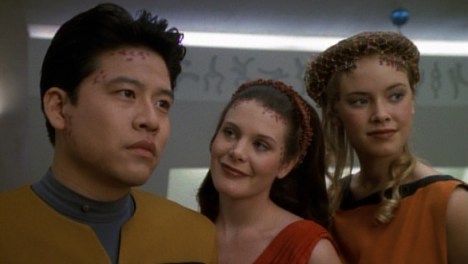
Star Trek: Voyager – Distant Origin (Review)

Like Remember before it, Distant Origin is a really great example of how Star Trek: Voyager‘s efforts to build a “generic Star Trek series can produce memorable and satisfying episodes of television.

There is very little about Distant Origin that demands to be set in the Delta Quadrant. In fact, Distant Origin arguably makes less sense as an episode set in the Delta Quadrant than it would as an episode set in the Alpha or Beta Quadrants. Episodes like The 37’s and Distant Origin (and the lies at the heart of Favourite Son) seem to suggest a lot of traffic between Earth and the Delta Quadrant beyond the Caretaker. It seems strange the Voth would migrate so far in search of a place to call home.

Skullduggery.

Skullduggery.

However, for all that Distant Origin feels like a strange fit for the series’ Delta Quadrant setting, it feels very much like quintessential Star Trek. Like Remember earlier in the season, Distant Origin is very much an old-fashioned Star Trek allegory that uses characters in cheesy make-up to comment upon contemporary issues. In Remember, it was the reality of holocaust denial. In Distant Origin, it is the age-old conflict of science-against-political-expedience. There is an endearing timelessness to the metaphor at the centre of the story.

With its dinosaur characters, its fixation upon evolution, and its doctrine of “origin”, Distant Origin seems very specifically tailored to the heated debates around science and creationism in American culture. However, the allegory is powerful enough that it maintains a potency even beyond that. Distant Origin has aged remarkably well, working effectively as a metaphor for climate change denial or even for historical revisionism in favour of the national myth. Distant Origin is both a season and a series highlight.

The bones of a theory.

The bare bones of a theory.

Continue reading

Star Trek: Voyager – Real Life (Review)

Real Life is in some ways a departure for Star Trek: Voyager.

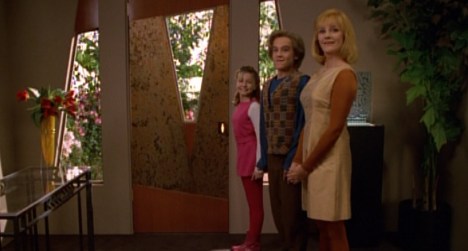
That much is obvious from the teaser, which introduces three new characters on a new set. More than that, the three characters comprise a nuclear family and the set is built to resemble the stereotypical American family home. It is a very strange image, even before the characters begin talking like they escaped from The Brady Bunch. In what might be the best teaser of the entire third season, it is revealed that the EMH has fashioned himself a holographic family and is “commuting” to work in sickbay from the holodeck.

Projections.

Projections.

It is certainly an interesting idea, one that consciously brushes up against the kinds of limitations and expectations that Voyager has faced. It feels experimental, quite removed from the broader third season attempts to position Voyager as the most generic of the Star Trek spin-offs. This does not look or feel like any other episode in the franchise’s history. Indeed, with its focus on family dynamics and conflict, it feels like an extension of Ronald D. Moore’s work on episodes like Family and Doctor Bashir, I Presume.

This makes the episode’s failure to follow through on any of that potential even more disappointing. The third season of Voyager has dramatically scaled down its ambition following the spectacular misfires of the second season. The show is no longer attempting to create long-form stories or introduce iconic new recurring alien species, instead setting more modest goals for itself. There is something disheartening in seeing Voyager set more modest challenges for itself in episodes like Macrocosm or Fair Trade, only to spectacularly bungle the handling of those challenges.

Family matters.

Family matters.

Real Life is another example of the trend. The premise is interesting, and the episode hits on any number of intriguing ideas. There is a great story to be told using this premise, exploring core themes about the human condition in a way that is quite different from the normal storytelling on Voyager. However, the episode flirts with the premise and then balks at it. Real Life is terrified of the implications of its story, padding out the plot with an unnecessary techno-babble-laden diversion and casually discarding the holographic family at the end of the script.

Real Life is an underwhelming story, rendered all the more disappointing for the promise that it squanders.

Photon father.

Photon father.

Continue reading

Star Trek: Voyager – Before and After (Review)

You might be interested in our other reviews from the third season of Star Trek: Voyager:

Before and After is an episode that should be more interesting than it ultimately is.

There is no small irony in the fact that the one future constant suggested by Before and After would be gone by the third episode of the following season, while the generic tone of the episode’s future flashes would prove entirely accurate. In some ways, Voyager was a paradox. It was generally quite professional and sleek, the show’s polished exterior seeming a little too lifeless and sterile at times. However, this was all an elaborate and well-rehearsed illusion. Behind the scenes, Voyager was a turbulent and chaotic piece of television.

voy-beforeandafter22a

Those conversations and would tweak some of the future suggested by Before and After. Jennifer Lien would depart, and Kes would be retired. Jeri Ryan would be hired, and Seven of Nine would join the crew. Much like what had happened with Deep Space Nine, the planned third season cliffhanger would be thwarted and pushed into the fourth season to make way for a much more bankable story. On Deep Space Nine, Homefront and Paradise Lost were shunted for The Way of the Warrior. On Voyager, Year of Hell, Part I would be brushed aside for Scorpion, Part I.

At the same time, it was clear that Paramount was wary and uncertain of what the future might hold for the franchise. Viewing figures had begun a decline that would continue until the end of Enterprise. The writers on Deep Space Nine had been instructed by the studio to add an existing character and focus on the Klingons early in their fourth season, hoping to shore up viewers. Similar discussions were taking place behind the scenes on Voyager, with the network and producers looking to spice things up on the series.

voy-beforeandafter35a Continue reading

Star Trek: Voyager – Favourite Son (Review)

Favourite Son feels like the culmination of something that has been festering across the third season of Star Trek: Voyager.

The Star Trek franchise is generally regarded as progressive and forward-thinking. There is some debate to be had about whether this is an accurate summary of the franchise, given some of the creative decisions made over the course of its half-century run. However, there are times at which the franchise feels particularly liberal and points at which it feels particularly reactionary. A product of the mid-nineties, running through to the turn of the millennium, Voyager tends to feel very conservative in places.

This is a little bit what watching the episode feels like.

This is a little bit what watching the episode feels like.

In the second season, this reactionary tendency played out through the treatment of the Kazon in episodes like Initiations and Alliances. In the third season, with the Kazon long gone, it seems that Voyager has turned its reactionary gaze upon its female cast members. To be fair, the show’s first two seasons had any number of unfortunate creative decisions when it came to various female characters. Most notably, the decision to turn Seska into a baby-crazed maniac in Manoeuvres did not bode for the first female-led Star Trek series.

Nevertheless, a misogynist streak has manifested itself across the third season as a whole. In some cases, this has been relatively subtle; like the awkward insistence upon sexualising three-year-old Kes in the eyes of her two mentor figures in Warlord and Darkling. In other cases, this has been the entire point of the plot; like the decision to have Q try to sleep with the franchise’s first female lead and introduce his shrewish wife in The Q and the Grey or to introduce a psycho stalker in Alter Ego.

The original red wedding.

The original red wedding.

Other times, this sexist attitude has bubbled through the background of various episodes to the point that it builds to critical mass. Torres is victimised by her male colleagues over the course of three straight episodes, and none of them are held accountable; she is sexually assaulted by Vorik in Blood Fever, stunned by Chakotay in Unity, and tortured by the evil!EMH in Darkling. In each of those cases, the show seems to shrug off the violence committed by male characters against one of the show’s female leads.

All of these elements come to the fore in Favourite Son, an episode that would have been painfully retrograde had it aired as part of the original series during the sixties. Favourite Son is that most uncomfortable myth dressed up in science-fiction drag, the tale of an island of beautiful women using their sexual prowess to lure men into their clutches to emasculate them. It is terrifying to think that this episode made it to air in the late nineties.

A beautiful dream.

A beautiful dream.

Continue reading

Star Trek: Voyager – Rise (Review)

Rise is in many ways a very typical episode of Star Trek: Voyager.

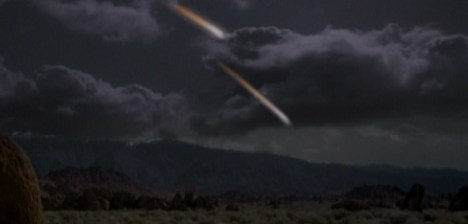
It is an episode that certainly has an interesting premise. For all its myriad flaws, Voyager tended to have a genuine interest in playing with science-fiction concepts. At its worst, this attitude manifested itself through the various “anomaly of the week” stories that followed a familiar pattern of the ship encounter some sort of strange phenomenon with predictable results. Often this phenomenon involved time travel or interstellar dust clouds, a trend that could be traced back to early episodes like Time and Again or The Cloud.

That crashing feeling.

That crashing feeling.

However, Voyager did occasionally use its interest in science-fiction storytelling to construct interesting stories. Deadlock might have set a damning precedent for the show, but it was compelling television. Blink of an Eye is a very clever little story. In true Star Trek fashion, Voyager would even use these science-fiction ideas to construct engaging allegories like the exploration of holocaust denial in Remember or the meditation on creationism in Distant Origin.

These concepts gave the series a sense of texture. They served to distinguish the show from its siblings. For example, Star Trek: Deep Space Nine was generally less interested in science-fiction high concepts than in characterisation and politics. When those sci-fi elements did show up, they were usually to torture O’Brien in episodes like Whispers, Visionary, Hard Time and Time’s Orphan. Of course, Deep Space Nine had sci-fi concept-driven stories like Playing God or One Little Ship, but they tended to stand out more from the series around them.

Up on the roof's the only place I know...

Up on the roof’s the only place I know…

Rise has a suitably high concept, a core idea that could easily have been lifted from the pages of the same pulp magazines that inspired The Cloud Minders. The episode is essentially a paranoid thriller unfolding within a confined space, but that confined space just happens to be a giant elevator that stretches from the surface of the planet into orbit. The premise is ridiculous, feeling like it was lifted from forties or fifties periodicals with giant insects and half-naked men on the cover. In other words, it feels of a piece with Innocence or The Thaw or Tuvix.

It is too much to argue that Rise has a brilliant concept, but it at least has an intriguing one. While it might be hard to use the basic elements of Rise to construct a classic, it should be relatively straightforward to construct a thrilling episode of television. Unfortunately, Rise simply does not work. More than that, Rise does not work for the most boring of reasons. As with a lot of Voyager, the episode is an interesting premise undercut by both a deeply flawed (and half-hearted) execution and the show’s own long-standing structural weaknesses. This happens all too often.

A dark moment for the series.

A dark moment for the series.

Continue reading

Star Trek: Voyager – Darkling (Review)

There is something to be said for the pulpier side of Star Trek: Voyager, the aspect of the show that plays like a cheesy sci-fi b-movie.

Brannon Braga is very much the driving force behind this aspect of the show, as evidenced by his scripts for the belated Cold War body-swapping horror of Cathexis or the psychological nightmare of Projections or the trashy psychedelic terror of Cold Fire or even the weird evolutionary anxieties of Threshold and Macrocosm. These sorts of episodes often feel like they belong in a late night movie slot reserved for forgotten horror flicks from the fifties and sixties. Of course, Braga is not alone in this; episodes like Meld and The Thaw also fit the pattern.

Blurred lines.

Blurred lines.

Of course, these episodes do not always hit the mark. Charitably, it could be argued that they land about half the time and misfire spectacularly about one third of the time. However, there is something strangely compelling about these episode. They feel distinct from what audiences expect from Star Trek. Even if they are arguably just an extension of late Star Trek: The Next Generation episodes like Sub Rosa or Genesis or Eye of the Beholder, they feel like something different from the show’s more conventional “let’s do archetypal Star Trek” plotting.

Darkling is an episode that doesn’t quite work, but which is oddly endearing in its dysfunction. It is a ridiculous central premise executed in a deeply flawed (and occasionally uncomfortable) manner. However, there is something weirdly compelling about wedding the show’s science-fiction premise to gothic horror through the fractured psyche of a computer program.

Patchy.

Patchy.

Continue reading

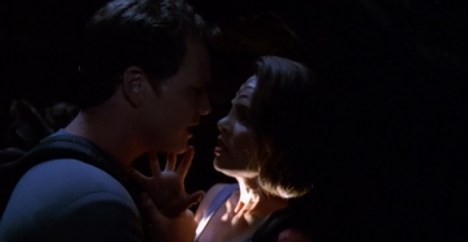
Star Trek: Voyager – Blood Fever (Review)

Blood Fever is a strange and dysfunctional episode.

By this point in the third season, Star Trek: Voyager has abandoned any sincere attempt to develop or define its own identity. Instead, the series has committed itself to being the most generic Star Trek show imaginable. In many ways, this represents a disappointing betrayal of an interest premise and a fascinating cast of characters. In other ways, this allows the show to focus on telling archetypal Star Trek stories like Remember or Distant Origins or Living Witness, stories that deal with broad themes through science-fiction allegory.

Tunnels of love.

Tunnels of love.

In its strongest moments, Blood Fever feels like it wants to be that kind of classic Star Trek metaphorical exploration of contemporary society. In many ways, Blood Fever is an exploration of contemporary attitudes towards sex and sexuality, of the damage that can be wrought by sexual repression on levels both personal and societal. It is building upon the idea of pon’farr as introduced by Theodore Sturgeon (and refined by D.C. Fontana) in Amok Time, as the volcanic eruption of sexual desire following years of repression.

Unfortunately, Blood Fever lacks the courage of its convictions. The script feels like a victim of the same social mores that it seeks to critique, either unable or unwilling to talk about sex and sexuality in a manner that is suitably candid. As a result, Blood Fever ends up a muddled and ineffective piece of television that seems unwilling to call out its characters and which inevitably builds towards a tired rehash of an iconic Star Trek scene. Waiting seven seasons for this must be very unsatisfying.

Droning on.

Droning on.

Continue reading

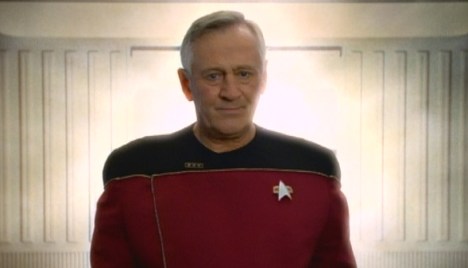
Star Trek: Voyager – Coda (Review)

In many ways, the Jeri Taylor era of Star Trek: Voyager represented a reaction to the direction that the show had taken under Michael Piller.

Michael Piller had imagined a more dynamic and adventurous version of the show, focusing on two crews thrown together by fate and forced to coexist while journeying through uncharted territory. After seven seasons of Star Trek: The Next Generation, Piller was understandably (and perhaps justifiably) concerned that the second iteration of Star Trek might have been growing somewhat stale. Star Trek: Deep Space Nine was in the process of breaking new ground, and Piller felt that it was necessary for the franchise to find a new direction and identity.

Daddy's home.

Daddy’s home.

This is a good idea in theory. In practice, Michael Piller’s vision was disastrous. Piller wanted to do new things, but found himself working with a staff vehemently opposed to his vision of the series and phoning in scripts that should have been provocative like Alliances or Investigations. More than that, Piller was unable to properly realise his own ambitions, citing scripts like Tattoo as incredibly accomplishments rather than recognising them for the embarrassing failures that they were. When Piller was ousted after the second season, Jeri Taylor took over.

Jeri Taylor would oversee the third and fourth seasons of Voyager. She had a very clear vision of what Voyager should be, a rather conservative and generic iteration of the larger Star Trek franchise. Traditionally, the third season had served as a point of transition for the Star Trek spin-offs. It was in their third seasons that The Next Generation and Deep Space Nine really broke the mould and discovered their own unique identities. In contrast,t he third season of Voyager marked a point of retreat from the basic premise of the show.

Carry on regardless.

Carry on regardless.

Taylor wanted to focus on telling very safe and familiar Star Trek stories, ones that did not necessarily rely upon the premise of the show. There are any number of episodes where this approach simply did not work, with episodes like Warlord or The Q and the Grey or Alter Ego feeling like reheated Star Trek leftovers. However, there were points at which Taylor’s approach paid off. Future’s End, Part I and Future’s End, Part II were pure popcorn, but they worked on those terms. It didn’t matter that nobody seemed too bothered at getting Voyager back to Earth.

Coda is another example of the strengths of Taylor’s approach to Voyager. It is a very familiar and archetypal episode of Star Trek, one that might have been assembled from the leftover pieces of Cause and Effect or Tapestry. However, that relative simplicity becomes a strength, allowing Taylor to craft a script focusing on Janeway and giving Kate Mulgrew some meaty material into which she might sink her teeth. There is nothing particularly new or exciting here, but there is something to be said for executing old standards with such charm.

Of course he's evil. He's an admiral.

Of course he’s evil. He’s an admiral.

Continue reading