• Following Us

  • Categories

  • Check out the Archives


  • Awards & Nominations

Non-Review Review: Star Trek – Insurrection

“I think I’m having a mid-life crisis,” Riker tells Troi at one point in Star Trek: Insurrection, and it might be the most telling line in the film.

Insurrection is many things, perhaps too many things. However, it primarily feels like a meditation on what it means to grow old, focusing on the cast of Star Trek: The Next Generation. That first live-action Star Trek spin-off had revived the franchise as an on-going cultural concern, even launching a feature film franchise including Star Trek: Generations and Star Trek: First Contact, and spawning its own spin-offs including Star Trek: Voyager and Star Trek: Deep Space Nine.

A fist full of Data.

However, by the time that Insurrection arrived, The Next Generation was looking quite old. The Next Generation had launched more than a decade earlier, and had been off the air for almost five years. Although it had been a pop cultural behemoth, even its children (or its younger siblings) were starting to look a little long in the tooth. Deep Space Nine was in its final season, and Voyager was closer to its end than to its beginning. There was a creeping sense of fatigue and exhaustion.

In theory, this positions Insurrection quite well. After all, the original feature film franchise really came into its own when the characters found themselves forced to confront their own mortality. Star Trek II: The Wrath of Khan breathed new life into the franchise as it forced Kirk to come to terms with his old age, while Star Trek III: The Search for Spock indulged the sense of grown-ups behaving badly in a story that forced Kirk to throw aside his ship and his career in service of an old friend.

Picard’s hairpiece was fooling nobody.

Stories about age and mortality resonate, and so Insurrection has a fairly solid foundation from which to build. There is just one sizable problem. The cast and crew of The Next Generation have no intention of growing old, of wrestling with mortality, of confronting their age. Insurrection is fundamentally a story about rejecting this maturity and this sense of age, of refusing to accept that time takes its toll and denying that old age is best faced with solemn dignity and reflection.

Insurrection is a story about mamboing against the dying of the light.

A familiar dance.

Continue reading

Star Trek: Voyager – Season 3 (Review)

The third season of Star Trek: Voyager marks the point at which the show stops trying.

To be fair, it is not as though the opening two seasons of the show were marked by a surplus of ambition. Caretaker was a bold piece of science-fiction that promised a host of interesting ideas for the new Star Trek show, but all of those fascinating conflicts were quickly brushed aside by episodes like Parallax and Time and Again, which insisted on formulaic plotting and familiar storytelling. In many ways, the first season of the show felt like a cheaper eighth season of Star Trek: The Next Generation.

voy-fairtrade3

During the second season, the production team did attempt something a little bolder. Michael Piller returned from his work on Legend convinced that the franchise needed a dramatic shake-up and reinvention. So he attempted to introduce long-form storytelling on the series, with an arc building the Kazon as a credible threat to ship and crew. This arc failed spectacularly for a variety of reasons, with episodes like Alliances and Investigations ranking among the worst in the series’ run.

The Voyager writing staff were apparently traumatised by their experiences on that second season. Piller stepped aside at the end of the year, forced by the threat of mass resignations. Piller bid farewell to the show with Basics, Part I and Basics, Part II, effectively allowing the staff a clean slate coming into the third series of the show. Jeri Taylor stepped up into the role of showrunner, trying to steady a ship that was very clearly on troubled water. Three years into the run, how did Voyager define itself?

voy-futuresendparti13a

The third season has traditionally been a formative year for the Star Trek spin-offs. Michael Piller took charge of Star Trek: The Next Generation during its third season and established the template for the franchise heading into the nineties. Ira Steven Behr solidified the direction of Star Trek: Deep Space Nine during its third season, outlining many of the concepts and ideas that would play in the stronger fourth and fifth seasons. Even Star Trek: Enterprise came into its own in its third season, telling its own stories.

Voyager did not come into its own during this third season. Jeri Taylor’s direction for Voyager set the series on a course back to familiar territory. The third season of Voyager marks the point at which a troubled series adopts the path of least resistance, content to stop pushing itself in any direction and let itself be pulled by the gravity of the franchise around it. The third season of Voyager marks the point at which the series becomes content to be generic Star Trek.

voy-distantorigin27a

Continue reading

Non-Review Review: Star Trek – First Contact

Star Trek: First Contact caps off the thirtieth anniversary celebrations with one eye to the past and one eye to the future.

The second film to feature the cast of Star Trek: The Next Generation is surprisingly nostalgic in places. The script makes several rather blatant nods towards Star Trek II: The Wrath of the Khan, perhaps the consensus pick for the best Star Trek feature film. It marks the return of a memorable antagonist from the parent series, serving as a direct sequel to a particular episode and pitting the lead character in a battle of wills against an old opponent. More than that, it builds upon a rich tradition of the franchise riffing upon Moby Dick.

"This scene is going to seem really ironic when they launch Star Trek: Enterprise."

“This scene is going to seem really ironic when they launch Star Trek: Enterprise.”

However, there are other major influences. Most notably, the film leans quite heavily upon Star Trek IV: The Voyage Home. In both films, the Enterprise crew film themselves sent back in time to save Earth from an alien threat, resulting in comedic misadventures as the characters interact with a supporting cast native to this time period. Most analysis of First Contact tends to focus on The Wrath of Khan parallels, as they dominate the primarily plot. Nevertheless, the secondary plot draws heavily from The Voyage Home.

More than that, the feature film draws heavily upon the existing Star Trek mythos. The movie is a direct sequel to The Best of Both Worlds, Part I and The Best of Both Worlds, Part II, recognising that two-parter as the moment that The Next Generation truly came into its own and stepped out from under the shadow of the original Star Trek series. Even beyond that acknowledgement of franchise history, First Contact does not take the crew back in time to the present day or a historical event. It takes the crew back to the point at which the future of Star Trek truly begins.

"Mister Worf, I'll be damned if I'm going to let Star Trek: Deep Space Nine out-badass me."

“Mister Worf, I’ll be damned if I’m going to let Star Trek: Deep Space Nine out-badass me.”

Still, while the movie is constructed as a definite celebration of the past, it also serves to define the future of the franchise. The template for the remaining Rick Berman years can be found in this feature film. The success of the action and adventure beats in this instalment undoubtedly informed the emphasis on such elements in Star Trek: Insurrection and Star Trek: Nemesis. The final two films in this particular iteration of the franchise owe a lot more to this particular film than to Star Trek: Generations.

Even more, the impact of the film reached well beyond this set of characters. The other three television series were all heavily shaped and defined by this particular feature film. Star Trek: Deep Space Nine inherited a lot of the look and feel of this film, with the crew swapping out into these grey uniforms with Rapture. The Dominion War would use a lot of the ships designed for the combat sequence towards the opening of the scene. Some of the other production design also bled in, including the space suits in Empok Nor.
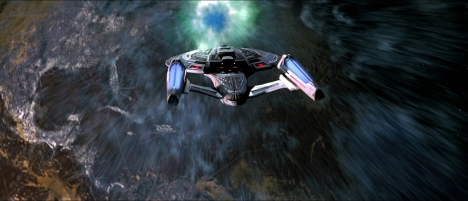
No time like the past.

No time like the past.

Star Trek: Voyager would inherit some of that production design as well, including the space suits in episodes like Day of Honour or Demon. However, the film’s biggest impact on that particular series was the renovation of the Borg. Brannon Braga would seize upon the idea of the Borg as a recurring threat, setting them up in episodes like Blood Fever and Unity mere months after the release of the film. The Borg would serve as the basis of the big third and fourth season two-parter, Scorpion, Part I and Scorpion, Part II. Alice Krige would appear in Endgame.

In its own way, this film also signals the end of the Berman era. The arrival of the Vulcan ship in the closing minutes serves to set up the premise of Star Trek: Enterprise. James Cromwell would make the torch-passing cameo in Broken Bow, reprising his role as Zefram Cochrane. The idea of doing a prequel television series that charted the origin of the franchise feels very much rooted in the (critical and commercial) success of this iteration of the film franchise.
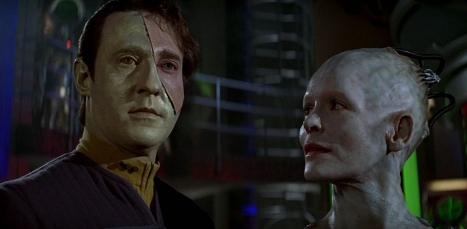
"Captain, when the Borg promised you a pound of flesh, it turns out that they meant it literally."

“Captain, when the Borg promised you a pound of flesh, it turns out that they meant it literally.”

On the audio commentary, writers Brannon Braga and Ronald D. Moore speak of the thirtieth anniversary as “the peak” of the franchise. After all, it seemed like the celebrations would last forever. First Contact was just one small part of a whole season of television that marked the best that the franchise had to offer. There was a wide selection of material, including episodes like Trials and Tribble-ationsFlashbackFuture’s End, Part I and Future’s End, Part II. Following all of those, First Contact was really just the cherry on top of a very delicious cake.

However, the issue with First Contact as “the peak” is quite simple. From this vantage point, the audience can survey the entire Berman era. First Contact is positioned so that the audience can see the metaphorical beginnings of the Star Trek franchise, but also the makings of the end of this particular iteration. From the peak, there is only one direction.

"Just checked Rotten Tomatoes there. Still the best in the series. Don't make me put on Nemesis, Mister Worf."

“Just checked Rotten Tomatoes there. Still the best in the series. Don’t make me put on Nemesis, Mister Worf.”

Continue reading

Star Trek: Enterprise – Demons (Review)

This May, we’re taking a look at the fourth (and final) season of Star Trek: Enterprise. Check back daily for the latest review.

In some ways, Star Trek: Enterprise ends where it should have began.

A lot of the final stretch of the final season seems dedicated to exploring the show’s original sin, the flaws that came baked into the premise as early as Broken Bow. After all, Bound had taken the cringe-inducing adolescent fixation on “sexiness” that informed ideas like the “decontamination gel” and pushed them to their sexist extremes. Similarly, In a Mirror, Darkly, Part I and In a Mirror, Darkly, Part II offered the revenge of the two members of the ensemble all but forgotten in subsequent years while pushing the show’s early reactionary tendencies to eleven.

Under the Earthlight. The serious Earthlight.

Under the Earthlight. The serious Earthlight.

Even These Are the Voyages… seemed to confirm fears that the show had been built as a sequel to Star Trek: The Next Generation and Star Trek: First Contact rather than a prequel to the original Star Trek, a fear shared by many fans frustrated by elements like the design of the ship or the appearance of the Nausicaans in Fortunate Son or the Ferengi in Acquisition. That final episode left open the (admittedly remote) possibility that the entire show was nested inside the holodeck of Picard’s ship.

Demons and Terra Prime touch on the same introspective ideas, by taking the show’s final two-parter (if not its de facto finale) and using it to tell a story that probably should have been told half-way through the first season. It seems like the production team have finally decided to grapple with the core themes of Enterprise. Just at the last possible minute.

"Dead or alive, you're coming with me."

“Dead or alive, you’re coming with me.”

Continue reading

Star Trek: Enterprise – Vanishing Point (Review)

Next year, Star Trek is fifty years old. We have some special stuff planned for that, but – in the meantime – we’re reviewing all of Star Trek: Enterprise this year as something of a prequel to that anniversary. This April, we’re doing the second season. Check back daily for the latest review.

Vanishing Point continues the “remix” formula that we’ve come to expect from the second season of Star Trek: Enterprise. In particular, Vanishing Point is a rather heady Star Trek: The Next Generation cocktail. It has shades of Remember Me, Realm of Fear, The Next Phase and even The Inner Light – with a healthy dose of Brannon Braga’s questions about the nature of reality. All of these elements blend together to form Vanishing Point, an episode that feels overly familiar and rote despite an intriguing set-up.

It is a shame that it doesn’t work better. Vanishing Point brings us back to the idea that Archer and his crew are pioneers in space exploration. The teaser reminds us that the crew of the Enterprise still don’t take the transporter for granted – that it is still something of a mystery to them, despite the audience’s familiarity with the device. Vanishing Point feels like the first time that Enterprise has emphasised this sense of novelty and inexperience since the first season.

Reflections...

Reflections…

However, the episode feels like something of a disappointment. The entire story turns out to be a gimmick and a twist. There is nothing wrong with this sort of storytelling. After all, the franchise has played these sorts of games before. Indeed, some of Braga’s best scripts – Frame of Mind and Projections come to mind – touch on similar ideas with similar twists. The problem with Vanishing Point is that these twists seem a bit too loose or too disconnected to properly resonate.

Vanishing Point feels like the rough sketch of a good episode doodled quickly on the back of a napkin, a collection of connective clauses all designed to keep the story ticking for forty-five minutes before ending on a fairly stock twist. There is a great deal of potential here, but Vanishing Point never quite delivers on it.

Trip Tucker: Space Tourist...

Trip Tucker: Space Tourist…

Continue reading

Star Trek: Enterprise – Singularity (Review)

Next year, Star Trek is fifty years old. We have some special stuff planned for that, but – in the meantime – we’re reviewing all of Star Trek: Enterprise this year as something of a prequel to that anniversary. This April, we’re doing the second season. Check back daily for the latest review.

Star Trek: The Next Generation casts a pretty long shadow.

Singularity aired over eight years after All Good Things… and it still feels like an attempt to re-capture the mood and atmosphere of that second-generation Star Trek spin-off. Singularity feels like it might have made for a passable seventh-season instalment of The Next Generation, airing somewhere between Phantasms, Masks and Genesis. You would probably only have to tweak Singularity ever-so-slightly for that earlier cast.

"Hai!"

“Hai!”

Of course, this fixation on The Next Generation is not unique to the second season of Star Trek: Enterprise. After all, Star Trek: Voyager spent a significant portion of its run trying to re-capture the magic associated with The Next Generation. There were lots of generic aliens- and anomalies-of-the week. The second season of Enterprise is just interesting in this regard because it is really the last gasp of this sort of nostalgic storytelling on so wide a scale.

It would not be easy. It would take the box office failure of Star Trek: Nemesis, a change of management at UPN, falling ratings and the threat of cancellation. Nevertheless, Enterprise would eventually manage to exorcise the ghost of The Next Generation. In the meantime, Singularity offers a reminder of just how closely Enterprise was hewing to The Next Generation.

"Are you sitting comfortably? Then we'll begin."

“Are you sitting comfortably? Then we’ll begin.”

Continue reading

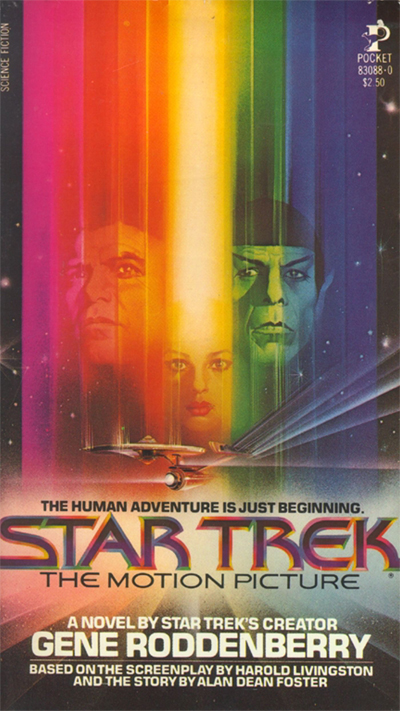
Star Trek: The Motion Picture by Gene Roddenberry (Review)

This June, we’re taking a look at some classic Star Trek movie tie-ins and other interesting objects. Check back daily for the latest reviews and retrospectives.

Star Trek: The Motion Picture is heavily influenced by Gene Roddenberry. It’s a piece of work that serves as an example of Roddenberry’s vision of the franchise – what he felt Star Trek should look like in the late seventies and beyond. Much like the first and second seasons of Star Trek: The Next Generation, there’s a sense that this is the perfect distillation of Roddenberry’s later-day version of Star Trek, distinct from the versions that existed before and afterwards.

Although Roddenberry doesn’t have a writing or story credit on The Motion Picture, his influence is keenly felt; right down to hiring a bona fides science-fiction writer (Alan Dean Foster) to provide the story. (After hearing pitches from other authors like Ray Bradbury, Harlan Ellison and Theodor Sturgeon.) This was in keeping with his work on the early seasons of the show, where he tried to convince published science-fiction authors to contribute to Star Trek.

While Roddenberry doesn’t have a writing credit on the film, he did write the novelisation of the screenplay, which serves as a direct insight into how Roddenberry approached the franchise and how he saw Star Trek in 1979.

st-tmp-roddenberry

Continue reading

Star Trek: The Next Generation – Brothers (Review)

This January and February, we’ll be finishing up our look at the second season of Star Trek: The Next Generation and moving on to the third year of the show, both recently and lovingly remastered for high definition. Check back daily for the latest review.

Brothers is Star Trek: The Next Generation getting back to business at usual. Well, not quite usual, but close enough. Following the monumental season-bridging epic that was The Best of Both Worlds and the breathing space afforded by Family, Brothers is a good old-fashioned science-fiction adventure story revolving around one of the show’s most popular character and really written to satisfy a laundry list of Star Trek tropes and conventions.

Although its notable for maintaining a thematic consistency that is threaded through the fourth season, and also for affording Brent Spiner to play three different roles, the most striking aspect of Brothers from a production point of view is the fact that it is written by Rick Berman. Berman had been serving as producer on the show since Encounter at Farpoint, but this was his first scripting contribution. He’d only write one more episode of The Next Generation before the show went off the air.

Given Berman’s production style, it feels strangely appropriate that Brothers is so carefully and meticulously structured and constructed.

"Let's put a smile on that face..."

“Let’s put a smile on that face…”

Continue reading

Star Trek: The Next Generation – Family (Review)

This January and February, we’ll be finishing up our look at the second season of Star Trek: The Next Generation and moving on to the third year of the show, both recently and lovingly remastered for high definition. Check back daily for the latest review.

He’s still out there. Dreaming about starships and adventures. It’s getting late.

Yes. But let him dream.

– Robert and Marie try to figure out what all this “Star Trek” milarky is about

Starry, starry night...

Starry, starry night…

Continue reading

Star Trek: The Next Generation – The Best of Both Worlds, Part II (Review)

This January and February, we’ll be finishing up our look at the second season of Star Trek: The Next Generation and moving on to the third year of the show, both recently and lovingly remastered for high definition. Check back daily for the latest review.

The Best of Both Worlds, Part II was always going to feel like a bit of an anti-climax. After all, the show had spent so much time building up the Borg as this implacable and undefeatable adversary. In Q Who?, it had taken the interference of a god-like entity to allow the Enterprise a chance to escape their unstoppable foe. In The Best of Both Worlds, Part I, the Enterprise had been able to run for a while – but the Borg eventually caught up with them and took what they wanted.

Since The Best of Both Worlds, Part II was never going to end with the Borg destroying Earth, and since Star Trek: The Next Generation was never going to be a show willing to exact a dramatic cost high enough to justify victory against such overwhelming odds, the resolution to the two-parter was never going to live up to the heightened drama and impossible stakes suggested by The Best of Both Worlds, Part I.

Still, the second part of the adventure is charming and exciting enough that it never completely falls apart. While the resolution to the crisis does seem a little trite and convenient, The Best of Both Worlds hangs together as the show’s best two-part adventure until at least Chain of Command in the sixth season.

A Number One fan?

A Number One fan?

Continue reading