• Following Us

  • Categories

  • Check out the Archives


  • Awards & Nominations

Star Trek – The Man Trap (Review)

To celebrate the release of Star Trek: Into Darkness this month, we’ll be running through the first season of the classic Star Trek all this month. Check back daily to get ready to boldly go. It’s only logical.

It really is amazing how busy the Star Trek universe is. Or, well, how busy it was at one point. Although there are plenty of alien civilisations scattered across the vast gulf space, numerous empires vying for power and glory, the first season of Star Trek seems fixated on the notion that the universe is packed with the relics and ruins of long-dead civilisations. The Man Trap is just one example, as Kirk and his crew investigate an archaeological dig on the planet M-113, decorated with “the ruins of an ancient and long-dead civilisation.” Of course, the civilisation isn’t quite dead, but there’s a definite funereal atmosphere about The Man Trap.

That somewhat grim atmosphere makes the show’s fixation on long-dead worlds somewhat fascinating, given how the series is primarily about mankind’s optimistic future. However, it creates a sense – palpable throughout the first year of Star Trek – that the human race is a relatively new arrival on the scene, but emerging following the collapse and decay of countless ancient civilisations. It’s an old universe, but it’s a new dawn.

Suckers!

Suckers!

Continue reading

Star Trek – The Enemy Within (Review)

To celebrate the release of Star Trek: Into Darkness this month, we’ll be running through the first season of the classic Star Trek all this month. Check back daily to get ready to boldly go. It’s only logical.

One thing that I don’t think the original Star Trek gets nearly enough credit for is the quality of the writers that Gene Roddenberry recruited to contribute scripts. Television obviously operated under a different model at the time, but there’s an impressive selection of science-fiction literary giants who contributed scripts to the show. More than that, it’s impressive how many of those stories became truly iconic Star Trek stories.

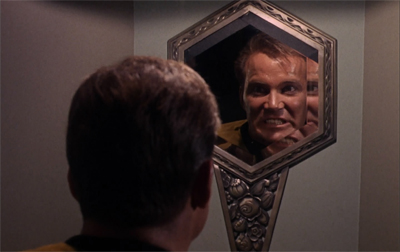
The Enemy Within is the work of author Richard Matheson, best known for stories like I Am Legend or What Dreams May Come. It’s very much a high-concept science-fiction story, but it’s also notable because it establishes two of what would become the show’s favourite tropes: transporter accidents and evil duplicates. Indeed, the two devices would be reunited in the following season’s Mirror, Mirror. These narrative elements even featured in the last season of Star Trek: Enterprise to air, in episodes like Daedalus and In a Mirror, Darkly.

Perhaps it’s a demonstration of how important these outside writers were to the development of Star Trek as a franchise that Matheson would effectively codify two stock narrative devices that would still be in use four decades later.

Mirror, mirror...

Mirror, mirror…

Continue reading

Star Trek – The Corbomite Manoeuvre (Review)

To celebrate the release of Star Trek: Into Darkness this month, we’ll be running through the first season of the classic Star Trek all this month. Check back daily to get ready to boldly go. It’s only logical.

Again, The Corbomite Manoeuvre is one of those early episodes of Star Trek that was shuffled around in the broadcast order. Not that there’s too much internal continuity to mess up or anything like that, but it is particularly noticeable when episodes at the start of a television show get shuffled around. The writers are establishing characters and concepts, so it feels strange to watch the first episode written with McCoy after we’ve already seen him established as the ship’s doctor.

(The first episode aired, The Man Trap, centres around McCoy, which makes it strange when the ship suddenly has a different Chief Medical Officer in the Where No Man Has Gone Before.)

Fortunately though, The Corbomite Manoeuvre is the last time that this really becomes a concern, as Star Trek seems to iron out all the difficulties and the nuances on a new television show. Effectively the first regular episode of the show produced after two pilots, a large part of the charm of The Corbomite Manoeuvre is really watching it all come together.

What a dummy...

What a dummy…

Continue reading

Star Trek – Crew by John Byrne (Review)

To celebrate the release of Star Trek: Into Darkness this month, we’ll be running through the first season of the classic Star Trek all this month. Check back daily to get ready to boldly go. It’s only logical.

We’ll be supplementing our coverage of the episodes with some additional materials – mainly novels and comics and films. This is one such entry.

Majel Barrett Roddenberry was the first lady of the Star Trek franchise, in more ways than one. She was married to Gene Roddenberry and remained a part of the franchise after his death. She guest starred on the shows occasionally, continued to lend her voice to the computers and offered the occasional interview to the press. Although her actual influence on the television shows was relatively minimal (and she was occasionally prone to protesting various plot developments including the Dominion War on Star Trek: Deep Space Nine), she did remain involved in Star Trek until she passed away in 2008.

However, she was also involved from the start. She had the recurring role of Christine Chapel throughout the original television show, and appeared in the unaired pilot, The Cage, as Christopher Pike’s first officer. Identified only as “Number One”, this almost made her the literal “first lady” of Star Trek. I’m surprised that Number One hasn’t been used more often as a character, with her appearances in tie-ins generally restricted to her time on board Pike’s Enterprise.

John Byrne’s miniseries might have the title Crew, and feature supporting roles for Christopher Pike and Mister Spock, but it is very much the story of Number One. Published a year after her death, and dedicated to her memory, Crew feels like a fitting farewell to the actress responsible for one of the franchise’s earliest and most intriguing supporting characters.

Fate protects fools, little children... and ships named Enterprise.

Fate protects fools, little children… and ships named Enterprise.

Continue reading

Star Trek – Where No Man Has Gone Before (Review)

To celebrate the release of Star Trek: Into Darkness this month, we’ll be running through the first season of the classic Star Trek all this month. Check back daily to get ready to boldly go. It’s only logical.

In a way, there’s a very clear divide between The Cage and Where No Man Has Gone Before. It’s clearer than the strange new actor sitting in the middle of the Bridge or the fact that Spock is suddenly a lot less casual. In a way, each is perfectly positioned in popular consciousness. The Cage was produced in late 1964, but wouldn’t be shown on television until 1988, after spending years touring the fan circuit. It remains a strange bit of Star Trek history, sitting simultaneously outside any of the five television shows, and simultaneously a completely inexorable part of the franchise’s evolution. It’s where it all began, but not where the first Star Trek began.

In contrast, Where No Man Has Gone Before feels more like the pilot episode of Star Trek. Sure, the fashion changes a bit in the episodes to come, the entire cast has yet to be assembled, but this is recognisably the same ship and the same show as The Corbomite Manoeuvre or The Man Trap. It’s more than the actors filling roles, the consistent characterisation of Spock or the fact that it actually aired on television in September 1966. This is what the next three years of Star Trek will be like. It’s an aesthetic or an approach to storytelling that is markedly different to the way that The Cage tackled many of the same themes and ideas.

While The Cage laid down many of the philosophical underpinnings of the broader Star Trek universe – including the classic show – it is also a lot less physical and visceral than the classic Star Trek. Indeed, The Cage featured the Captain of the Enterprise reasoning with an advanced bunch of god-like aliens, appealing to human virtues. The action sequences felt a bit extraneous. In contrast, Where No Man Has Gone Before sees the Captain of the Enterprise punching a god-like being repeatedly in the face while hitting on the same themes.

I think that’s perhaps the most dynamic difference between not only The Cage and Where No Man Has Gone Before, but between Star Trek and its spin-offs.

All the old familiar faces...

All the old familiar faces…

Continue reading

Star Trek: Early Voyages #1 – Flesh of my Flesh (Review)

To celebrate the release of Star Trek: Into Darkness this month, we’ll be running through the first season of the classic Star Trek all this month. Check back daily to get ready to boldly go. It’s only logical.

We’ll be supplementing our coverage of the episodes with some additional materials – mainly novels and comics and films. This is one such entry.

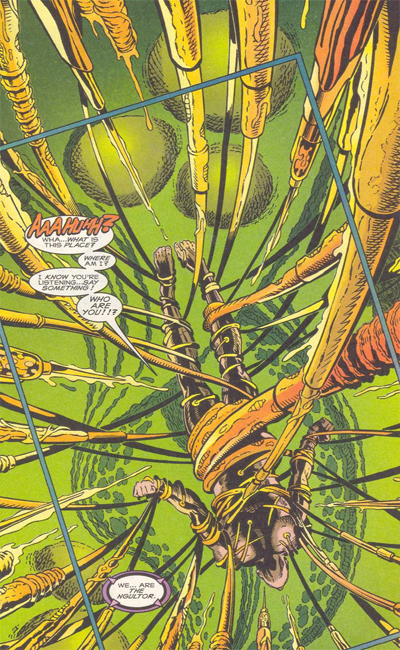
In the late nineties, Marvel were publishing Star Trek comic books. One of those books, perhaps the book garnering the most critical praise, was Star Trek: Early Voyages. Written by Dan Abnett and Ian Edginton, the series was intended to follow the mission of the USS Enterprise under the command of Captain Christopher Pike. Published monthly, the comic is perhaps the best indication of what a Star Trek show starring Christopher Pike might have actually looked like. Although the series was cancelled suddenly after only seventeen issues, ending on a cliffhanger, it is still a fascinating look at what might have been.

Looks like they've hooked a Pike...

Looks like they’ve hooked a Pike…

Continue reading

Star Trek – The Cage (Review)

To celebrate the release of Star Trek: Into Darkness this month, we’ll be running through the first season of the classic Star Trek all this month. Check back daily to get ready to boldly go. It’s only logical.

The Cage is fascinating. Looking at it now, it holds up phenomenally well a s apiece of sixties science-fiction. However, it feels like we’re watching a prototype of Star Trek. In many respects, The Cage feels like a rough sketch that captures some essentials, but is missing out on the finer details. Spock is there! But he smiles! The set design looks the same, but the characters are different. Some of the cast fill the same roles, but some are dramatically different. Watching The Cage, you can see a lot of the philosophy that Gene Roddenberry would bring to Star Trek, but it’s very difficult to imagine an on-going series spinning out of this adventure, let alone one that managed to become as iconic or influential as Star Trek would ever be.

Still, it’s pretty solid viewing. It’s entertaining on its own terms, but it’s also informative in the context of the series. It’s more like dry run or a test drive of the concept.

To boldly go... for some reworking...

To boldly go… for some reworking…

Continue reading

Star Trek – Vulcan’s Glory by D.C. Fontana (Review)

To celebrate the release of Star Trek: Into Darkness this month, we’ll be running through the first season of the classic Star Trek all this month. Check back daily to get ready to boldly go. It’s only logical.

We’ll be supplementing our coverage of the episodes with some additional materials – mainly novels and comics and films. This is one such entry.

I’ve never really felt too strongly one way or another about continuity. I never got too upset about Klingon forehead ridges, or the fact that Khan somehow remembered Chekov from an episode that took place before he joined the Enterprise. I’ve always found the use of the term “canon” to describe the shared continuity as more than a little indulgent or absurd. I consider some of the better tie-in novels I have read to be a worthy part of the Star Trek universe, regardless of the fact that they may not fit, or they may contradict what was depicted on-screen. I’ve never been too tightly tied to the notion that something is “important” or “in continuity” among this 700-episode franchise.

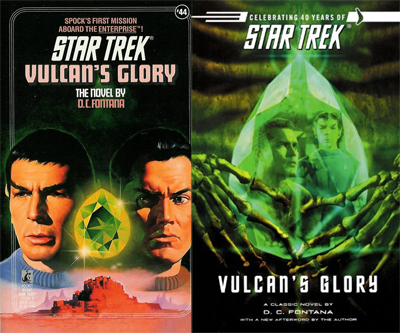
Still, I can’t help but feel like there’s something almost legitimate about Vulcan’s Glory. It is a novel from writer D.C. Fontana, who served as script editor and writer on the classic Star Trek show, and is regarded as one of the guiding lights of the franchise. She went on to write for both Star Trek: The Next Generation and Star Trek: Deep Space Nine. Given her importance to the show over its extended history, anything Fontana writes about it is worthy of note. Indeed, Vulcan’s Glory was originally published in 1989 and was reissued in 2006 for the franchise’s fortieth anniversary.

Even to somebody reluctant to consign “importance” or “worthy” to a tie-in based on outside factors, the story of Spock’s first mission on board the Enterprise, written by one of the strongest writers of the original Star Trek and a guiding influence on the franchise, still jumps out as a pretty important book.

vulcansglory

Continue reading

Star Trek: The Next Generation – The Child (Review)

To celebrate the twenty-fifth anniversary of Star Trek: The Next Generation, and also next year’s release of Star Trek: Into Darkness, I’m taking a look at the recent blu ray release of the first season (and a tiny bit of the second), episode-by-episode. Check back daily for the latest review.

Let’s play make believe for a second here. Let’s imagine you are producing a television show that had a very rocky first season, but seemed to be making steps in the right direction. This was a show already respected for its depiction of social issues like racism or drug use…

However, despite that, the first year of the show had some major gender issues. Your writers and actors had been pointing out that some of the episodes in that first year could be considered sexist. Of the three actresses in you regular cast, two left. One became the first regular on a Star Trek show to die in the middle of the season, and you had to write the first episode of the second season to write out the other actress who had been having some trouble with a male producer.

Now, keeping all that in mind, let’s carefully consider what to do with the remaining female lead character. If you are producing the second season of Star Trek: The Next Generation, you choose to have an alien impregnate that character without consent, use her body as incubation chamber, exploit her maternal instincts and then make her watch what she believes to be her own child die. More than that, you make sure that the female character is completely superfluous to the script itself, and that nobody seems to care particularly about her.

Don't worry, Troi. Face of the Enemy is less than half a decade away...

Don’t worry, Troi. Face of the Enemy is less than half a decade away…

Continue reading

Non-Review Review: Star Trek VI – The Undiscovered Country

On seeing the new Star Trek, I decided to dig into my old DVD’s and review my personal favourite of the Original Series movies. The cliched choice is The Wrath of Khan, and it is indeed awesome, but I’ve always had a soft spot for The Undiscovered Country, despite its abuse of Shakespeare. So, having just witnessed Kirk and Spock’s first voyage, what did I make of their last?

Continue reading