• Following Us

  • Categories

  • Check out the Archives


  • Awards & Nominations

Star Trek – Bread and Circuses (Review)

The first Star Trek pilot, The Cage, was produced in 1964. To celebrate its fiftieth anniversary, this December we are reviewing the second season of the original Star Trek show. You can check out our first season reviews here. Check back daily for the latest review.

Bread and Circuses is not subtle. Then again, that is the point.

There’s a lot of interesting stuff happening in Bread and Circuses, the fourteenth episode produced for the second season, but the last to air. There’s the idea of a world dominated by “a twentieth century Rome”, a rogue captain, a Prime Directive dilemma and a scathing indictment of modern television. Not only is it one of the last episodes with a “produced by Gene L. Coon” credit, it is also an episode co-written by Roddenberry and Coon. It is also the episode of Star Trek that endorses Christianity most explicitly and heavily.

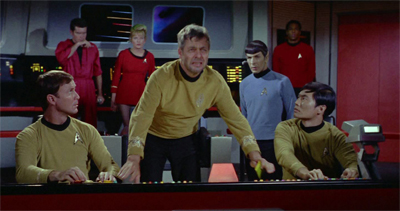
"Wait, we're only getting it in black and white?"

“Wait, we’re only getting it in black and white?”

Bread and Circuses is a bold and audacious piece of television, full of venom and righteous anger, rich in satire and cynicism. It’s a plot so ridiculously over-stuffed with good ideas that viewers are liable to forgive the show’s somewhat cop-out ending where Kirk and his away team beam back to the Enterprise and continue on their merry way as though little has actually happened. Bread and Circuses feels like it uses every minute of its fifty-minute runtime wisely, balancing character with world-building.

It is probably a little bit too messy and disjointed to be labelled a dyed-in-the-wool classic, particularly when compared to the shows produced around it. Nevertheless, it is a decidedly ambitious piece of work, and one that demonstrates what Star Trek could do when it sets its mind to something.

When in Rome...

When in Rome…

Continue reading

Star Trek – The Apple (Review)

The first Star Trek pilot, The Cage, was produced in 1964. To celebrate its fiftieth anniversary, this December we are reviewing the second season of the original Star Trek show. You can check out our first season reviews here. Check back daily for the latest review.

It’s amazing how iconic Star Trek could be, even when it was terrible. There’s something quite ironic about how much of the franchise’s truly memorable iconography is rooted in some of the show’s weakest episodes. The Apple is one of the most iconic and memorable Star Trek episodes, featuring a giant evil dragon head sculpture, David Soul in orange body paint, lots of speechifying from Kirk, and a strong atheistic message with Kirk casting himself as Satan in the Garden of Eden.

It is also just terrible.

"VAAAAAAAL!!!"

“VAAAAAAAL!!!”

Continue reading

Space: Above and Beyond (Review)

This November (and a little of December), we’re taking a trip back in time to review the third season of The X-Files and the first (and only) season of Space: Above and Beyond.

It is very hard to judge a series based on the first season alone. After all, many long-running series evolve quickly and radically from their debut year. In many cases, the first season is about desperately trying to find a footing as everybody gets used to the realities of producing a television show. Assessing a first season is often an exercising in gauging potential, which makes it a risky proposition when trying to evaluate the first and only season of a cancelled television show.

Space: Above and Beyond contains its fair share of clunkers, as does any first season with twenty-odd episodes. There are episodes that seem at odds with the premise and mood of the show, being written by staff writers before the show went to air or simply trying to do something with which the show isn’t comfortable. There are episodes that have interesting ideas, but don’t place emphasis on the show’s strengths.

spaceaboveandbeyond-pilot32

However, this is all but expected for a first season. A first season is a learning experience for all involved. After all, the first season of The X-Files was packed with episodes like Shadows, Fire, Lazarus, Young at Heart and Born Again. It is very rare for the first season of any show – particularly a genre show – to be the strongest. There are rules to be learned, beats to be established, foundations to be laid. If shows are lucky, that work gets to pay off in later seasons, as everybody gets more comfortable.

Space: Above and Beyond never got that chance, which is a shame. Because there is a phenomenal amount of potential on display here.

spaceaboveandbeyond-thefarthestmanfromhome24

Continue reading

Space: Above and Beyond – And If They Lay Us Down to Rest… (Review)

This November (and a little of December), we’re taking a trip back in time to review the third season of The X-Files and the first (and only) season of Space: Above and Beyond.

The last stretch of episodes of Space: Above and Beyond are quite mournful and introspective.

It is very difficult to tell a war story. There are a host of tightropes that any writer has to navigate. After all, it is very easy for a story about the bonds of warfare and humanity in wartime to be interpreted as militaristic or fascistic. At the same time, it is very easy for an anti-war parable to seem critical of the soldiers fighting the war, to dismiss the bravery and courage on display in that most horrific of environments.

Seeing eye-to-eye...

Seeing eye-to-eye…

With its futuristic tech and gigantic guns, as well as its fascination with the military apparatus, it is easy to read Space: Above and Beyond as a pro-military piece. Given how much pride it takes in the way that it presents military life, or how much it wallows in the military setting, a casual viewer might be forgiven for assuming the it glorifies warfare. However, this is the most superficial of readings. It ignores a lot of what the show actually has to say about combat and warfare.

Space: Above and Beyond is by turns cynical and romantic in its portrayal of this futuristic conflict – it clearly respects and appreciates the sacrifices made by those in service of mankind, but is also wary about the motivations of those ordering the sacrifices. It is a very delicate balance to maintain. However, And If They Lay Us Down to Rest… and … Tell Our Moms We Done Our Best seem to lay the cards out on the table, once and for all. This is as anti-war as the show ever gets.

Face of the enemy...

Face of the enemy…

Continue reading

Star Trek – The Doomsday Machine (Review)

The first Star Trek pilot, The Cage, was produced in 1964. To celebrate its fiftieth anniversary, this December we are reviewing the second season of the original Star Trek show. You can check out our first season reviews here. Check back daily for the latest review.

The Doomsday Machine is another Star Trek classic.

Much like Amok Time directly before it, The Doomsday Machine is a piece of Star Trek that works both as powerful drama and clever allegory. It is an episode that has had a tremendous influence on the franchise. The “planet killer” has become a staple of Star Trek tie-in fiction, and even the franchise itself has kept the episode’s legacy alive, with the son of Commodore Decker originally planned as a regular in Star Trek: Phase II and eventually appearing in Star Trek: The Motion Picture.

All hands on Decker...

All hands on Decker…

The Doomsday Machine is at once a beautifully tragic character study and a potent cautionary tale for the atomic age. The episode the first example of “Star Trek does Moby Dick”, a story template that would become popular enough to sustain another episode in the same season, quite a few later Star Trek episodes across the franchise and no fewer than two of the franchise’s trips to the big screen. In many ways, The Doomsday Machine sets the template for Star Trek engaging with classic literature, building off The Conscience of a King.

It’s also beautifully produced, right down to the creature that Spinrad himself described as “a windsock dipped in cement.”

A commandeering presence...

A commandeering presence…

Continue reading

Star Trek (Gold Key) #1 – The Planet of No Return! (Review)

The first Star Trek pilot, The Cage, was produced in 1964. To celebrate its fiftieth anniversary, this December we are reviewing the second season of the original Star Trek show. You can check out our first season reviews here. Check back daily for the latest review.

The Star Trek comics published by Gold Key are somewhat infamous additions to the Star Trek canon. The company began publishing comic book tie-ins in July 1967, in the gap between the first and second seasons of the original Star Trek show. They continued to publish those tie-ins until 1978, when the license passed to Marvel. These early comics have become the source of much derision over the years, with fans dismissing them as hollow cash-ins produced by people with little understanding of the franchise itself.

However, recent years have seen something of a reappraisal of these early comic books. Once IDW Publishing secured the rights to produce tie-in Star Trek comic books, they devoted considerable effort to archiving and releasing classic and little-seen material from the franchise’s history. They released the Star Trek newspaper strips in a two-volume set, before turning their attention to the classic Gold Key comic books. It is a very worthwhile attempt to provide fans with a glimpse of oft-overlooked chapters in the franchise’s history.

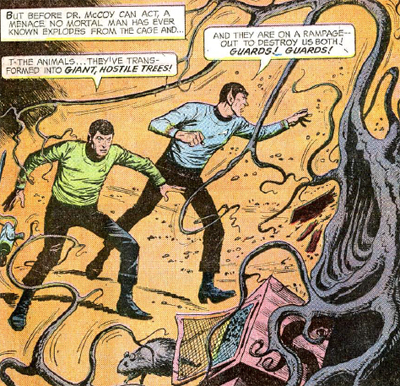
Plant life...

Plant life…

The Gold Key Star Trek comics are messy. A lot of the criticisms hold true. There are all manner of continuity errors in the production of the comic. Artist Alberto Giolitti takes quite some time to figure out what Scotty looks like, and the colourists take a bit of time to figure out what uniforms various cast members should be wearing. The writing is similarly clunky, with characters sounding a little out of sort as the basic plot details seem to stand at odds with still-relatively-small Star Trek canon had been established by the closing credit of Operation — Annihilate!

And yet, despite all these considerable flaws, these comics do make for an interesting time capsule. They don’t feel quite like Star Trek so much as an impression of what Star Trek would look described to somebody who has never seen it, filtered through the lense of fifties and sixties science-fiction comics. The early issues feel like three blind men describing an elephant, and it is glorious.

Branching out...

Branching out…

Continue reading

Space: Above and Beyond – Who Monitors the Birds? (Review)

This November (and a little of December), we’re taking a trip back in time to review the third season of The X-Files and the first (and only) season of Space: Above and Beyond.

Who Monitors the Birds? is a phenomenal piece of television.

Space: Above and Beyond is a show that only ran one season, languishing on Sunday nights before Fox decided to just scrap the idea of consistently scheduling it and just bounced it around the network timetable. It was not a breakout hit. It did not inspire a revival or resurrection in the way that other science-fiction properties have done. It has a very devoted and strong cult following, but its name is more likely to evoke a vague remembrance than anything more concrete.

spaceaboveandbeyond-whomonitorsthebirds13

And yet, despite that, Space: Above and Beyond was still a massively influential piece of television. Despite the fact that it was structured as a throwback to classic war movies, it was also a very progressive piece of television. The influence of Space: Above and Beyond can be keenly felt on Ronald D. Moore’s Battlestar Galactica, even though the show seldom gets any real credit for that influence. In some respects, Space: Above and Beyond was well ahead of its time.

Who Monitors the Birds? is put together with incredible skill and confidence. It is an episode that holds up fantastically, and which serves as a demonstration of the series’ lost potential.

spaceaboveandbeyond-whomonitorsthebirds3


Continue reading

Space: Above and Beyond – Hostile Visit (Review)

This November (and a little of December), we’re taking a trip back in time to review the third season of The X-Files and the first (and only) season of Space: Above and Beyond.

At this point, Space: Above and Beyond could do a lot worse than learn from The X-Files.

There are quite a few echoes of The X-Files in Space: Above and Beyond, becoming more pronounced as the show approaches the middle of the season. Eyes built on the suggestion of conspiracy and cover-up to assure viewers that Space: Above and Beyond was just as cynical about authority as The X-Files ever was. The Enemy felt like an attempt to copy the formula that Morgan and Wong had worked so well back in Ice.

Picture imperfect...

Picture imperfect…

Hostile Visit and Choice or Chance feels like an attempt to do a big sweeps two-parter in the style of The X-Files. This was a crucial moment for Space: Above and Beyond. The series had been scheduled outside of its comfort zone, had not been drawing huge ratings, had found itself preempted and bounced around the schedule as a result of factors outside its control. It needed a strong performance for the November sweeps, which were a matter of pride (and money) for the networks and a matter of interest for the advertisers.

So structuring a two-parter around that period makes a great deal of sense. Unfortunately, Hostile Visit does not make for the most compelling first half.

"I want a good clean sweep."

“I want a good clean sweep.”

Continue reading

Space: Above and Beyond – The Enemy (Review)

This November (and a little of December), we’re taking a trip back in time to review the third season of The X-Files and the first (and only) season of Space: Above and Beyond.

On paper, The Enemy seems like a good idea.

Space: Above and Beyond has a reasonably large cast. It has devoted character-centric episodes to the three leads, and done a nice bit of world-building around that. To this point, the shows have typically split the characters up, pushed some to the fore and others to the background.  The show is now about a third of the way through the first season, so it makes a great deal of sense to do a show that actually stresses the ensemble dynamic.

Nothing to fear, but fear itself...

Nothing to fear, but fear itself…

A story like The Enemy makes a great deal of sense. When you have an ensemble, you can generate drama from next to nothing. Lock five people in a room together, you’re sure to generate some friction. Character practically defines itself as they play off one another. If you can crank up the tension, it will all come together. So a war story where our heroes find themselves trapped together and cracking under the pressure seems like a solid basis for a good story.

The problem is that The Enemy is just a clumsy mess of a script, and one that stumbles over what should be a fairly robust set-up.

"I'm still not sure that producing the episode could be considered a war crime..."

“I appreciate that it was traumatic, but I’m still not sure that producing the episode could be considered a war crime…”

Continue reading

Space: Above and Beyond – Mutiny (Review)

This November (and a little of December), we’re taking a trip back in time to review the third season of The X-Files and the first (and only) season of Space: Above and Beyond.

Nothing says “this is a militaristic science-fiction show!” quite like a mutiny episode.

When producing a show like Space: Above and Beyond, doing a show based around a mutiny in wartime is a given. It’s no surprise that Mutiny is the third regular episode of the show. Indeed, when Battlestar Galactica – a show that owes a sizeable debt to Space: Above and Beyond – wanted to establish its own militaristic science-fiction credentials, it produced Bastille Day as the third episode of its first season – another story about an uprising on a spaceship in a time of crisis.

His sister's keeper...

His sister’s keeper…

Mutiny is also notable as the first episode of the season not credited to the creative team of Glen Morgan and James Wong. Of course, as executive producers, Morgan and Wong would have had a massive impact on the development and the writing of Mutiny. Stephen Zito is credited as the writer on the show. Zito is a veteran television writer and producer, working in the industry since the late eighties. He departed Space: Above and Beyond halfway through the first season, moving on to a long run on J.A.G.

Mutiny is far from perfect – indeed, it is often quite clunky in places. At the same time, it is a lot more comfortable in its skin than The Dark Side of the Sun was.

Watching like a Hawkes...

Watching like a Hawkes…

Continue reading