• Following Us

  • Categories

  • Check out the Archives


  • Awards & Nominations

Doctor Who: Victory of the Daleks (Review)

To celebrate the fiftieth anniversary of the longest-running science-fiction show in the world, I’ll be taking weekly looks at some of my own personal favourite stories and arcs, from the old and new series, with a view to encapsulating the sublime, the clever and the fiendishly odd of the BBC’s Doctor Who.

Victory of the Daleks originally aired in 2010.

Would! you! care! for! some! TEA???!!!

– the Daleks

Ah, the Daleks. They tend to rise and fall. They get built up and then they fall back down. Like the show itself, they come and go in cycles. The Dalek Invasion of Earth has the psychotic pepperpots invade Earth, while The Chase reduces them to little more than comic foils. Destiny of the Daleks makes jokes about them being unable to climb stairs, while Remembrance of the Daleks then proves that they can. In 2005, both Dalek and The Parting of the Ways invested considerable effort in making them scary again. The show eroded that away over time, turning them into bitchy foils for the Cybermen in Doomsday for the Doctor to hover up and competing to create the most phallic monster ever in Evolution of the Daleks.

Steven Moffat took over the show in 2010, and that means that he also took over the Daleks. Tending to the Doctor also means tending to his worst enemies. And, to be fair, that’s a bit what Victory of the Daleks feels like. It feels like an obligation, a bit of business to get out of the way quickly (the first episode not penned by Moffat) so that the fun stuff can commence.

Exterminate the rainbow...

Exterminate the rainbow…

Continue reading

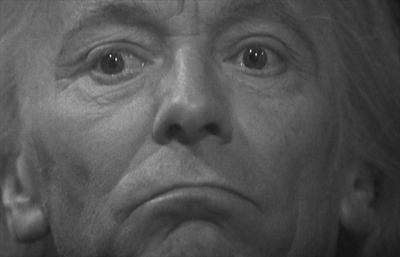
Doctor Who: The Chase (Review)

To celebrate the fiftieth anniversary of the longest-running science-fiction show in the world, I’ll be taking weekly looks at some of my own personal favourite stories and arcs, from the old and new series, with a view to encapsulating the sublime, the clever and the fiendishly odd of the BBC’s Doctor Who.

The Chase originally aired in 1965.

You’re from Earth?

No, no, Ma’am. No, I’m from Alabama.

– Barbara and Morton set things straight

There are times when Doctor Who seems to straddle the line between genius and insanity, when the viewer is left completely unsure whether they’ve witnessed something profoundly clever, or infuriatingly stupid. The Chase is one of those stories, one of those rare cases where I’m honestly not sure if I’m reading too much into a piece of television or simply scratching the surface of a whole wealth of complex meaning and symbolism. The Chase is, as near as I can make out, either a desperate attempt to cash-in on the then-current Dalek craze, or one of the craziest attacks the show ever made on the fourth wall. It’s either completely terrible or breathlessly brilliant, and I refuse to rule out the possibility that it is both, possibly at the same time.

Cutting to the chase...

Cutting to the chase…

Continue reading

Doctor Who: The Rings Of Akhaten (Review)

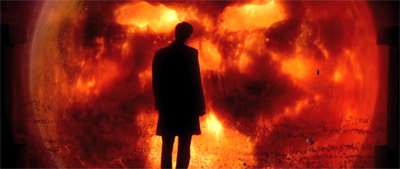
The Rings of Akhaten is a visual feast. Both the Mill and Millennium FX deserve a tremendous amount for realising the eponymous environment, which stands out as the perhaps the most impressively alien landscape to appear on Doctor Who since the show began broadcasting in high definition. It’s a solid demonstration that Doctor Who has come a long way since the eighties, and that the show is well able to keep pace with its American competitors. However, it also makes the news that the Mill has been forced to shut down all the more depressing – especially since that shut-down was partially due to the reduced number of Doctor Who episodes being produced each year.

In fact, a lot of the bigger problems with The Rings of Akhaten can be traced back to the decision to structure this seventh season of the revived show, split over two different years instead of across a single year. Most obviously, there’s the fact that we are half-way through this season of Doctor Who, and The Rings of Akhaten feels like the second or third episode of a given season. So much time is taken up with matters and concerns associated with the first half of a given season that The Rings of Akhaten ultimately feels quite light and almost insubstantial.

Burn with me...

Burn with me…

Continue reading

Doctor Who: The Android Invasion (Review)

To celebrate the fiftieth anniversary of the longest-running science-fiction show in the world, I’ll be taking weekly looks at some of my own personal favourite stories and arcs, from the old and new series, with a view to encapsulating the sublime, the clever and the fiendishly odd of the BBC’s Doctor Who.

The Android Invasion originally aired in 1975.

Is that finger loaded?

– the Doctor

We’re in the middle of one hell of a season here, aren’t we? Indeed, The Android Invasion is sandwiched between two stories that could legitimately vie for the title of “best Doctor Who story ever.” Perhaps that’s why it feels like such a let-down. The Android Invasion isn’t the worst Doctor Who story ever. Indeed, it isn’t the worst Tom Baker Doctor Who story ever, nor is it the worst Philip Hinchcliffe Doctor Who story ever. It is just sort of… there. It’s a very dull and mundane piece of television, one that feels all the more dull and mundane for the fact that it’s positioned in one of the strongest seasons that the show ever produced.

He needs a Doctor...

He needs a Doctor…

Continue reading

Doctor Who: Pyramids of Mars (Review)

To celebrate the fiftieth anniversary of the longest-running science-fiction show in the world, I’ll be taking weekly looks at some of my own personal favourite stories and arcs, from the old and new series, with a view to encapsulating the sublime, the clever and the fiendishly odd of the BBC’s Doctor Who.

Pyramids of Mars originally aired in 1975.

Yes, that’s resonating tuner. Part of an anti-gravity drive. Oh! They must be building a rocket.

Egyptian mummies building rockets? That’s crazy.

– the Doctor and Sarah Jane demonstrate how arbitrary “crazy” is on this show

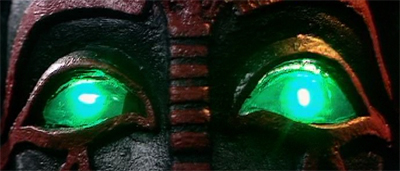
Pyramids of Mars is a classic slice of Doctor Who. It’s a piece of television that I dearly love, even if it is quite clear watching it that Robert Holmes was re-writing it by the seat of his pants. It’s got all the right ingredients for the Philip Hinchcliffe era of the show. Tom Baker is on phenomenal form. Sarah Jane has full adapted to being the only companion again. There’s one of those nice period settings that the BBC does so well. There’s an ancient evil arising to destroy the planet, and maybe the universe. Said evil is deliciously hammy, yet somehow quite intimidating.

Pyramids of Mars is the perfect storm, a carefully mixed cocktail of Doctor Who in the Hinchcliffe era. Given that the Hinchcliffe era is generally regarded as one of the best periods in the show’s history, that should give an idea of just how impressive it is.

Because "Sutekh the Benign" doesn't sound quite so threatening...

Because “Sutekh the Benign” doesn’t sound quite so threatening…

Continue reading

Doctor Who: Planet of Evil (Review)

To celebrate the fiftieth anniversary of the longest-running science-fiction show in the world, I’ll be taking weekly looks at some of my own personal favourite stories and arcs, from the old and new series, with a view to encapsulating the sublime, the clever and the fiendishly odd of the BBC’s Doctor Who.

Planet of Evil originally aired in 1975.

He used the neutron accelerator. If he hit Sorenson, it could be disastrous.

You mean things can get worse? I don’t believe it.

– the Doctor and Sarah Jane make sure we understand the stakes

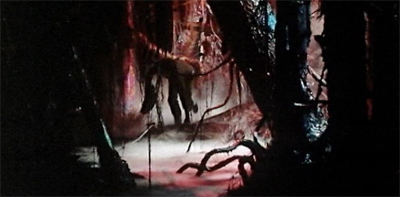
I feel a bit sorry for Planet of Evil. I mean, it sits near the start of one of the best seasons of Doctor Who, and yet it’s generally overlooked. It’s not that Planet of Evil is bad – The Android Invasion from the same season is actually bad, and is remembered as such. It’s more that Planet of Evil doesn’t really feel as exceptional as it could be. The Hinchcliffe and Holmes era of Doctor Who was cranking out classic adventures and iconic images to beat the band, but Planet of Evil just wound up feeling relatively generic. That’s not necessarily entirely fair. The opening two episodes of Planet of Evil are superb, but it is let down by a fairly average conclusion and undermined by a fairly weak supporting cast.

It is nowhere near the best story of the season, but it’s hardly a spectacular failure. there are times in the history of Doctor Who where Planet of Evil would be a welcome relief. However, it suffers from being a reasonably mediocre adventure in a fantastic season.

In the jungle, the peaceful jungle...

In the jungle, the peaceful jungle…

Continue reading

Doctor Who: Planet of the Spiders (Review)

To celebrate the fiftieth anniversary of the longest-running science-fiction show in the world, I’ll be taking weekly looks at some of my own personal favourite stories and arcs, from the old and new series, with a view to encapsulating the sublime, the clever and the fiendishly odd of the BBC’s Doctor Who.

Planet of the Spiders originally aired in 1974.

Oh dear, this is getting monotonous.

– the Doctor sums it up

Jon Pertwee’s final season is a real shame. The actor was, at the time, the actor who had served the longest period of time in the lead role. Starring as the Doctor for five years, and appearing as the face of the show during an era of renewal and reinvention, the actor deserved a much strong swansong. The year had started relatively strong with The Time Warrior, which I would rank among the best stories of the Pertwee era. However, every story after that just felt like it was treading water, revisiting old triumphs while biding time until the finalé. We had a Dalek episode in Death to the Daleks. We had a Malcolm Hulke lizard story with Invasion of the Dinosaurs. We had an off-world social commentary story in The Monster of Peladon. All felt like the cast and crew were just worn out, just going through the motions.

Sadly, Planet of the Spiders continues this trend, rather than bucking it.

Kiss of the spider-queen...

Kiss of the spider-queen…

Continue reading

Doctor Who: The Monster of Peladon (Review)

To celebrate the fiftieth anniversary of the longest-running science-fiction show in the world, I’ll be taking weekly looks at some of my own personal favourite stories and arcs, from the old and new series, with a view to encapsulating the sublime, the clever and the fiendishly odd of the BBC’s Doctor Who.

The Monster of Peladon originally aired in 1974.

Oh, have a heart, Sarah. I’ve been meaning to pay a return visit to Peladon for ages.

I can’t think why.

– the Doctor and Sarah Jane

What made The Curse of Peladon so fantastic was the fact that it felt so unique and different, as compared to all the Third Doctor adventures that had appeared before. Sure, the Doctor had travelled in time and space in Colony in Space, but The Curse of Peladon was really the first time that the colour television series had indulged in designing a truly alien world populated with truly alien creatures. Since the series had begun transmission in colour with Spearhead from Space, there had been nothing quite like it, and that was what made The Curse of Peladon so refreshing.

As such, the idea of doing The Monster of Peladon seems a bit questionable, especially when it’s going to feature the same world, the same aliens and be two episodes longer than the original adventure.

Not an underrated gem, I'm afraid...

Not an underrated gem, I’m afraid…

Continue reading

Doctor Who: Death to the Daleks (Review)

To celebrate the fiftieth anniversary of the longest-running science-fiction show in the world, I’ll be taking weekly looks at some of my own personal favourite stories and arcs, from the old and new series, with a view to encapsulating the sublime, the clever and the fiendishly odd of the BBC’s Doctor Who.

Death to the Daleks originally aired in 1974.

Keep away! Keep away!

– the Daleks have an understandable reaction to appearing in another Terry Nation script

I’ve remarked a bit that Pertwee’s final year feels a little like a victory lap, a clear attempt to revisit familiar, sometimes to provide a sense of closer. For example, Invasion of the Dinosaurs feels like the last true U.N.I.T. story, with betrayal and disillusionment closing that narrative strand. Similarly, Planet of the Spiders closes out the recurring New Age Buddhist iconography that the Barry Letts has been injecting into the show. However, some of these decisions to return to familiar concepts feel a little superfluous. Did we need an extended sequel to Curse of Peladon, for example?

And did we really need another throwback Terry Nation Dalek story, only a year after the last throwback Terry Nation Dalek story?

The clue is in the title...

The clue is in the title…

Continue reading

Doctor Who: Invasion of the Dinosaurs (Review)

To celebrate the fiftieth anniversary of the longest-running science-fiction show in the world, I’ll be taking weekly looks at some of my own personal favourite stories and arcs, from the old and new series, with a view to encapsulating the sublime, the clever and the fiendishly odd of the BBC’s Doctor Who.

Invasion of the Dinosaurs originally aired in 1974.

How are you feeling now?

Hungry, tired and I’ve got a headache.

– Mark asks Sarah Jane how her viewing went. I can empathise.

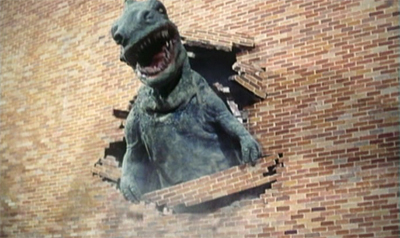
Ah, ambition. It’s hard to fault it… although there is a point where you simply have to. Invasion of the Dinosaurs crosses that line in the first episode. I know that Doctor Who is a BBC television serial. I understand that the classic series hardly had a huge amount of money to hand when it needed special effects. I am well aware that the special effects for the following season’s The Ark in Space amount to some bubblewrap and green paint. There is an art to watching many of these classic stories, and that art involves being wilfully blind to the fact that the special effects aren’t up to scratch. Beyond that, it’s arbitrary. There’ll always be one silly special effect that undermines an otherwise impressive episode – which special effect and which episode will vary from person to person.

However, Invasion of the Dinosaurs makes the special effects the whole point of the exercise. The title tells you that you should be watching the dinosaurs. Malcolm Hulke was given the brief to write a story about dinosaurs in contemporary London. There might be a plot underneath it all, but the serial expects that you are here for the dinosaurs. And, if you are…

I’m sorry. I’m so sorry.

A smashing time...

A smashing time…

Continue reading