• Following Us

  • Categories

  • Check out the Archives


  • Awards & Nominations

Star Trek: Voyager – Scorpion, Part I (Review)

In some ways, Scorpion, Part I is the perfect cap to the third season of Star Trek: Voyager.

The third season has largely seen the show retreating from ideas and concepts that would render it unique in the larger Star Trek canon. Although the first two seasons were hardly radical in terms of storytelling style or substance, Michael Piller did make a conscious effort to build off some of the premises unique to this show. The Kazon might have been a terrible idea in both concept and execution, but they were at least something new. While the second season botched its attempts at serialisation, at least it made the effort.

This is perhaps a metaphor for what Voyager is going to do to the Borg...

This is perhaps a metaphor for what Voyager is going to do to the Borg…

In the third season, the production team seem to have settled upon the idea of producing generic Star Trek, rather than telling stories unique to Voyager. This is something of a mixed blessing. While the third season features a host of forgettable episodes like Warlord and Alter Ego, it features few episodes as soul-destroying as Alliances or Investigations. More than that, episodes like Remember or Distant Origin demonstrate the appeal of producing generic Star Trek stories, ranking among the best episodes that the show has produced to date.

More than that, the production team have consciously pushed the show much closer to the model of Star Trek: The Next Generation. This is most obvious in the handling of Q as a character. While Death Wish found something novel and interesting to do with the character after All Good Things…, The Q and the Grey returns the character to his default settings for a cringe-worthy dress-up episode that owes far too much in concept and execution to Q-Pid. There are plenty of other examples.

This might also be a potent metaphor for what Voyager is about to do to the Borg...

This might also be a potent metaphor for what Voyager is about to do to the Borg…

However, Voyager‘s most overt embrace of the legacy of The Next Generation came with the introduction of the Borg. The Borg are in many ways the most iconic creation of the Berman era, perhaps the only new alien species liable to recognised alongside the Klingons or the Romulans or the Vulcans. After all, the Borg were the antagonists of Star Trek: First Contact, the theatrical release intended to celebrate the thirtieth anniversary. Their aesthetic influence can even be felt on Star Trek Beyond, the theatrical release intended to celebrate the fiftieth anniversary.

The Borg made their first appearance at the end of Blood Fever, in a postscript scene that feels like almost like a post-credits tease that arrived ten years too early. The Borg also appeared in Unity, an episode which featured Chakotay encountering the survivors from a disconnected Borg ship desperately trying to reconnect their shared link. However, neither of these episodes featured the Borg Collective, the powerful and single-minded collective consciousness that drives the hive mind.

Building a bridge...

Building a bridge…

So it makes sense that the Borg Collective would appear in full force for Scorpion, Part I, the third season finale and cliffhanger bridging to the fourth season. Once again, this is a creative decision right out of the Next Generation playbook. The Next Generation really cemented its distinct cultural identity with the broadcast of The Best of Both Worlds, Part I at the end of its third season. Part of this was simply down to the fact that it had outpaced the original Star Trek, which only lasted three years. However, part of it was also that the cliffhanger was spectacular television.

Scorpion, Part I is not spectacular television. It is good television. It is a satisfying blockbuster epic, with a strong sense of momentum and some interesting ideas. However, it also smells a little bit of desperation. It feels like Voyager has completely abandoned its own sense of identity and followed the path of least resistance. Insert your own joke there.

Or, you know, don't. Whatever floats your boat.

Or, you know, don’t. Whatever floats your boat.

Continue reading

Non-Review Review: Assassin’s Creed

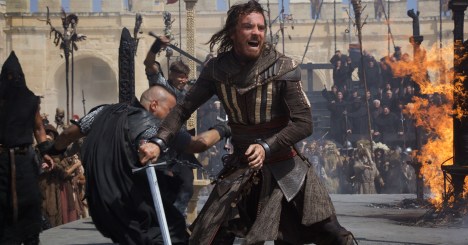
“What the f%$k is going on?” asks Michael Fassbender about halfway through the film.

It is not the first time that Cal Lynch has asked this question. Earlier on, the character wondered out loud “what’s happening?” after waking up following his state-sanctioned execution and being hooked up to a gigantic robotic claw that yanking him into the air mid-sentence. The audience is probably asking the same questions as Assassin’s Creed bounces across time and space with mountains of exposition (occasionally helpfully subtitled) about rival societies conspiring to find an artefact that can harness (and eliminate) mankind’s free will.

The Fass and the Furious.

The Fass and the Furious.

To be fair, incoherence is not the real problem with this disjointed video game adaptation. In fact, there is a certain weird charm to watching the amazing cast and the game director react to the crazed concepts that they have been dealt. For the first hour or so, the sheer weirdness of the film proves compelling, drawing in audience members willing to resist the tonal whiplash and laboured exposition as the film rockets along. What ultimately kills Assassin’s Creed is not its lack of sense, but the stubborn insistence that it must make sense.

Assassin’s Creed would be a stronger film were it willing to revel in its incoherence instead of trying to impose order upon it. The gonzo plotting and zany high concepts give the film a strange texture, but the problems do not really kick in until Assassin’s Creed starts awkwardly and painfully trying to construct a rational framework around this bizarre cavalcade. The result is to wed a visually hyper-kinetic and tonally unruly film to an incredibly tired generic plot that winds transforming the film into a plodding mess.

He's so hot right now.

He’s so hot right now.

Continue reading

Non-Review Review: Passengers

Passengers is a super creepy tale of male entitlement.

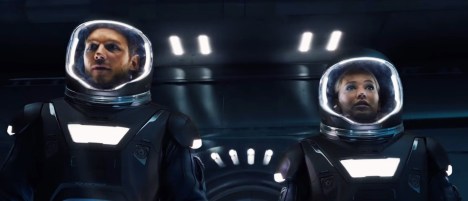
The movie has an intriguing science-fiction premise. On a sleeper ship intended to ferry passengers to the colony world of Homestead II, a freak accident awakens James Preston. The only problem is that Preston awoke far too early. Preston awoke approximately thirty years into a one-hundred-and-twenty-year voyage. The engineer is now destined to spend the rest of his life as the only waking inhabitant of a gigantic city ship, living and dying completely alone. It is a horrifying thought.

"We need a little space."

“We need a little space.”

There are suggestions of a powerful science-fiction epic to be found in the film. Jim finds his every physical need has been anticipated. He can live a life of material luxury. He will never want for food or space or activity. He effectively has a gigantic space craft all to himself. And therein lies the rub. Feeling almost like a sadistic episode of The Twilight Zone, Jim grapples with the question of what he will or will not do in order to end his loneliness. In his desperation, Jim makes a horrifying (if entirely understandable) decision.

The biggest problem with Passengers is that it strains too hard to make that decision palatable instead of terrifying. It is a super creepy tale of male entitlement that brushes aside any of this issues in favour of a much more conventional action romance.

Peace in a pod.

Peace in a pod.

Note: Very minor spoilers for Passengers follow. If you know the cast list, you can probably deduce where the movie is going from the opening ten minutes.

Continue reading

Non-Review Review: Why Him?

Why Him? is perhaps a little over-stretched.

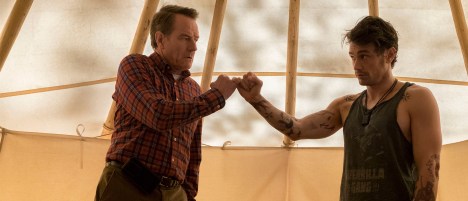
Why Him? is built around a very stock comedy template. A hard-working old-fashioned father finds himself at odds with his daughter’s new boyfriend, leading to a clash of competing masculine egos. The most innovative aspect of Why Him? is the decision to filter this standard comedy plot through two more filters. Why Him? is simultaneously a raunchy R-rated comedy full of profanity and bodily-function jokes. It is also framed as a Christmas comedy, as much as a comedy set in and around Los Angeles can seem like a Christmas comedy.

Guess who's coming to (Christmas) dinner.

Guess who’s coming to (Christmas) dinner.

These are hardly the boldest of innovations. Why Him? is a paper-thin comedy that is somehow stretched out to run over one hour and fifty minutes. There are any number of gags that work and a solid cast that never rises to exceptional, but the fact is that all of these elements overstay their welcome by at least a good twenty minutes. It is telling that one of the biggest issues with Why Him? is repetition, where the movie attempts to spin out slight jokes that prompt a knowing smile into running gags that exhaust all good will.

Ironically enough, given the title, Why Him? never makes a compelling case for its own scale and length.

Fists of fury.

Fists of fury.

Continue reading

Non-Review Review: Silence

Faith is a curious thing.

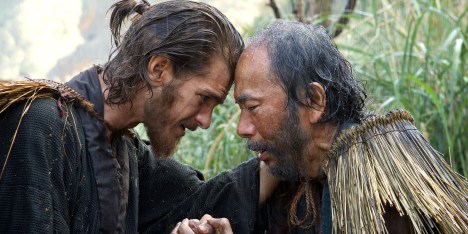
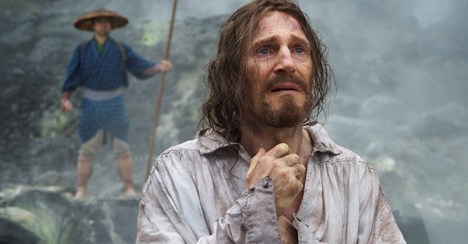
It is a fascinating concept, even (and perhaps especially) for those who lack it or wrestle with it. Pure and untempered faith in the face of a turbulent (and occasionally hostile) world is intriguing. It is something that many long to understand, even if it eludes them. Silence is very much a meditation (or an extended monologue) on the nature of religious belief playing out as a set of conversations and moral dilemmas. Characters wrestle with doubt and uncertainty, and particularly about what their faith means to them.

Easy pray.

Easy pray.

Silence is not a masterpiece or an epic. It is not one of Martin Scorsese’s major works, despite the energy and conviction with which he invests it. It is the weakest film from the director in a very long time, although that sounds very much like praising with faint criticism. Silence is a little too invested in its own dialogue with itself, as delivered through a series of monologues and occasionally through conversation between characters. Silence looks beautiful, but it often feels a little bit like a stunning visual companion to a book on tape.

And yet, in spite of all of this, there is an endearing earnestness to the film. Silence feels like the product of a long and considered reflection on the nature of faith and its place in the world. It never lacks for ambition or vision, playing as a two-and-a-half hour parable about suffering and transcendence. Silence is more interesting than successful, but that is largely because it is so very interesting.

Gotta have faith.

Gotta have faith.

Continue reading

Non-Review Review: Jackie

…  there was a spot, for one brief, shining moment, that was known as Camelot.

Towards the end of Jackie, the title character ruminates on her deceased husband. As a boy, he loved history. He especially loved the tales of Camelot. It does not matter that Camelot never existed, a figment of the collective imagination conjured into being through generations of myth and legend. People wanted to believe in Camelot, and so they invested it with a texture that seemed to manifest itself. Camelot was a story, but it was a story that was in many ways more appealing than the truth.

More like the Pastel House.

More like the Pastel House.

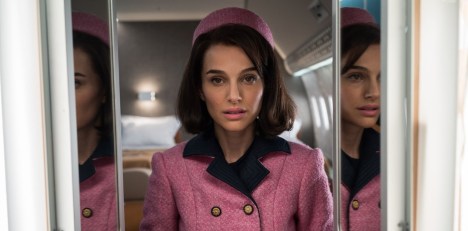
Jackie is a story about mythmaking. Arch and playful, self-aware and self-critical, Jackie tightens its focus on Jackie Onassis Kennedy to the days immediately following the death of her beloved husband. Using the iconic Time magazine interview as a framing device, Jackie follows its protagonist as she sets about building a legacy and a legend around John F. Kennedy. The lines between history and mythology blur, Jackie cleverly contrasting the title character’s restoration of the White House with her construction of her husband’s legend.

There are points at which Jackie seems a little too manner and a little too stage-managed, a little too perfect and a little too rehearsed. There are points at which Natalie Portman slips from being Jackie Onassis Kennedy playing the widow to a beloved legend to being Natalie Portman playing Jackie Onassis Kennedy playing the widow to a beloved legend. This sort of sly recursion is very much in fitting with the tone of the film, but it does occasionally feel a little too cold and a little too distant.

Mirrored in controversy.

Mirrored in controversy.

Continue reading

Non-Review Review: Office Christmas Party

Office Christmas Party is a mess. Far from a carefully orchestrated festive frivolity, it feels more like it was quickly cobbled together from whatever happened to be lying around the staff canteen.

Office Christmas Party plays like a seasonal-themed pot luck; a combination of weird flavours that might work well in other contexts or on their own, only to clash awkwardly when thrown together. There is a mix-tape quality to the film, as is probably to be expected in a movie with a cast this expansive. However, Office Christmas Party never finds a centre around which it might arrange this particular tale. Instead, it feels like a half-hearted collection of mad-libs that have been shamelessly borrowed from other and better films.

No escape Claus...

No escape Claus…

Continue reading

Non-Review Review: Sully – Miracle on the Hudson

Sully: Miracle on the Hudson has a certain Frank Capra quality to it.

To be fair, a lot of that comes from the casting of Tom Hanks in the title role. Hanks radiates a certain ineffable integrity, a “Hanksian Decency” that informs his performances in films as diverse as Bridge of Spies and Inferno. It is tempting to think of him as “America’s Dad”, particularly given the grey hair and the moustache that he donned for the title role here. However, it is also tempting to think of him as a latter-day Jimmy Stewart, the embodiment of a certain type of fundamental American decency that lends itself to this sort of narrative.

Hanks for the memories.

Hanks for the memories.

Similarly, director Clint Eastwood has a similar philosophy. Eastwood’s films tend to be organised around strong moral principles. Often those principles are articulated in terms of personal responsibility, particularly the responsibility that individuals have for others whether in a professional capacity (J. Edgar) or a personal capacity (Million Dollar Baby) or simply by virtue of being there (Gran Torino). Eastwood’s recurring fascination with individual responsibility makes him a quintessentially American director.

This combination is ideally suited to Sully, which is constructed as something akin to a modern-day American fairytale.

"Mr. Sullenberger goes to the NTSB Debriefing."

“Mr. Sullenberger goes to the NTSB Debriefing.”

Continue reading

Non-Review Review: Moana

Moana is a fantastic demonstration of the timeless appeal of the long-standing Disney formula.

At first glance, Moana seems very much like an archetypal animated Disney film. It is the story of a young woman who is forced to adventure outside of her comfort zone, surrounded by adorable animal sidekicks and trickster mentors on an archetypal hero’s journey that is set to a toe-tapping soundtrack. It is a template that has served Disney very well, producing any number of beloved family classics over the year. Moana is very much a celebration of that template, and an example of why it works so well.

Islands in the Pacific... That is what we are...

Islands in the Pacific…
That is what we are…

At the same time, there is a faint layer of self-awareness to the script that serves it well. Moana might appear to be an archetypal Disney fairytale story, but that is largely down to its central character. Moana is a celebration of its title character, to the point that it frequently seems like she is propping up the narrative. This is not to suggest that Moana is a deconstruction or subversion in anyway. Instead, the movie almost as a distillation of the appeal of the classic “princess” narrative. It is a story that trusts its lead character to hold a disorganised story together.

Surrounded by dysfunction and chaos, Moana is an affectionate tribute to these sorts of stories.

Good (demi-)god, man!

Good (demi-)god, man!

Continue reading

Non-Review Review: Allied

There is something of the uncanny about Allied, a pervading sense of “not-quite-right-ness” that pervades the film.

In some ways, that vague feeling of uncanniness recalls director Robert Zemeckis’ work in stop-motion computer animation in the earlier years of the century. There was something deeply uncomfortable about the director’s work on films like The Polar Express or A Christmas Carol, a sense of strange lifelessness beneath meticulously and painstakingly crafted exteriors. Zemickis’ computer-generated experiments often felt like they were trying too hard to mimic something organic and spontaneous.

Casa closed.

Marryin’ Marion

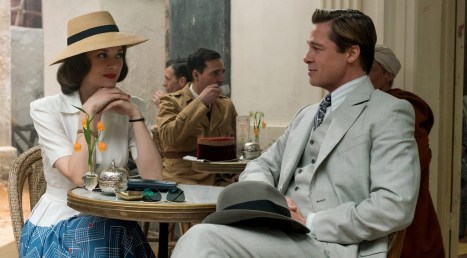
There is a similar sentiment to Allied, which plays very much as a love letter to classic Hollywood cinema. Indeed, the opening forty minutes of the film are dedicated to a very stylish couple operating out of “French Morocco.” Inevitably, their clandestine dealings bring them to a version of Casablanca that seems rooted more in Hollywood history than in reality. Unfolding against the backdrop of the Second World War, dealing with themes of love and betrayal, and starring a bona fides movies star, Allied feels very much like an approximation of a classic movie.

However, it never quite gets there.

Marryin' Marion.

Casa closed.

Continue reading