• Following Us

  • Categories

  • Check out the Archives


  • Awards & Nominations

Non-Review Review: Bad Times at the El Royale

Bad Times at the El Royale is over-stuffed, over-long, and unfocused. It is a muddle of big ideas thrown against one another, the sparks flying in whatever direction they will.

There is a sense in which writer and director Drew Goddard wants Bad Times at the El Royale to be about everything, to find some space within the movie for just about every possible allegory. It is difficult to explain what Bad Times at the El Royale is actually about, for reasons that extend beyond contemporary spoilerphobia. This is a movie that feels at once like it has important things to say, and a very abstract way of trying to say them.
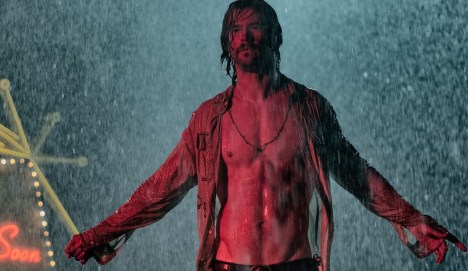
Red guy at night, Hemsworth fans’ delight.

There is also something brilliant in all of this, in the way that Drew Goddard swings wildly at such a broad array of big ideas in such a surreal context. Bad Times at the El Royale is packed to the brim with big ideas, offering a story that could easily be read as scathing political commentary, powerful religious allegory, or biting social satire. It is an unashamedly odd film that is wrestling with a variety of interesting themes. If it can’t pick just a handful to focus upon, it is because there are so many rich veins to tap.

Bad Times at the El Royale is a bold and infuriating piece of pop art. It’s also unashamedly ambitious and enthusiastically esoteric. It’s a movie that certainly won’t be for everybody, but it is broadcasting very strongly on its own distinctive wavelength.

Flower power.

Continue reading

Non-Review Review: 22 July

22 July is both a very well made and a spectacularly ill-judged film.

Written and directed by Paul Greengrass, 22 July focuses on the infamous attacks conducted by Anders Behring Breivik in Norway in 2011. The attacks were brutal and horrific, and sent shockwaves across both Europe and North America. To a certain extent, Breivik’s attacks prefigured a wave of similar violence in the years that followed, violence driven by nativism and xenophobia, toxic forms of ethno-nationalism that crept in to the social and politic spheres. There is no denying that these attacks (and their aftermath) deserve attention and discussion. They are a formative moment in modern western politics.

However, there is also a sense that Paul Greengrass might not be the best director to tell this sort of story. There are several reasons for this, but most them come down to Greengrass’ stylistic sensibilities, his strengths and weaknesses as a filmmaker. It is incredibly obvious from the outset what kind of film Greengrass is trying to make. Greengrass is trying to capture the horror and brutality of Breivik’s actions, and to present the ordinary everyday heroism of those who survived and endured his assault. However, Greengrass’ directorial sensibilities conspire to undercut these aspects of the film.

Greengrass may be a very naturalistic film director, who at times seems almost like a documentarian in his storytelling, but he can direct a visceral and effective action sequence. This means that the part of 22 July that really feels alive and propulsive is the mass shooting. More than that, Greengrass’ no-frills style means that most of the characters in 22 July never feel particularly well-developed or well-formed, never having a life outside of the frame or what the movie expects of them. As a result, the only character who does stand out is Brievik himself.

The result is a film about mass murder and ethno-nationalism that structurally resembles more conventional issue-driven movies, but without any of the strong emotional cues or distinctive performances that serve to place the moral weight within those narratives. Instead, 22 July often feels rather blunt and matter-of-fact, a collection of events and occurrences without any actual living characters to clog up the mechanics. The only things that stand out within 22 July are those elements that are (by their nature) heightened and extreme.

The result is a movie about a horrific terrorist attack that only seems to come alive in its depiction of the attack, and an ensemble drama about the cultural response to trauma where the only compelling character is a white supremacist terrorist.

Continue reading

Non-Review Review: Venom

Transformative trauma is a cornerstone of the superhero genre.

Sometimes that trauma is emotional; the deaths of Thomas and Martha Wayne, the loss of Uncle Ben, the explosion of Krypton. Sometimes that trauma is physical; having piping hot metal coated over your bones as your memory is wiped, physically mutating into something unrecognisable as human, having your entire body turn to trauma. To misquote Stan Lee, “with great power comes great responsibility.” More often than not, it also comes with great suffering.

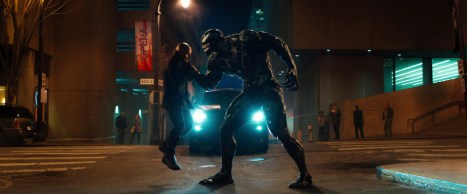
Back in black.

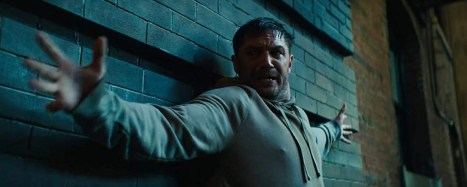
In its best moments, Venom seems to realise this. At the core of Venom is the traumatised character of Eddie Brock, who has watched his entire life fall apart and who suddenly finds himself sharing his body with a murderous alien entity with monstrous appetites. Brock is played by Tom Hardy, one of those rare actors with both immense physical presence and incredibly vulnerability. Unshaved and scruffy looking, with faded tattoos and wearing clothes that look like they haven’t been washed, Eddie looks like he’s been through hell even before his transformative experience.

There are moments when Venom almost plays as a weird psychological thriller about a character experiencing a real-time break from reality, a reporter who is losing his fragile grip on reality after suffering one too many personal and professional setbacks. As the situation gets worse, Eddie starts hearing voices in his head and losing control of his body. He finds himself in a situation where terrible things happen, but he is able to disassociate himself from the brutality and violence. Venom never quite commits to this idea, but it simmers through the story.

Wall’s well that ends well.

The first two acts of Venom are ropey and uneven, suffering from a fuzzy lack of detail and no strong focus on any of the film’s central ideas. Nevertheless, the film survives largely on the strength of Tom Hardy’s performance and the weirdness of the concept. However, things fall to pieces in the third act. Part of this is because Venom feels the need to transform into a regular superhero movie as it reaches its conclusion. Part of this is because Ruben Fleischer cannot direct action. Part of this is because of collision of clumsy exposition and muddled computer-generated imagery.

Venom loses what little control it has of itself as it reaches its climax.

MRI are we here?

Continue reading

Non-Review Review: Apostle

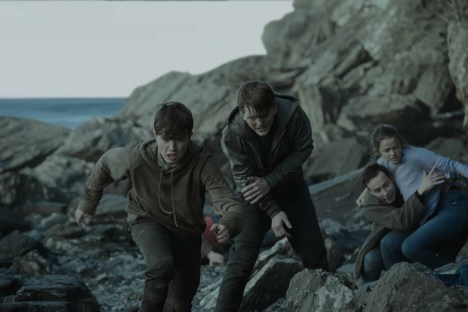
The paraphrase Ernest Hemmingway, Apostle happens at first very slowly and then all at once.

Written, directed and editted by Gareth Evans, Apostle wears its influences on its sleeve. The premise of the film invites an easy observation along the lines of The Raid meets The Wicker Man.” This is massively reductive, of course. It also misunderstands the film. If anything, the more accurate (but equally reductive) description of Apostle might be “The Raid by way of The Wicker Man.” Evans period piece exploration of religion and devotion is very much a game of two halves. Perhaps even that might be more accurately formulated as two-thirds-to-one-third.

The only boy who could ever reach me…

Apostle suffers somewhat in its pacing. The first two acts of the film are given over to a sense of mounting dread and anxiety, to the slow and gradual reveal of what precise brand of horror is unfolding on this mysterious island maintained by this mysterious cult. Evans is a capable director who skillfully creates a sense of the uncomfortable and the uncanny, but the issue with Apostle is that any cinematically literate audience has a very good idea where these two acts of mounting dread are inevitably leading.

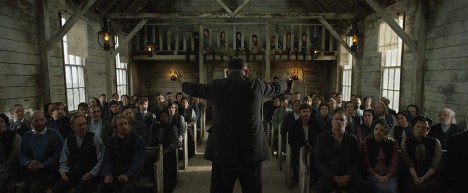
However, Apostle really comes into its own when it finally plays the hand that it has been carefully and slowly hinting towards in its first ninety minutes.

Burning inside.

Continue reading

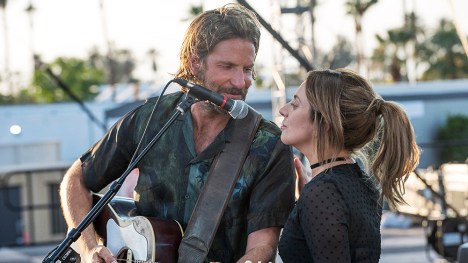
Non-Review Review: A Star is Born (2018)

At one point in A Star is Born, Bobby Maine outlines his brother’s approach to music for the benefit of Ally.

According to Bobby, Jackson believes that all music can be broken down to “twelve notes between an octave.” By Jackson Maine’s logic, Bobby explains all musical expression is “those same twelve notes, played over and over again. All any artist can offer the world is how they see those twelve notes.” It is a strange moment, one that comes very close to self-awareness from writer and director Bradley Cooper, suggesting something very close to a mission statement for his directorial debut.

Ain’t playin’.

A Star is Born is the fourth major American motion picture with that name and that premise. There are countless other stories built around the same basic concept, which has itself been translated into various settings and contexts across the globe. The story of A Star is Born is familiar. An older man discovers a talented young woman and elevates her to stardom, while his own grip on celebrity slips away between his fingers. It is an archetypal Hollywood story, and perhaps a defining American fairytale. All Cooper can do is tell that familiar story in his own way.

There are certainly moments when A Star is Born seems to take this idea to heart. In terms of basic trappings and mechanics, A Star is Born gestures towards modernity, understanding that it needs to update its core premise in the way that each of its three forerunners did. There are any number of details within A Star is Born that position the film within the modern cultural context. This is a twenty-first century take on a familiar story, and it looks distinct enough from the earlier three iterations.

Has a nice sing to it.

However, there’s a recurring anxiety within A Star is Born, a sense of trepidation. In terms of style and sensibility, Cooper’s adaptation hews closest to the country-and-western infused seventies remake with Barbara Streisand and Kris Kristofferson, which is a canny choice; it is probably the least seen and the least iconic iteration of the story, making it ripe for reinvention. However, there is also a strong sense that A Star is Born is reluctant to cross the four decades that have passed since that particular iteration of the familiar story.

The result is a film that feels at odds with itself. A Star is Born is inherently a metafictional text, suggesting a rebirth of Lady Gaga from a pop star to a credible leading actor in a prestige piece. Gaga acquits herself well in the role, but A Star is Born feels uncertain and untrusting of her. Repeatedly, A Star is Born seems to refuse to let Gaga be Gaga, instead adhering to a very fixed and very nostalgic seventies ideal of “authenticity.” This is a film that ends with the assertion that a modern pop star can only find herself when using her voice to deliver an ageing rocker’s words.

Doesn’t quite hit all the right notes.

Continue reading

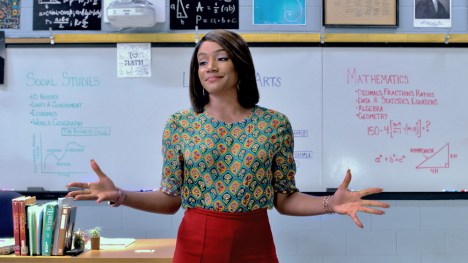
Non-Review Review: Night School

Night School works better than it probably should, while never quite escaping its fundamental flaws.

Night School suffers from a lot of the structural issues that affect modern studio comedies. Most obviously, the film feels over-extended. It’s not just the run time, which clocks in at a muscular one-hundred-and-ten minutes, which is asking a lot for a broad comedy with a very simple premise. It is the individual jokes within the comedy, which are often stretched to breaking point and beyond. Perhaps the most egregious example is an early gag about finding hair in food at a restaurant, which goes on for what feels like five minutes built around the same standard social set-up.

To teach’s own.

There are very few major surprises in Night School. There are a few small and smart ideas buried in the mix, but they often feel crowded out by the broad jokes and the familiar clichés. There’s a recurring sense that Night School doesn’t always play to its strengths, at least below the headline. At the same time, the film understands that it lives or dies by the chemistry between its two leads, offering a conventional persona-driven conflict of manners that places Kevin Hart and Tiffany Haddish in opposition to one another before inevitably moving them into alignment.

Night School is diverting, if unsatisfying. It manages a passing grade, if little more.

Hart to Hart.

Continue reading

Non-Review Review: Rosie

Rosie is a a very timely piece of Irish cinema, but one that never loses sight of the humanity of this national crisis.

From beginning to end, Rosie is infused with an endearing humanity. Writer Roddy Doyle and director Paddy Breathnach keep the story tightly focused on one particular family caught in the midst of the homeless crisis. Breathnach often literalises this, with a handheld camera that keeps the film literally centred on the face of the eponymous protagonist. Even in wide open spaces, even in public, even when she’s the only adult crossing a green or a schoolyard, Rosie is so tightly focused that it feels claustrophic and almost suffocating.

This is the point, of course. Rosie is a very visceral film, and with good reason. Doyle and Breathnach work hard to ensure that the audience feels ever minor crisis, and that it understands precisely how precarious the situation facing this family happens to be. A delayed lunch break seems catastrophic, a child spending time with a friend seems like a disaster. Time is fleeting, and always slipping through the fingers of its protagonist. When life seems to unfold moment to moment, there is no opportunity to catch her breath or to worry about the bigger picture.

Rosie is a fascinating piece of Irish cinema, both timely and intimate, both reflecting contemporary culture and telling its own story within that framework. It’s an impressive piece of work.

Continue reading

Non-Review Review: The Land of Steady Habits

“You’re mean,” observes a potential romantic partner of Anders Hill, around the halfway point of The Land of Steady Habits.

It would be reductive to suggest that this is the most bracing or cutting piece of character work in The Land of Steady Habits, but it is not entirely unfair. The Land of Steady Habits is very much a story of upper-class social anxiety, of wealthy characters without any real problems in their lives who instead fixate on the kinds of problems that less well-off people probably wish that they had. Anders Hill is a prime example. A solemn and depressive figure who has become alienated from his previously idyllic existence, Anders is a character who is entirely responsible for his current predicament.

Going steady.

In some ways, this is very typical of the work of writer and director Nicole Holofcener, who has adapted The Land of Steady Habits from a novel by Ted Thompson. The film’s status as an adaptation accounts for some of the details that distinguish the film from Holofcener’s other work, most notably the focus on a male (rather than a female) protagonist, but The Land of Steady Habits is very much of a piece with Holofcener’s other work. It is a wry and acerbic study of people who have everything except what they actually need, and who stumble around causing emotional carnage while looking for that something.

With that in mind, Holofcener’s films live and die based on the charm of the leading characters – on how much the audience is drawn into the hollow void at the centre of their existence. By that measure, The Land of Steady Habits is a mixed bag at best. Ben Mendelsohn is great as the pathetic and contemptible Anders Hill, an impotent affluent man-child who seems capable of mustering charm for only a few scarce minutes at a time. However, Anders himself is not anybody that it seems particularly interesting or exciting to spend ninety-eight minutes with.

Sofa, so good.

Continue reading

Non-Review Review: A Simple Favour

At one point around the two-thirds mark of the film, an insurance claims investigator offers a recap of all the twists and turns of A Simple Favour to that point. “It’s bananas!” she observes.

She’s not wrong. A Simple Favour is modern film noir with a pitch black sense of humour, populated with two femme fatales and driven with an infectious enthusiasm. It is not a parody or a deconstruction of the genre, but instead a demented celebration. This is a film that revels in the tropes and the conventions of these sorts of layoured labyrinthine narratives, processing all the sharp turns and wacky reveals with an eager (and effectively disconcerting) smile on its face.

Picture perfect.

A Simple Favour often feels like an extended homage to the work of Gillian Flynn, filtered through the lens of Paul Feig. This combination works very well, going down like the kind of martini served in a freezing glass with ice-cold gin. Both Flynn and Feig share an acerbic sense of humour, and tendency to pick at the gender roles usually assigned by society. A Simple Favour might share some of its DNA with Gone Girl or Sharp Objects, but it also feels like the vicious and biting younger sibling of Bridesmaids or Spy.

A Simple Favour does suffer a little bit from the comparisons to Flynn’s work, and occasionally veers slightly too far into broad comedy, but it is powered by a sophisticated charm threaded with a pitch black sense of humour.

Red flags.

Continue reading

Non-Review Review: The Predator

The Predator adopts the as-ambitious-as-it-is-counter-productive of smirkingly mocking big budget franchise films while also actually being a big budget franchise film.

Shane Black’s sequel to the beloved eighties actioner is jarring, caught between two masters. On the one hand, Black writes the characters in his patented self-ware style, with banter and wry liners to beat the band. However, these characters are then dropped right into the middle of a fairly brain-dead paint-by-numbers action film that is clearly structured to feel like a contemporary franchise foundation stone. There is a constant push-and-pull between these two extremes, which is disorienting and distracting.

The Predator took the reviews rather well.

The Predator never seems sure whether it is a good old-fashioned fun-dumb blockbuster mocking the pretensions of modern franchise films or alternatively a smart self-aware action comedy picking at the tropes of fun dumb action films. It’s never entirely clear whether the issues with The Predator are playful self-parody or just terrible plotting; whether Shane Black is not taking any of this seriously or whether he is taking all of it much too seriously.

Whenever The Predator seems to be working, it veers too sharply one way or the other and the audience gets whiplash.

Pred-locks.

Continue reading