• Following Us

  • Categories

  • Check out the Archives


  • Awards & Nominations

Millennium – 19:19 (Review)

This May and June, we’re taking a trip back in time to review the fifth season of The X-Files and the second season of Millennium.

One of the interesting aspects of the second season of Millennium is just how carefully structured all the chaos actually is.

There is an endearing and infectious randomness to the plotting of episodes like Sense and Antisense or A Single Blade of Grass, with individual episodes often struggling to fit together on an act-by-act basis. However, things become a lot clearer from a distance. Pulling back, it appears quite clear that there is a method to the madness. The episodes in the season – particularly those positioned towards the beginning and the end – each serve a clear purpose in the larger arc of the second season.
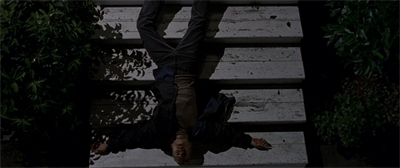
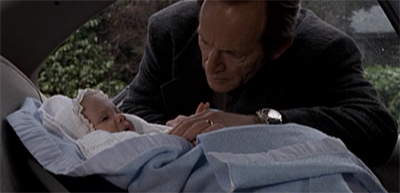
Will he die for our sins?

Will he die for our sins?

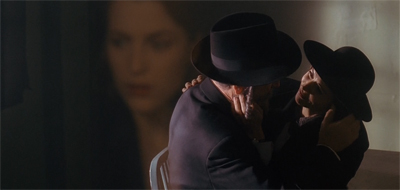
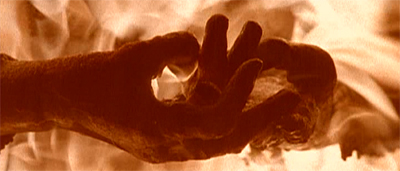
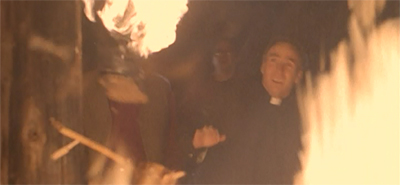
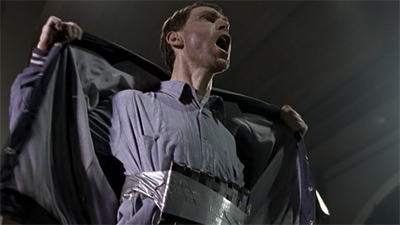
The first third of the season is very much about establishing concepts that will be of use later in the story. The Beginning and the End removes Frank from the yellow house and starts him on a new journey. Beware of the Dog introduces the Old Man and teases the mythology of the Millennium Group. Monster introduces Lara Means. The Curse of Frank Black gives Frank his long dark midnight of the soul. 19:19 and The Hand of St. Sebastian were the last two episodes in this opening act, and they exist to affirm the show’s cosmology.

Both 19:19 and The Hand of St. Sebastian firmly establish the show’s apocalyptic worldview in a Christian theological framework. 19:19 does this by exploring biblical prophecy and eschatology, while The Hand of St. Sebastian reveals the Millennium Group to be a secret Christian sect who have existed for over a thousand years. Although the show has always taken a lot of its imagery and iconography from Christianity, 19:19 engages explicitly with the idea of biblical prophecy and millennialism.
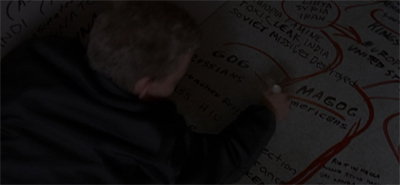
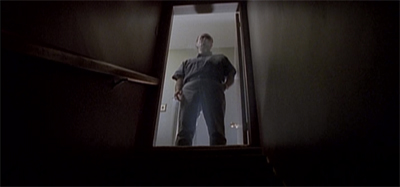
All part of the plan...

All part of the plan…

Continue reading

The X-Files – Gethsemane (Review)

This February and March, we’re taking a trip back in time to review the fourth season of The X-Files and the first season of Millennium.

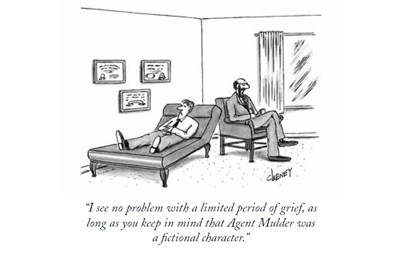
Agent Mulder died late last night from an apparent self-inflicted gunshot wound to the head.

– Agent Dana Scully, 22nd October 1997

xfiles-gethsemane27 Continue reading

Millennium – Sacrament (Review)

This February and March, we’re taking a trip back in time to review the fourth season of The X-Files and the first season of Millennium.

If Force Majeure and The Thin White Line seem to call forwards towards the weird and eccentric second season, Sacrament is a bit more modest. In many ways, Sacrament seems to foreshadow the last stretch of episodes in the first season. The forces of evil seem to encircle the Black family, creeping closer and closer to the big yellow house and everything it represents. For the first time, Sacrament explicitly puts Frank’s family at the heart of a case; this time focusing on the kidnapping of his sister-in-law from her child’s christening.

In many respects, this points towards the direction the show will take in its final stretch of episodes. Lamentation and Powers, Principalities, Thrones and Dominions will see the forces of evil explicitly violate the Black residence, insidiously eroding the idealised life that Frank has tried to build for his family in their new Seattle home. The cliffhanger at the end of Paper Dove pushes the concept to its logical conclusion, as a secret that Frank has tried to keep from his family finally comes home to roost.

Worst. Uncle. Ever.

Worst. Uncle. Ever.

As with WeedsSacrament demonstrates that writer Frank Spotnitz has an uncanny understanding of how Chris Carter built Millennium. It is an episode that is soaked through with the core themes of the series; it is a story about good and evil, and how evil taints everything that it touches. As with a lot of Millennium, Sacrament is not subtle; the moment that Tom Black is identified as the brother of our protagonist, it is inevitable that the forces of evil will come barrelling down upon him.

Nevertheless, Sacrament demonstrates a clear understanding of what it wants to be, and is a pretty effective snapshot of Millennium at this moment in time. The first season of Millennium is often overlooked and overshadowed amid the controversies surrounding the second or third seasons, but Sacrament stands as a great example of what the first season was trying to do.

Our father...

Our father…

Continue reading

The X-Files – Kaddish (Review)

This February and March, we’re taking a trip back in time to review the fourth season of The X-Files and the first season of Millennium.

Kaddish is the last solo script that Howard Gordon wrote for The X-Files.

The writer would remain part of the writing staff until the end of the fourth season, contributing to scripts like Unrequited or Zero Sum. However, Kaddish would be the last script credited to Howard Gordon alone. So Gordon does not quite get the clean farewell that Darin Morgan got with Jose Chung’s “From Outer Space” or that Glen Morgan and Howard Wong received with Never Again. Instead, Howard Gordon remains a pretty significant presence on the show even after writing his final solo script.

The word made flesh...

The word made flesh…

Nevertheless, Kaddish is packed with a lot of the images and themes associated with Gordon’s work. As with Fresh Bones or Teliko, it is a horror story set within a distinct ethnic community. As with Firewalker or Død Kälm or Grotesque, there is an element of body horror at play. As with Lazarus or Born Again, this is essentially a supernatural revenge story. Kaddish offers a distilled collection of the tropes and signifiers that Gordon helped to define for The X-Files, making it an appropriate final script for the writer.

It helps that Kaddish is a surprisingly sweet and thoughtful little horror story.

The outside looking in...

The outside looking in…

Continue reading

Millennium – Force Majeure (Review)

This February and March, we’re taking a trip back in time to review the fourth season of The X-Files and the first season of Millennium.

Papa?

It’s begun.

Fire and ice.

Fire and ice.

Continue reading

Millennium – Kingdom Come (Review)

This February and March, we’re taking a trip back in time to review the fourth season of The X-Files and the first season of Millennium.

Kingdom Come is a horrible misjudged episode of Millennium, and the show’s first truly spectacular misfire.

Kingdom Come was notably the first episode to air out of production order. It had been produced as the fourth episode following The Pilot, between Dead Letters and The Judge. However, the episode was broadcast as the sixth episode of the television season, after 5-2-2-6-6-6 and before Blood Relatives. The official reason given for this delay was the death of Cardinal Joseph Bernardin in mid-November 1996, following a long and public battle with cancer. It was suggested that an episode about a serial killer targeting religious figures would have been in poor taste at the time.

A light in the darkness...

A light in the darkness…

Still, whatever the official reason given, it cannot help but feel like the production staff were hoping to bury a stinker a little deeper into the season. Kingdom Come is an episode that does not work on any number of levels, offering a rather patronising and condescending view of religious faith as explained through stilted exposition and trite cliché. The show’s observations about faith and hope feel more like sentiments from Hallmark greeting cards than observations on the human condition.

The result is an episode that embodies the worst traits of Millennium, feeling just as crass and sensationalist as it does hollow and superficial.

The episode really bombed...

The episode really bombed…

Continue reading

The X-Files – The Field Where I Died (Review)

This February and March, we’re taking a trip back in time to review the fourth season of The X-Files and the first season of Millennium.

Morgan and Wong’s four scripts for the fourth season of The X-Files are utterly unlike any other stories in the show’s nine-season run. Experimental, bold, confrontational; these four stories stretch and pull at The X-Files, as if eager to see just how far the hit show will bend.

The Field Where I Died is probably the weakest of these four episodes, but it is also the most ambitious. It is a script with big ideas and a willingness to commit to those ideas. There is no modesty here, no hesitation. There is a sense that Morgan and Wong are committing wholeheartedly to their themes and their concepts. The Field Where I Died is an episode that rubs quite a lot of people the wrong way, for a number of different reasons; however, the episode never pulls its punches. It never holds back. It never tries to be anything that it is not.

Far afield...

Far afield…

There is a lot to admire here. The Field Where I Died is not an episode with a simply formulaic concept or a conventional structure. It looks and feels completely unlike any other episode of the show. Even when the show touched on similar themes in its final season, the result was radically different. Hellbound is a much more conventional episode than The Field Where I Died. More than Home or Musings of a Cigarette-Smoking Man or Never Again, this is an episode that really seems like an odd fit for The X-Files.

Then again, that may be the beautiful thing about The Field Where I Died, for all its many flaws. It is utterly unlike anything else on television in the nineties. The fact that it can produce an episode of television so unique and incomparable is ultimately what makes The X-Files feel like The X-Files. The fact that The Field Where I Died feels so unconventional and eccentric is precisely what makes it a worthy episode of The X-Files.

Another roaring success for Mulder...

Another roaring success for Mulder…

Continue reading

Star Trek – Return to Tomorrow (Review)

The first Star Trek pilot, The Cage, was produced in 1964. To celebrate its fiftieth anniversary, this December we are reviewing the second season of the original Star Trek show. You can check out our first season reviews here. Check back daily for the latest review.

Return to Tomorrow is similar to By Any Other Name in a number of ways.

Most superficially, it’s an episode about aliens in human bodies, who find themselves learning (or, in this case, remembering) how to appreciate all that mankind has to offer. The plot similarity is rather broad, but it seems strange that By Any Other Name and Return to Tomorrow would be produced right after one another, and that no significant effort would be made to space them apart on initial broadcast. (Both aired in February of 1968.)

Leonard Nimoy only gets to smile once a year, so the show makes the most of it...

Leonard Nimoy only gets to smile once a year, so the show makes the most of it…

However, there are more fundamental and underlying similarities between Return to Tomorrow and By Any Other Name. Both are episodes that are very much engaged with the underlying philosophy of the franchise, particularly concerning humanity’s place in the universe. Indeed, there’s an argument to be made that Return to Tomorrow and By Any Other Name both work much better as statements of philosophical intent than they do as stories in their own right.

Co-written by Gene Roddenberry, Return to Tomorrow is a rather generic piece of television, but one that feels like a considered statement of the franchise’s central themes.

"Things are going to be a little different around here..."

“Things are going to be a little different around here…”

Continue reading

Star Trek – Bread and Circuses (Review)

The first Star Trek pilot, The Cage, was produced in 1964. To celebrate its fiftieth anniversary, this December we are reviewing the second season of the original Star Trek show. You can check out our first season reviews here. Check back daily for the latest review.

Bread and Circuses is not subtle. Then again, that is the point.

There’s a lot of interesting stuff happening in Bread and Circuses, the fourteenth episode produced for the second season, but the last to air. There’s the idea of a world dominated by “a twentieth century Rome”, a rogue captain, a Prime Directive dilemma and a scathing indictment of modern television. Not only is it one of the last episodes with a “produced by Gene L. Coon” credit, it is also an episode co-written by Roddenberry and Coon. It is also the episode of Star Trek that endorses Christianity most explicitly and heavily.

"Wait, we're only getting it in black and white?"

“Wait, we’re only getting it in black and white?”

Bread and Circuses is a bold and audacious piece of television, full of venom and righteous anger, rich in satire and cynicism. It’s a plot so ridiculously over-stuffed with good ideas that viewers are liable to forgive the show’s somewhat cop-out ending where Kirk and his away team beam back to the Enterprise and continue on their merry way as though little has actually happened. Bread and Circuses feels like it uses every minute of its fifty-minute runtime wisely, balancing character with world-building.

It is probably a little bit too messy and disjointed to be labelled a dyed-in-the-wool classic, particularly when compared to the shows produced around it. Nevertheless, it is a decidedly ambitious piece of work, and one that demonstrates what Star Trek could do when it sets its mind to something.

When in Rome...

When in Rome…

Continue reading

Star Trek – The Apple (Review)

The first Star Trek pilot, The Cage, was produced in 1964. To celebrate its fiftieth anniversary, this December we are reviewing the second season of the original Star Trek show. You can check out our first season reviews here. Check back daily for the latest review.

It’s amazing how iconic Star Trek could be, even when it was terrible. There’s something quite ironic about how much of the franchise’s truly memorable iconography is rooted in some of the show’s weakest episodes. The Apple is one of the most iconic and memorable Star Trek episodes, featuring a giant evil dragon head sculpture, David Soul in orange body paint, lots of speechifying from Kirk, and a strong atheistic message with Kirk casting himself as Satan in the Garden of Eden.

It is also just terrible.

"VAAAAAAAL!!!"

“VAAAAAAAL!!!”

Continue reading