• Following Us

  • Categories

  • Check out the Archives


  • Awards & Nominations

Star Trek: Deep Space Nine – Covenant (Review)

Covenant is a flawed and fascinating episode.

In its own way, although obviously a much less extreme manner than The Siege of AR-558, this is an episode that could only have been produced on Star Trek: Deep Space Nine. This is not simply down to matters of continuity, and how the episode ties into the mythology of the series. More specifically, it is an exploration of religious themes and ideas that is only really possible within the framework of this particular Star Trek spin-off. It is difficult to imagine Star Trek: The Next Generation or Star Trek: Voyager tackling the idea of religious cults so effectively.
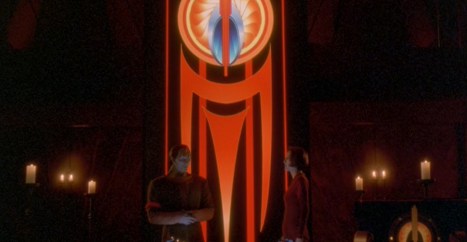
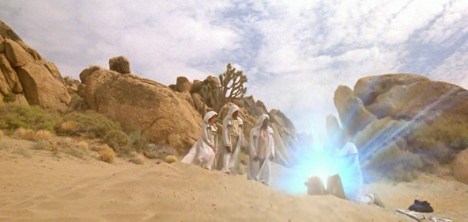
Altaring his plans.

Part of this is down to a lingering suspicion that the other Star Trek shows subtly (or not so subtly) consider all religions to be cults. After all, shows like The Return of the Archons, The Apple, For the World is Hollow and I Have Touched the SkyJustice, Who Watches the Watchers? and Devil’s Due left little room for ambiguity. The other Star Trek series seem downright hostile to the idea of religious belief, even if episodes like The Cloud and Sacred Ground might suggest a more open-minded approach to spirituality.

Deep Space Nine has generally been more willing to engage with the idea of religious belief as something that is worthy of exploration and consideration, something that is for an individual to determine on their own terms. Some characters on Deep Space Nine are explicitly atheist, like Jadzia Dax or Odo. Some characters hold strong religious beliefs, like Kira or Nog. Some characters believe in spiritual traditions without ever seeming particularly devote, like Worf. Some characters even evolve over the course of the series, like Sisko.

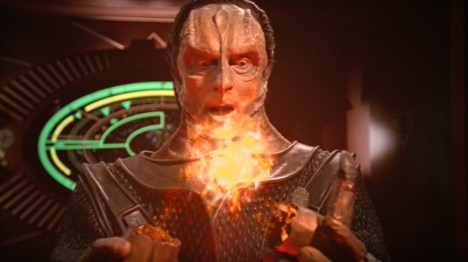
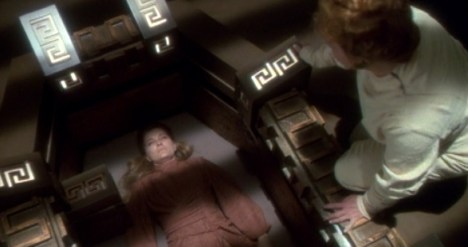
Preach out and touch faith.

This willingness to accept multiple facets and forms of religious belief allows Deep Space Nine to construct a story like Covenant. In any other Star Trek series, Covenant would seem like a knee-jerk dismissal of religious faith and organised belief, the tale of how a group of Bajorans were swindled by a charismatic leader with tragic consequences. It would be read as a generic condemnation of religious belief, an endorsement of an atheistic worldview that has developed beyond the need for such superstition.

Instead, Covenant is something more interesting and nuanced than that. It is an episode about a particular kind of belief, about a particular sort of religion. It is an episode about the dangers of a very particular form of worship. It is an episode about the perils of religious cults, but one which understands the distinction between that and other forms of spirituality.

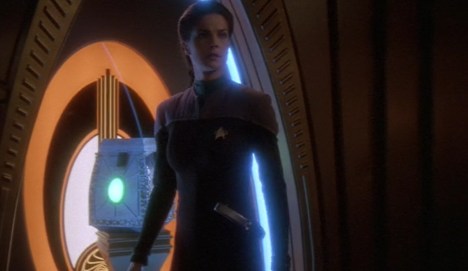
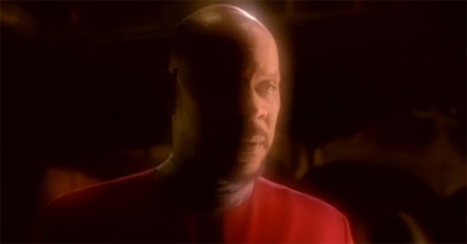
He hasn’t a prayer.

Continue reading

Star Trek: Deep Space Nine – Shadows and Symbols (Review)

Image in the Sand and Shadows and Symbols continue to reframe the theology of Star Trek: Deep Space Nine in terms of Christian iconography.

To be fair, it makes sense that Christian imagery and metaphor should so heavily influence film and television. The United States is the world’s largest exporter of entertainment, and so it makes sense that its preoccupations should filter through into the art that it creates. After all, certain plot and story threads on Star Trek: Voyager (including the Kazon, and the treatment of immigrants and refugees in Displaced and Day of Honour) are very clearly anchored in a number of racial anxieties unique to California during the nineties.

The writing’s on the wall.

However, there was something very interesting in the way that Deep Space Nine had introduced and developed its theology. The early seasons of Deep Space Nine were heavily influenced by more eastern religions, like Buddhism. They were also more ambiguous in their portrayal of the wormhole aliens, suggesting that the enigmatic creatures could be both aliens and gods, depending on one’s perspective. Even then, there was a recurring suggestion in episodes like Emissary and Prophet Motive that the wormhole aliens did not conform to human morality.

As Deep Space Nine approaches the end of its run, it simplifies its approach to religion. The Prophets become a lot less ambiguous, and the spiritual framework becomes a lot more conventional. This process really began in earnest with The Assignment and was solidified in The Reckoning, but it becomes a lot more concrete in Image in the Sand and Shadows and Symbols.

Let there be light.
And it was good.

Continue reading

Star Trek: Deep Space Nine – Image in the Sand (Review)

There is an endearing sense of symmetry to the seventh season premiere of Star Trek: Deep Space Nine.

The writers who worked on the show have been quite candid about their creative process. In particular, most of the production team would acknowledge that the show was heavily improvised rather than planned in advance. While the creators had a sense of the direction in which they wanted to move, they did not have a clear destination in mind until quite late in the journey. This was quite obvious looking at a number of the strange narrative detours that the arc took, most notably Gul Dukat’s time as a space pirate between Return to Grace and By Inferno’s Light.

A Time to Sands.

At the same time, as the seventh season began, it seemed like the writers working on Deep Space Nine had a much stronger idea of how they wanted the series to come to a close. Image in the Sand and Shadows and Symbols feel like a very clever structural choice for the seventh season premiere. They exist at once as echoes of the arc that opened the sixth season and as preludes to the story that would conclude the seventh. They exist as bookends to these two chapters of the larger series, feeling almost like the exact midpoint of a larger story.

Positioned approximately half-way between the epic six-episode arc that opened the sixth season and the sprawling ten-episode narrative that would draw down the curtain at the end of the seventh season, Image in the Sand and Shadows and Symbols feel like a much smaller affair. However, they are still well-observed and well-written, covering a lot of thematic and narrative ground in a way that contextualises what come before and sets up what will follow.

“Play it again, Sisko.”

Continue reading

Star Trek: Deep Space Nine – Tears of the Prophets (Review)

Tears of the Prophets has a number of very good ideas.

The character arc driving the episode is very good, particularly in the context of a finale leading into the final season of the show. Star Trek: Deep Space Nine has always been a show more interested in character arcs and long-form storytelling than the other Star Trek shows, so “Benjamin Sisko experiences a loss so great that he resigns his commission” is an organic story beat. It feels like a story that the writers on this show can tell, and a story that fits very comfortably within the grand mythic framework that the writers are trying to construct.

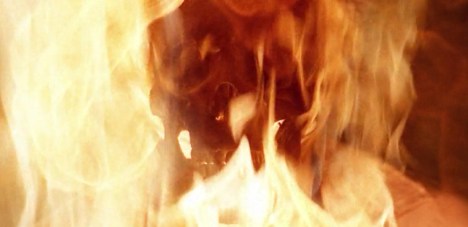
All fired up.

Deep Space Nine has earned a lot of goodwill in this regard, demonstrating a willingness to let stories play out over extended periods and to follow stories through to their natural conclusion. Sisko leaving the station at the end of Tears of the Prophets is not the same as Picard being assimilated at the end of The Best of Both Worlds, Part I or Worf leaving the Enterprise at the end of Redemption, Part I. Any savvy audience member knows that Sisko will return to his post, probably sooner rather than later, but they also trust the show to treat it as more than just a striking cliffhanger.

Unfortunately, Tears of the Prophets is compromised by a number of very poor ideas. Some of those ideas did not originate with the writing staff, their hands forced by outside factors. Ira Steven Behr’s original plans for Tears of the Prophets did not include the death of Jadzia Dax, but the writers had to incorporate that plot element rather late in the cycle. Of course, this does not excuse some of the poor decisions made in how the writers chose to handle that unforeseen plot element, although that was also a result of a number of outside factors.

So Jad to zia you.

However, Tears of the Prophets also leans into some of the more frustrating creative decisions of the sixth season as a whole. The script doubles down on some of the least satisfying elements of Deep Space Nine‘s long-form storytelling, even combining several of these frustrating beats into a central narrative strand of the season finale. Tears of the Prophets combines the generic cartoon villainy of Gul Dukat as suggested at the climax of Waltz and the teaser to Wrongs Darker Than Death or Night with the stock mysticism of the Pah-Wraiths from The Reckoning for a heady ill-judged cocktail.

The result is a somewhat uneven episode, a story with a very strong central character arc that plays to the strengths of the show, but with several supporting elements that indulge the series’ worst impulses.

Funeral for a friend.

Continue reading

Star Trek: Voyager – The Omega Directive (Review)

The Omega Directive plays like Star Trek: Voyager is trying to push itself.

It is an episode which finds Janeway acting secretively and unilaterally, casually brushing aside the Prime Directive in service of some hidden agenda. This is a very big deal. On the original Star Trek, it frequently seemed like the Prime Directive was something for Kirk to outwit. However, since Star Trek: The Next Generation, the franchise has taken the rule to have a lot more moral weight. Even more precisely, since Caretaker, Janeway has emphasised that it is not her place to intervene directly in the affairs of alien civilisations.

The be-all and end-all.

So there sound be something very shocking about Janeway keeping secrets from her crew and forsaking the moral principle that had been the cornerstone of her first few years in command. Given how conventional Voyager has been, how carefully the show has pitched itself as the most archetypal of Star Trek shows, this should be a pretty big deal. What would get Janeway to consciously (and even enthusiastically) cross those lines? How far would she go? What else is she concealing from the people around her? It should be a powerhouse episode of television.

However, The Omega Directive falls flat. Part of the problem is timing, with The Omega Directive sandwiched between Inquisition and In the Pale Moonlight in terms of the overall franchise chronology. Star Trek: Deep Space Nine had been transgressing and subverting franchise norms for years at this point. The Omega Directive feels like something relatively small-scale, juxtaposed against the activities of Section 31 or Sisko’s complicity in murder. The Omega Directive thinks that it is playing in the same league, but it is not even the same sport.

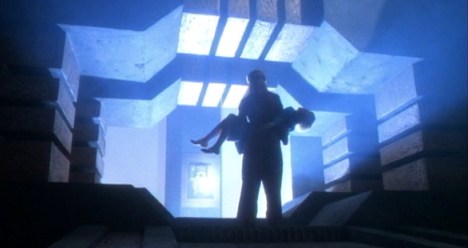
An explosive new development.

More than that, there is a clumsiness to The Omega Directive. The episode touches on a number of interesting ideas, but the story’s thematic weight is quite consciously removed from the core premise. The Omega Directive works best as a weird episode touching on Borg spirituality, and on the question of the Collective’s motivations, but the episode invests so much energy in the black-ops norm-shattering framing device that these elements do not feel like satisfying pay-off. The core themes of The Omega Directive feel like they belong in another episode.

The Omega Directive is a wasted opportunity, its underwhelming subversive trappings distracting from what might have been a compelling meditation on faith and belief.

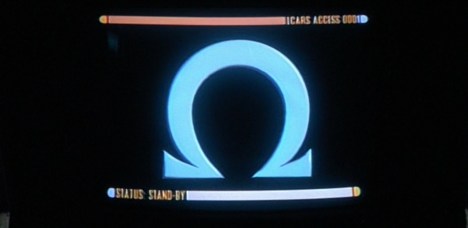
That healthy blue glow.

Continue reading

Non-Review Review: Silence

Faith is a curious thing.

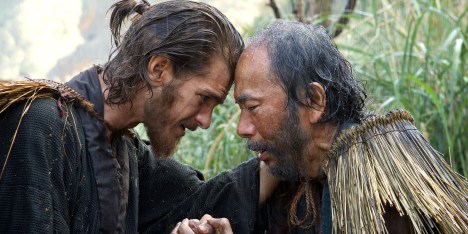
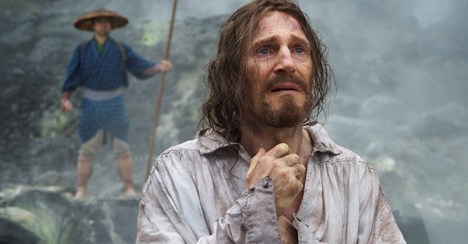
It is a fascinating concept, even (and perhaps especially) for those who lack it or wrestle with it. Pure and untempered faith in the face of a turbulent (and occasionally hostile) world is intriguing. It is something that many long to understand, even if it eludes them. Silence is very much a meditation (or an extended monologue) on the nature of religious belief playing out as a set of conversations and moral dilemmas. Characters wrestle with doubt and uncertainty, and particularly about what their faith means to them.

Easy pray.

Easy pray.

Silence is not a masterpiece or an epic. It is not one of Martin Scorsese’s major works, despite the energy and conviction with which he invests it. It is the weakest film from the director in a very long time, although that sounds very much like praising with faint criticism. Silence is a little too invested in its own dialogue with itself, as delivered through a series of monologues and occasionally through conversation between characters. Silence looks beautiful, but it often feels a little bit like a stunning visual companion to a book on tape.

And yet, in spite of all of this, there is an endearing earnestness to the film. Silence feels like the product of a long and considered reflection on the nature of faith and its place in the world. It never lacks for ambition or vision, playing as a two-and-a-half hour parable about suffering and transcendence. Silence is more interesting than successful, but that is largely because it is so very interesting.

Gotta have faith.

Gotta have faith.

Continue reading

Star Trek: Deep Space Nine – Rapture (Review)

Faith can be a tricky issue.

At one point in Rapture, the primary cast take a moment to reflect upon it. Kira tries to explain her belief in Sisko and the Prophets to Dax and O’Brien. She struggles. They have difficulty understanding how Kira can invest so much certainty in something so intangible. Eventually, Worf interjects. “Do not attempt to convince them, Major,” he urges her. “They cannot understand.” Dax is a little surprised by Worf’s interest in the topic. “Since when did you believe in the Prophets?” she asks. Worf responds, “What I believe in is faith.”

Gotta have faith.

Gotta have faith.

It is a short conversation, but one that reveals a lot about Star Trek: Deep Space Nine. As a rule, the Star Trek franchise tends towards a strong atheism, rejecting notions of religion and spirituality as the hallmarks of an underdeveloped civilisation; Return of the Archons, The Apple, For the World is Hollow and I have Touched the Sky, Who Watches the Watchers?, Devil’s Due, False Profits, Chosen Realm. This makes a certain amount of sense, given that the franchise prides itself on its rationalism. However, it also feels a little narrow-minded.

Rapture might just be the franchise’s most compelling exploration of unquestioning faith, a harrowing portrayal of devotion and inspiration that captures at once the ecstasy of unwavering belief and the discomforting aspects of watching someone embrace something outside a rational frame of reference. Rapture is a mesmerising piece of television.

"I, for one, welcome our new Klingon overlords."

“I, for one, welcome our new Klingon overlords.”

Continue reading

Star Trek: Voyager – Sacred Ground (Review)

This February and March (and a little bit of April), we’re taking a look at the 1995 to 1996 season of Star Trek, including Star Trek: Deep Space Nine and Star Trek: Voyager. Check back daily for the latest review.

Sacred Ground is a rather strange episode.

In a way, this is where the second season of Star Trek: Voyager dies. This is certainly true in a literal sense; it is the last of the four episodes held over from the end of the second season, buried between a quarter and a third of the way into the show’s third year. However, the episode also closes out some of themes that were bubbling through the first two years of the show. Michael Piller had imbued the first two seasons of the show with a new age spirituality, mostly through the character of Chakotay. Sacred Ground closes that out.

Holy plot.

Holy plot.

There is a sense that the show is uncomfortable with Sacred Ground. Although it was the first of those four carryover episodes to be produced, Sacred Ground was the last of the four to be broadcast. While the decision to air Basics, Part II at the start of the season makes logical sense, it is strange that the production team would choose to bury the episode as far into the season as possible. Of those four episodes, the production team were ready to air False Profits before Sacred Ground. That is a frightening thought.

It is understandable. Voyager‘s previous attempts at new age mysticism had not gone well, reducing Chakotay to a Native American cliché in episodes like The Cloud and Tattoo. However, it is also quite frustrating, as Sacred Ground comes closer to working than any of Piller’s earlier attempts.

Burying the consequences.

Burying the consequences.

Continue reading

Star Trek: Deep Space Nine – Accession (Review)

This February and March, we’re taking a look at the 1995 to 1996 season of Star Trek, including Star Trek: Deep Space Nine and Star Trek: Voyager. Check back daily Tuesday through Friday for the latest review.

In its third and fourth seasons, Star Trek: Deep Space Nine is undergoing something of a transformation; a metamorphosis.

This is only natural. Shows evolve and grow as they go on. The production team discovers what works and what doesn’t, allowing them to play the strengths of the premise and the ensemble. It happens to most shows, if they live long enough. It happened to Star Trek: The Next Generation when Michael Piller came on board in its third season. It will happen to Star Trek: Voyager when Michael Piller departs in its third season. Change and transformation is inevitable, for television shows as much as for people.

That healthy orb-experience glow...

That healthy orb-experience glow…

The third and fourth seasons of Deep Space Nine saw a change taking place. Ira Steven Behr had taken more and more control of the show since the late second season, starting with The Maquis, Part II. Michael Piller had stepped back from the show in its third season, completely ceding control with Life Support. The show was changing in a material sense. The Dominion came to the fore, Bajor faded to the background; Worf joined the cast, Odo found his people, the Klingons were an on-going concern again.

By this point in the fourth season, the transformation is almost complete. Deep Space Nine is very close to its final form, standing on the edge of its biggest departures from the established Star Trek canon. Part of those changes involves a reconfiguring of what Bajor means to the series. Accession begins the process of drawing down the curtain on the Bajor arc as it began with Emissary all those years ago, allowing Sisko to find some peace in his position and a sense of closure in his appointment before the show’s emphasis on Bajor changes dramatically.

Gotta have faith...

Gotta have faith…

Continue reading

The X-Files – The Truth (Review)

This December, we’re taking a trip back in time to review the ninth season of The X-Files.

It is interesting how the popular memory of a thing can differ from the actual thing itself.

Memory was always a key theme of The X-Files, particularly in the early years of the show. Although the aliens and the conspirators were plucked from the demented imaginations of the most paranoid tinfoil hat enthusiasts, a surprising amount of the show was rooted in real history that had been allowed to slip by under the radar: the genocide of the Native Americans; the resettlement of German and Japanese war criminals after the Second World War; radiation experiments upon prisoners; the Tuskegee syphilis experiment.

Daddy's home.

Daddy’s home.

The truth is contained in the gap between memory and history. In a way, then, it feels entirely appropriate that the popular memory of The X-Files should remain quite distinct from the show itself. The popular memory of The X-Files tends to suggest that the mythology makes no sense, that it does not fit together in any tangible form. This is an opinion repeated so often that it has become a critical shorthand when discussing the end of the show; much like the assertion “they were dead all along” tends to come when discussing Lost.

The truth is that the mythology of The X-Files largely made sense. Sure, there were lacunas and contradictions, inconsistencies and illogicalities, but the vast majority of the mythology was fairly linear and straightforward. It had been fairly straightforward for quite some time. The show had been decidedly ambiguous in its first few seasons, only confirming that colonisation was the conspiracy’s end game in Talitha Cumi at the end of the third season. Elements like the black oil and the bees tended to cloud matters, but the internal logic was clear.

Everything burns...

Everything burns…

Significant portions of both The X-Files: Fight the Future and Two Fathers and One Son had been dedicated to spelling out the finer details of the mythology in great detail. Mankind were not the original inhabitants of Earth; the former occupants had returned and were making a rightful claim; the conspirators had agreed to help them, selling out mankind for a chance to extend their own lives. Everything else was window dressing. The production team had laid everything out during the fifth and sixth seasons.

Still, the general consensus of The X-Files was that it was a show driven by mysteries that was always more interested in questions than answers. This was certainly true, but it was somewhat exaggerated. When the cancellation was announced, the media immediately demanded answers. A month before The Truth was broadcast, Tim Goodman complained about how the show offered “precious few answers to Carter’s riddles.” Two days before the broadcast, Aaron Kinney wondered of the conspirators, “Who are these people and what is their agenda?”

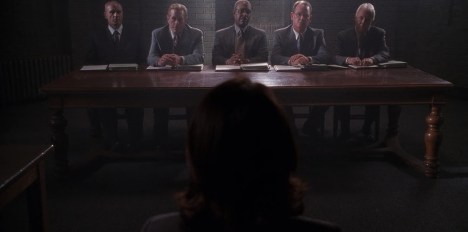
The Truth on trial...

The Truth on trial…

It does not matter that these answers have mostly been provided and that the truth is mostly know. This was the context of the conversation unfolding around The Truth, and it likely explains a number of the creative decisions taken during the production of the episode. The Truth plays as an extended video essay dedicated to providing answers that were offered three or four seasons earlier in relation to mysteries that are no longer part of the show. The Truth is a passionate and intense argument that the mythology of The X-Files does make sense.

For viewers tuning back into the show for the first time in years, this means long expository monologues and skilfully edited montages that do not tie into the plot of the episode in any significant way. For those who stuck with the show for these past few seasons, it means rehashing everything that the show has taken for granted since the fifth or sixth season. While it feels like The Truth is desperately longing for vindication, to the extent where the show puts itself on trial in the person of Fox Mulder, this does not make for compelling viewing.

Happy ending.

Happy ending.

Continue reading