• Following Us

  • Categories

  • Check out the Archives


  • Awards & Nominations

The X-Files – Musings of a Cigarette-Smoking Man (Review)

This February and March, we’re taking a trip back in time to review the fourth season of The X-Files and the first season of Millennium.

“No great man lives in vain. The history of the world is but the biography of great men.”

– Thomas Carlyle, On Heroes, Hero-Worship, and the Heroic in History

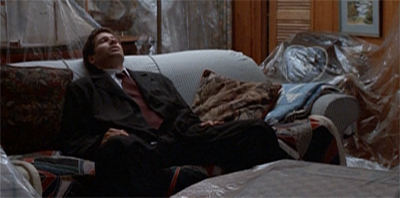
Light 'em up...

Light ’em up…

Continue reading

The X-Files – Unruhe (Review)

This February and March, we’re taking a trip back in time to review the fourth season of The X-Files and the first season of Millennium.

Unruhe was the first episode of The X-Files to air on Sunday nights.

The show had vacated its traditional Friday evening slot to make room for Millennium. It had been moved to Sunday evenings. Although the production team were initially quite cautious about the move, it would ultimately pay dividends for the show. The show had already become a mainstream hit, but the Sunday night slot would help to push it into the stratosphere. Airing alongside Fox’s other long-running success story, The Simpsons, the show would secure its highest ratings ever less than six months after moving into its new slot.

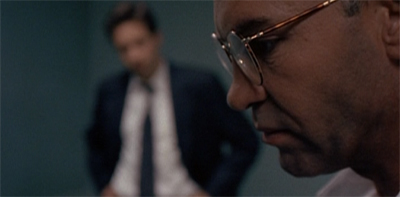
Photo copy?

Photo copy?

Of course, this also draws attention to another interesting facet of Unruhe. This was the first episode of The X-Files to air after Millennium hit the air. Unruhe aired two days after the pilot. The impact of Millennium has already been keenly felt on the fourth season of The X-Files in a number of ways; deadline and production issues hindered Herrenvolk, while James Wong and Glen Morgan had been drafted back to The X-Files to help shore up the fourth season. However, Unruhe seems to directly (and perhaps pointedly) acknowledge Chris Carter’s younger series.

Unruhe is an episode that would probably have been quite at home on Millennium. It is an episode that could easily have been re-worked or re-tooled for Carter’s new show – with only a few minor changes. With its serial offender, fascination with forensic psychology, and its grim reflection on mankind’s capacity for evil, it feels like an story that could comfortably have been told using Frank Black. While it serves to welcome Millennium to the genre neighbourhood, it also seems to suggest that Millennium might be a little redundant.

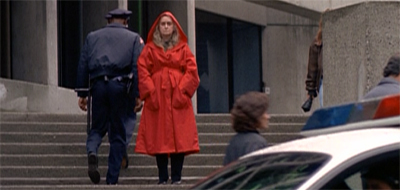
A walk among the tombstones...

A walk among the tombstones…

Continue reading

Millennium – Pilot (Review)

This February and March, we’re taking a trip back in time to review the fourth season of The X-Files and the first season of Millennium.

You think you’re protecting me but you make it worse, Frank. You can’t shut the world out for me. You can’t ask me to pretend that I don’t know what you do.

Everyone pretends. We all make believe. These men I help catch – make us.

We’re raising a daughter, Frank. The real world starts to seep in. You can’t stop it.

I want you to make believe that I can.

Fade to Black...

Fade to Black…

Continue reading

The X-Files (Topps) #17 – Thin Air (Review)

This February and March, we’re taking a trip back in time to review the fourth season of The X-Files and the first season of Millennium.

By all accounts, this was the kind of creative team that Ten Thirteen Productions probably wanted on Topps’ X-Files comic since the start.

Stefan Petrucha and Charles Adlard had done a phenomenal amount of work on The X-Files comic line. They had written sixteen issues of the monthly series, an annual, two digests and a slew of short stories scattered across various forums. However, it was quite clear that their approach to the comic was not quite what Ten Thirteen had hoped for when they licensed the comic to Topps. Petrucha’s scripts were ambitious, bold and playful; they were occasionally downright cheeky. Adlard was a master of mood and expression; he was less suited to likeness.

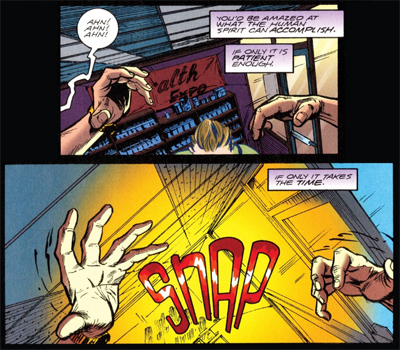
Here come the men in black...

Here come the men in black…

This had caused no small amount of friction between the production company and the creative team. By all accounts, the working relationship between Petrucha and the production company was quite strained. Eventually they fired him from the comic, making Home of the Brave the last story written by Stefan Petrucha and Charles Adlard on Topps’ The X-Files comics. Given the two had been with the comic from the start, this was quite a radical change.

However, this did allow Topps to put a team more agreeable to Ten Thirteen’s demands on the comic.

"I call it blue steal..."

“I call it blue steal…”

Continue reading

Star Trek: Enterprise – Silent Enemy (Review)

Next year, Star Trek is fifty years old. We have some special stuff planned for that, but – in the meantime – we’re reviewing all of Star Trek: Enterprise this year as something of a prequel to that anniversary. This January, we’re doing the first season. Check back daily for the latest review.

Silent Enemy is very much a game of two halves.

It’s an episode that suffers from the decision to incorporate two radically different plots into a single episode. In many respects, it’s a show that suffers from Star Trek: Enterprise‘s decidedly old-fashioned storytelling aesthetic: the sense that most hours of Star Trek need to have two plots running through them for pacing and structural reasons. This storytelling technique is a decidedly outdated approach to television, reflecting the narrative conservatism at play in the first season of the show.

We come in peace...

We come in peace…

Silent Enemy is built around two plots. The primary plot sees the ship coming into conflict with a bunch of strange predatory aliens who do not respond to attempts for contact, and who grow increasingly belligerent over the course of the episode. Archer and his crew find themselves facing an opponent far stronger and more aggressive than they are. It’s a pretty bleak, pretty heavy plotline. Inevitably, the show decided to pair it with something a bit more light-hearted, so we get Hoshi trying to figure out what Reed’s favourite food is that Chef can bake him a super-special birthday cake.

While the combination of plotlines isn’t the worst in the history of the franchise – the episode doesn’t feel like Frankenstein’s monster in the same way that Life Support does, for example – it’s still rather incongruous. Silent Enemy is an episode weakened by the decision to combine these two into a single story; the desire to offset the doom of the “Enterprise under siege” story with something a bit more easy-going and comedic.

Alien aliens...

Alien aliens…

Continue reading

The X-Files – Talitha Cumi (Review)

This November (and a little of December), we’re taking a trip back in time to review the third season of The X-Files and the first (and only) season of Space: Above and Beyond.

Talitha Cumi is a staggeringly confident piece of television, the kind of episode casually produced by a show at (or approaching) the top of its game.

It is interesting just how much this season finalé seems to promise business as usual. It is perhaps the least radical of the show’s season-ending cliffhangers, with the third season closing on an immediate rather than a conceptual threat to our leads and to The X-Files as a show. The Erlenmeyer Flask ended with the death of Deep Throat and the closing of the X-files. Anasazi ended with Mulder being burnt alive in a boxcar filled with alien bodies. Gethsemane ups the ante further.

A stab in the dark...

A stab in the dark…

In contrast, Talitha Cumi ends with the Alien Bounty Hunter walking towards Mulder and Scully in a rather menacing fashion. It is very effective television – and a solidly suspenseful cliffhanger – but it also feels rather low-key when compared to other season-ending episodes. Talitha Cumi feels like a pretty effective hook, rather than a game-changer. There’s an immediacy to the cliffhanger, but nothing that threatens to upend the show as a whole.

Then again, one suspects that is entirely the point. The third season has been largely about consolidation of The X-Files. It makes sense that it wouldn’t throw everything up into the air at the end of the season.

It's been a long year...

It’s been a long year…

Continue reading

The X-Files – Avatar (Review)

This November (and a little of December), we’re taking a trip back in time to review the third season of The X-Files and the first (and only) season of Space: Above and Beyond.

Avatar is really the first time that The X-Files relies on a member of its supporting cast to carry a story all by themselves.

Later seasons will get a bit more adventurous when it comes to sharing screen time. Musings of a Cigarette-Smoking Man and En Ami both offer viewers a glimpse at the man behind the cigarette. The Lone Gunmen prepare for their own spin-off with The Unusual Suspects and Three of a Kind. Even Skinner gets a couple more character-centric episodes with Zero Sum and S.R. 819. In a way, Hungry is a day-in-the-life episode of a monster of the week.

Pushing Mulder to the background...

Pushing Mulder to the background…

Avatar is an episode that demonstrates that these kinds of stories are possible – that The X-Files can lift the focus off of Mulder and Scully for a week and flesh out those characters who exist at the periphery of the series. Just under two years after he was first introduced, Mitch Pileggi has proven himself invaluable to the series. Asking him to carry an episode like this demonstrates the show’s faith in the character.

Avatar is a bit rough around the edges, struggling to decide whether it is part of the show’s conspiracy mythology or a stand-alone monster tale in a season that has worked hard to delineate the two types of show. Still, it’s an ambitious late-season installment that makes a lasting impression on what The X-Files can be.

Don't look now...

Don’t look now…

Continue reading

The X-Files (Topps) #1/2 – Tiptoe Through the Tulpa (Review)

This November (and a little of December), we’re taking a trip back in time to review the third season of The X-Files and the first (and only) season of Space: Above and Beyond.

Tiptoe Through the Tulpa is another nice “extra” from Topps’ licensing of The X-Files. The comic book was Topps’ most successful property, and the company worked very hard to promote it across various platforms. They tried to recruit potential readers from within the comic book industry and outside the comic book industry, devoting considerable time and energy to advertising the ongoing series.

Stefan Petrucha and Charles Adlard had provided promotional strips for TV Guide and for Hero Illustrated, both very clear attempts at courting potential new readers. Both strips adopted very different approaches. Aimed at as broad an audience as possible, the strip for TV GuideCircle Game – was a tight five-page story that covered a lot of ground in a very efficient manner. In contrast, the strip for Hero IllustratedTrick of the Light – was very clearly targeted at a much more niche audience, featuring in-jokes and references for fans and geeks.
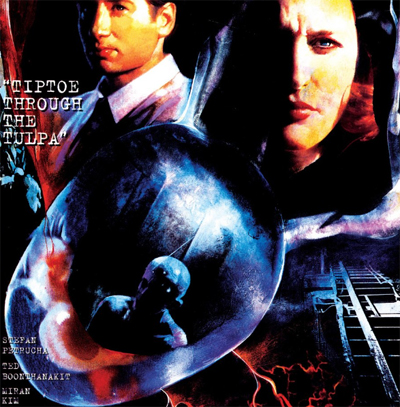
He's not 1/2 the man he used to be...

Herbert’s not 1/2 the man he used to be…

Tiptoe Through the Tulpa was written as a tie-in promotion for Wizard magazine, a giveaway for people who read the comic industry’s most popular collector and insider magazine. People would buy Wizard #53, fill out a form and then send away for their copy of the seventeen-page X-Files #1/2. It was a gimmick, but it was a gimmick that was very clearly aimed at broadening the comic’s audience, convincing a few readers who wouldn’t otherwise try the book to check out a “free” sample comic.

As such, Tiptoe Through the Tulpa is written as a seventeen-page comic that could serve as a potential jumping-on point for new readers. It is rather light, rather simple, but nevertheless makes for a clean and effective X-Files one-shot.

Cue theme music...

Cue theme music…

Continue reading

Space: Above and Beyond – Stay With The Dead (Review)

This November (and a little of December), we’re taking a trip back in time to review the third season of The X-Files and the first (and only) season of Space: Above and Beyond.

There is a nice story buried somewhere in Stay With the Dead. Space: Above and Beyond has generally worked better as a story about warfare than an action-adventure science-fiction show. As such, it’s telling that the best parts of Stay With the Dead have less to do with the plot-driven flashback-ridden mystery at the heart of the episode, and more to do with the aspects of the script that confront the uncomfortable realities of war.

Post-traumatic stress disorder is an absolutely terrifying aspect of armed conflict. War claims lives; countless soldiers and civilians are sacrificed in the name of the greater good. However, even those who survive are left scarred by the experience. The trauma need not be physical. Exposure to combat and warfare can leave a lasting psychological scar. It has widely been suggested that shell-shock and other post-traumatic stress disorders have been under-reported among veterans of previous conflicts.

The wages of warfare...

The wages of warfare…

Stay With the Dead broaches the topic when West is recovered from the field of battle suffering from anxiety attacks and struggling to recall the details of his experience. He is unable to sleep, with even the smallest noise reminding him of his experiences. Army doctors are unable to help him, and make suggestions that seem more interested in what is most convenient for the war effort rather than addressing his own needs. There’s a lot of potentially compelling commentary about how warfare works, and the conflicts of interest that arise.

However, instead of exploring these issues, Stay With the Dead instead becomes a flashback race-against-time mystery. It is not a very good one.

Purple haze...

Purple haze…

Continue reading

The X-Files (Topps) – Circle Game (Review)

This November (and a little of December), we’re taking a trip back in time to review the third season of The X-Files and the first (and only) season of Space: Above and Beyond.

There are any number of events that suggest The X-Files was on the cusp of exploding into a phenomenon. The show was spawning conventions and merchandise. It was becoming a hot property in international markets, moving from BBC 2 up to BBC 1 and then across to Sky. It was quickly becoming compelling water-cooler television. The first season had been lucky to avoid cancellation. The second season had rocketed up the ratings. The third was going to be a pretty big deal.

In light of all of this going on around it, a five-page comic doesn’t seem like that big a deal. Written by Stefan Petrucha and illustrated by Charles Adlard, Circle Game would almost seem as business-as-usual for Topps’ popular X-Files tie-in comic. The only significant difference was that Circle Game had been written and illustrated specifically for the July 15th issue of TV Guide. As part of their “stellar summer sci-fi issue!”, the magazine had given over five pages to Petrucha and Adlard to tell an entire X-Files story.

X marks the spot...

X marks the spot…

Even ignoring the narrative challenges posed by such an assignment, that’s a pretty big deal. Even in the age of the internet, time-shifted viewing and multi-channel television, TV Guide still has a circulation of over two million readers. To give a sense of scale, the biggest-selling contemporary comic books would have a readership of less than a tenth of that. To give it a more relevant sense of scale, the July 1995 issue of The X-Files comic book – the version on the stands at this point – sold approximately 72,000 copies.

All of this is just to stress that giving The X-Files comic book five pages of TV Guide was a pretty big deal.

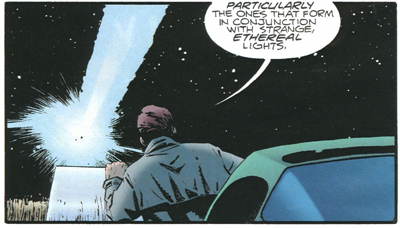
Lights in the sky...

Lights in the sky…

Continue reading