• Following Us

  • Categories

  • Check out the Archives


  • Awards & Nominations

The X-Files – Drive (Review)

This July, we’re taking a trip back in time to review the sixth season of The X-Files and the third (and final) season of Millennium.

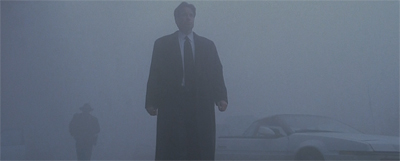
In many ways, Drive feels like an episode that tackles the move to California head-on.

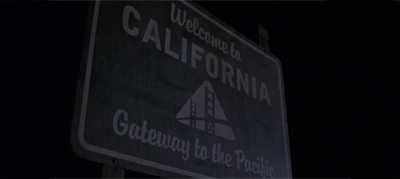
After all, the plot of Drive essentially finds Mulder trapped in a car heading westwards through Nevada and into California. The episode even lingers on a “welcome to California” sign, tacitly acknowledging the massive change that had taken place behind the scenes between the fifth and sixth seasons of The X-Files. It is a very clever way of addressing a major change to the production of the show, one that is candid and open about the fact that things are inherently different now.

"Running out of west..."

“Running out of west…”

More than that, Drive figures out how to build an episode of The X-Files around the change in production location. The sixth season often finds the production team struggling to find the right tone and mood to match the new location; after all, the show cannot simply pretend that it is still filming in Vancouver. California is sunnier, hotter and drier than Vancouver ever was – the sixth season of The X-Files spends a little time trying to adapt to those new filming conditions.

This challenge is arguably most obvious in the string of (literally and metaphorically) lighter episodes in the first stretch of the season. The sixth season is quite controversial among fans of the show because there is a period of time where it seems like The X-Files might transform itself into a quirky romantic sit-com. Episodes like Triangle, Dreamland I, Dreamland II, How the Ghosts Stole Christmas and The Rain King would be the lighter episodes of any previous season; they seem to pile in on top of one another at the start of the sixth season.
Feels like going home...

Feels like going home…

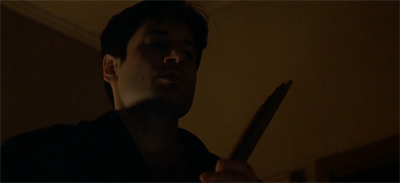
In contrast, Drive is very much a quintessential episode of The X-Files. It is a classic episode of the show. It is scary, it is tense, it is meticulously constructed. There is humour to be found, but the stakes feel real and personal. Writer Vince Gilligan very shrewdly plays into the constraints of the new Los Angeles production realities. A lot of Drive takes place during the day on long desert roads. It takes advantage of California’s impressive interstate system, with twenty-five highways covering almost two-and-half thousand miles.

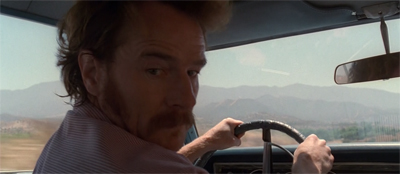
However, Drive is more than simply a demonstration that The X-Files can still work in its new home. Drive is a superb piece of television in its own right. It is highly regarded as one of the finest episodes of The X-Files from the second half of the run. It is notable for a wonderful premise, a great script, and a mesmerising guest performance from Bryan Cranston. Drive would be the first collaboration between writer Vince Gilligan and actor Bryan Cranston, but not the last.
Drive of your life...

Drive of your life…

Continue reading

Non-Review Review: The X-Files – Fight the Future

The X-Files: Fight the Future is often described as the mythology episode that somehow got released into theatres. In her review, Joyce Millman teased that Fight the Future was little more than “a two-hour episode of the show, except with better production values and a nicer wardrobe for Scully.” It is a fair point. It is not too hard to imagine a slightly cheaper version of Fight the Future split into two parts and replacing The End and The Beginning as the two-parter bridging the fifth and sixth seasons of the show.

Certainly, Fight the Future retains the late-stage mythology’s reluctance to provide any real sense of closure to the long-running plot about alien invasion and colonisation. Writers Chris Carter and Frank Spotnitz increase the stakes by using some of that sweet blockbuster money to pay for a gestating alien fetus, but what do Mulder and Scully actually accomplish? What would a viewer jumping from The End to The Beginning miss, except for the fact that the Well-Manicured Man has left the mortal plane to visit that great Somerset estate in the sky?

What you've all been waiting for, admit it...

What you’ve all been waiting for, admit it…

The answer is nothing, but that is not the point. As much as Fight the Future enjoys playing with the trappings of the mythology (black oil! bees! tanker trucks! space ships! Oklahoma City!), the film is only interested in the idea of alien colonisation as a vehicle to explore the show’s central relationship. Carter and Spotnitz have shrewdly realised that Fight the Future will have the largest possible audience for the show, and has decided to give the general public what they want.

As a two-hour mythology episode, Fight the Future leaves a lot to be desired. As a two-hour Mulder and Scully ship tease, it is right on the money.

Buried secrets...

Buried secrets…

Continue reading

The X-Files (Topps) #38 – Cam Rahn Bay (Review)

This May and June, we’re taking a trip back in time to review the fifth season of The X-Files and the second season of Millennium.

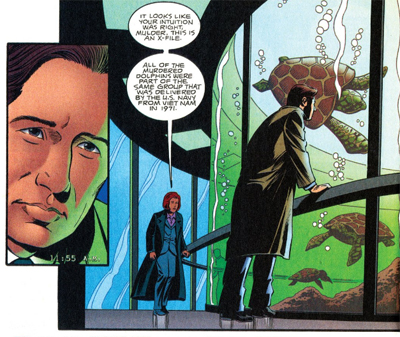
Cam Rahn Bay returns to one of the recurring themes of John Rozum’s run on Topps’ X-Files tie-in comic book.

It is essentially a cautionary tale amount mankind tampering with nature and the unforeseeable repercussions of such meddling. As such, it feels very much in keeping with scripts like Skybuster or Scum of the Earth. This idea of human hubris is a theme that is very much in keeping with The X-Files as a franchise, perhaps most keenly reflected in Chris Carter’s deep affection for Mary Shelley’s Frankenstein and for environmental causes. Cam Rahn Bay is very much in keeping with that aesthetic.

All at sea...

All at sea…

However, there are problems with the story. Most obviously, Rozum’s prose seems a little clunky and awkward. Cam Rahn Bay is a heavy-handed and clumsy meditation on mankind’s fixation with imposing its will over the natural world. However, there is also something slightly hypocritical about the story. As much as Cam Rahn Bay criticises the use of animals in a military capacity, it never seems to question the use of animals in captivity. While the training of dolphins to do military work is treated as deplorable, training them to do tricks for entertainment is lauded.

Cam Rahn Bay feels a little tonally ill-judged, with this fairly significant blindspot undermining a lot of Mulder’s impassioned rhetoric about how mankind treats the natural world.

"Sorry, I was just thinking abotu Deep Throat..."

“Sorry, I was just thinking abotu Deep Throat…”

Continue reading

The X-Files – The Red and the Black (Review)

This May and June, we’re taking a trip back in time to review the fifth season of The X-Files and the second season of Millennium.

“Before the exploration of space, of the moon and the planets, man hailed that the heavens were the home and province of powerful gods who controlled not just the vast firmament, but the earthly fate of man himself and that the pantheon of powerful, warring deities, was the cause and reason for the human condition, for the past and the future, and for which great monuments would be created on earth as in heaven. But in time man replaced these gods with new gods and new religions that provided no more certain or greater answers than those worshipped by his Greek or Roman or Egyptian ancestors. And while we’ve chosen now our monolithic and benevolent gods and found our certainties in science, believers all, we wait for a sign, a revelation. Our eyes turn skyward ready to accept the truly incredible to find our destiny written in the stars.”

Lift me up...

Lift me up…

Continue reading

The X-Files – Patient X (Review)

This May and June, we’re taking a trip back in time to review the fifth season of The X-Files and the second season of Millennium.

This should not work.

There are lots of reasons why Patient X and The Red and the Black should simply implode under their own weight. Most obviously, they are scripts that are rather blatantly just piling more and more back story and convolution onto a framework that is already overloaded and over-stretched. They are introducing new characters at a late stage of the game. They rely on contrivance and sketchy character development. They seem to exist at odds with the script for The X-Files: Fight the Future, which had been written and shot, but was awaiting release.

Everything burns...

Everything burns…

However, despite all this, Patient X and The Red and the Black work very well together. They are the strongest story-driven mythology two-parter since Nisei and 731 at the start of the third season. There is an energy and drive to Patient X and The Red and the Black that has been largely absent from the show’s big blockbuster two-parters since Herrenvolk at the start of the fourth season. After a year-and-a-half treading water as the release date of the movie draws ever closer, it is nice to see Chris Carter cut completely loose.

Patient X and The Red and the Black form a story which doesn’t seem at all worried about what any of this means for the summer realise of Fight the Future. Parts of it become quite difficult to reconcile with the film as released. However, the two-parter is all the stronger for it.

Fog of war...

Fog of war…

Continue reading

The X-Files – Bad Blood (Review)

This May and June, we’re taking a trip back in time to review the fifth season of The X-Files and the second season of Millennium.

Despite a notable absence of Darin Morgan, Bad Blood makes a much more convincing case for Vince Gilligan as the heir apparent to Darin Morgan than Small Potatoes did at the end of the fourth season.

Bad Blood finds Gilligan touching on some of the same broad ideas as Small Potatoes – how Mulder is perceived and how he perceives himself, a sly awareness of the show’s tropes and conventions. However, Bad Blood feels a lot more honed and focused than Small Potatoes. It felt like Small Potatoes only got to the meat of the story it wanted to tell in its final third, while Bad Blood is shrewd enough to put its core concepts front-and-centre. While Bad Blood has the same broad humour of Small Potatoes, it feels a lot more convincing when it comes to characters.

The tooth is out there...

The tooth is out there…

It could be argued that Gilligan drew quite heavily on the work of Darin Morgan in some of his scripts. There is no shame in this. After all, Darin Morgan is perhaps the most widely-praised writer to work on The X-Files. In this context, Bad Blood is something of a spiritual successor to Jose Chung’s “From Outer Space.” Gilligan’s script is not quite as structurally or philosophically ambitious as Darin Morgan’s final credited script for the series, but it does hit on the same fundamental idea that truth is an inherently subjective construct.

Bad Blood is essentially an episode that is not only about how Mulder and Scully see each other, but how they see themselves.

Mulder knows what's at stake...

Mulder knows what’s at stake…

Continue reading

The X-Files (Topps) #37 – The Face of Extinction (Review)

This May and June, we’re taking a trip back in time to review the fifth season of The X-Files and the second season of Millennium.

Suspension of disbelief is a curiously fickle thing.

It is a concept that generates considerable debate in its function and application. After all, the normal mode of fiction generally accepts that fiction is… well, fictional. There is no real belief to shatter, because there is an innate understanding between artist and audience that a work of art should be interpreted as a representation of reality rather than a piece of reality. Even in the case of “true stories”, audiences will willingly and readily accept alterations and adjustments designed to streamline the story in question.

Ramming speed...

Ramming speed…

After all, the concept of “suspension of disbelief” is quite firmly disengaged from the concept of reality. The old cliché about “truth being stranger than fiction” illustrates the distinction. The real world (and the stories of the people who inhabit it) are full of coincidences and contrivances that audiences would consider to be lazy writing or poor construction if they appeared in a work of fiction. Nevertheless, while “suspension of disbelief” might be more complex than its three-word nature would suggest, it is a useful philosophy.

What “breaks” a work of fiction? At what point does the artist – whether intentionally or otherwise – push the audience out of the story? What causes a double take to occur or a quizzical eyebrow to raise? What story developments prompt angry sighs or bitter grumbling? There is no hard and fast answer. The line will always be arbitrary, varying from audience member to audience member. Everybody has different expectations when it comes to art, and so that threshold is distinct for every person.

"Don't worry, Scully! Stay right there... I'm going to get my camera."

“Don’t worry, Scully! Stay right there… I’m going to get my camera.”

Sometimes people can agree on where the line falls on a certain work, but everybody has their limits. There are some people who embrace perceived absurdities or inconsistencies or incongruities in their stories; there are some people who simple do not consider those absurdities or inconsistencies or incongruities to exist at all. One of the great things about The X-Files as a television show is the sense of adventure and excitement that the premise generates. It is highly flexible, allowing for almost anything.

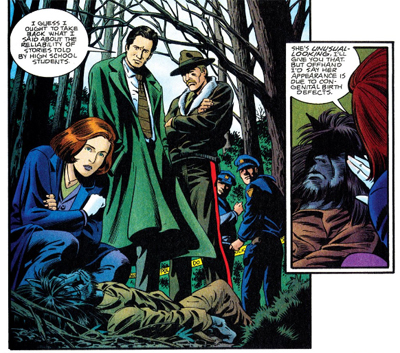
At the same time, it seems quite clear that writer John Rozum and artist Alex Saviuk find themselves charging head-first towards that highly arbitrary and high flexible boundary with The Face of Extinction, a story about a secret race of intelligent goat people who have lived alongside human civilisation for millennia and who also (conveniently) speak perfect English. It is a rather absurd concept, and one that seems at odds with the relatively grounded style of the first five seasons of The X-Files.

Beastly.

Beastly.

Continue reading

The X-Files (Topps) #35-36 – N.D.E. (Review)

This May and June, we’re taking a trip back in time to review the fifth season of The X-Files and the second season of Millennium.

N.D.E. is a nice clever character-driven story, one that perhaps suggests a direction that John Rozum might have taken the monthly tie-in comic.

Ten Thirteen had made it quite clear that they did not want long arcs or ambitious storytelling from their licensed comic books. They wanted reliable straight-down-the-middle storytelling, with none of the playful self-awareness and meta-narratives that drove Stefan Petrucha and Charles Adlard’s work on the title. As a result, the comic has been rather more conservative in approach since John Rozum took over. His time on the title has not produced anything as cynical or grim as One Player Only or Home of the Brave.

Healing palm...

Healing palm…

While Rozum is undoubtedly limited by constraints imposed by Ten Thirteen, there is something disappointing about his run on the comic. Rozum has tended to favour done-in-one stories, single issue adventures that wrap up everything quite neatly within twenty-four pages. Rozum has grown quite efficient at this, but there is little room for nuance in stories like The Kanishibari, Silver Lining, Crop Duster or Soma. Rozum’s stories tend to work better when stretched out a little, with Be Prepared and Remote Control allowing room for nice character moments.

N.D.E. is another two-part story that takes advantage of that additional space to tell a story about Scully. N.D.E. has a fascinating central idea, and a number of clever twists, but it also allows room to explore Scully’s character and philosophy in more depth than the comic has really afforded her. N.D.E. is perhaps a bit clunkier than Be Prepared or Remote Control, but it is the strongest story of Rozum’s final year on the title. Looking at how well this approach works in those stories, it is a shame that Rozum did not employ it more frequently.

You can play the theme to The X-Files in your head if it helps...

You can play the theme to The X-Files in your head if it helps…

Continue reading

The X-Files – Emily (Review)

This May and June, we’re taking a trip back in time to review the fifth season of The X-Files and the second season of Millennium.

The biggest problems with Emily can be summed up in five words:

“… and then Mulder showed up.”

Sorry, Mulder.

Sorry, Mulder.

Continue reading

The X-Files (Topps) #32 – Crop Duster (Review)

This February and March, we’re taking a trip back in time to review the fourth season of The X-Files and the first season of Millennium.

Crop Duster feels rather generic.

That is a shame. After all, John Rozum’s script hits on all sorts of big themes related to The X-Files. It is a story about a small community that has its own secrets, haunted by the legacy of sins long past. The paranormal evil at work in the rural community of Kelly in Kentucky ultimately masks a more mundane story about human violence and betrayal. There is a sense that the basic ingredients of Crop Duster should add up to more than a disposable one-shot. Unfortunately, they don’t.

Alien bodies...

Alien bodies…

Continue reading