• Following Us

  • Categories

  • Check out the Archives


  • Awards & Nominations

Star Trek (DC Comics, 1984) #9-16 – New Frontiers (aka The Mirror Universe Saga) (Review)

The first Star Trek pilot, The Cage, was produced in 1964. To celebrate its fiftieth anniversary, this December we are reviewing the second season of the original Star Trek show. You can check out our first season reviews here. Check back daily for the latest review.

Eight issues is a long time in the world of comic books, even by the standards of modern storytelling. Committing to the same story arc for two-thirds of a calendar year is a big decision, even moreso in December 1984. Nevertheless, DC comics committed to an eight-issue Star Trek story arc in the wake of Star Trek III: The Search for Spock, on throwing Kirk and the crew into a truly epic adventure with the fate of the Federation hanging on the line. It is no wonder that The Mirror Universe Saga remains the gold standard for Star Trek comic books, reprinted and repackaged repeatedly over the years.

The Mirror Universe Saga is an epic in just about every sense of the word, spanning two universes and eight issues. Not only do writer Mike Barr and artist Tom Sutton find themselves handling the fallout from the last feature film, but they also dabble in an iconic piece of Star Trek history. The Mirror Universe Saga takes full advantage of its format to offer a spectacular and impressive adventure that would have been impossible to realise on film in 1984 – indeed, it is hard to imagine television or cinema doing justice to the scale of the adventure now.
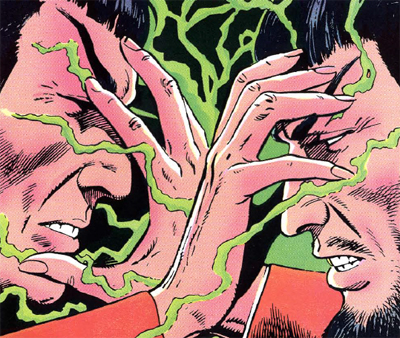
Meeting of minds...

Meeting of minds…

However, The Mirror Universe Saga succeeds on more than simply epic scale and meticulous attention to detail – although Barr and Sutton provide those with gusto. Despite everything going on around it, The Mirror Universe Saga largely works because it never loses track of the characters at the heart of the story. While the Terran Empire might be plotting an invasion in the midst of an internal revolution, the more powerful moments of The Mirror Universe Saga come from throwing the characters into contact with their alternate selves.

In 1984, it seems like The Mirror Universe Saga had figured out what would be the core ingredients for the most successful follow-ups to Mirror, Mirror. It deduced that the mirror universe could not just be playground where everything is gloriously and campily evil; it had to retain some level of emotional reality or connection. What good is a mirror if it is not reflecting anything?

Set course... for eeeevil!

Set course… for eeeevil!

Continue reading

Star Trek – New Visions #1: The Mirror, Cracked (Review)

The first Star Trek pilot, The Cage, was produced in 1964. To celebrate its fiftieth anniversary, this December we are reviewing the second season of the original Star Trek show. You can check out our first season reviews here. Check back daily for the latest review.

It is interesting the ideas that wind up becoming the focal points for fans and tie-in fiction.

For example, there is a wealth of tie-in material based around individual episodes of the Star Trek franchise. Despite the fact that Gary Seven only appeared in Assignment: Earth, the character has inspired tie-in novels and comic books about his exploits from a wealth of different writers. Similarly, the history of Khan Noonien Singh has been thorough explored (and re-explored) in various novels and comic books as well, despite the fact that he only appeared in one episode of the classic television show and one of the theatrical films – his popularity grew to the point where he reappeared in the rebooted series.

Boom, boom, boom, shake the bridge!

Boom, boom, boom, shake the bridge!

There is a lot of fixation on the perceived “missing” adventures from Kirk’s five-year mission, a revisionism that occasionally seems intended to downplay the two seasons of Star Trek: The Animated Series. Michael Jan Friedman wrote a series of novels exploring Captain Picard’s tenure commanding the Stargazer. There is a wealth of material filling the gaps between The Turnabout Intruder and Star Trek: The Motion Picture; and from there to Star Trek II: The Wrath of Khan.

In contrast, there is less material filling the gap between the opening sequences of Star Trek: Generations and Encounter at Farpoint; particularly if you exclude material focusing on Captain Sulu or Captain Picard. The Lost Era novel series was short-lived, and the comics have little interest in it. Similarly, the tie-in novels may have expanded continuity past Endgame, but there is an incredible “safeness” to it all. Sure, Deep Space Nine might be destroyed; but it will be rebuilt with most of the same craft. Voyager may be home, but it’ll be sent out again. Janeway may die, but she’ll be back.

A transporter, darkly...

A transporter, darkly…

Continue reading

Star Trek: Deep Space Nine – The Soul Key by Olivia Woods (Review)

This September and October, we’re taking a look at the jam-packed 1994 to 1995 season of Star Trek, including Star Trek: Deep Space Nine and Star Trek: Voyager. Check back daily for the latest review.

The Soul Key would wind up being the last novel published as part of the Deep Space Nine relaunch.

The Soul Key was published in July 2009. The next month, Una McCormack’s wonderful The Never-Ending Sacrifice would be published. However, McCormack’s novel was very written outside the relaunch, running as a companion to the series and unfolding in the immediate aftermath. After that, the Deep Space Nine book line found itself folded into various crossovers, like Typhon Pact and The Fall. There was a sense that the line was drifting away from Deep Space Nine and being recontextualised in Pocket Books’ larger Star Trek series.

The Soul Key picks up where Fearful Symmetry left off, following Kira, mirror!Iliana and Vaughn as they venture into the mirror universe in pursuit of the crazed Iliana Ghemor.

ds9-soulkey

Continue reading

Star Trek: Deep Space Nine – Through the Looking Glass (Review)

This September and October, we’re taking a look at the jam-packed 1994 to 1995 season of Star Trek, including Star Trek: Deep Space Nine and Star Trek: Voyager. Check back daily for the latest review.

It’s very tempting to write off the problems with the mirror universe episodes of Star Trek: Deep Space Nine as diminishing returns – the idea that repeated exposure to what was once novel robs that item of its novelty. It is possible to become immune to the charms of camp, dulled to absurd space opera, and just worn out by watching the cast play “space pirates meet Star Wars.”

However, this does a bit of a disservice to the mirror universe as a concept. As iconic as it has become, Mirror, Mirror worked very well as a piece of introspection for the original Star Trek. Crossover stands out as one of the strongest episodes in the first two years of Deep Space Nine, because it manages to capture the thoughtful-yet-campy self-criticism of Mirror, Mirror.

Let's face it, after what O'Brien's been through, nobody would be surprised if he snapped...

Let’s face it, after what O’Brien’s been through, nobody would be surprised if he snapped…

In contrast, Through the Looking Glass marks the point at which the mirror universe really ceases to be a clever concept, and becomes something that is simply kept around because it’s old and because the production team like the idea of playing “roguish rebels and evil empires” in a way that’s impossible in the mainstream Star Trek universe.

While the episode does have an interesting central premise and is nowhere near as weak as some of the mirror universe episodes ahead, Through the Looking Glass is the moment where the mirror universe seems to get away from Deep Space Nine.

They really nailed Rom to the wall...

They really nailed Rom to the wall…

Continue reading

Star Trek: Deep Space Nine (Malibu Comics) #29-30 – Enemies and Allies (Review/Retrospective)

This September and October, we’re taking a look at the jam-packed 1994 to 1995 season of Star Trek, including Star Trek: Deep Space Nine and Star Trek: Voyager. Check back daily for the latest review.

Enemies and Allies is a particular brand of oddity. It is the most throwaway story imaginable.

Continuing the trend of recruiting Star Trek actors to write for the comics, Malibu pursued Star Trek: Voyager regular Tim Russ to write for their monthly Star Trek: Deep Space Nine comic. Russ was ably assisted by Mark Paniccia. Paniccia was the editor for Malibu’s Star Trek comics. He co-wrote Rules of Diplomacy with Aron Eisenberg, and also wrote the script for the two-part Sole Asylum headlining the twenty-ninth and thirtieth issues of the Deep Space Nine monthly.

Star Trekkin' across the mirror universe!

Star Trekkin’ across the mirror universe!

As with the other actors to write for the line and the Star Trek actors-turned-writers in general, Russ concentrates on his own character. He crafts a story based around Tuvok. However, it is quite clear that Malibu has not reached the stage where it could launch a Voyager comic. It was in the process of planning such a comic when Marvel bought the rights to license all Star Trek comics in 1996. As such, Tim Russ is tasked with writing a comic centring around Tuvok without taking place in the same continuity of Voyager.

The solution to this problem was quite ingenious, even if the execution was less than satisfying. Tim Russ would write a two-part short story centring around mirror!Tuvok, the character who fleetingly cameo-ed in Through the Looking Glass.

Reflections on Tuvok...

Reflections on Tuvok…

Continue reading

Star Trek: Deep Space Nine – Fearful Symmetry by Olivia Woods (Review)

The September and October, we’re taking a look at the jam-packed 1994 to 1995 season of Star Trek, including Star Trek: Deep Space Nine and Star Trek: Voyager. Check back daily for the latest review.

Fearful Symmetry had a long and painful history. The novel was originally scheduled for release April 2007. This would have seen the novel published about a year after the release of the previous Star Trek: Deep Space Nine relaunch novel, Warpath. The plan had been for new author Leanna Morrow to write the novel. When that proved impossible, Olivia Wood stepped in to rescue the assignment. Fearful Symmetry was eventually published in June 2008, over a year behind the initial schedule.

It’s interesting to speculate how that delay affected the Deep Space Nine relaunch. The next novel in the series, The Soul Key, would be the last published before the print Star Trek universe realigned as part of the Typhon Pact and The Fall, very much “event” books that served to relaunch the fictional universe. It is interesting to speculate whether the year between Warpath and Fearful Symmetry contributed to the decision to discontinue that particular iteration of the Deep Space Nine relaunch.

Still, whatever the reason, Fearful Symmetry is more interesting than successful. It is a book written with a number of great ideas, but some very flawed execution. It adopts a very “comic book” approach towards the Star Trek universe – featuring high concepts and crossovers and character who have been exaggerated slightly and distorted so as to fit the general perception of them rather than any consistent internal characterisation.

Fearful Symmetry is a bold and ambitious piece of work, particularly from a first time novelist. Unfortunately, it doesn’t work quite as well as it needs to.

ds9-fearfulsymmetry

Continue reading