

The trailer for Joss Whedon’s Avengers: Age of Ultron has arrived. Check it out below!
Filed under: Movies | Tagged: age of ultron, avengers, Comics, films, marvel, Movies, ultron | 2 Comments »











The trailer for Joss Whedon’s Avengers: Age of Ultron has arrived. Check it out below!
Filed under: Movies | Tagged: age of ultron, avengers, Comics, films, marvel, Movies, ultron | 2 Comments »
Guardians of the Galaxy hits a few bumps along the way, but it works very well.
The key to this would seem to be James Gunn. Like the best of the Marvel comic adaptations, Guardians of the Galaxy is a film that manages to find its own unique authorial voice amid the cross-pollination of Marvel’s vast cinematic universe. Like Shane Black on Iron Man 3, Kenneth Branagh on Thor or Jon Favreau on Iron Man, James Gunn manages to put his own unique stamp on Guardians of the Galaxy – a film that remains compellingly personal amid the apocalyptic 9/11 imagery.

Lighting the way…
While the film suffers from some of the structural weaknesses that are typical of Marvel’s blockbusters, its strengths come from the director and co-writer. Although set in a vast universe with epic stakes and impossible odds, Guardians of the Galaxy works best when it focuses on its characters, whether the human Peter Quill (with his “outlaw name” Star Lord), the killing machine Drax, the sentient and sensitive tree Groot, the racoon named Rocket or the prodigal daughter named Gamora.
Guardians of the Galaxy is a film that introduces itself to the image of Peter Quill dancing beneath the logo, to the tune of Fooled Around and Fell In Love by Elvin Bishop, playing from a cassette labelled “Awesome Mix, Vol. 1.” That is all you need to know.
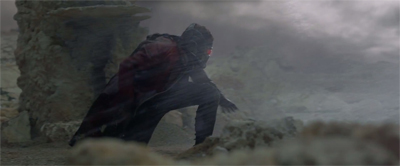
Gotta dance…
Filed under: Non-Review Reviews | Tagged: chris pratt, cosmic, gamora, groot, GUARDIANS OF THE GALAXY, i am groot, James Gunn, john c. reilly, kree, marvel, non-review review, nova corps, peter quill, review, rocket, rocket raccoon, ronan the accuser, Star Lord, zoe saldana | 4 Comments »
This May, to celebrate the release of X-Men: Days of Future Past, we’re taking a look at some classic and modern X-Men (and X-Men-related) comics. Check back daily for the latest review.
To describe Chris Claremont’s three six-part miniseries that comprise X-Men: The End as “convoluted” is to miss the point. Of course they are convoluted. Claremont is essentially writing a gigantic epilogue to his work on Uncanny X-Men. He is tidying away decades of continuity and offering a sense of closure to his work on these characters and their world. Claremont is an exceptional storyteller when it comes to long-form serialised storytelling.
As a writer, Claremont tends to layer interesting twists on top of interesting twists, with every resolution opening up more avenues for future stories to explore. He has demonstrated an ability to string along plots for decades, revisiting characters and situations years after most readers had forgotten about them. These are the qualities that make his Uncanny X-Men run so deeply fascinating, but they are also the qualities that make him a bit of an awkward fit for a concept like The End, an epic miniseries built around the idea of wrapping up the entire X-Men mythos.

Some things never go into fashion…
However, what is so fascinating about X-Men: The End is that all of the elements that Claremont uses are the same elements that he has been playing with since he took over Uncanny X-Men. The story beats have a familiar pattern to them, the themes are familiar, the characters speak as they did in the years that Claremont wrote them. What is fascinating about X-Men: The End is the way that it serves to really set Claremont’s take on the X-Men in stone, treating the elements associated with Claremont as a truly inexorable part of the comic’s mythology.
X-Men: The End is very much a Chris Claremont comic, through-and-through. That’s what makes it feel like such a perfect fit.
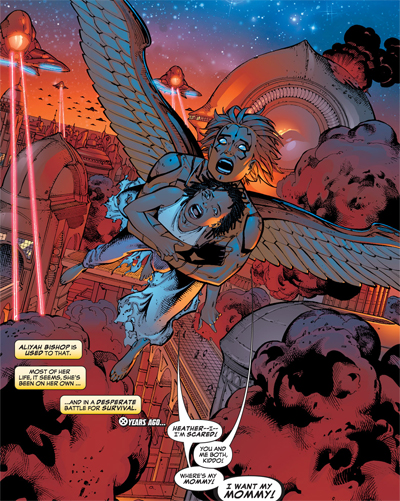
A wing and a prayer…
Filed under: Comics | Tagged: alien, aliens, apocalypse, Brood, chris clarement, Comics, hero's journey, heroes and martyrs, Kitty Pryde, marvel, sean chen, shi'ar, Sinister, the end, x-men | Leave a comment »
All this week, to celebrate the release of X-Men: Days of Future Past, we’re publishing a serialised interview that we conducted with the wonderful Chris Claremont back in February for publication in a British comic book magazine. Many thanks to Mr. Claremont for taking the time to talk to us, and also to Adam Walsh for allowing us to publish this.
Seventeen years is a long time in real life. It’s an eternity in comic book publishing.
Chris Claremont remained on Uncanny X-Men for seventeen years non-stop from 1975 through to 1991. Even Stan Lee only wrote The Amazing Spider-Man for a decade. It’s a phenomenal accomplishment, particularly in an industry where that sort of creative stability is uncommon.
Did Claremont have any idea at the time that he would be working on the title for that long? “I never thought I would stay on for seventeen years,” he freely admits. “I just never ran out of ideas. It was too much fun. They were my friends, I didn’t want to dump them and run away.

Filed under: Comics | Tagged: chris claremont, creators' rights, marvel, marvel comics, uncanny x-men, x-men | Leave a comment »
This May, to celebrate the release of X-Men: Days of Future Past, we’re taking a look at some classic and modern X-Men (and X-Men-related) comics. Check back daily for the latest review.
Jason Aaron’s work on the character of Wolverine is absolutely fascinating. The writer was written for Logan across a number of different books and in a number of different contexts. Indeed, his first professional comic book credit was on an eight-page story featuring the character. Since the publication of that first story, Aaron has enjoyed a long and productive relationship with Marvel’s most iconic mutant.
He has written Get Mystique for the third volume of Wolverine. He has written a number of miniseries featuring the character – including the tie-in Manifest Destiny miniseries and a six-part Astonishing Spider-Man and Wolverine miniseries. Along the way, he has provided a number of back-ups and short stories featuring the character. He also secured two different spin-offs for Wolverine – the sixteen-issue Weapon X title and Wolverine and the X-Men.
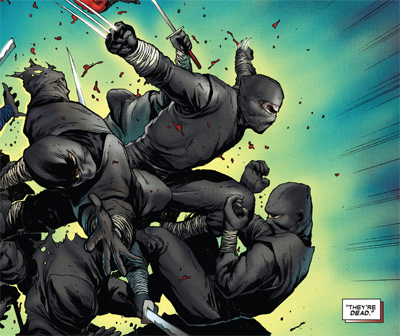
Slice o’ life…
So Aaron and Wolverine work quite well together. It’s no surprise that Aaron was chosen as the writer to launch the fourth volume of Wolverine, shepherding the book to its three-hundredth issue. While his work on Wolverine might not be quite as brilliantly eccentric as Astonishing Spider-Man and Wolverine or as insanely fun as Wolverine and the X-Men, it does represent a rather thoughtful and insightful reflection on the popular comic book character.
After all, one of the recurring themes of Aaron’s work with Wolverine is the idea that a character who has lived to long – and one who has been published so frequently – must have seen and done almost everything by this point. The trick is to try and find something new and exciting for the character after all these years. In many respects, that is what is most interesting about Jason Aaron’s run on Wolverine: how much of the run exists to push the character into position for the next leg of his arc.
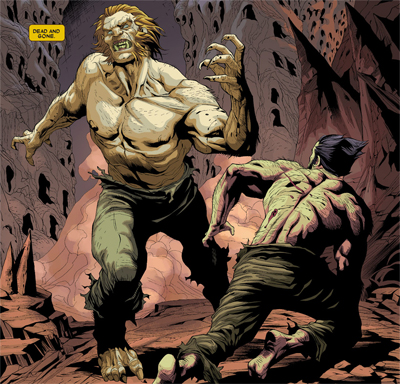
Villains of all Creeds down here…
Filed under: Comics | Tagged: Comics, enemy of the state, Jason Aaron, marvel, Red Right Hand, revevenge, sabretooth, weapon x, wolverine, wolverine and the x-men, wolverine goes to hell, x-men | Leave a comment »
This May, to celebrate the release of X-Men: Days of Future Past, we’re taking a look at some classic and modern X-Men (and X-Men-related) comics. Check back daily for the latest review.
Divided We Stand actually feels like the start of something interesting for Ed Brubaker’s run on Uncanny X-Men. It’s a story arc that heralds a bold new direction for Marvel’s merry mutants in the wake of Messiah Complex, taking the team out of their comfort zone and suggesting that Uncanny X-Men will be moving a little outside its comfort zone and trying something different. It’s a story arc that sees the team reflecting on the past and considering the future.
So, naturally, it is Ed Brubaker’s last solo arc on Uncanny X-Men.
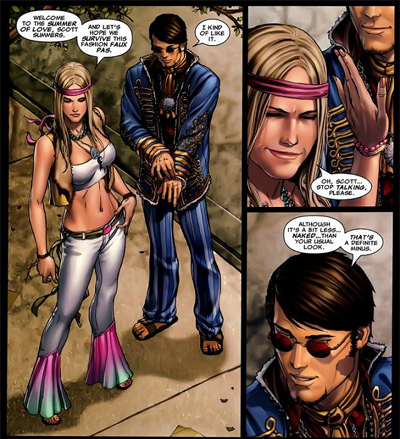
A bad trip?
Filed under: Comics | Tagged: civil rights, cyclops, ed brubaker, gay marriage, marvel, metaphor, Mutants, nostalgia, san francisco, sixties, uncanny x-men, x-men, Xavier | Leave a comment »
This May, to celebrate the release of X-Men: Days of Future Past, we’re taking a look at some classic and modern X-Men (and X-Men-related) comics. Check back daily for the latest review.
Strangely enough, it’s the second relaunch of the Ultimate comic book line that feels like it is finally dealing with Ultimatum. Jeph Loeb’s “kill ’em all and let editorial sort ’em out” event had served as the catalyst of a relaunch for the entire line, ending long-running books like Ultimate Spider-Man, Ultimate Fantastic Four and Ultimate X-Men. The line was re-tooled and re-focused and relaunched following that event.
However, that relaunch quickly fizzled out. Mark Millar’s run on Ultimate Comics: Avengers could not quite measure up to the dizzying heights of his original run on The Ultimates. Jeph Loeb’s Ultimate Comics: X shipped sporadically at best and his run on Ultimate Comics: New Ultimates was something of a mess. Meanwhile, Brian Michael Bendis continued his run on Ultimate Comics: Spider-Man as if nothing much had changed.
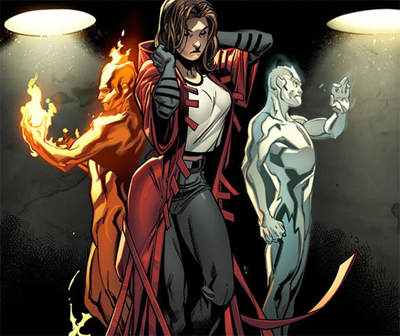
A song of ice and fire…
Oddly enough, it was the second relaunch that seemed to click. Coming out of The Death of Spider-Man, the slate was cleaned and the various books all got new beginnings. Jonathan Hickman took over Ultimate Comics: The Ultimates, Nick Spencer helmed Ultimate Comics: X-Men, while Brian Michael Bendis launched Miles Morales in a new volume of Ultimate Comics: Spider-Man. This was a very real shift in the status quo, and one that marked a clear departure from what came before, with bold new vision.
One of the more interesting attributes of the latest relaunch of the Ultimate line was the sense of heightened continuity between the various books. In particular, Jonathan Hickman’s run on The Ultimates overlapped quite heavily with Nick Spencer’s work on X-Men. As a result, the first year of each of the three titles seemed to be building towards Divided We Stand, a massive crossover between the various titles.

Sentinels-of-not-quite Liberty…
Spencer’s X-Men doesn’t work quite as well as Hickman’s Ultimates, suffering from the fact that nothing seems to get resolved. Dealing with a massive cast and an epic scope, Spencer’s Ultimate Comics: X-Men spends its first year establishing where all of its characters are and how their situations reflect on the larger story that is in motion. It’s an ambitious storytelling model, as Spencer crafts one big story from the ground (or the sewers) to the heights of the Oval Office, but it means that everything is barely set up before it is time to knock it down again.
Spencer’s Ultimate Comics: X-Men is a run with no shortage of great ideas and impressive scale, but one that suffers from the fact that the writer never gets to follow through on the world that he has built.
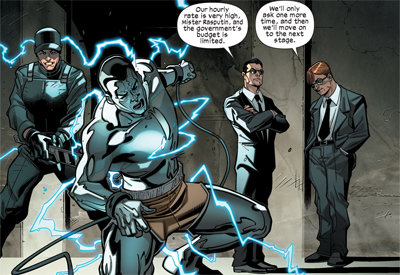
Shocking treatment…
Filed under: Comics | Tagged: marvel, Mutants, nick spencer, ultimate, ultimate comics: x-men, ultimate universe, ultimate x-men, x-men | Leave a comment »
This May, to celebrate the release of X-Men: Days of Future Past, we’re taking a look at some classic and modern X-Men (and X-Men-related) comics. Check back daily for the latest review.
Marvel went through a phase of publishing books based around “The End” of various iconic properties. These comics allowed creators to imagine telling the last possible story for a given character or corner of the Marvel universe. Creators like Garth Ennis or Peter David got to write stand-alone one-shot stories for The Punisher and The Incredible Hulk, respectively. Paul Jenkins wrote a six-issue miniseries Wolverine: The End, while Jim Starlin closed off the entire Marvel Universe with Marvel Universe: The End.
However, given the sprawling and expansive continuity of the X-Men franchise, it stands to reason that any attempt to tell the final X-Men story would have to be a rather epic tale. Writer Chris Claremont wrote Uncanny X-Men for well over a decade, so even asking him to close off his own threads and plot points would take up considerable space. However, X-Men: The End is an absolutely sprawling comic book saga that is spread across three miniseries and eighteen issues.
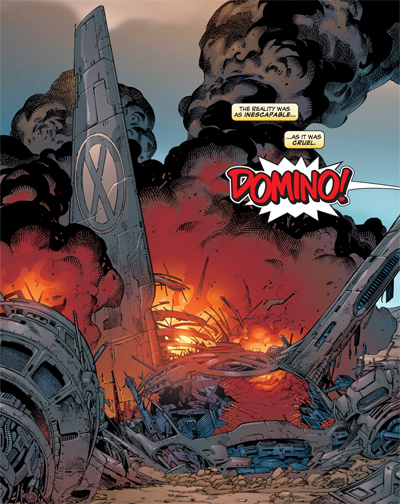
Blackbird down…
In a way, it feels like a touching coda for Claremont’s version of The X-Men. The writer defined the X-Men franchise, introducing many of the plot and character elements that readers would come to take for granted when reading an X-Men story. The End isn’t Claremont’s last X-Men story by any stretch – the writer still works on the franchise quite frequently in a variety of different roles, enjoying short runs and long runs.
However, The End does seem to serve as an epic farewell tour of the world that Claremont helped to build and define. As such, it’s fitting that the miniseries is somewhat clunky and awkward and epic and sprawling and melodramatic and overblown and absurd and unexpected. It is a capstone to Claremont’s gigantic X-Men epic, a closing statement and thoughtful summation to decades of work.
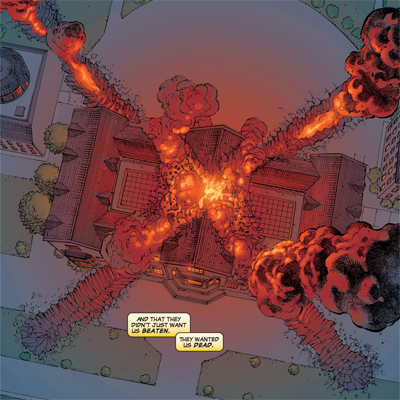
“X” marks the spot…
Filed under: Comics | Tagged: chris claremont, coda, Comics, marvel, Mister Sinister, sean chen, the end, uncanny x-men, x-men, x-men: the end | Leave a comment »
This May, to celebrate the release of X-Men: Days of Future Past, we’re taking a look at some classic and modern X-Men (and X-Men-related) comics. Check back daily for the latest review.
Astonishing Spider-Man and Wolverine is a beautifully absurd comic book. Writer Jason Aaron and artist Adam Kubert keep the comic moving at a frantic pace, twisting and turning as they introduce crazy concept after crazy concept. There are enough brilliant over-the-top ideas in Astonish Spider-Man and Wolverine to sustain an on-going for years – and yet the duo tear through them with a speed that makes all of Astonishing Spider-Man and Wolverine seem like a delirious blur.
And yet, despite that, Astonishing Spider-Man and Wolverine reads like a tribute to the glorious ridiculousness possible within the confines of mainstream comic books – giant metal-faced sentient planets! robotic dinosaurs! guns that fire the energy of creation! a diamond-encrusted baseball bat as a means of time travel! There’s a surreal magic to Astonishing Spider-Man and Wolverine that marks it as one of the highpoints of Jason Aaron’s work on Wolverine. It’s funny, awe-inspiring and even occasionally moving.
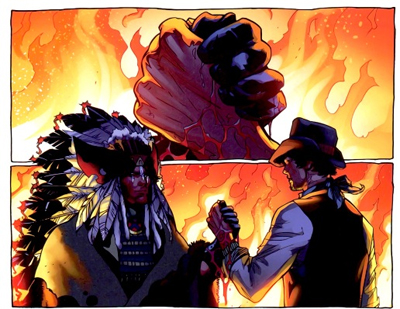
Blood brothers…
Filed under: Comics | Tagged: adam kubert, astonishing spider-man and wolverine, Jason Aaron, logan, marvel, marvel comics, peter parker, spider man, wolverine | Leave a comment »
This May, to celebrate the release of X-Men: Days of Future Past, we’re taking a look at some classic and modern X-Men (and X-Men-related) comics. Check back daily for the latest review.
In 2006, Ed Brubaker was one of the hottest younger writers working at Marvel Comics. He was writing a celebrated run on Captain America. He was about to take over Daredevil following a monumental run by Brian Michael Bendis. He was also going to launch The Immortal Iron Fist with collaborator Matt Fraction. It was a year that cemented Ed Brubaker as one of the primary voices writing at Marvel Comics. In the midst of all that, Brubaker also took over the X-Men franchise.
In the early years of the decade, Marvel had tasked Brian Michael Bendis to reinvent the Avengers franchise, which he had done with Avengers Disassembled and an extended stint on New Avengers. Bendis had done this by tearing down a lot of the elements of The Avengers taken for granted and demonstrating that nothing was safe. The Avengers Mansion was destroyed, Hawkeye and Vision were killed, Wolverine and Spider-Man were recruited. The approach was iconoclastic, but it worked.
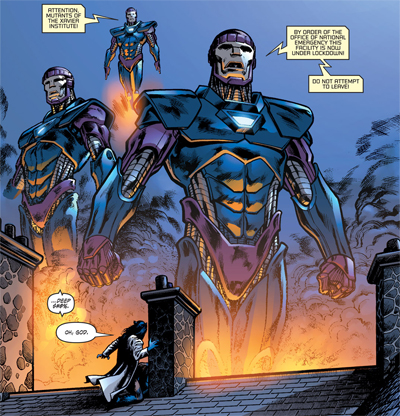
Sentinels of liberty…
It’s not too hard to see Ed Brubaker’s stint on the X-Men franchise as a not-entirely-successful attempt to emulated Bendis’ reinvention of The Avengers. There was a clear attempt to focus on aspects of the mythology that were outside the comfort zone, and to attack and undermine some of the most sacred areas of the mythology. After all, Brubaker began his run on Uncanny X-Men with The Rise and Fall of the Shiar Empire, a twelve-issue space opera that took the focus of the book off the wake of House of M.
Logically, then, Deadly Genesis serves as the equivalent of Bendis’ Avengers Disassembled. It’s the story that exists as the lead-in to Brubaker’s run, outside the monthly series. It sets the agenda for a lot of what is to follow, shifting the premise and changing the rules. However, Brubaker’s work suffers because he doesn’t have the same freedom that Bendis had with New Avengers. He can’t just clear the board and start anew. Deadly Genesis find him heaping a bold new status quo on top of a bold new status quo.

Burning it all down…
Filed under: Comics | Tagged: charles xavier, comic books, Comics, cyclops, deadly genesis, ed brubaker, gabriel summers, house of m, marvel, Mutants, Professor X, review, scott summers, uncanny x-men, vulcan, x-men | 2 Comments »



 the m0vie blog