• Following Us

  • Categories

  • Check out the Archives


  • Awards & Nominations

Mark Waid, Ian Churchill and Ken Lashley’s Deadpool – Sins of the Past (Review/Retrospective)

This May, to celebrate the release of X-Men: Days of Future Past, we’re taking a look at some classic and modern X-Men (and X-Men-related) comics. Check back daily for the latest review.

It’s interesting to try to chart the meteoric rise of Deadpool. Over the past decade, Deadpool has emerged as one of Marvel’s most popular comic book characters. He features in various miniseries and variant covers, populated quite a few books from month-to-month. While his exposure hasn’t quite reached the same level as that of Spider-Man or Wolverine, Deadpool is easily one of the most frequently-appearing characters in Marvel Comics.

It is strange to think that he is a relatively young character, originating in Rob Liefeld’s New Mutants shortly before it became X-Force. First appearing in February 1991, Rob Liefeld created Deadpool as a decidedly nineties character – “the merc with the mouth”,  he felt like a conscious composite of Spider-Man with more outrageous villains (or anti-heroes) like Deathstroke. Indeed, the similarity is something of a cheesy joke. Where might one practise their Deathstroke? In the Deadpool, of course.
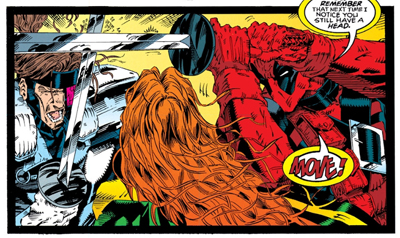
Crossing swords...

Crossing swords…

Liefeld created a cheesy and hyperactive foe for his mutant characters, allowing the character all manner of cheesy and awkward one-liners. However, that version of Deadpool is almost unrecognisable when compared to the character as he exists today. The modern version of Deadpool is a character aware of his own fictional nature, with dialogue balloons painted yellow to distinguish him from the less self-aware characters around him.

Today’s Deadpool is more of a comedy force of nature than a serious anti-hero, a character basking in the absurd rather than trying to appear badass. It’s interesting to wonder how that character transformed so radically (and so thoroughly). Certainly, his first solo miniseries seems to occupy the strange space between Rob Liefeld’s half-serious mercenary psychopath and Joe Kelly’s comic book comic. While still a little too steeped in nineties aesthetic for its own good, Mark Waid’s Deadpool is a small step in that direction.
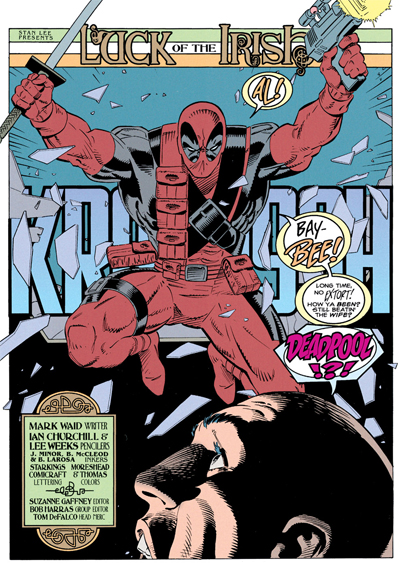
Well, at least he knows how to make an entrance...

Well, at least he knows how to make an entrance…

Continue reading

X-Men – Days of Future Past (Review/Retrospective)

This May, to celebrate the release of X-Men: Days of Future Past, we’re taking a look at some classic and modern X-Men (and X-Men-related) comics. Check back daily for the latest review.

What’s striking about Days of Future Past is how incredibly short it is.

That’s not to suggest that the comic “feels” small or has a shortage of ideas or anything like that. In Days of Future Past, writer Chris Claremont and artist John Byrne toss out a whole host of ideas that shape and define the entire X-Men mythos. These issues continue to inspire the X-Men comic book line. Without Days of Future Past, there would be no Age of Apocalypse. The franchise’s fiftieth anniversary “event”Battle of the Atom – is essentially a gigantic tribute to Days of Future Past.

Everything burns...

Everything burns…

In fact, the influence of this story extends beyond the X-Men as a comic book franchise. “Bad alternate future” may be a trope favoured by the X-Men comics, but it’s a staple of the genre and – arguably – the medium. There’s a reason that the iconic cover to the first issue of this story arc has been emulated so often, or that Alan Moore planned to riff on the story’s central idea for his proposed Twilight of the Superheroes. Days of Future Past is just a great story hook.

However, reading it today, it’s striking how short it is. All of this come from two issues.

The poster child for this sort of story...

The poster child for this sort of story…

Continue reading

Todd McFarlane’s Run on Spider-Man (Review/Retrospective)

This April, to celebrate the release of The Amazing Spider-Man 2, we are taking a look at some classic and modern comics featuring Spider-Man (and friends). Check back daily for the latest review.

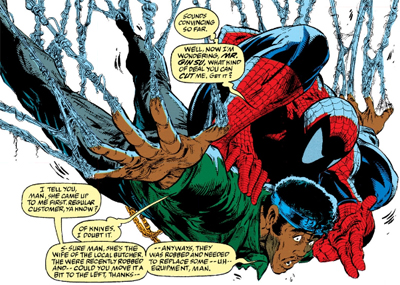
Todd McFarlane is undoubtedly one of the best artists ever to work on Spider-Man. His take on the character is iconic and influential. He really captures the sense of Spider-Man as a character who should be unnerving or disturbing – a character who is part insect, whose limbs are able to bend and contort in ways that would seem unnatural to a casual observer. His run on The Amazing Spider-Man with writer David Michelinie is one of the most underrated Spider-Man comics ever produced.

McFarlane was working at Marvel around the time that the company was investing more power in its artists. More and more, artists were becoming more essential to the creative process – whether credited as “plotters” or “writers.” Jim Lee was wresting control of the X-Men franchise from veteran writer Chris Claremont. Rob Liefeld was writing and drawing on his popular X-Force, launched from New Mutants.

Holding it together...

Holding it together…

In this context, it made sense to allow Todd McFarlane to branch out and write his own Spider-Man title. Launched to run alongside The Amazing Spider-Man, McFarlane’s adjectiveless Spider-Man remains one of the comic book success stories of the nineties, selling 2.5 million copied on initial release. It remains one of the best selling comic books of all time, with the original artwork recently selling for over $675,000.

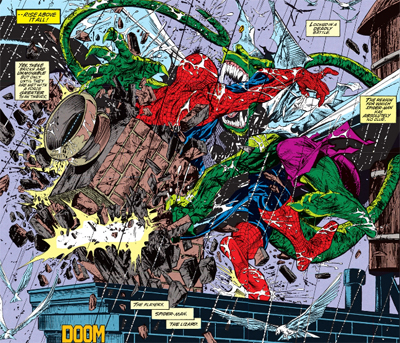
As with many of its contemporary artist-drive series, McFarlane’s Spider-Man is a compelling read. It’s a glimpse inside the mindset of the comic book industry, a snapshot of trends that were still developing. McFarlane’s writing might be a little over-cooked, his plotting a little weak and he may not have the strongest sense of theme or structure. However, McFarlane’s artwork is absolutely spectacular, and there’s something very fascinating about McFarlane’s attempt to write Spider-Man as a horror comic starring the iconic web-slinger.

A sting in the tale...

A sting in the tale…

Continue reading

Spider-Man: Chapter One (Review/Retrospective)

This April, to celebrate the release of The Amazing Spider-Man 2, we are taking a look at some classic and modern comics featuring Spider-Man (and friends). Check back daily for the latest review.

Spider-Man: Chapter One is a strange little comic. In context, it makes a great deal of sense. Spider-Man has always been one of Marvel’s most popular and iconic comic book heroes. In the late nineties, the comic book industry was trying to figure out how to push forward, following the sales explosion and implosion of the mid-nineties. With superheroes like Spider-Man and the X-Men primed for a transition to the big screen, revisiting the early days of these heroes made a great deal of sense.

And John Byrne was the logical choice for a book like this. Byrne was a unique talent. He had enjoyed incredibly successful runs on Uncanny X-Men and The Fantastic Four at Marvel. More than that, though, he had already overseen the successful relaunch of another classic character. In the wake of DC’s universe-altering line-wide Crisis on Infinite Earths, John Byrne had been the writer who re-drafted Superman’s origin as part of the Man of Steel miniseries in 1986.

Boundless enthusiasm...

Boundless enthusiasm…

And so, Marvel gave us Spider-Man: Chapter One. The comic was a reimagining of the earliest days of the wall-crawling superhero, spanning thirteen issues and covering many of the character’s earliest encounters with his classic foes. John Byrne was writing the script and providing the artwork for the comics, which seemed primed to introduced Spider-Man to a whole new generation of readers, giving audiences a back-to-basics take on Spider-Man that was fresh and accessible.

At least, that was the idea. In actuality, Spider-Man: Chapter One feels like a massive miscalculation on just about everybody’s part. It seems to be aiming for some middle ground between Kurt Busiek and Pat Olliffe’s contemporary Untold Tales of Spider-Man and Brian Michael Bendis’ pending Ultimate Spider-Man. It seems like Byrne is never sure whether he’s simply re-telling the classic Stan Lee and Steve Ditko run on The Amazing Spider-Man with a few bells and whistles, or trying to make it his own.

You are about to enter... the Spidey zone...

You are about to enter… the Spidey zone…

Continue reading

The Amazing Spider-Man – The Gauntlet: The Juggernaut – Something Can Stop the Juggernaut (Review/Retrospective)

This April, to celebrate the release of The Amazing Spider-Man 2, we are taking a look at some classic and modern comics featuring Spider-Man (and friends). Check back daily for the latest review.

Something Can Stop the Juggernaut is a bit of an oddity in the grand scheme of The Gauntlet, if not the larger scheme of Brand New Day. One of the stated goals of Brand New Day was to present readers with a thoroughly modernised version of Spider-Man, an iteration of the character who had been distilled to his purest essence, unburdened by the weight of decades of character development and continuity.

As the “new” in Brand New Day suggests, a large part of the editorial stance on Brand New Day was the opportunity to do something novel with The Amazing Spider-Man. It was a conscious break with the old, and an attempt to push the character in new directions. After all, the early issues made an effort to shuffle new characters into the established ensemble and to feature new villains and threats for our hero to face.

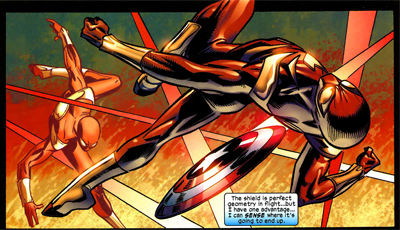
Leaping into action...

Leaping into action…

(To the point where the emphasis on classic foes was one of the selling points of The Gauntlet – a sense that the comics were finally trying to bring many of these iconic baddies into the twenty-first century alongside a reinvigorated and re-energised Spider-Man. Indeed, it’s interesting how much of The Gauntlet makes a point to reference or mirror Peter’s continuity reset into Brand New Day. Much like Peter in One More Day, many of his classic foes lose their new-found families to reset them to villainy, except without the benefit of a magical reset button at the end.)

So drawing back in celebrated creator Roger Stern to craft a sequel to a beloved eighties Amazing Spider-Man story feels rather surreal. The three-part Something Can Stop the Juggernaut exists as an explicit to Stern’s deservedly beloved classic Nothing Can Stop the Juggernaut, right down to classic flashbacks to the comic, follow-up references to various characters, and the fact that events spiral from that story.

Spidey is a little tied up...

Spidey is a little tied up…

Something Can Stop the Juggernaut is crafted as a celebration of vintage Spider-Man, which works very well in the context of The Gauntlet. As the on-going epic spirals towards its climax in Shed and Grim Hunt, it’s nice to hace a reminder of a classic Spider-Man story. After all, Grim Hunt makes a point to stress the perfection of another classic Spider-Man story, albeit in a very different way.

Something Can Stop the Juggernaut seems to exists to assure readers that the legacy and history of Spider-Man is still valid and meaningful, not rendered moot by the continuity-tinkering shennanigans of One More Day.

The Juggernaut who fell to Earth...

The Juggernaut who fell to Earth…

Continue reading

Andy Diggle’s Daredevil – Reborn (Review/Retrospective)

This April, to celebrate the release of The Amazing Spider-Man 2, we are taking a look at some classic and modern comics featuring Spider-Man (and friends). Check back daily for the latest review.

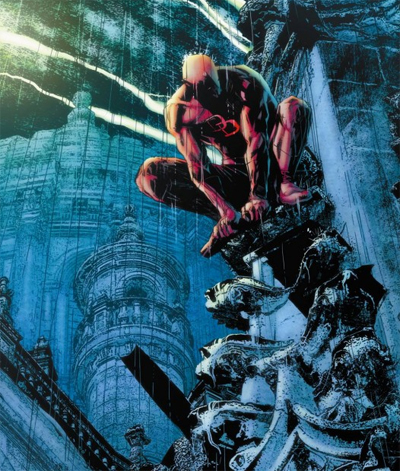
Well, by the end of Daredevil: Reborn, it is certainly time for a change.

Radar love...

Radar love…

Continue reading

The Amazing Spider-Man – The Gauntlet: The Scorpion – The Sting (Review)

This April, to celebrate the release of The Amazing Spider-Man 2, we are taking a look at some classic and modern comics featuring Spider-Man (and friends). Check back daily for the latest review.

Like Scavenging before it, The Sting saps a little of the momentum of The Gauntlet. In fact, The Sting might just be the weakest single chapter of the entire epic – a one-shot story that has little interesting or insightful to offer. While Van Lente’s fourteen page It is the Life represents the shortest single story in The Gauntlet, The Sting feels like the most hollow – the story that could be removed most easily from the sequence of events without any sense of loss or absence.

Indeed, even branding it as “the Scorpion” feels a bit cynical. While the Scorpion is a classic and iconic Spider-Man adversary, the character included here has no real connection to the wall-crawling adventurer. This new Scorpion has no history with Peter Parker, and was really a supporting character in the Avengers spin-off The Initiative. Along with the guest appearance from New Avengers baddie the Hood, The Sting seems like the wider Marvel Universe is encroaching upon The Gauntlet.

While it’s occasionally nice to get a sense that Spider-Man coexists in the same world as the Avengers or the Fantastic Four, The Gauntlet really isn’t the place for this. In fact, all the outside characters serve to undermine the otherwise effective claustrophobia of The Gauntlet – chipping away at the sense that Spider-Man is alone and isolated, being hunted and pursued by an ominous adversary.

Something to chew over...

Something to chew over…

Continue reading

Andy Diggle’s Run on Daredevil – Shadowland (Review/Retrospective)

This April, to celebrate the release of The Amazing Spider-Man 2, we are taking a look at some classic and modern comics featuring Spider-Man (and friends). Check back daily for the latest review.

Shadowland is a disappointing climax to a wonderful decade of Daredevil. From the moment that Kevin Smith launched the second volume of the character through to the end of Ed Brubaker’s run, the Man Without Fear enjoyed a wonderfully consistent run of stories including runs from some of the best writers and artists working in comics, pushing the character in bold new directions and well outside his comfort zone.

Shadowland has a lot of problems, but the most obvious is that it betrays its central character. Matt Murdock is one of the most fascinating protagonists in comics, a proud (and occasionally arrogant) individual who might have the best of intentions but isn’t always able to make the right choices. Watching Murdock deal with his own mistakes and setbacks was a pretty compelling hook, as the comic pushed its protagonist into increasingly uncomfortable positions.

Unfortunately, the same cannot be said for Shadowland. Despite an interesting premise, it all falls apart when it decides that “a demon did it” is an acceptable explanation for Murdock’s latest errors in judgement.

Devilish delight?

Devilish delight?

Continue reading

Andy Diggle’s Run on Daredevil (Review/Retrospective)

This April, to celebrate the release of The Amazing Spider-Man 2, we are taking a look at some classic and modern comics featuring Spider-Man (and friends). Check back daily for the latest review.

One of the most remarkable things about Daredevil was how consistent the quality of the title had been. Andy Diggle inherited Daredevil at the height of its popularity. Ed Brubaker’s Daredevil was well-loved and enjoyed, climaxing on a celebratory 500th issue. Brubaker had come on after Brian Michael Bendis’ much-lauded run on the title. The two are considered among the best writers to work on the character since Frank Miller redefined the Man Without Fear. Diggle was succeeded by Mark Waid, who has made a reinvigoured and nostalgic Daredevil into one of Marvel’s best-reviewed and best loved books.

These are all great runs. Andy Diggle’s Daredevil run is not well-remembered. Diggle essentially wrote twelve issues of the main title, and almost the same number of crossover tie-ins, miniseries and one-shots. Whereas those other successful runs of Daredevil existed with their own space and freedom, Diggle’s Daredevil was very much event-driven. The big moment in all of Diggle’s Daredevil writing is the street-level crossover event Shadowland. It’s a problematic event, and quite a few of those problems reverberate back into Diggle’s work on the main title.

And yet, despite that, what’s most frustrating about Diggle’s Daredevil run is that it really could (and should) have been so much better.

The Devil you know...

The Devil you know…

Continue reading

J. Michael Straczynski’s (and Ron Garney’s) Run on the Amazing Spider-Man – Civil War (Review/Retrospective)

This April, to celebrate the release of The Amazing Spider-Man 2, we are taking a look at some classic and modern comics featuring Spider-Man (and friends). Check back daily for the latest review.

Spider-Man is a pretty important character in the whole Civil War event. Indeed, he’s probably the event’s third most important character – aside from Captain America and Iron Man. So it makes sense that J. Michael Straczynsi’s extended run on The Amazing Spider-Man would stop and engage with the massive crossover spanning the entire Marvel Universe. And, from a logistical “structuring a comic book crossover tie-in so it makes any sense to a reader picking up the book” point of view, Straczynski does a great job. You can read The Amazing Spider-Man without needing to even pick up the Civil War miniseries.

However, as a piece of writing on its own merits, Straczynski’s Amazing Spider-Man tie-in is a mess. Straczynski’s Amazing Spider-Man run has been collecting trouble aspects for quite some time, particularly when Straczynski seemed to brush up against the editorial demands for the book. Sins Past was perhaps the most obvious example, but with Civil War the comic entered a phase where it was pretty much an editorial means to an end. Everything from this point on was pushing towards One More Day, an event that would wipe decades of continuity from the title. (Including Straczynski’s run.)

Civil War really gets the ball rolling on these sweeping editorially-mandated changes, but that’s not the only problem with the story arc. Given Spider-Man’s importance to Civil War, and his role as defector from one side to the other, it seems like Spider-Man would really be the perfect lens through which Straczynski could explore the issue. Unfortunately, it quickly becomes clear upon which side of the issue Straczynski comes down.

A tangled web...

A tangled web…

Continue reading