• Following Us

  • Categories

  • Check out the Archives


  • Awards & Nominations

J. Michael Straczynski’s (and Ron Garney’s) Run on the Amazing Spider-Man – Civil War (Review/Retrospective)

This April, to celebrate the release of The Amazing Spider-Man 2, we are taking a look at some classic and modern comics featuring Spider-Man (and friends). Check back daily for the latest review.

Spider-Man is a pretty important character in the whole Civil War event. Indeed, he’s probably the event’s third most important character – aside from Captain America and Iron Man. So it makes sense that J. Michael Straczynsi’s extended run on The Amazing Spider-Man would stop and engage with the massive crossover spanning the entire Marvel Universe. And, from a logistical “structuring a comic book crossover tie-in so it makes any sense to a reader picking up the book” point of view, Straczynski does a great job. You can read The Amazing Spider-Man without needing to even pick up the Civil War miniseries.

However, as a piece of writing on its own merits, Straczynski’s Amazing Spider-Man tie-in is a mess. Straczynski’s Amazing Spider-Man run has been collecting trouble aspects for quite some time, particularly when Straczynski seemed to brush up against the editorial demands for the book. Sins Past was perhaps the most obvious example, but with Civil War the comic entered a phase where it was pretty much an editorial means to an end. Everything from this point on was pushing towards One More Day, an event that would wipe decades of continuity from the title. (Including Straczynski’s run.)

Civil War really gets the ball rolling on these sweeping editorially-mandated changes, but that’s not the only problem with the story arc. Given Spider-Man’s importance to Civil War, and his role as defector from one side to the other, it seems like Spider-Man would really be the perfect lens through which Straczynski could explore the issue. Unfortunately, it quickly becomes clear upon which side of the issue Straczynski comes down.
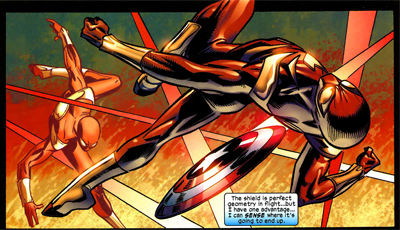
A tangled web...

A tangled web…

Continue reading

Spider-Man: Reign (Review/Retrospective)

This April, to celebrate the release of The Amazing Spider-Man 2, we are taking a look at some classic and modern comics featuring Spider-Man (and friends). Check back daily for the latest review.

Spider-Man is not Batman.

This really should be self-evident, but it doesn’t seem to be. The biggest problem with Marc Webb’s The Amazing Spider-Man was that it wasted a lot of time telling audiences an origin story they all knew and had last seen a decade earlier. The second biggest problem was that the movie seemed to want to be a Batman film. There are a variety of tropes and conventions that work much better in a Batman story than they ever will in a Spider-Man story, and vice verse.

Unfortunately, The Amazing Spider-Man is far from the only Spider-Man story to make this mistake. Spider-Man: Reign, written and illustrated by Kaare Andrews, is essentially an attempt to use Spider-Man to tell another version of The Dark Knight Returns. It goes about as well as you might expect. (That is: not at all.)

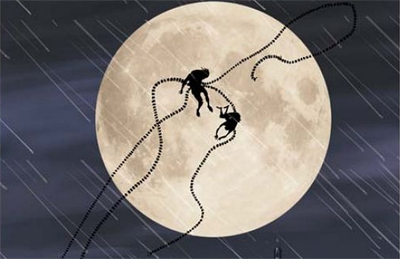
Swinging through the night...

Swinging through the night…

Continue reading

Mark Waid and Ron Garney’s Run on Captain America (Review/Retrospective)

This March, to celebrate the release of Captain America: The Winter Soldier, we’ll be taking a look at some classic and not-so-classic Avengers comic books. Check back daily for the latest updates!

Mark Waid and Ron Garney’s ten-issue run on Captain America is a bit of an oddity. The run follows an impressive ten-year stint by writer (and editor) Mark Gruenwald, but is situated right before Marvel’s attempt at a mid-nineties reboot with Heroes Reborn. As a result, the run feels like it is over before it begins, more of a blip on the radar than a bold new beginning for the character – indeed, it is very much a bold new beginning right before another bold new beginning.

Mark Waid is probably one of the most easily overlooked writers to work on Captain America. He has written over fifty issues featuring the character, but his work has been scattered across multiple volumes and divided by editorial decisions. His longest unbroken stint on the character is thirteen issues of the same comic book. It’s a very weird relationship to have with a character, and there’s a sense that Waid’s take on Captain America was never as developed as it might have been. It feels like scattered snapshots rather than an entire mosaic.

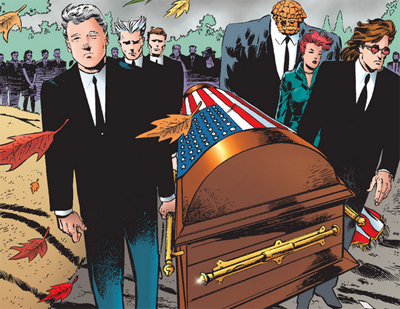
Funeral for a friend...

Funeral for a friend…

Continue reading

Marvel 1602: The New World (Review/Retrospective)

This March, to celebrate the release of Captain America: The Winter Soldier, we’ll be taking a look at some classic and not-so-classic Avengers comic books. Check back daily for the latest updates!

One of the more frustrating things about the major comic book producers is the general reluctance to let any potential franchise or brand die with dignity. Marvel Zombies was an amusing gag, but the company ran it into the ground fairly quickly – although they did work to keep Robert Kirkham and Sean Phillips around for at least one of the sequels. Marvel Apes went from a vaguely witty cover gag into a spin-off universe of its own. Those two side projects eventually (and inevitably) overlapped.

Neil Gaiman’s Marvel 1602 was a curiosity. It was a rather simple gimmick, transposing the modern-day Marvel Universe to the seventeenth century. It afforded Gaiman to make some of his typical meta-commentary and was an excuse to play around with novel twists on classic characters. The Marvel Universe is big enough and vast enough that even a rather basic concept like that can be maintained across eight issues.

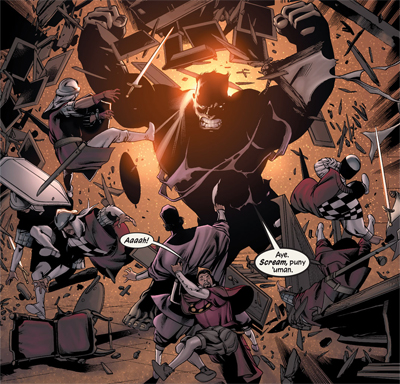
A smashing time...

A smashing time…

Continue reading

Brian Michael Bendis and Alex Maleev’s Moon Knight (Review/Retrospective)

This March, to celebrate the release of Captain America: The Winter Soldier, we’ll be taking a look at some classic and not-so-classic Avengers comic books. Check back daily for the latest updates!

One of the more endearing aspects of comic book publishing is the way that the “little guys” occasionally get a shot. There are mountains of titles published each month featuring iconic characters like Batman or Wolverine, but the major companies are occasionally willing to check chances on more quirky and unknown characters using top-tier talent. One of the big surprises of DC’s “new 52” relaunch was the decision to put superstar writer Geoff Johns on pop culture joke Aquaman.

Despite the fact that he has never quite set the world on fire, Marvel seems willing to invest in repeated attempts to launch the character of Moon Knight. Most recently, writer Warren Ellis has launched a new volume of the comic with artist Declan Shalvey. However, before the latest relaunch, Marvel tried another high-profile take on Moon Knight written by Brian Michael Bendis and illustrated by Alex Maleev, the duo responsible for one of the best-loved runs ever published on Daredevil.

The series made it to twelve issues, before Marvel cancelled it due to disappointing sales. Bendis has insisted that it was always the plan to end the series after twelve issues, but it seems strange that the series was not announced as a miniseries. Still, it’s easy to understand why Moon Knight struggled to find an audience. It’s great to have Bendis and Maleev crafting an on-going street-level comic book, but the series seems almost at war with itself, struggling with the difficulties of fitting this character in this particular role.

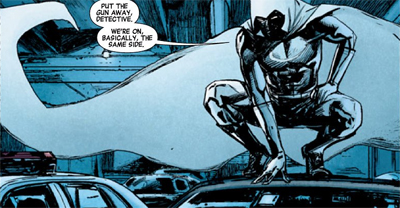
Oh what a knight...

Oh what a knight…

Continue reading

Agents of S.H.I.E.L.D. – Eye-Spy (Review)

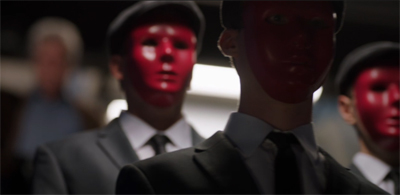
Well, we’re still at the point where Agents of S.H.I.E.L.D. is improving, so that’s something. On the whole, Eye-Spy is a well-produced and stylish piece of television, even if it still feels too light and fluffy and generic for its own good. Like 0-8-4, it feels like the kind of story that the show had to tell at some point, providing an explanation for why Coulson is doing what he is doing and giving him a dark secret from his past. It all feels pretty routine.

Still, there are signs that Agents of S.H.I.E.L.D. might be finding its feet. We still aren’t getting good television, with the show still feeling a little bit too much like a higher-budget and more stylish NCIS spin-off for its own good, but – like The AssetEye-Spy suggests that it might be possible to get good television at some point in the future.

Masque of the red... er, face...

Masque of the red… er, face…

Continue reading

Agents of S.H.I.E.L.D. – The Asset (Review)

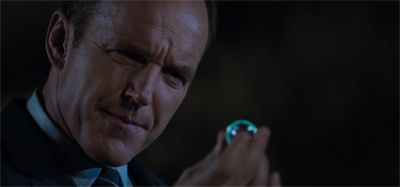
Well, The Asset is certainly stronger than The Pilot and 0-8-4, not that those two episodes represent an especially high bar for the show to cross. The Asset is hardly the best episode of television in the history of the medium. It still suffers from many of the same problems as the first two episodes, involving the cast and formula and the constant name-dropping. However, it does tease the possibility of improvement. The Asset isn’t an episode of a brilliant piece of television, but it is an episode that shows the potential to develop into something far more exciting and compelling.

Coulson appreciates the gravity of the situation...

Coulson appreciates the gravity of the situation…

Continue reading

Stan Lee & Jack Kirby’s Thor – The Might Thor Omnibus, Vol. 1 (Review/Retrospective)

To celebrate the release of Thor: The Dark World towards the end of next month, we’ll be looking at some Thor and Avenger-related comics throughout September. Check back weekly for the latest reviews and retrospectives.

I am a massive fan of The Mighty Thor. There’s just something so clever and playful about the idea of a classic Norse deity reimagined as a Marvel superhero, a self-aware take on the whole “modern myth” approach to American comic book storytelling that it’s hard not to love. Indeed, I would rank portions of Lee and Kirby’s work on Thor among the best of their output from the Silver Age, a truly epic large-scale epic fantasy narrative that isn’t anchored or tethered to any limitations beyond the imaginations of those working on it.

While The Fantastic Four is a lot more consistent and a lot more important in the grand scheme of comic book history, Thor is a bit rockier. It took Lee and Kirby a considerable amount of time to find their creative voice on Thor – a difficulty compounded by the fact that heavy work loads on other Marvel often forced the duo to delegate the early issues of the book to other writers and artists. As a result, this mammoth tome of Thor serves more as a learning curve, building towards a point where the duo will have figured out quite how to tell compelling and exciting stories featuring the God of Thunders.

Taking the hammer for a spin...

Taking the hammer for a spin…

Continue reading

West Coast Avengers Omnibus, Vol. 1 (Review/Retrospective)

To celebrate the release of Thor: The Dark World towards the end of next month, we’ll be looking at some Thor and Avenger-related comics throughout September. Check back weekly for the latest reviews and retrospectives.

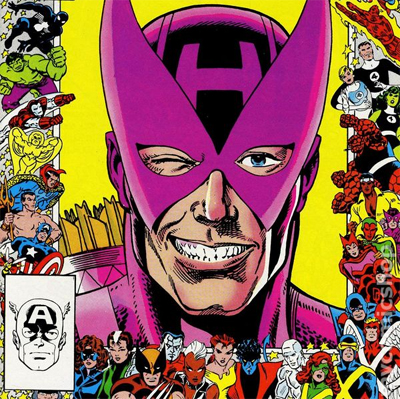
I’ve never been especially fond of the classic Avengers. The group has always seemed particularly insular and self-centred for a comic book superhero team, with so much emphasis on their by-laws and regulations, their posh fifth avenue mansion and the strange sense of pride that second-tier characters like Hawkeye seem to place on their own importance within the Avengers franchise. There have been great runs, and there have been comics that I have enjoyed a great deal, but I will concede that I am not a fan of the Silver and Bronze Age Avengers aesthetic.

West Coast Avengers is a clear attempt to develop the franchise, to give Marvel a second high-profile Avengers book. Launched in 1984 and running for a decade, the book followed the establishment of a second superhero team branded on the classic Avengers model. Of course, part of me suspects that this was all just a plan to get Hawkeye out of the mansion (“you and Mockingbird can relocate quickly… and the sooner you do — the sooner our west coast team is operational — the better!” Vision insists).

There are moments of wry self-awareness in West Coast Avengers, but far too much of it reads far too earnestly.

And yet somehow this guy has appeared in two of the biggest superhero blockbusters of the past five years...

And yet somehow this guy has appeared in two of the biggest superhero blockbusters of the past five years…

Continue reading

Rick Remender’s Run on Secret Avengers – Avengers vs. X-Men (Review/Retrospective)

To celebrate the release of Thor: The Dark World towards the end of next month, we’ll be looking at some Thor and Avenger-related comics throughout September. Check back weekly for the latest reviews and retrospectives.

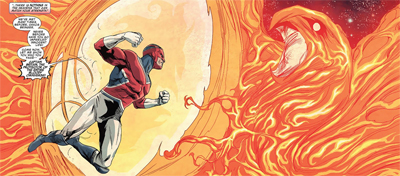
Secret Avengers manages one of the strongest tie-ins to Avengers vs. X-Men. I will confess that I am not normally a fan of comic book event tie-ins. They tend to distract from on-going narratives crafted by long-term writers in order to assure a cynical short-term sales boost. At worst, they can feel like vacuous filler, comics full of nonsense that are impossible to decipher unless you’re reading the giant crossover of the month. Both Ed Brubaker’s Captain America and Matt Fraction’s Invincible Iron Man lost a lot of momentum thanks to crossovers.

On the other hand, I’ll concede that good writers can shrewdly use crossovers to tell their own stories. Perhaps the most obvious example is Alan Moore’s wonderful Swamp Thing tie-in to Crisis on Infinite Earths – stories that can be read (and be quite entertaining) on their own terms, without requiring the reader to constantly flick back or forth. Kieron Gillen’s Uncanny X-Men tie-in to Avengers vs. X-Men manages to retain its own identity and tell its own story, and Rick Remender’s Secret Avengers makes a valiant attempt.

Into the fire...

Into the fire…

Continue reading